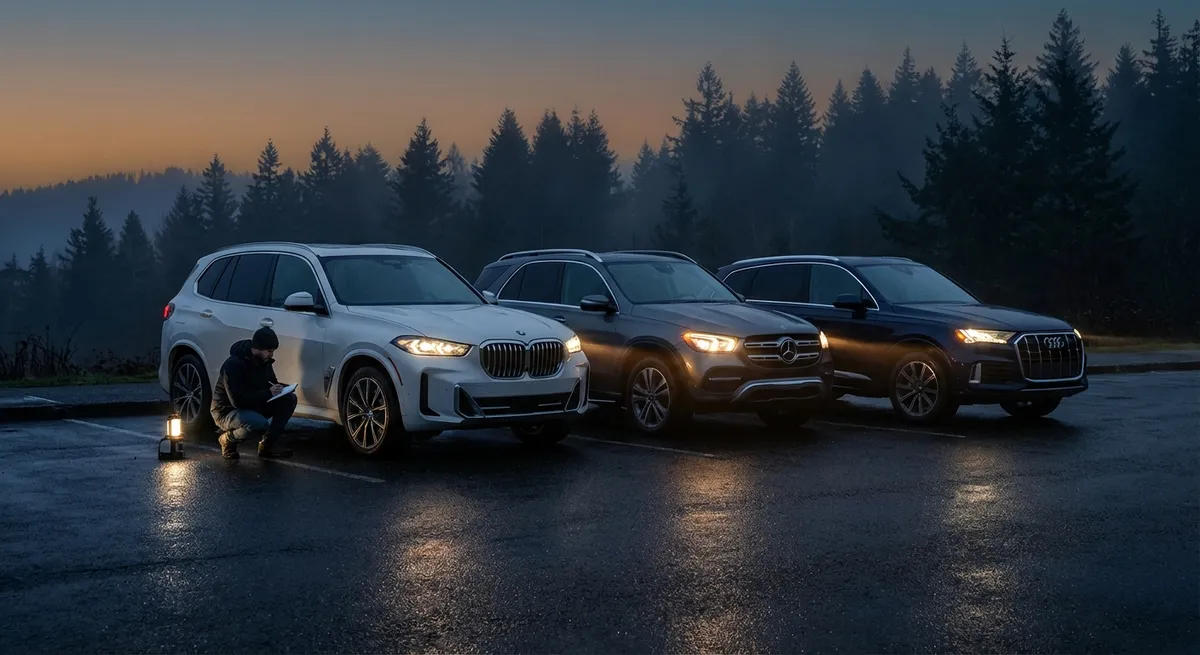
The premium midsize SUV segment has become the de facto benchmark for what modern utility vehicles can be: fast, quiet, tech-heavy, and family-ready without feeling like a compromise. For 2025, three nameplates dominate serious shopping lists among enthusiasts and discerning buyers alike—the BMW X5, Mercedes-Benz GLE, and Audi Q7. All three have been refined over multiple generations, each bringing its own interpretation of performance, comfort, and technology. This review puts them under the microscope in five critical areas that matter to drivers who care about more than just a big touchscreen and a glossy badge.
1. Powertrains and Performance: Character Over Pure Numbers
On paper, the X5, GLE, and Q7 all offer a similar recipe: turbocharged engines, available all-wheel drive, and a choice of six- and eight-cylinder power. In practice, their personalities are distinctly different.
The 2025 BMW X5 remains the segment’s driver’s SUV. The xDrive40i uses a 3.0-liter turbocharged inline-six (B58 family) with mild-hybrid assistance, delivering around 375 hp and 383 lb-ft of torque. Power comes on early, and BMW’s ZF 8-speed automatic is still the benchmark for shift speed and smoothness. The X5 M60i’s 4.4-liter twin-turbo V8 with a 48-volt system pushes well over 500 hp, and it feels it; launch control sprints feel sports-sedan quick, not SUV-quick. Steering is precise, body control is tight, and with the optional adaptive M suspension and rear-axle steering, the X5 shrinks around you on a back road.
Mercedes-Benz’s GLE focuses less on raw agility and more on effortless thrust and refinement. The GLE 450’s 3.0-liter inline-six with EQ Boost mild-hybrid tech delivers a smooth wave of torque that feels more relaxed but every bit as effective in daily driving. The GLE 580 and high-output AMG trims add serious power with a twin-turbo V8, but even then, the chassis tuning leans toward composure over aggression. The 9-speed automatic prioritizes smooth shifts, and the standard drive modes noticeably alter throttle and transmission mapping, making the GLE feel plush in Comfort and more alert in Sport.
The Audi Q7 approaches performance as a system-level exercise. The 2.0-liter turbo four (in 45 TFSI trims) is adequate but unexciting; enthusiasts will gravitate to the 3.0-liter V6 (55 TFSI), which uses a turbocharger and mild-hybrid system to balance power and efficiency. Quattro all-wheel drive is standard, and with the available air suspension and four-wheel steering, the Q7 feels remarkably planted and predictable, especially in bad weather. Unlike the X5, the Q7 doesn’t encourage you to attack corners; instead, it rewards precise, smooth inputs with a confidence-inspiring, almost clinical composure.
For buyers who value steering feel and throttle response, the X5 stands out. If you want strong, effortless power with a softer edge, the GLE delivers. For those in four-season climates who prioritize stability and predictability above all else, the Q7’s chassis and Quattro tuning remain a strong draw.
2. Ride, Handling, and Noise: How They Really Feel on the Road
Ride quality is one of the key differentiators among these SUVs, and all three handle the tricky trade-off between comfort and control in different ways.
The BMW X5, when equipped with the base steel springs, offers a firm but controlled ride that enthusiasts will appreciate and some families may find a touch stiff on broken pavement. Optional adaptive dampers and two-axle air suspension can transform it, allowing the chassis to relax in Comfort mode while preserving sharp body control in Sport. Road noise is well controlled, though wide performance tires on M Sport models transmit more impact harshness and a bit more roar at highway speeds. Enthusiasts will enjoy the X5’s communicative front end; you feel the road surface, but it rarely becomes intrusive.
In the GLE, Mercedes leans harder into comfort. The standard suspension is tuned soft, isolating occupants from most imperfections. With the optional AIRMATIC air suspension or the advanced E-ACTIVE BODY CONTROL (where available), the GLE feels like it glides over expansion joints and rough asphalt. The system can actively counteract body roll and pitch, so even in quick transitions the cabin stays relatively flat. Acoustic insulation is excellent, with low wind noise and a relaxed, almost cocooned feel at highway speeds. The trade-off is less steering feedback and slightly more body motion in aggressive driving compared with the X5.
Audi’s Q7 sits between the two. On steel springs, the Q7 feels firm but not harsh; it has a distinctly Germanic sense of solidity, as if the structure absorbs hits without relaying them to the cabin. With the optional adaptive air suspension, you can tailor the ride from taut to plush. The Q7 may be the quietest of the trio, with excellent suppression of wind and road noise and very little creaking or flex over rough roads—a testament to the VW Group MLB Evo platform’s rigidity. The handling balance is inherently neutral, and with rear-steer, low-speed maneuverability improves while high-speed lane changes feel exceptionally stable.
If your priorities are maximum comfort and a luxurious float, the GLE is the most relaxing. If you want a more connected, driver-focused experience, the X5’s chassis tuning is the most rewarding. The Q7 offers a balanced middle ground—with an edge in perceived structural solidity and long-distance refinement.
3. Interior Design, Space, and Practicality
Step inside, and the three SUVs present very different interpretations of luxury and usability—even as they converge on large digital displays and premium materials.
The BMW X5’s interior is a clear evolution of BMW’s current design language: a curved display housing a 12.3-inch instrument cluster and a 14.9-inch central touchscreen, integrated clever ambient lighting, and high-quality switchgear. Materials are generally excellent, with optional extended leather and open-pore wood trims giving it a contemporary, upscale feel. The downside is the heavy reliance on the touchscreen for climate and common functions—BMW’s iDrive 8/8.5 retains a rotary controller, but you still do a lot via menus. Front seating is comfortable and highly adjustable, with strong lateral support. Rear legroom is generous for two adults; three across is possible but snug for long trips. The optional third row is best described as emergency-use only.
Mercedes’s GLE interior feels more like a lounge than a cockpit. Twin 12.3-inch displays under a shared glass panel run the MBUX system, with bright graphics and extensive customization. Some trims offer ambient lighting with a wide color palette, metallic-look vents, and rich wood or polished metal inlays. Physical buttons for climate controls and shortcut functions are more intuitive than BMW’s largely screen-based layout. The front seats can be specified with heating, cooling, and even massage, and their long-distance comfort is among the best in the segment. Second-row space is generous, with a more open feel thanks to the upright greenhouse. A third row is available but small; families who truly need three usable rows may want to look at the GLS or a dedicated three-row rival.
Audi’s Q7 cabin is the most conservative visually but arguably the most timeless. It uses a three-screen setup—digital Virtual Cockpit for the driver, a main upper MMI touch display, and a lower haptic climate and functions screen. The interface is clean and logically structured, though the lower touchscreen’s haptic “click” can be divisive. Material quality is consistently high; real aluminum, fine-grain woods, and soft-touch plastics dominate, with less glossy piano black than some competitors. Where the Q7 really distinguishes itself is packaging: its third row is more usable than the X5’s or GLE’s, and with the second row adjusted, you can accommodate six adults in reasonable comfort for shorter trips. Cargo space with all three rows up is modest but improves significantly with the third row folded.
For pure front-row wow factor, the GLE is hard to beat. The X5 feels the sportiest and most driver-centric, with the Q7 offering the most quietly upscale, function-forward interior and the most credible third-row option of the three.
4. Technology, Driver Assistance, and Infotainment
Modern premium SUVs are as much rolling computers as mechanical machines, and software execution is now a key decision factor for many buyers.
BMW’s iDrive 8/8.5 platform in the X5 brings extensive connectivity, including over-the-air (OTA) updates, a robust voice assistant (“Hey BMW”), and cloud-based navigation with real-time traffic. Wireless Apple CarPlay and Android Auto are standard on most trims. The system is fast and highly configurable, but the consolidation of climate and many convenience functions into the touchscreen can be frustrating while driving. BMW’s driver-assistance suite typically includes features like adaptive cruise control with stop-and-go, lane-keeping assist, blind-spot monitoring, and traffic-jam assist in certain markets. Highway Assist functions can provide semi-automated driving on well-marked highways, though the driver must remain attentive and ready to intervene.
The GLE’s MBUX system pairs crisp graphics with what is still one of the most natural-language-capable voice assistants in the segment (“Hey Mercedes”). The system supports augmented reality navigation overlays on certain models, projecting arrows and street names onto a live camera feed. Wireless smartphone integration is widely available, and the menu structure is relatively intuitive. Button redundancy for key functions is a plus. Mercedes tends to offer a comprehensive suite of active safety and driver-assistance technologies, including adaptive cruise, active lane-keeping, blind-spot assist, evasive steering assist, and cross-traffic support. The brand’s focus on active safety is evident in the breadth and tuning of these systems, which usually intervene smoothly and predictably.
Audi’s MMI in the Q7 is arguably the clearest and least gimmicky in day-to-day use. Virtual Cockpit remains among the best digital instrument clusters on the market, enabling full-screen mapping, configurable layouts, and sharp readouts. The central touchscreen interfaces are cleanly organized, though Audi leans heavily on haptic feedback for the lower screen, which some drivers find distracting. Wireless CarPlay/Android Auto is widely supported, and OTA updates are increasingly part of the Q7’s tech strategy. Audi’s driver-assistance suite offers adaptive cruise assist, lane-keeping, traffic-jam assist, and robust pre-collision warning and braking. The tuning is generally conservative—less intrusive than some rivals—making it easier for drivers who dislike overly proactive systems.
If you prioritize a deep, feature-rich tech ecosystem and don’t mind a bit of complexity, BMW’s X5 is the enthusiast’s connected SUV. If you want a highly polished, visually impressive system with strong voice control and active safety emphasis, the GLE stands out. For those who favor clarity, logical layout, and excellent instrumentation, the Q7 offers a more understated but very competent technology package.
5. Ownership Costs, Efficiency, and Long-Term Considerations
Beyond test drives and first impressions, premium SUV buyers should examine efficiency, projected ownership costs, and long-term support.
In their six-cylinder configurations, all three SUVs hover in a similar fuel economy band, with variations depending on driving style, options, and drivetrain calibration. Mild-hybrid systems in all three help smooth stop-start operation and marginally reduce fuel consumption, especially in urban driving. BMW often posts slightly better real-world efficiency in its 3.0-liter X5 than the V6 Q7 and GLE counterparts, thanks to careful engine and transmission tuning—but differences are often within a few mpg.
Insurance costs and depreciation are similar across the trio, though brand perception and option loadouts can meaningfully influence resale values. Historically, well-maintained BMW X5s and Mercedes GLEs hold their value strongly in markets that favor performance and luxury, while Audi Q7s can be attractive used buys thanks to slightly softer residuals and a reputation for solid build quality.
Maintenance and reliability are nuanced. All three brands pack in sophisticated electronics, complex suspension options (especially air and active systems), and turbocharged, high-output engines—none of which are inexpensive to repair out of warranty. Extended warranties or certified pre-owned (CPO) programs can mitigate risk. Independent reliability data over the last few model years has shown mixed results across all three, with most issues related to electronics, sensor faults, and occasional drivetrain or suspension components rather than catastrophic engine failures. For owners planning to keep the vehicle past the initial warranty period, budgeting for potential suspension and infotainment repairs is prudent, especially on air-suspension-equipped models.
From an environmental and regulatory perspective, all three manufacturers are moving toward plug-in hybrid and full-electric offerings in parallel (e.g., BMW’s iX, Mercedes EQE SUV, Audi Q8 e-tron). For buyers considering long-term compatibility with evolving emissions regulations and low-emission zones, plug-in hybrid trims of the X5 and GLE may offer a more future-ready compromise—though specific availability and tax incentives vary by market.
In total cost-of-ownership terms, no option is “cheap,” but careful configuration (avoid unnecessary large wheels that increase tire costs and reduce comfort, choose realistic option packages, and consider extended coverage) can make any of these SUVs a more rational long-term choice.
Conclusion
The 2025 BMW X5, Mercedes-Benz GLE, and Audi Q7 represent three mature, highly capable interpretations of the premium midsize SUV. The X5 is the driver’s choice, with the sharpest chassis, potent powertrains, and a cockpit that prioritizes engagement—ideal for enthusiasts who still want family usability. The GLE targets buyers seeking a serene, tech-forward, comfort-first experience, with a cabin that feels overtly luxurious and a ride tuned for relaxation. The Q7 offers a quietly sophisticated blend of composure, packaging efficiency—especially in its more usable third row—and a tech suite that favors clarity over flash.
For car enthusiasts and serious shoppers, the key is to align each model’s character with your real-world priorities. If you live for the occasional back-road blast, the X5 is hard to ignore. If daily comfort, smoothness, and a lounge-like cabin matter most, the GLE will likely feel right immediately. If you need credible three-row practicality and value clean, understated execution, the Q7 remains an exceptionally well-rounded option. As always, the data and details can guide you, but only time behind the wheel of each will reveal which premium SUV actually fits your life.
Sources
- [BMW USA – BMW X5 Overview](https://www.bmwusa.com/vehicles/x-models/x5/sports-activity-vehicle/overview.html) - Official specifications, powertrain details, and feature overview for the current X5
- [Mercedes-Benz USA – GLE SUV](https://www.mbusa.com/en/vehicles/class/gle/suv) - Official information on GLE engines, technology, and available equipment
- [Audi USA – Q7 Model Page](https://www.audiusa.com/us/web/en/models/q7/q7/2024/overview.html) - Audi’s official specs, interior layout, and technology features for the Q7
- [U.S. Department of Energy – Fueleconomy.gov](https://www.fueleconomy.gov/feg/byclass.jsp?class=Standard%20Sport%20Utility%20Vehicle%204WD) - Comparative EPA fuel economy data for midsize luxury SUVs
- [IIHS – Midsize Luxury SUVs Crashworthiness Ratings](https://www.iihs.org/ratings/by-class/midsize-luxury-suv) - Independent safety and crash-test ratings relevant to the X5, GLE, and Q7
Key Takeaway
The most important thing to remember from this article is that this information can change how you think about Reviews.