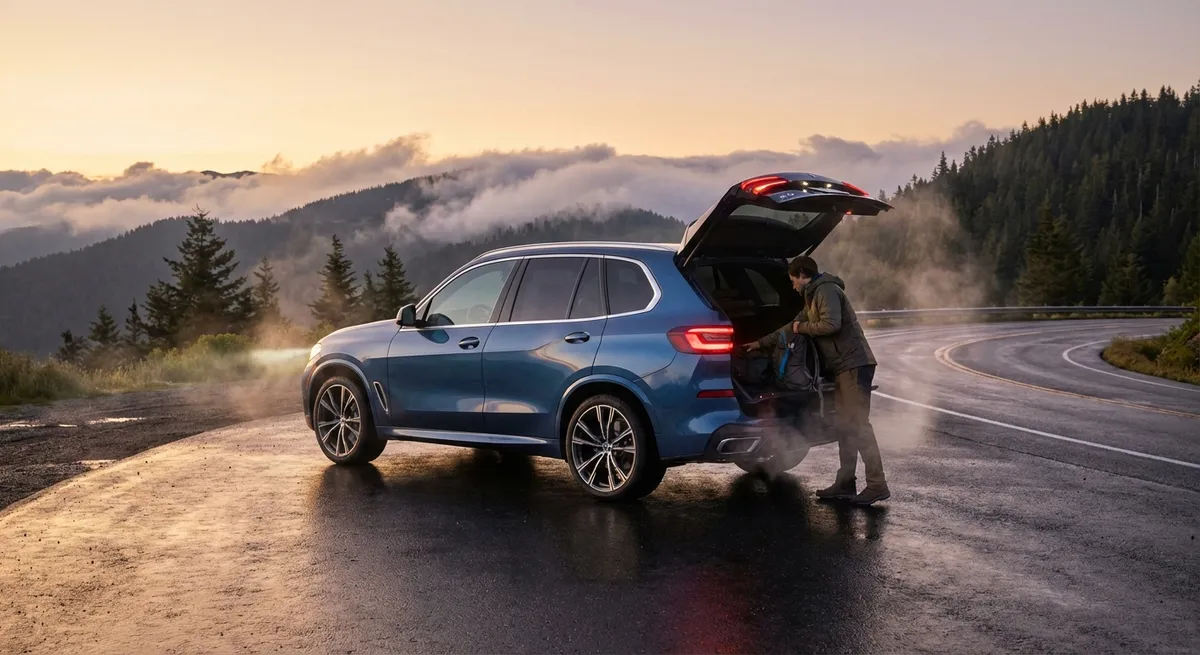
The 2025 BMW X5 xDrive40i continues to be one of the benchmark midsize luxury SUVs, sitting in a crowded field that includes the Mercedes-Benz GLE, Audi Q7, and Lexus RX. For 2025, BMW refines the formula rather than rewriting it, focusing on improved powertrain efficiency, cabin tech, and driver-assistance capability. This review looks beyond the brochure claims, breaking down how the X5 actually behaves on the road, how its tech works in real-world use, and what ownership trade-offs enthusiasts and shoppers should expect.
Powertrain and Driving Dynamics: Where the X5 Still Feels Like a BMW
Under the hood, the 2025 X5 xDrive40i retains BMW’s 3.0-liter turbocharged inline-six (B58 family), now paired with 48-volt mild-hybrid assistance. Output is a robust 375 hp and 383 lb-ft of torque, with temporary overboost torque under certain conditions, routed through an 8-speed ZF automatic to standard xDrive all-wheel drive.
On the road, the powertrain combination is one of the X5’s strongest attributes. Throttle response is immediate in Sport mode, with the mild-hybrid system filling in low-rpm torque and smoothing start-stop transitions. In Comfort mode, the calibration is more relaxed, ideal for urban commuting and highway cruising. The 8-speed transmission is quick to kick down but avoids the hunting behavior some rivals exhibit on rolling terrain.
Steering feel is precise and reasonably weighted, especially with the M Sport package’s more aggressive tuning, though it lacks the hydraulic feedback of older BMWs. Optional adaptive M suspension and air suspension (availability varies by market and package) allow the X5 to transition from composed highway cruiser to confident back-road performer. Body roll is well controlled, and the chassis maintains stability under brisk cornering, helped by the wide track and well-tuned electronic stability control.
Enthusiasts will notice the inline-six’s character: smooth, linear power delivery with a refined exhaust note that remains subdued in Comfort but gains a bit of edge under load in Sport. Official 0–60 mph times hover around the mid-5-second range, putting the xDrive40i near the top of the segment for non-performance trims. Braking performance is strong and consistent, with well-modulated pedal feel, though fade resistance will depend on wheel/tire package and driving style.
Interior Design, Ergonomics, and Materials: High-Tech, With Some Trade-Offs
Inside, the 2025 X5 adopts BMW’s latest iDrive 8.5 interface on a curved display setup, combining a 12.3-inch digital instrument cluster with a 14.9-inch central touchscreen. The look is clean and modern, with a minimal physical button count compared with earlier X5 generations. Ambient lighting, open-pore wood, and available glass controls elevate the premium feel, especially in higher trims.
Seat comfort is excellent in the front row, with a wide range of adjustments, including optional multi-contour seats with adjustable side bolsters and thigh support. The driving position is textbook BMW: low enough to feel connected to the chassis while still providing the elevated sightlines SUV buyers expect. Second-row space is generous, offering adult-friendly legroom and headroom, with optional rear climate controls and seat heating. A third-row is optional in some markets, but it’s best regarded as an occasional-use feature rather than a full-time three-row solution.
Materials quality is generally high, but there are some contrasts. Soft-touch surfaces dominate the main contact areas, while harder plastics appear in lower, less-visible zones. The standard synthetic leather (Sensafin in many markets) is convincing, but leather purists may prefer the optional Vernasca or Merino leather for an upgrade in tactile feel. Fit and finish are tight, with consistent panel gaps and minimal rattles even on rough pavement.
Ergonomically, the move to a more touchscreen-centric interface brings both advantages and downsides. The center console remains clean, and the presence of a physical iDrive controller is a major plus for those who want to operate the system without reaching for the screen. However, climate controls and some frequently used functions now reside primarily in the touchscreen and submenus, which can increase distraction until the driver adapts. Enthusiasts may miss the old-school row of tactile buttons, but the learning curve is manageable after a few days of use.
Storage is practical: the split tailgate has been replaced by a single-piece liftgate in recent generations, but the cargo area remains square and usable, with underfloor storage in some configurations. With the second row folded, the X5 delivers a flat load floor and competitive cargo volume for the segment.
Infotainment, Connectivity, and Driver Assistance: Powerful, But Busy
The iDrive 8.5 system is one of the most powerful and configurable infotainment platforms in the SUV market. Graphics are crisp, animations smooth, and the processor responds quickly to inputs. Wireless Apple CarPlay and Android Auto are standard, which is non-negotiable at this price point, and the wireless charging pad, multiple USB-C ports, and over-the-air update capability position the X5 well for long product cycles.
The home screen uses a widget-based layout, allowing drivers to prioritize navigation, media, or vehicle data displays. BMW’s built-in navigation is well integrated, with real-time traffic, charge/energy consideration for hybrid models (in applicable variants), and augmented reality overlays on some configurations. Voice control has improved, but is still best used for structured commands (navigation entries, climate adjustments) rather than free-form conversation.
On the driver-assistance front, the X5 offers a sophisticated suite of ADAS features. Standard equipment typically includes forward-collision warning with automatic emergency braking, lane-departure warning, blind-spot monitoring, and rear cross-traffic alert. Stepping up to higher packages adds adaptive cruise control with stop-and-go, lane-keeping assist, traffic-jam assist, and an advanced parking assistant with automated parallel and perpendicular parking.
In practice, adaptive cruise control is smooth and confidence-inspiring, maintaining consistent gaps and handling cut-ins with relatively little drama. The lane-centering function is capable on clearly marked highways but can feel ping-pongy on poorly marked roads. BMW’s calibration tends to leave the driver with a clear sense of responsibility; there is no attempt to market the system as hands-off autonomous capability. That said, regular chimes and steering-input prompts remain part of the experience, and drivers must be comfortable with the system’s occasional abrupt corrections when markings or surrounding traffic confuse the sensors.
For enthusiasts who value manual control, all ADAS systems can be configured or disabled through menus, but it does require some time to set up the X5 exactly as desired. As with most modern premium SUVs, mastering the feature set is part of the ownership experience.
Ride Quality, NVH, and Real-World Efficiency: How It Lives Day to Day
Ride quality in the 2025 X5 xDrive40i depends heavily on wheel size and suspension options. On 20-inch wheels with the adaptive suspension, the X5 offers a composed, slightly firm ride that filters out major impacts without feeling floaty. Larger 21- or 22-inch wheels improve stance and steering precision but transmit more sharp-edged impacts into the cabin—something to consider if you drive regularly on rough or winter-damaged roads.
Noise, vibration, and harshness (NVH) are well controlled. At highway speeds, wind noise is minimal thanks to double-pane glass (on some trims) and effective aerodynamic design. Road noise is present but not intrusive, influenced by tire selection. The inline-six remains quiet at cruising speeds, with only a muted hum entering the cabin under moderate acceleration. Under full throttle, the engine note becomes more pronounced but remains refined rather than aggressive.
Fuel economy for the xDrive40i is competitive in the segment, aided by the mild-hybrid system’s ability to support the engine under load and capture energy during deceleration. In EPA testing, previous model years have delivered mid-20s mpg combined, and real-world reports often align closely when driving is balanced between city and highway. Aggressive use of Sport modes and frequent short trips will pull efficiency down, but for an SUV with this level of performance, operating costs remain reasonable.
The mild-hybrid system also improves low-speed smoothness. Restarts from stop-start events are nearly seamless, and short periods of engine-off coasting at speed can occur under light loads, though drivers may barely notice the transitions. There is no plug-in capability on this specific xDrive40i model (BMW offers separate plug-in hybrid variants in some markets), so those looking for EV-style commuting will need to consider those versions or full EV alternatives within the brand.
Value, Options Strategy, and Ownership Considerations
The X5 xDrive40i occupies a premium price tier, and like most German luxury SUVs, the base MSRP can rise quickly once options are added. For many buyers, the sweet spot lies in a mid-level configuration: xDrive40i with a Premium or similar package, adaptive suspension, and a moderate wheel size. This spec captures most of the important tech and comfort features without encroaching on the much higher prices of heavily optioned or performance-oriented trims.
From a value perspective, the X5 justifies its price through its balanced performance, strong build quality, and modern technology stack. Depreciation is in line with or slightly better than many European rivals, though not as gentle as some Lexus or Acura competitors. For buyers who plan to keep the vehicle beyond the warranty period, factoring in higher out-of-warranty maintenance and repair costs is essential—BMW offers prepaid maintenance and extended warranty products that may make sense for high-mileage or long-term owners.
Reliability data for recent X5 generations has been mixed but improving, with most issues skewing toward electronics and infotainment rather than core powertrain failures. Routine maintenance, including oil changes, brake service, cooling system care, and software updates, is crucial for long-term durability. Enthusiast owners often highlight the robustness of the B58 inline-six as a positive; it has a strong reputation across multiple BMW models when properly maintained.
Resale value is strengthened by broad market recognition of the X5 nameplate and continued demand for well-optioned, six-cylinder configurations. When spec’ing an X5 with future resale in mind, prioritizing widely desired features—premium audio, driver-assistance packages, and practical interior options—typically pays off more than niche cosmetic upgrades.
Conclusion
The 2025 BMW X5 xDrive40i remains one of the most well-rounded midsize luxury SUVs on the market, delivering a combination of performance, refinement, and technology that still feels distinctly BMW. For enthusiasts, the inline-six and sorted chassis provide more engagement than many rivals, while day-to-day usability, comfort, and tech integration make it a strong choice for families and commuters alike.
It is not without trade-offs: the move toward touchscreen-centric controls introduces some learning curve, option pricing can escalate rapidly, and long-term ownership requires budgeting for premium maintenance. Yet for buyers seeking an SUV that drives like a luxury sport sedan without surrendering practicality, the X5 xDrive40i should be high on the test-drive list. Properly configured, it strikes a rare balance between driving enjoyment, long-haul comfort, and modern digital capability.
Sources
- [BMW USA – 2025 BMW X5 Overview](https://www.bmwusa.com/vehicles/x-models/x5/sports-activity-vehicle/overview.html) - Official specifications, features, and package details for the X5 lineup
- [U.S. Environmental Protection Agency (EPA) – Fuel Economy Data](https://www.fueleconomy.gov/feg/byclass/Sport_Utility_Vehicle_Midsize.jsp) - Official fuel economy ratings and class comparisons for midsize SUVs
- [IIHS – BMW X5 Crashworthiness and Safety Ratings](https://www.iihs.org/ratings/vehicle/bmw/x5-4-door-suv) - Independent safety and crash-test data for the BMW X5
- [Car and Driver – BMW X5 Review and Road Test](https://www.caranddriver.com/bmw/x5) - Instrumented testing, performance metrics, and comparative impressions
- [J.D. Power – BMW X5 Consumer Ratings and Reliability Information](https://www.jdpower.com/cars/2024/bmw/x5) - Owner satisfaction, quality, and reliability insights relevant to current-generation X5 models
Key Takeaway
The most important thing to remember from this article is that this information can change how you think about Reviews.