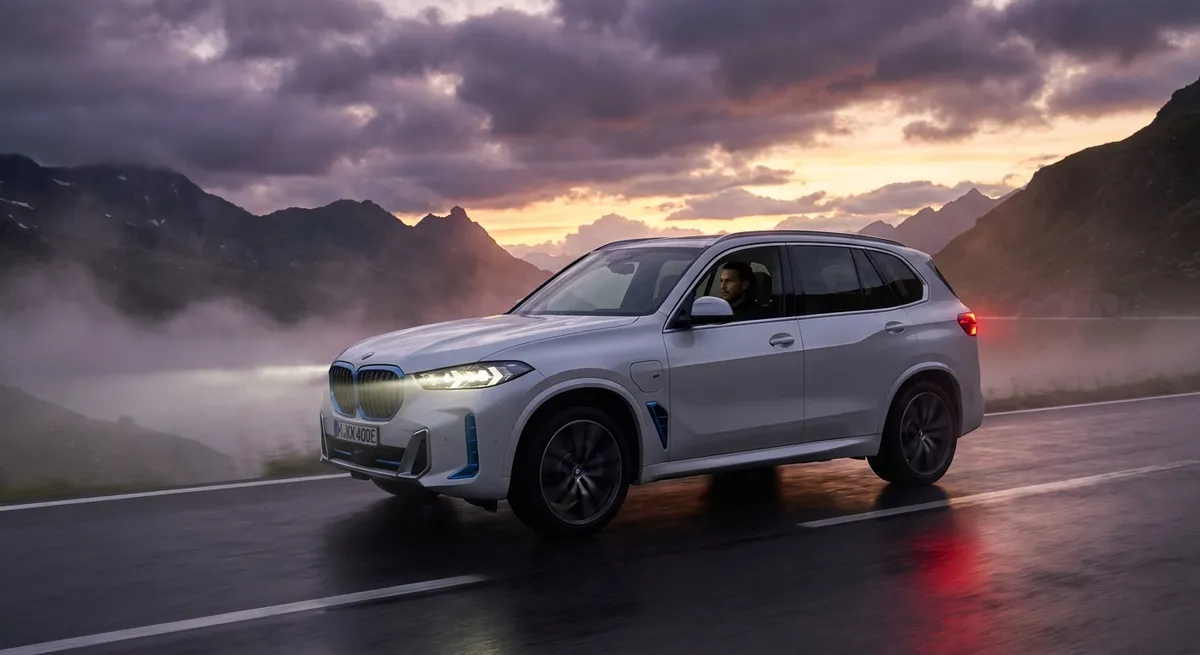
The 2025 BMW X5 xDrive50e lands in a pivotal moment for luxury SUVs, where buyers want power, efficiency, and tech without sacrificing comfort or capability. As BMW’s plug-in hybrid entry in the midsize segment, the xDrive50e aims to bridge the gap between traditional gasoline performance and full EV living. This review focuses on what matters most to enthusiasts and serious shoppers: powertrain depth, real-world efficiency, chassis and ride behavior, cabin tech, and ownership realities.
Powertrain and Performance: Where the Plug-In Starts to Make Sense
Under the hood, the 2025 X5 xDrive50e combines a 3.0-liter turbocharged inline‑six (B58 series) with an integrated electric motor and lithium‑ion battery to deliver a system output of about 483 hp and 516 lb‑ft of torque. The gasoline engine alone produces roughly 308 hp, while the electric motor contributes about 194 hp, with the combined figure carefully calibrated by the hybrid control software to avoid simple arithmetic addition of those numbers.
Power is routed through an 8‑speed ZF automatic transmission and BMW’s xDrive all‑wheel‑drive system. Enthusiasts will appreciate that the transmission is a true torque‑converter automatic, not a CVT, giving more natural shift behavior and better response under hard acceleration. BMW claims a 0–60 mph time in the mid‑4‑second range, putting the xDrive50e uncomfortably close to traditional performance SUVs in straight-line speed while still being the “efficiency‑minded” option in the lineup.
The electric motor is integrated into the transmission housing, which reduces packaging complexity and allows for seamless transitions between EV and hybrid operation. Regenerative braking is tuned to feel relatively natural compared to some PHEVs; the pedal is progressive and avoids the grabby, inconsistent feel that plagues less-refined systems. When driven hard, the system prioritizes battery power for boost, so you get that instant electric torque filling in turbo lag, giving the X5 a strong mid‑range surge that feels more like a V8 than a six‑cylinder.
Electric Range, Efficiency, and Charging: Real Benefits Beyond the Spec Sheet
One of the headline numbers for the 2025 X5 xDrive50e is its estimated electric-only range, which in EPA testing typically lands in the 35–40‑mile window, depending on wheel size and options. For many owners, that’s enough to cover the average American round‑trip commute on electrons alone, turning the X5 into an EV during the week and a hybrid highway cruiser on weekends.
The battery pack, with a usable capacity in the mid‑20 kWh range, is mounted low in the chassis, central to the vehicle’s footprint. This positioning benefits both center of gravity and cargo usability, though some underfloor storage is sacrificed. Unlike a full EV, the X5 xDrive50e is limited to AC charging; there is no DC fast charging capability. On a Level 2 home charger (240V), you’re typically looking at about 3–4 hours for a full charge from near empty, with onboard charging power around 7.4 kW.
Efficiency depends heavily on how you use the car. In EV mode, energy consumption is generally in line with large luxury EV SUVs on a per‑mile basis, but the real advantage comes from the hybrid flexibility: if you keep the battery topped off and mostly drive short trips, gasoline use can be sporadic. On longer highway runs with a depleted battery, expect fuel economy in the mid‑20 mpg range—respectable for a heavy, powerful all‑wheel‑drive SUV but not revolutionary.
Drive modes are central to how the X5 behaves: “Electric” prioritizes EV running until the battery state-of-charge drops, “Hybrid” continuously blends both systems for optimal efficiency, and “Sport” keeps the gasoline engine engaged for maximum performance, using the battery as a power booster. Enthusiasts can also manually hold battery charge for later use—useful if you want to save EV range for urban portions of a trip. The key takeaway for potential buyers: to unlock the full financial and environmental benefits, home charging access is essentially mandatory.
Chassis, Handling, and Ride: Balancing Weight With Control
The X5 xDrive50e carries significant mass due to its battery and hybrid hardware, with curb weight easily exceeding 5,500 lb depending on configuration. BMW counters that heft with a sophisticated chassis: double‑wishbone front and multi‑link rear suspension, adaptive dampers, and an available air suspension and active roll stabilization system.
Even in its standard configuration, the X5 feels more controlled than many of its rivals. Steering is electrically assisted but still offers a meaningful sense of front tire load, particularly in Sport mode. Body roll is well‑contained, especially for a tall SUV, and the hybrid’s low‑mounted battery helps reduce the top‑heavy feeling. Enthusiast drivers will notice that the xDrive50e carries its weight more gracefully than most PHEVs; it still feels like a BMW in the way it tucks into corners and accelerates out of them with authority.
Air suspension, if equipped, adds another layer of flexibility: it can lower at speed to improve aerodynamics and stability, and raise for light off‑pavement usage. Combined with adaptive dampers, the system can shift from comfort‑oriented, long‑distance compliance to a firmer, more tied‑down character with a mode change. For buyers in rough‑road regions, the configurability is a major advantage over fixed‑rate setups.
Braking performance is solid given the mass, with large rotors and multi‑piston calipers supplemented by regenerative braking. In spirited driving, some enthusiasts may detect the subtle blending of regen and friction at the top of the pedal stroke, but BMW has done a better job than most in this class at keeping the interface consistent. Towing capacity remains competitive for a midsize luxury SUV, with ratings around 5,900 lb when properly equipped—enough for many boats, small campers, and track-day trailers.
Interior, Technology, and Practicality: Luxury Meets Complex Software
Inside, the 2025 X5 xDrive50e leans heavily into BMW’s current design language: a wide curved display integrates both the digital instrument cluster and central infotainment screen, running BMW Operating System 8.x or newer. Resolution and brightness are excellent, with crisp graphics and responsive touch input. The system supports over‑the‑air updates, which is crucial as BMW continues refining UI layout, voice control, and energy management features.
Digital climate controls have migrated mostly into the touchscreen, which some owners may find less intuitive than physical knobs. However, BMW’s configurable quick-access tiles and improved voice assistant do help mitigate menu-diving. Wireless Apple CarPlay and Android Auto are standard, and the available head‑up display is one of the clearer, more informative units in the segment, offering navigation prompts, speed, ADAS status, and even hybrid system information.
Material quality meets expectations for a premium SUV at this price point: soft-touch surfaces, real metal accents, and well‑executed leather or synthetic upholstery options. The plug‑in hardware doesn’t significantly compromise passenger space; rear seat legroom and headroom remain generous for adults. Cargo capacity is slightly affected by the battery packaging, but the X5 still offers a usable load area, with the split tailgate design adding practicality for loading heavy items or sitting on the lower section at outdoor events.
Driver assistance and safety tech are comprehensive: adaptive cruise control with stop-and-go, lane-keeping assistance, blind spot monitoring, cross‑traffic alerts, and available highway driving assistance are all on the menu. Enthusiasts may disable some of these systems in favor of a more “analog” experience, but for long-distance family trips, they reduce fatigue significantly. Hybrid‑specific displays provide energy flow diagrams, driving efficiency scores, and EV range projections, giving technically inclined drivers useful feedback to refine their driving style.
Ownership Costs, Use Cases, and Who the X5 xDrive50e Is Really For
From an ownership perspective, the X5 xDrive50e occupies a nuanced space. Purchase price typically slots above the conventional gas‑only X5 but below a full‑EV luxury SUV with similar performance. In some markets, federal or regional incentives for plug‑in hybrids can offset a portion of that premium, though incentive structures are evolving rapidly and may differ by jurisdiction and battery size.
Maintenance costs can be favorable in the early years because a significant portion of urban or commuter driving can be done with the engine off, reducing wear on oil‑dependent components and brakes. However, PHEVs add complexity: high‑voltage battery, power electronics, electric motor integration, and dual propulsion systems all introduce potential long‑term repair costs. For buyers planning to keep the vehicle far past warranty, it’s worth factoring in the higher technical complexity vs. a simpler internal-combustion X5.
The ideal use case for the X5 xDrive50e is a buyer who:
- Has reliable access to Level 2 home or workplace charging
- Regularly drives short to moderate daily distances but still needs long‑range flexibility
- Values performance and refinement as much as fuel savings
- Wants an interim step toward electrification without committing to public fast‑charging infrastructure
For frequent long‑distance highway drivers without charging access, the value proposition weakens; a highly efficient diesel (where available) or a mild‑hybrid gasoline SUV might make more sense. But for tech‑savvy buyers in suburban or urban settings, the xDrive50e offers a compelling mix of quiet EV commuting, long‑trip convenience, and classic BMW driving dynamics.
Conclusion
The 2025 BMW X5 xDrive50e stands out as one of the most complete plug‑in hybrid SUVs currently on the market, especially for drivers who refuse to trade performance for efficiency. Its hybrid system is powerful and refined, its real‑world electric range can meaningfully cut fuel use for many owners, and its chassis dynamics remain true to BMW’s reputation despite the added weight.
Potential buyers should approach it with clear expectations: to unlock its strengths, you must charge it regularly, and you should be comfortable with a technologically dense vehicle. For those who fit that profile, the xDrive50e isn’t just a compromise between gasoline and electric—it’s a genuinely compelling performance‑luxury SUV that happens to plug in.
Sources
- [BMW USA – 2025 BMW X5 Specifications](https://www.bmwusa.com/vehicles/x-models/x5/overview.html) – Official BMW site with current specs, powertrain details, and equipment information for the X5 lineup
- [U.S. Department of Energy – FuelEconomy.gov: Plug‑In Hybrid Electric Vehicles](https://www.fueleconomy.gov/feg/phevs.jsp) – Explains how PHEVs work, efficiency considerations, and typical use‑case scenarios
- [EPA – Green Vehicle Guide](https://www.epa.gov/greenvehicles/electric-vehicle-myths) – Provides guidance on EV and PHEV efficiency, emissions, and common misconceptions
- [IIHS – Crash Test Ratings for Midsize Luxury SUVs](https://www.iihs.org/ratings/class/midsize-luxury-suv) – Safety ratings and crash test data for comparable vehicles in the X5’s segment
- [National Renewable Energy Laboratory – Plug‑In Hybrid Electric Vehicles Research](https://www.nrel.gov/transportation/plugin-hybrid-electric-vehicles.html) – Technical insights into PHEV technology, energy use patterns, and grid impacts
Key Takeaway
The most important thing to remember from this article is that this information can change how you think about Reviews.