The 2025 BMW X5 xDrive50e arrives at a moment when many SUV shoppers want genuine electric capability without sacrificing long‑distance flexibility. Positioned as the plug‑in hybrid (PHEV) sweet spot in BMW’s midsize lineup, the xDrive50e promises luxury, performance, and enough electric range to cover most daily driving. This review takes a focused, enthusiast‑oriented look at how the X5 xDrive50e actually behaves on the road, what its specs mean in real use, and how it stacks up as a long‑term purchase for serious SUV buyers.
Powertrain and Performance: Inline-Six Meets High-Voltage Assist
At the heart of the 2025 X5 xDrive50e is a sophisticated plug‑in hybrid system that pairs BMW’s 3.0‑liter turbocharged inline‑six (B58 series) with a rear‑mounted electric motor integrated into the 8‑speed automatic transmission. Combined system output is rated at approximately 483 hp and 516 lb‑ft of torque, placing the xDrive50e squarely in performance SUV territory without matching the outright aggression of an X5 M or M60i.
The internal combustion engine alone produces around 308 hp, but the real story is how smoothly the 194‑hp electric motor fills in torque at low rpm. Off the line, the xDrive50e feels more like a pure EV than a conventional hybrid: torque is immediate, and the engine often remains silent in light to moderate acceleration when the battery is charged. BMW claims 0–60 mph in the mid‑4‑second range; in practice, the launch feels consistently strong and repeatable thanks to all‑wheel drive, well‑calibrated traction control, and the broad torque plateau.
Enthusiasts will appreciate the gearbox tuning. In Sport mode, the ZF‑sourced 8‑speed shifts crisply and holds gears longer, while the electric assist masks turbo lag and keeps the engine in its sweet spot. The inline‑six retains BMW’s signature smoothness, with a restrained but satisfying exhaust note under load. Importantly, the transition between electric and gasoline power is nearly seamless: there’s no abrupt engagement or shudder when the engine fires, which has historically been a weak point in some rival PHEVs.
For buyers cross‑shopping performance variants of the X5, the xDrive50e occupies an interesting middle ground. It isn’t as raw or vocal as the V8‑powered M60i, but it offers similar real‑world pace with quieter, more refined operation in daily driving—and dramatically lower fuel consumption when plugged in regularly.
Electric Range, Battery Tech, and Real-World Efficiency
The xDrive50e’s defining upgrade over its predecessor (the 45e) is its larger high‑voltage lithium‑ion battery. BMW fits a pack of roughly 25.7 kWh gross (usable capacity slightly lower), enabling an EPA‑estimated electric‑only range of up to about 40–39 miles depending on wheel and tire configuration. For many commuters, that means a full workday’s worth of driving can be completed without burning any gasoline, assuming consistent home or workplace charging.
In EV mode, the X5 will operate as a rear‑biased all‑wheel‑drive electric SUV at urban and suburban speeds. The system will prioritize electric propulsion up to highway velocities before calling on the engine under heavier loads or at higher speeds, depending on the selected drive mode and accelerator input. Around town, the vehicle behaves much like a full EV: near‑silent operation, strong low‑speed torque, and smooth regenerative braking that blends nicely with the friction brakes.
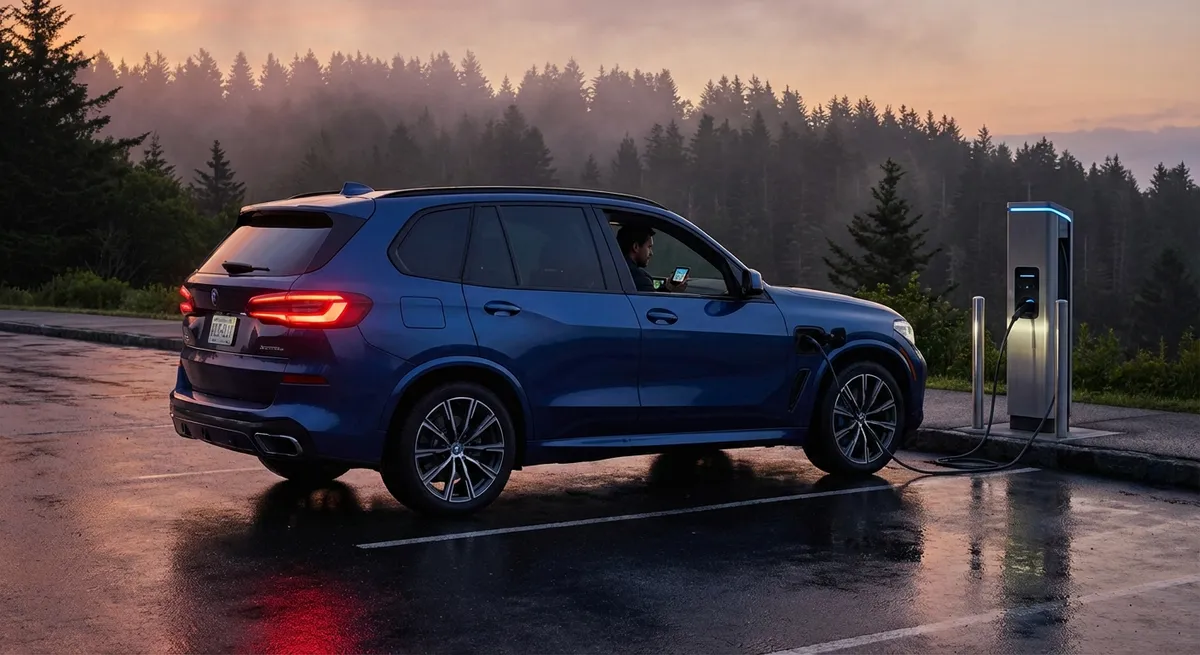
Charging is AC‑only (no DC fast charging), with a maximum onboard charger rate of about 7.4 kW. On a Level 2 home charger, a full charge typically takes around 3–4 hours from low state of charge, which is entirely manageable for overnight or workplace top‑ups. While some shoppers may wish for faster charging, the battery size and PHEV use‑case make Level 2 more than adequate.
Real‑world efficiency depends heavily on usage patterns. Drivers who plug in daily and mostly run within the electric range can see gasoline consumption drop dramatically, with many short trips consuming no fuel at all. On longer highway journeys with a depleted battery, the X5 xDrive50e behaves like a well‑executed conventional hybrid, typically returning fuel economy in the high‑20s mpg range in mixed driving—impressive for a near‑500‑hp, all‑wheel‑drive luxury SUV.
Crucially, buyers should understand that the EPA’s combined MPGe figure reflects a blend of electric and gasoline operation. The biggest savings arrive when the battery is regularly used and recharged. For those unable or unwilling to plug in frequently, a standard X5 xDrive40i may be a more rational choice.
Chassis, Ride, and Handling: Balancing Weight with Precision
The added mass of the battery pack (mounted low in the chassis) and hybrid hardware makes the xDrive50e heavier than the gasoline‑only X5 variants, yet BMW has engineered the suspension and steering to keep the driving experience very much in line with the brand’s dynamic expectations. The weight distribution remains close to 50:50, aided by the low placement of the battery, which helps stability and cornering composure.
Standard steel springs and adaptive dampers offer a compliant, controlled ride. Optional two‑axle air suspension and active roll stabilization further refine the platform, allowing the X5 to remain impressively flat in corners while soaking up rough pavement. In Comfort mode, the SUV isolates occupants from most road imperfections without feeling overly soft or detached; in Sport, body movements tighten, steering weight increases, and the vehicle’s responses become noticeably sharper.
Steering feel is typical of modern BMW: accurate, quick enough, and nicely weighted, though not overflowing with feedback. The front end turns in decisively, and the rear axle follows predictably, aided by the instantaneous torque contribution from the electric motor when you roll back onto the throttle mid‑corner. Optional rear‑axle steering (where available) can further reduce the turning circle and enhance high‑speed stability, though not all markets offer it on the PHEV.
Braking performance is an area where some PHEVs feel compromised, but BMW’s integration of regenerative and friction braking is well executed. The pedal is firm and consistent under normal driving, with only a slight change in feel when more aggressive regenerative braking kicks in. Under repeated heavy stops, the system hauls the X5 down confidently; larger brake packages tied to certain option bundles are recommended for drivers who regularly tow or drive in mountainous regions.
For enthusiasts, the key takeaway is that the xDrive50e does not feel like a science project. It behaves like a modern, powerful BMW SUV that happens to be significantly more efficient when you use its electric capability as intended.
Interior, Tech, and Usability: Luxury with a Learning Curve
Inside, the 2025 X5 xDrive50e mirrors the broader X5 lineup, with a high‑quality cabin, modern digital interfaces, and a blend of physical and capacitive controls. Materials are consistent with the premium price point: soft‑touch surfaces, precise switchgear, and available leather upholstery with detailed stitching patterns. Optional packages can add features such as glass‑finish controls, upgraded ambient lighting, and premium open‑pore wood or metallic trims.
The central technical feature is the curved display array, which combines a 12.3‑inch digital instrument cluster and a 14.9‑inch central touchscreen running BMW Operating System 8.x. The graphics are crisp and the system is powerful, with over‑the‑air update capability and integrated navigation that supports charging stops and hybrid‑aware route planning. Wireless Apple CarPlay and Android Auto are included, though some users may face an initial learning curve with BMW’s layered menu structure.
Hybrid‑specific information is readily available: energy flow diagrams, e‑range estimates, and drive mode indicators help the driver understand when the vehicle is operating in EV, hybrid, or engine‑dominant modes. Preconditioning functions allow you to use grid power to heat or cool the cabin before departure, preserving battery for driving. Customizable drive mode shortcuts can store preferred combinations of steering, suspension, and powertrain behavior.
Practicality remains a strong point. The rear seat comfortably accommodates adults, and cargo space is competitive within the segment, though the battery packaging slightly alters underfloor storage compared with non‑PHEV X5 models. The rear load floor remains flat and usable, and the split tailgate (where offered) is convenient for loading heavy items or using as a low bench. Buyers should verify exact cargo figures in their market, but in most real‑world scenarios, the xDrive50e functions just as capably as a conventional X5 for family duty, road trips, and weekend gear hauling.
Available driver‑assistance systems include adaptive cruise control with stop‑and‑go, lane‑keeping support, traffic‑jam assist in certain conditions, 360‑degree camera views, automated parking maneuvers, and exit‑warning systems. These features are competitive in the segment, though some rivals emphasize hands‑free driving capabilities more aggressively. As always, shoppers should confirm which systems are standard versus optional in their region, as packaging can differ by market and model year.
Ownership Case: Charging Habits, Incentives, and Long-Term Value
The X5 xDrive50e makes the most sense for buyers who can integrate charging into their routine. Home Level 2 charging is ideal; a dedicated 240‑volt circuit in a garage or driveway allows you to leave every morning with a full battery, effectively turning the SUV into an EV for short and medium‑distance trips. If workplace charging is available, the benefit compounds, allowing multiple electric‑only segments throughout the day.
For those living in apartments or without reliable access to charging, the xDrive50e still functions as a powerful and efficient hybrid, but much of the cost and complexity of the PHEV system will be underutilized. In such cases, a conventional X5 or a different hybrid solution might be more appropriate. Before committing, buyers should realistically assess their daily mileage, access to power, and willingness to plug in.
In the U.S. and some other markets, plug‑in hybrids may qualify for government incentives or tax credits, though eligibility rules have become more stringent and often depend on final assembly location, battery sourcing, and MSRP caps. The regulatory landscape is evolving, so prospective owners should consult up‑to‑date official resources to understand which benefits still apply to the X5 xDrive50e in their region.
Long‑term, the PHEV powertrain introduces additional complexity—battery, power electronics, and electric motor systems—beyond a standard ICE SUV. BMW backs the high‑voltage components with specific warranty coverage (often around 8 years/100,000+ miles in many markets, but buyers should verify local terms). Routine maintenance, however, can be reduced when much of your driving is electric: fewer engine cold starts, reduced oil contamination, and less mechanical wear during low‑load operation. Brake wear may also decrease due to regenerative braking.
Resale value will likely depend on regional attitudes toward PHEVs and the progression of charging infrastructure. In markets where full EV adoption is slower and long‑distance flexibility remains a priority, well‑maintained PHEVs can hold their value strongly. The X5’s established brand cachet and broad dealer support network further bolster its long‑term appeal.
Conclusion
The 2025 BMW X5 xDrive50e stands out as one of the most complete plug‑in hybrid luxury SUVs currently available. It blends genuinely strong performance with meaningful electric range, without demanding the compromises of going fully electric. Enthusiasts get an SUV that still drives like a BMW—balanced, composed, and quick—while efficiency‑minded buyers gain a pathway to dramatically lower fuel consumption when charging is used consistently.
For shoppers who can plug in at home or work and want a single vehicle that can commute in silence on weekdays and cross continents on weekends, the X5 xDrive50e makes a compelling, technically sophisticated case. It’s not the right answer for every buyer, but for the right use‑profile, it may be the most rational—and rewarding—X5 in the lineup.
Sources
- [BMW USA – 2024–2025 BMW X5 Plug-In Hybrid (xDrive50e) Specifications](https://www.bmwusa.com/vehicles/x-models/x5/plug-in-hybrid/specs.html) – Official specs, powertrain details, dimensions, and feature availability
- [EPA – Fuel Economy and Energy Consumption for BMW X5 Plug-In Hybrid](https://www.fueleconomy.gov/feg/Find.do?action=sbs&34387=on) – EPA‑rated fuel economy, MPGe, and range data for X5 PHEV models
- [IIHS – BMW X5 Safety Ratings](https://www.iihs.org/ratings/vehicle/bmw/x5-4-door-suv) – Crash test results, safety ratings, and available driver‑assistance technology evaluations
- [U.S. Department of Energy – Plug-In Hybrid Electric Vehicle (PHEV) Basics](https://afdc.energy.gov/vehicles/electric_plug_in_hybrid.html) – Technical background on PHEV operation, charging, and efficiency considerations
- [U.S. Department of Energy – Federal and State Incentives for Plug-In Vehicles](https://afdc.energy.gov/laws) – Up‑to‑date database of incentives, tax credits, and regulations affecting PHEV ownership
Key Takeaway
The most important thing to remember from this article is that this information can change how you think about Reviews.