The 2025 BMW X5 xDrive50e lands in a crowded luxury SUV segment with a sharpened mission: deliver true BMW dynamics while offering meaningful electric-only capability and flagship-level tech. For shoppers cross-shopping high-end family haulers and for enthusiasts who still care about chassis balance, the updated plug-in X5 is one of the most technically interesting SUVs on sale. This review digs deep into performance, efficiency, usability, and ownership realities to help you decide if the xDrive50e deserves a spot in your garage.
Powertrain and Performance: Where the Numbers Actually Matter
The heart of the 2025 X5 xDrive50e is a plug-in hybrid system that pairs a 3.0-liter turbocharged inline-six (BMW’s B58 engine) with an integrated electric motor housed in the 8-speed automatic transmission. System output is an impressive 483 hp and 516 lb-ft of torque, a significant jump over the outgoing xDrive45e. For context, that places it above many competitors’ plug-in SUVs in raw output while undercutting full-fat performance SUVs on operating costs.
BMW claims a 0–60 mph time in the low 4-second range when launch control is engaged, and independent instrumented tests have placed it roughly between 4.4 and 4.6 seconds, depending on options and conditions. The electric motor delivers strong low-end torque, smoothing turbo lag and making around-town driving feel effortlessly responsive. Unlike some PHEVs that feel two-step or disjointed as they hand off between gas and electric power, the X5’s calibration is impressively cohesive: throttle inputs are linear, gear changes are quick and mostly transparent, and highway passing is immediate.
Chassis tuning is equally telling. With standard xDrive all-wheel drive and an available adaptive air suspension, the X5 xDrive50e manages to juggle comfort and composure. In Comfort mode, body motions are well controlled but never harsh, while Sport mode firms things up and tightens steering weight without becoming punishing. Optional features like Integral Active Steering (rear-wheel steering) further shrink the SUV’s perceived size in tight city streets and parking garages, making the nearly 5,500-pound X5 feel unexpectedly agile. For driving enthusiasts, the xDrive50e doesn’t quite mimic an M car, but it’s notably more engaging than many rival plug-in SUVs.
Electric Range, Efficiency, and Real-World Usability
On paper, the 2025 X5 xDrive50e’s 29.5-kWh (gross) battery pack enables an EPA-rated electric-only range of roughly 39–40 miles, depending on wheel size and equipment. In practical mixed driving—suburban commutes, short highway stints, and city errands—owners can realistically expect mid-30s for EV miles before the engine reliably steps in. For many daily use cases, that means commuting entirely on electric power, using gasoline only on longer trips.
The plug-in system offers several selectable modes: a default hybrid mode that optimizes efficiency, an all-electric mode that prioritizes battery usage up to highway speeds, and a battery-hold mode that preserves charge for later (useful if you’re heading into low-emission zones or congested city centers where electric operation is preferred). Under steady-state highway conditions, the SUV will often blend engine and motor power to keep fuel consumption in check, and once the battery is depleted, the X5 behaves much like a conventional hybrid, still recapturing energy via regenerative braking.
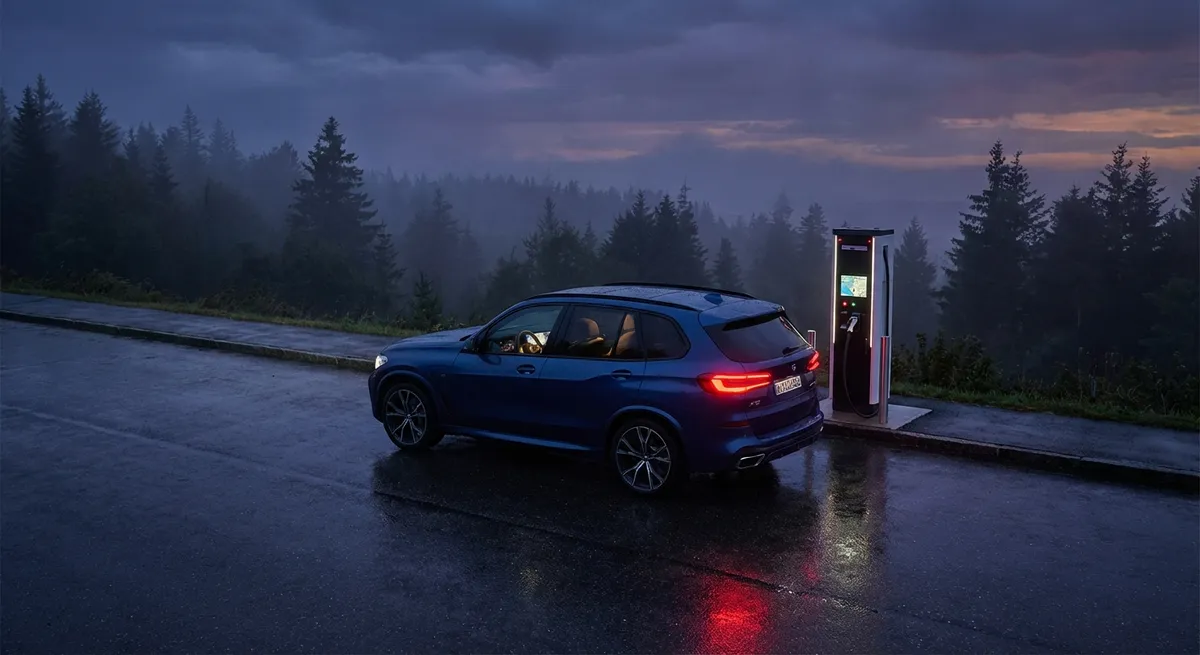
Charging performance is geared more toward overnight top-offs than rapid road-trip turnarounds. The onboard AC charger supports up to 7.4 kW on a Level 2 setup, giving a full charge in about 3–4 hours on a 240V home unit. There’s no DC fast charging, which is standard for PHEVs; the idea is that you plug in at home or work and start every day with a full battery. For many households with access to home charging, the result is gasoline consumption that mirrors or even beats some compact crossovers, despite the X5’s size and performance. For buyers without consistent charging access, the xDrive50e still functions well, but its main advantage—frequent all-electric use—will be underutilized.
Interior, Technology, and Everyday Comfort
Inside, the X5 xDrive50e continues BMW’s evolution toward a more digital, tech-forward cabin without completely abandoning physical controls. The defining visual elements are the curved dual-display layout: a 12.3-inch digital instrument cluster and a 14.9-inch central touchscreen running BMW’s latest iDrive 8.5 interface. Graphics are crisp, response times are quick, and the home screen is highly configurable. BMW has trimmed dedicated buttons over the years, so climate controls now live mostly within the touchscreen, though temperature and volume retain physical knobs.
Material quality is in line with segment expectations: soft-touch surfaces, available extended and full Merino leather, real wood trims, and carefully damped switchgear. The xDrive50e’s added battery mass is cleverly packaged under the floor, so passenger space is effectively identical to the conventional X5. Front seats offer a wide range of adjustment, with optional multi-contour seating, ventilation, and massage. Second-row legroom and headroom comfortably accommodate adults, and the backrest angle adjusts to balance comfort with cargo needs.
Infotainment and connectivity features are abundant. Wireless Apple CarPlay and Android Auto are standard, as is a high-resolution navigation system that can integrate charging stops and energy-aware routes. Available tech, such as the Bowers & Wilkins surround sound system, enhances the premium feel. An optional head-up display delivers key driving information directly in the driver’s line of sight, and the available augmented reality navigation overlays arrows and guidance prompts on a live camera feed in the center display—genuinely useful in unfamiliar cities.
Ride comfort is one of the xDrive50e’s standout attributes. With the adaptive suspension in its softer settings and the mass of the battery placed low in the chassis, the SUV feels planted yet compliant over broken pavement, expansion joints, and rough urban roads. Road and wind noise are well suppressed, especially in EV mode, where the absence of engine noise elevates the perception of refinement. Even with large 21- or 22-inch wheels, the suspension tuning keeps the ride acceptably smooth, though buyers prioritizing comfort may prefer the smaller wheel options.
Safety, Driver Assistance, and Ownership Considerations
The 2025 X5 xDrive50e packs a comprehensive suite of active safety and driver-assistance technologies, some standard and others bundled in packages. Baseline features typically include forward collision warning with automatic emergency braking, lane departure warning, blind-spot monitoring, and rear cross-traffic alert. Optional systems like Highway Assistant (where available) can provide hands-free driving on certain pre-mapped highways under defined conditions, combining adaptive cruise control, lane centering, and advanced driver monitoring.
Surround-view cameras, a 3D parking view, and an automated parking assistant further reduce parking stress in tight urban environments. The plug-in model also benefits from predictive energy management that can use navigation data, traffic information, and topography to optimize when the powertrain will lean on the battery versus the engine, indirectly enhancing safety by delivering smooth, predictable power delivery.
From an ownership perspective, the xDrive50e introduces a few unique considerations. The high-voltage battery is typically covered by a separate, longer warranty (often around 8 years or 80,000–100,000 miles, depending on region and regulations), giving buyers added confidence about long-term durability. Maintenance intervals for the engine and transmission are similar to non-hybrid BMWs, but brake wear can actually be reduced due to regenerative braking reclaiming kinetic energy and easing the load on physical pads and rotors.
Total cost of ownership hinges heavily on how often you plug in. In markets where electricity is cheaper than gasoline, frequent charging can significantly lower running costs versus a purely gasoline-powered X5. Some regions also offer tax incentives, rebates, or access privileges (such as HOV lanes) for plug-in hybrid vehicles, further improving the value proposition. Potential buyers should check local policies and incentives; these can meaningfully shift the long-term economics in the xDrive50e’s favor.
Cargo, Practicality, and How It Fits Real Lifestyles
Beyond powertrain tech and luxury trimmings, the core question for any SUV remains: how well does it handle the realities of everyday life? The X5 xDrive50e answers with a versatile, well-thought-out package that only minimally compromises practicality for electrification. The battery’s underfloor placement means cargo volume is slightly reduced versus some gasoline-only variants but remains competitive—still easily accommodating luggage for a family weekend, a full grocery run, or large strollers.
The split-opening rear tailgate, a hallmark X5 feature, is particularly useful. The lower section folds down to create a small bench or loading platform, making it easier to slide in heavy items or sit while changing shoes at a trailhead. With the rear seats up, cargo space is generous and square, and folding the rear backrests (which split 40/20/40) creates a flat load floor for larger cargo. While the xDrive50e does not offer a third-row seat in most configurations, that omission benefits rear passenger comfort and cargo depth, aligning the vehicle more with two-row luxury rivals than three-row family buses.
Towing capacity is another strong suit. Properly equipped, the X5 xDrive50e can tow up to around 5,952 pounds (approx. 2,700 kg), a figure that comfortably covers small boats, campers, and utility trailers. The electric motor’s low-end torque helps with initial pull-off and low-speed maneuvering, especially on inclines or with a heavy load attached. Trailer Stability Control and other integrated towing aids add confidence.
For urban and suburban buyers, footprint and maneuverability matter. While the X5 is not a compact SUV, the optional rear-wheel steering significantly reduces the turning circle, making tight turns and parallel parking more manageable. High seating position and generous glass area deliver good visibility, augmented by the excellent camera systems. Families will appreciate wide-opening rear doors for child-seat loading, ISOFIX/LATCH anchor points, and ample interior storage for bottles, devices, and travel essentials.
In mixed use—school runs, commuting, road trips, and the occasional tow—the xDrive50e’s blend of EV capability and long-range flexibility stands out. Owners can run day-to-day errands on electric power alone, yet still have the freedom to take a 500-mile highway trip without worrying about charging infrastructure. For many buyers, that dual nature is precisely the sweet spot between today’s EV promise and the reality of varied driving patterns.
Conclusion
The 2025 BMW X5 xDrive50e sits at an intersection where driving engagement, luxury, and electrification meaningfully overlap. Its plug-in hybrid powertrain is not a token add-on; it delivers real-world electric range, strong performance, and lower operating costs for drivers who plug in regularly. Inside, the X5 blends high-end materials with cutting-edge digital tech, all wrapped in a chassis that still feels like a BMW—confident, composed, and rewarding.
This isn’t the cheapest path into a mid-size SUV, nor the purest expression of zero-emission driving, and buyers must be realistic about their ability and willingness to charge at home. But for enthusiasts who refuse to surrender driving dynamics and for families who want one vehicle that can commute on electrons and road-trip on gasoline, the xDrive50e is one of the most compelling luxury SUV choices on the market today.
Sources
- BMW USA – 2025 BMW X5 Overview – Official specifications, trims, and feature information for the current X5 lineup, including plug-in hybrid details
- U.S. Department of Energy – fueleconomy.gov: BMW X5 xDrive50e – EPA-rated fuel economy, electric range, and energy consumption data for the X5 plug-in hybrid
- IIHS – BMW X5 Crashworthiness and Safety Ratings – Independent crash test results and safety evaluations for the BMW X5 platform
- BMW Group PressClub – The New BMW X5 and BMW X6 (Technical Release) – Detailed engineering and technical background on the latest X5 updates and powertrains
- EPA – Green Vehicle Guide – Context on plug-in hybrid technology, emissions, and how PHEVs compare to conventional and fully electric vehicles
Key Takeaway
The most important thing to remember from this article is that this information can change how you think about Reviews.