The 2025 BMW X5 xDrive50e sits at the intersection of performance, efficiency, and practicality in the midsize luxury SUV segment. As plug-in hybrids (PHEVs) become a strategic middle ground between traditional gasoline and full EVs, the updated X5 xDrive50e is one of the clearest examples of how far the technology has come. This review breaks down the model in detail for shoppers who care about driving dynamics, real-world efficiency, cabin tech, and long-term ownership realities.
Powertrain & Performance: Where Electrification Enhances the BMW Feel
BMW’s xDrive50e replaces the outgoing xDrive45e and substantially raises the performance bar. Under the hood is a 3.0-liter turbocharged inline-six (B58 family) paired with an electric motor integrated into the 8‑speed automatic transmission. Combined system output is rated at approximately 483 hp and 516 lb‑ft of torque, a significant jump over the previous PHEV variant and more than enough to move this SUV with authority.
From a standstill, the xDrive50e delivers strong, seamless acceleration, with BMW quoting a 0–60 mph time in the low 4‑second range when using launch control. The electric motor fills in low‑rpm torque, masking turbo lag and making the SUV feel more responsive in day-to-day driving than many purely gasoline rivals. Full-time all-wheel drive (xDrive) continuously monitors traction and adjusts torque distribution between the front and rear axles, which is particularly noticeable when accelerating on wet or uneven surfaces.
The 8‑speed ZF automatic remains one of the benchmarks in the segment: shifts are quick yet smooth, and manual control via paddle shifters gives enthusiasts more engagement on twisty roads. BMW’s adaptive suspension and optional air suspension setups help balance body control with ride compliance. In Comfort mode, the vehicle soaks up rough pavement confidently, while Sport mode tightens damping, reduces body roll, and sharpens throttle response for a more athletic feel.
Hybrid-specific drive modes allow the xDrive50e to prioritize electric-only operation (up to highway speeds), maintain battery charge for later use, or optimize for performance by blending gas and electric power more aggressively. Braking feel—a known challenge in many hybrids—is well resolved here, with regenerative braking blending into the mechanical brakes smoothly enough that most drivers won’t notice the transition.
Electric Range, Efficiency & Charging: A PHEV That Can Replace Your Daily Gas Use
One of the key selling points of the 2025 BMW X5 xDrive50e is its improved electric-only range. With a battery pack sized around 25+ kWh usable (significantly larger than many earlier PHEVs), the xDrive50e offers an EPA-estimated electric-only range in the neighborhood of 35–40 miles, depending on equipment and conditions. For many commuters, that’s sufficient to complete a full day’s driving on electricity alone, provided overnight charging is available.
In typical mixed driving using both the engine and electric motor, fuel economy can surpass many traditional gasoline-only midsize luxury SUVs. When driven as intended—plugging in consistently and using EV mode for shorter trips—owners may find their monthly fuel usage drops dramatically, though it’s important to remember that official MPG and MPGe figures will vary by configuration and driving style.
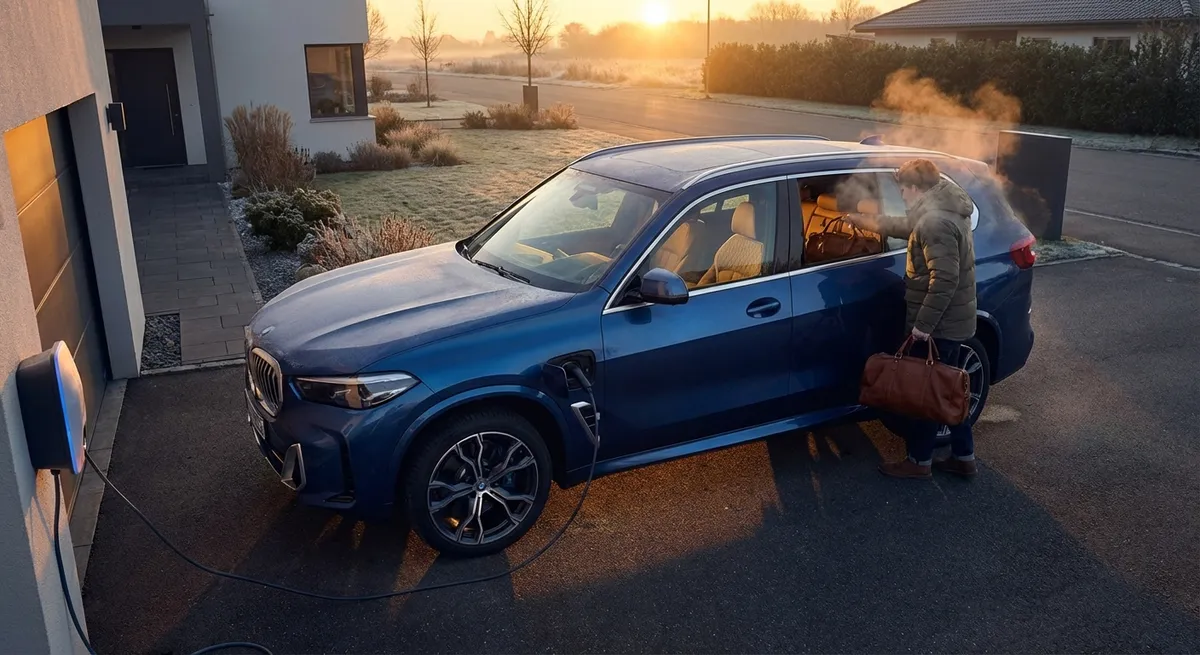
Charging is AC-only via a Type 1 (J1772) connector in North America, with onboard charging power around 7.4 kW when using a Level 2 home or workplace charger. At that rate, a full charge from near empty can be completed in roughly 3–4 hours on a 240V circuit, while a standard 120V household outlet will take substantially longer and is best suited for overnight top-ups. There is no DC fast charging capability, which is typical for PHEVs and less of a drawback given the relatively small battery pack versus a full EV.
For potential buyers, the key operational advantage is flexibility. On days with mostly local driving, the X5 can operate nearly as an EV, particularly if you precondition the cabin while plugged in. On longer trips, the gasoline engine and a sizable fuel tank eliminate range anxiety and lengthy charging stops. The trade-off is complexity: you’re maintaining both a combustion engine and a high-voltage battery system, which underscores the importance of adhering to BMW’s maintenance schedule.
Interior, Technology & Practicality: High-Tech Cabin Without Sacrificing Space
Inside, the 2025 X5 xDrive50e exemplifies BMW’s current design language, dominated by a curved dual-screen layout that houses both the digital instrument cluster and the central infotainment display. BMW’s latest iDrive system (iDrive 8.x) offers a capacitive-touch interface with configurable home screens, natural language voice control, and cloud-based navigation with real-time traffic. Wireless Apple CarPlay and Android Auto are standard on most trims, reducing reliance on the native interface for smartphone-centric owners.
Material quality is broadly in line with expectations for this segment: soft-touch surfaces, real leather (or high-quality synthetic alternatives, depending on package), and precise switchgear. Ambient lighting and optional glass controls add an upscale visual flair. PHEV packaging is often a concern, but BMW has integrated the battery under the floor in a way that preserves most of the cargo capacity and rear-seat space of the conventional X5. The rear bench remains adult-friendly, with sufficient legroom and headroom for tall passengers.
From a usability standpoint, the powertrain’s hybrid components are largely invisible to occupants. The cargo floor is only marginally higher than non-PHEV variants, and the split tailgate layout—long a practical hallmark of the X5—remains. Families will appreciate the wide-opening rear doors, ISOFIX/LATCH anchors for child seats, and the high seating position that gives good visibility in traffic.
The digital instrument cluster can display hybrid-specific information, such as real-time power flow between the engine, motors, and battery, as well as predicted EV range. Efficient driving coaches in the infotainment system provide feedback to help maximize electric usage. Enhanced driver-assistance features, including adaptive cruise control with stop-and-go, lane-keeping assistance, and traffic jam assist (where available and legal), further enhance ease of use in daily commuting and highway travel.
Safety, Driver Assistance & Dynamics: Balancing Confidence With Engagement
Safety and driver assistance are pivotal considerations for SUV buyers, and the 2025 X5 xDrive50e is engineered to meet modern expectations. Standard safety equipment typically includes forward collision warning, automatic emergency braking with pedestrian detection, blind-spot monitoring, rear cross-traffic alert, and lane-departure warning. Higher trims and option packages add more advanced systems such as traffic jam assist, active lane keeping, and adaptive cruise control that can handle stop-and-go traffic.
BMW’s driver-assistance systems generally err on the side of driver engagement rather than full automation. Lane-keeping assist is confident but less intrusive than some competitors, giving the driver clear control while providing gentle steering corrections when drifting out of the lane. The adaptive cruise control maintains following distance smoothly, and the system can recognize speed limits via camera-based traffic sign recognition (where supported).
From a structural safety perspective, the X5 platform is designed for high crash performance, with extensive use of high-strength steel and aluminum in key areas. While specific crash-test ratings for each model year may vary and should be checked directly with the Insurance Institute for Highway Safety (IIHS) and the National Highway Traffic Safety Administration (NHTSA), the X5 line historically performs well in impact tests.
Handling remains a standout trait in the segment. Even with the added mass of the battery pack, the xDrive50e feels composed and predictable at speed. Battery placement low in the chassis marginally lowers the center of gravity compared with some gasoline-only SUVs, helping reduce body roll. Steering is direct and precise, if not as communicative as older hydraulic setups, and available rear-axle steering (in some markets or packages) can improve maneuverability in tight parking situations and enhance stability during high-speed lane changes.
For buyers concerned with towing and utility, the X5 xDrive50e still offers meaningful capability, though maximum towing capacity for PHEV variants may be modestly lower than certain purely gasoline trims. Always verify the specific towing rating for the configuration you’re considering, including whether a factory trailer package is required for maximum ratings.
Ownership, Costs & Who This SUV Really Suits
From an ownership standpoint, the 2025 BMW X5 xDrive50e occupies an interesting space. Upfront pricing is typically higher than both the base gasoline X5 and some rival luxury SUVs. However, potential savings on fuel—especially for owners who consistently charge and use EV mode—can offset part of that premium over several years. In certain markets, PHEVs may qualify for federal, state, or local incentives or access to high-occupancy vehicle (HOV) lanes, though such programs are evolving and must be checked at the time of purchase.
Maintenance costs will likely be in line with other modern BMWs, which means a higher baseline than mainstream brands but broadly competitive with peer luxury marques. The hybrid setup introduces additional components—battery, inverter, electric motor—but BMW typically offers specific warranties on high-voltage components (often around 8 years/80,000–100,000 miles in the U.S., subject to verification). Using approved fluids, following the prescribed service intervals, and keeping the battery regularly charged will help ensure long-term reliability.
Resale value may be attractive due to the X5’s brand perception and the growing acceptance of electrified powertrains in the used market. That said, buyers considering very long-term ownership (beyond 8–10 years) should factor in potential battery degradation and the evolving landscape of full EVs, which may influence relative desirability.
The ideal X5 xDrive50e owner is someone who:
- Has reliable access to Level 2 charging at home or work and can plug in frequently.
- Wants genuine performance and all-weather capability without committing to a full EV.
- Values a premium, technology-rich interior and strong driver-assistance features.
- Regularly mixes city commuting (where EV mode shines) with highway trips where the gasoline engine’s range is beneficial.
For shoppers firmly committed to full electric driving and DC fast charging reliance, a pure EV SUV may be more appropriate. Conversely, for those who cannot or will not regularly plug in, a conventional gasoline or diesel X5 could be simpler and, in practice, more economical. The xDrive50e is at its best when treated as what it is designed to be: an electrified BMW that rewards drivers who use both sides of its dual personality.
Conclusion
The 2025 BMW X5 xDrive50e demonstrates how far plug-in hybrid SUVs have progressed, blending robust performance, credible electric-only range, and an upscale, technology-forward cabin. It preserves the core attributes that have long defined the X5—engaging dynamics, premium materials, and practicality—while adding a meaningful layer of electrified efficiency. For buyers willing to plug in regularly and who want a bridge between the familiar world of gasoline and the rapidly expanding landscape of EVs, the xDrive50e stands out as one of the most compelling options in the midsize luxury SUV class.
Sources
- [BMW USA – 2025 BMW X5 Overview](https://www.bmwusa.com/vehicles/x-models/x5/sports-activity-vehicle/overview.html) - Official product information, specifications, and options for the latest X5 lineup
- [U.S. Department of Energy – FuelEconomy.gov Plug-In Hybrid Information](https://www.fueleconomy.gov/feg/phevtech.shtml) - Technical explanation of how plug-in hybrids work, including efficiency and charging concepts
- [IIHS – BMW X5 Crash Test Ratings](https://www.iihs.org/ratings/vehicle/bmw/x5-4-door-suv) - Independent safety and crash-test results for the BMW X5 platform
- [U.S. Department of Energy – Alternative Fuels Data Center](https://afdc.energy.gov/fuels/electricity_infrastructure.html) - Context on charging infrastructure and considerations for home and public charging
- [EPA – Green Vehicle Guide](https://www.epa.gov/greenvehicles) - Information on emissions, fuel economy, and regulatory context for electrified vehicles, including PHEVs
Key Takeaway
The most important thing to remember from this article is that this information can change how you think about Reviews.