The latest BMW X5 xDrive50e is one of the most technically interesting midsize luxury SUVs on sale in 2025. It looks familiar, but beneath the sheet metal BMW has overhauled the plug-in hybrid system, updated the cabin tech, and subtly sharpened the dynamics. For shoppers cross-shopping luxury SUVs—whether coming from a traditional gas model or testing the electrified waters—the X5 xDrive50e offers a compelling mix of efficiency, performance, and practicality. This review focuses on how it actually works as a daily driver, with five key angles serious buyers and enthusiasts should examine closely.
Powertrain and Performance: Where the X5 xDrive50e Really Stands Out
BMW’s latest plug-in hybrid system is the headline feature of the X5 xDrive50e, and it’s not a minor refresh. The SUV pairs a 3.0-liter turbocharged inline-six with an updated electric motor integrated into the 8‑speed automatic transmission, backed by a significantly larger high-voltage battery.
Combined output is around 483 hp and 516 lb-ft of torque, a substantial jump over the previous generation plug-in X5. The result is acceleration that feels closer to a traditional performance SUV than a “green” compromise: 0–60 mph is in the mid‑4‑second range when you use launch control and have a reasonably charged battery. Power delivery is smooth and linear; the electric motor fills in the torque curve at lower rpm, masking turbo lag and making the SUV feel effortlessly quick in city driving.
The plug-in system provides multiple drive modes—Hybrid, Electric, and Sport—each altering the way the gas engine and motor interact. In Hybrid, the X5 xDrive50e will prioritize electric propulsion at lower loads, firing the engine only when necessary, while Electric mode will keep it in EV operation up to highway speeds as long as there’s sufficient charge. Sport mode locks the drivetrain into a more aggressive mapping, maximizing combined power and sharpening throttle response.
Handling is typically BMW: controlled body motions, well-weighted steering, and strong braking performance. The optional adaptive M suspension and available active roll stabilization can further reduce body roll and improve responsiveness, though buyers should be aware that these systems add complexity and potential long-term maintenance costs. The additional mass of the battery pack is noticeable only when you push hard, and even then, the X5 maintains composure better than many rivals thanks to its balanced weight distribution and sophisticated chassis tuning.
Electric Range, Efficiency, and Charging Reality
For many buyers, the critical question is not peak horsepower—it’s how usable the electrification is in everyday driving. BMW has significantly increased the battery capacity in the xDrive50e compared with the outgoing xDrive45e, enabling an all-electric range that can realistically cover most commutes and daily errands.
In real-world mixed driving, it’s reasonable to expect electric-only operation in the 30–40 mile range, depending on conditions, driving style, and temperature. City-heavy trips with gentle throttle use will stretch the range, while high-speed highway runs will shorten it. For many suburban owners who can charge at home, this means the engine may rarely need to start on workdays, effectively turning the X5 into an EV for short distances with the flexibility of a gasoline backup for longer trips.
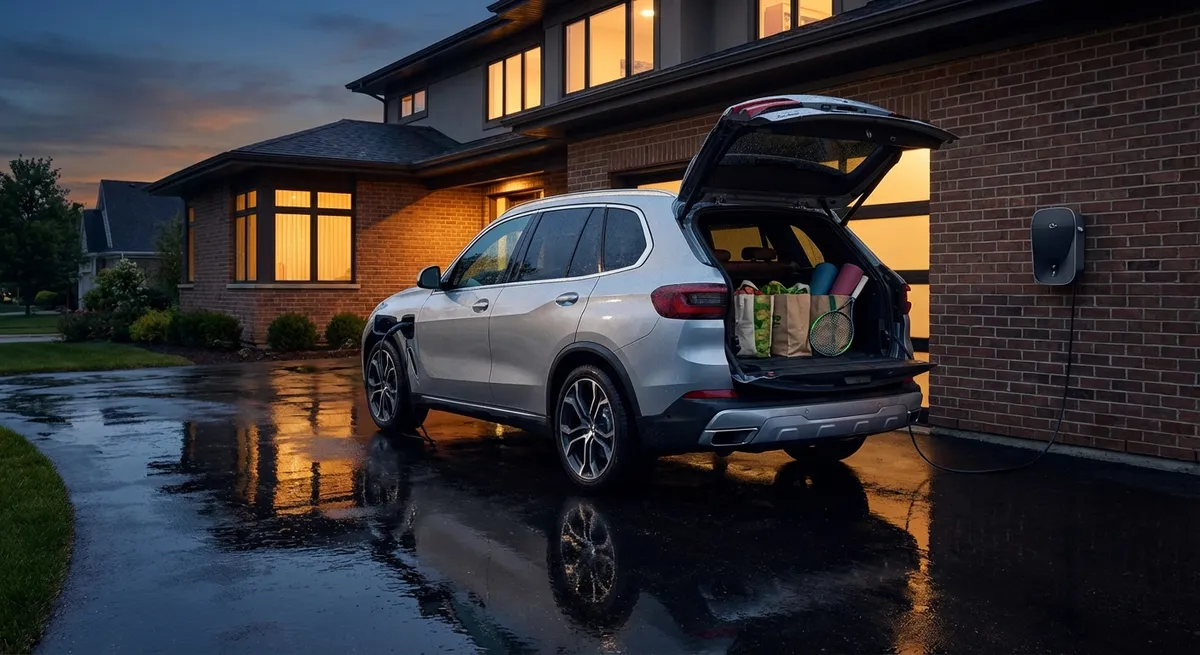
The onboard AC charger supports Level 2 charging (240V), and a full charge can typically be accomplished overnight on a home wall box. Unlike a pure EV, DC fast-charging isn’t central to the X5 xDrive50e’s use case; most owners will top up at home or at workplace chargers. The plug-in strategy is simple: charge whenever you can, use EV mode for local travel, keep Hybrid mode for mixed use, and let the engine handle long-distance drives without range anxiety.
Efficiency when the battery is depleted depends on usage. In charge-sustaining mode, the X5 behaves like a conventional turbocharged six-cylinder SUV with some hybrid assistance, offering respectable but not class-leading fuel economy. For owners who don’t regularly plug in, the cost advantage narrows significantly, and a conventional X5 40i may make more financial sense. For those who do plug in, the blend of electric miles and gasoline operation can dramatically lower running costs, particularly where electricity is cheap relative to fuel.
Interior, Infotainment, and Usability as a Family SUV
Inside, the X5 xDrive50e aligns closely with the rest of the updated X5 lineup, showcasing BMW’s current design language and tech stack. The cabin is dominated by a curved dual-screen layout: a 12.3‑inch digital instrument cluster paired with a 14.9‑inch central touchscreen running BMW’s latest iDrive infotainment system.
Material quality is high, with soft-touch surfaces, real leather (or high-grade synthetic options), and available open-pore wood or metallic trim. The ergonomics are mostly sound—key driving controls remain physical—but more climate and seat functions have migrated into the touchscreen. Enthusiasts may miss the older iDrive controller’s more button-heavy setup, but the system’s voice control and configurable widgets partially offset the reduced physical interface.
Space is a strong point. The second row provides generous headroom and legroom for adults, and the seating position offers a good blend of comfort and support. The plug-in hardware is packaged under the floor and in the rear, but BMW has largely preserved cargo capacity compared to the internal-combustion X5 variants. There is still a slight step in the cargo floor and some underfloor storage is occupied by battery components, so buyers who frequently carry bulky gear should physically inspect the loading area to confirm it meets their needs.
Noise insulation is very good, especially in EV mode where the cabin is impressively quiet at low speeds. On the highway, wind and road noise are well controlled, and the optional acoustic glass can further enhance refinement. Features such as a head-up display, configurable ambient lighting, and advanced driver-assistance systems (adaptive cruise, lane-keep assist, traffic jam assist) round out a comprehensive tech offering, though some of these are bundled into option packages that can raise the price significantly.
Ownership Costs, Long-Term Considerations, and Incentives
The X5 xDrive50e sits at the higher end of the price spectrum for midsize luxury SUVs, and the plug-in hybrid system adds complexity that buyers should factor into long-term ownership plans. In many markets, plug-in hybrids may still qualify for tax incentives, local rebates, or preferential parking and access rules, but these programs are evolving; shoppers should check current federal, state, and local policies before finalizing a deal.
Routine maintenance for the gasoline engine (oil changes, coolant, spark plugs) remains, but the hybrid system introduces high-voltage components that require specialist handling. BMW typically offers an 8‑year/100,000‑mile (or similar) warranty on the high-voltage battery, which should reassure early owners, but potential second-hand buyers should pay close attention to remaining warranty coverage and charging history when evaluating used examples.
Tire and brake wear can be somewhat mitigated by regenerative braking, especially if the owner drives predominantly in EV or Hybrid modes in urban conditions. Still, this is a heavy, powerful SUV on performance-oriented tires; expect consumables to be priced accordingly. Optional air suspension and active chassis systems improve comfort and dynamics but bring additional complexity and potential repair costs as the vehicle ages.
From a total-cost-of-ownership standpoint, the X5 xDrive50e can be financially attractive for drivers who regularly charge and accumulate significant city miles, where electric propulsion dramatically reduces fuel use. For low-mileage drivers or those who rarely plug in, the benefits are more about performance and technology than hard savings, and a careful comparison with the X5 40i or rival luxury SUVs is warranted.
How It Compares and Who Should Buy It
In the plug-in hybrid luxury SUV space, the X5 xDrive50e faces competitors such as the Volvo XC90 Recharge, Mercedes‑Benz GLE 450e, and certain versions of the Porsche Cayenne E‑Hybrid. Each takes a slightly different approach to the balance between performance, electric range, and comfort.
The BMW leans toward performance and driver engagement while still delivering usable EV range. It feels more athletic than most Volvo XC90 configurations and more involving than many GLE models, without reaching the sharper, more focused (and more expensive) character of a Cayenne E‑Hybrid. That makes the X5 xDrive50e a strong choice for drivers who value a responsive chassis and robust acceleration but also want an EV-like experience for daily use.
Prospective owners should think carefully about their usage pattern:
- If your commute and daily errands fall within the X5’s EV range and you have consistent access to Level 2 charging, the xDrive50e can serve as a near-electric SUV Monday through Friday, with no compromises for weekend road trips.
- If you frequently tow or travel long distances at high speed, the plug-in’s advantages diminish compared with a conventional six-cylinder X5, though the extra torque can be useful for towing.
- If you primarily drive in dense urban areas with congestion charges or low-emission zones, the plug-in’s electric capability and potential regulatory benefits add significant appeal.
Ultimately, the X5 xDrive50e is best suited to buyers who want one vehicle to cover a wide range of roles: performance SUV, efficient commuter, family hauler, and long-distance tourer, with minimal compromise in any single area.
Conclusion
The 2025 BMW X5 xDrive50e is a sophisticated plug-in hybrid SUV that goes beyond simply bolting an electric motor onto an existing platform. Its powertrain delivers serious performance and genuinely useful electric range, while the interior tech, comfort, and space meet modern luxury expectations. Ownership costs and complexity are higher than a standard gasoline SUV, but for drivers who can take advantage of regular charging and mixed-use patterns, the xDrive50e offers a compelling blend of efficiency and excitement.
For car enthusiasts, the appeal lies in the depth of engineering: a smooth inline-six paired with a strong electric motor, a well-tuned chassis, and a cabin that integrates advanced tech without feeling sterile. For practical buyers, it’s the ability to run errands silently on electricity yet still head cross-country without planning charging stops. In a market crowded with SUVs promising to “do it all,” the X5 xDrive50e comes closer than most to actually delivering on that promise—provided you use its plug-in capabilities as intended.
Sources
- BMW Official X5 Plug-In Hybrid Overview - Manufacturer specifications, powertrain details, and feature breakdown for the latest X5 lineup
- U.S. Department of Energy – Fueleconomy.gov: Plug-In Hybrid Vehicles - Technical explanation of how plug-in hybrids work, including efficiency considerations and charging behavior
- EPA – Green Vehicle Guide - Official U.S. government resource on vehicle emissions, fuel economy ratings, and environmental impact of different powertrains
- IIHS – SUV Safety Ratings - Crash-test and safety evaluation data for large and midsize SUVs, useful for comparing segment alternatives
- Volvo XC90 Recharge – Official Site - Reference point for a key plug-in hybrid SUV competitor, including specs and technology overview
Key Takeaway
The most important thing to remember from this article is that this information can change how you think about Reviews.