The 2025 BMW X5 xDrive50e arrives at a moment when midsize luxury SUVs are being forced to do it all: deliver performance, efficiency, tech, and comfort without sacrificing real-world usability. Positioned as the plug-in hybrid (PHEV) variant in the X5 lineup, the xDrive50e replaces the previous xDrive45e with more power, more electric range, and a recalibrated mission: convince buyers that a PHEV can be the sweet spot between pure ICE and full EV. This review focuses on how the 50e performs as a daily driver, a family hauler, and an enthusiast’s compromise, with five core areas enthusiasts and serious shoppers should look at closely.
Powertrain and Performance: Where Hybrid Tech Feels Seamless
BMW’s plug-in X5 has always leaned more toward “luxury tourer” than “green science project,” and the 2025 xDrive50e continues that trend with a deeply integrated powertrain.
Under the hood is a 3.0-liter turbocharged inline-six (B58 generation) paired with an electric motor integrated into the 8-speed ZF automatic transmission. Combined system output is around 483 hp and 516 lb-ft of torque, a notable jump over the outgoing xDrive45e. The gasoline engine alone makes roughly 308 hp; the electric motor contributes around 194 hp, though not simultaneously at their individual peaks. BMW claims a 0–60 mph time in the low 4-second range, which matches many performance sedans and is significantly quicker than most mainstream midsize SUVs.
What matters more than the numbers is how the system behaves. Low-speed takeoff in Hybrid mode is predominantly electric, which makes city driving smooth and quiet. When you dig into the throttle, the transition from EV assist to full gas+electric thrust is almost imperceptible; the gearbox and motor management keep the inline-six in its torque sweet spot, masking turbo lag and downshifts. Enthusiasts will appreciate the flexibility: Eco Pro mode keeps the drivetrain relaxed and electric-heavy, Comfort mode feels like a well-tuned luxury SUV, and Sport mode sharpens throttle response, firms up the adaptive dampers, and keeps the powertrain ready for rapid passing.
The xDrive50e uses BMW’s rear-biased xDrive all-wheel-drive system, which sends more torque to the rear axle until slip is detected or extra traction is requested. On a winding road, the SUV feels more “rear-drive” than many of its competitors, rotating predictably and resisting understeer better than you’d expect from a plug-in hybrid weighing over 5,600 lbs. The optional M Sport differential, which can actively distribute torque side-to-side at the rear axle, further improves corner exit traction and agility.
Braking performance is solid, though the blend between regenerative and friction braking is still a key area for PHEVs. BMW’s tuning is among the best: pedal feel is progressive, and most drivers won’t notice the handoff between regen and the mechanical brakes. For buyers cross-shopping fully electric SUVs, the X5 xDrive50e offers a compelling balance of performance and familiarity: it still sounds and feels like a BMW inline-six when pushed, but it has the low-end instant shove that EV fans crave.
Electric Range, Charging, and Real-World Efficiency
For many buyers, the xDrive50e’s usefulness will be defined by its electric-only range and how easily it fits into daily charging routines. BMW has increased the high-voltage battery capacity to approximately 25.7 kWh gross (about 21 kWh usable), up from the prior generation’s roughly 17 kWh system. Official EPA electric-only range figures are expected in the low to mid-30-mile range, depending on wheel size and options, though real-world drivers who are gentle on the throttle and primarily in city traffic often report slightly better results with similar BMW PHEVs.
In practical terms, this means that many commutes under 25–30 miles round trip can be done almost entirely on electricity if the vehicle is charged at home each night. Hybrid mode intelligently balances battery and engine use; the SUV will favor electric drive in urban areas and when cruising gently, then call on the inline-six more aggressively when climbing grades or at higher highway speeds.
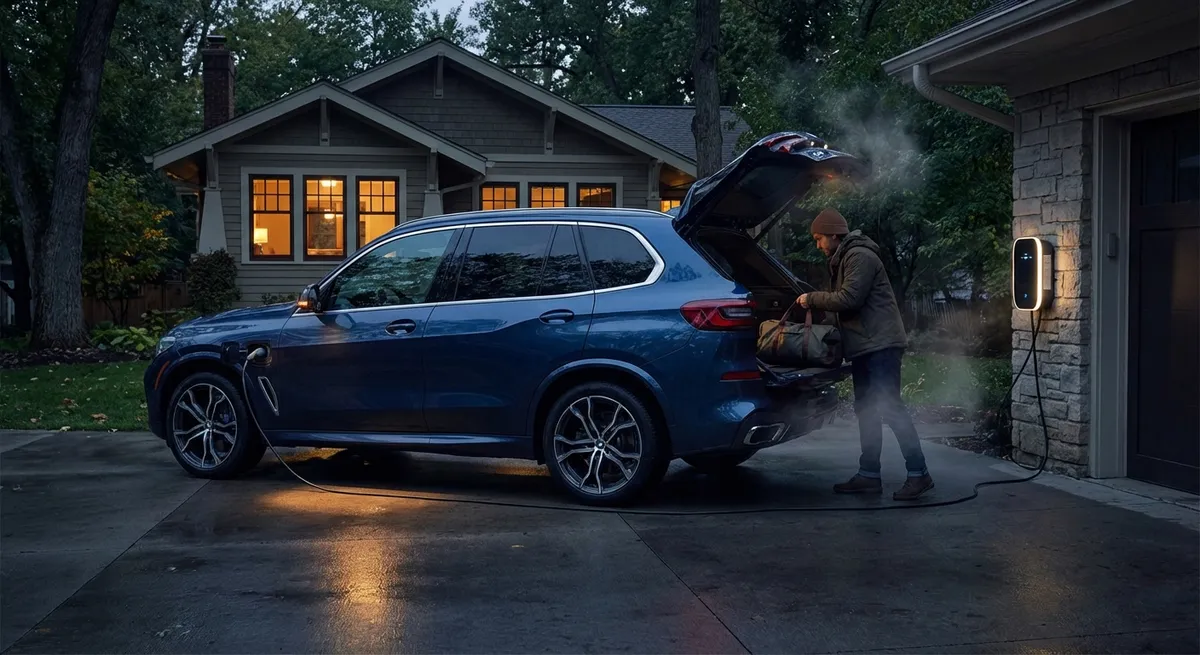
Charging hardware is straightforward. The xDrive50e uses a single-phase onboard charger supporting up to 7.4 kW AC on Level 2. With a typical 240V Level 2 home charger, you can expect a full charge from near-empty in about 3–4 hours. There is no DC fast charging, which is common for PHEVs; BMW’s intent is clearly overnight home charging and occasional workplace top-ups, not road-trip fast-charging like an EV.
Fuel economy in hybrid operation is where the X5 PHEV can make financial sense. With a full battery, you’ll start your day effectively in an electric SUV. Once the battery is depleted, the vehicle behaves like a conventional hybrid, using the engine more, but still recapturing energy through regen braking and coasting. For drivers who plug in regularly and spend most of their time in town, overall fuel consumption can be dramatically lower than a comparable gasoline X5 xDrive40i—often well above 50 MPGe on mixed-use weeks. However, those who never plug in will see consumption similar to a heavy, powerful six-cylinder luxury SUV, which defeats the PHEV’s purpose.
For buyers in regions with high fuel prices or emissions-based congestion charges, the ability to run in pure EV mode for daily errands—and still keep a gasoline engine for longer trips—makes the xDrive50e a compelling “best of both worlds” proposition.
Chassis, Ride Quality, and Handling Dynamics
Midsize luxury SUVs live or die by how well they isolate occupants from the outside world without turning into numb, wallowy appliances. The 2025 X5 xDrive50e rides on BMW’s CLAR platform, with front double-wishbone and rear multi-link suspension. Adaptive dampers are standard on the PHEV, and air suspension is available depending on market and package.
In Comfort mode, the ride quality is supple yet controlled. Broken pavement and expansion joints are rounded off, but there’s no excessive float or bobbing. The extra weight of the battery pack, located low in the chassis, actually helps with vertical motion control; the X5 feels planted and stable at highway speeds. Optional 21- or 22-inch wheels sharpen aesthetics but slightly erode ride comfort over sharp impacts; buyers prioritizing comfort should consider the smaller 20-inch wheels with higher-profile tires.
Handling is where the BMW tuning philosophy still distinguishes itself from many competitors. Steering is electrically assisted and variable, with a light effort at low speeds that becomes heavier and more precise as speeds rise. While purists will note the lack of granular road feel compared to older hydraulic systems, the steering ratio and feedback are well-judged for a modern luxury SUV. Turn-in is confident, body roll is well-controlled, and the rear-biased AWD plus torque-vectoring options ensure the X5 feels smaller and more agile than its size suggests.
The available two-axle air suspension can vary ride height, which is useful both for loading cargo (lowered) and for mild off-road or deep snow scenarios (raised). This is not a hardcore off-roader in the vein of a Land Cruiser or Defender, but xDrive, decent ground clearance, and the PHEV’s low-end torque make it competent on rough gravel roads, muddy fields, or unpaved rural routes. Most owners, though, will appreciate how confidently it dispatches long highway drives: stable, quiet, and composed, with very good crosswind resistance and solid lane-centering when equipped with driver-assistance packages.
Enthusiasts who want more involvement can specify the M Sport package and dynamic handling options, but even in standard trim, the 50e is one of the more dynamically accomplished PHEVs in the segment.
Interior, Tech, and Everyday Usability
Inside, the 2025 X5 xDrive50e mirrors the broader BMW lineup with a driver-focused cockpit and the brand’s Curved Display setup. A 12.3-inch digital instrument cluster sits alongside a 14.9-inch central touchscreen, both running BMW Operating System 8.5 (or later, depending on production). The graphics are sharp, animations are smooth, and the system’s processing power makes it feel more like a modern tablet than an aftermarket head unit.
The interface is built around tiles and widget-style layouts, with a configurable home screen. You can still use the iDrive rotary controller on the center console, which remains a major advantage over fully touch-dependent systems, especially while driving. Wireless Apple CarPlay and Android Auto are standard in most markets, and integration is seamless. BMW’s own navigation system is robust, featuring real-time traffic, over-the-air map updates, and EV-specific routing that factors in state of charge and charging opportunities—useful if you want to maximize electric driving on longer journeys.
Material quality is convincingly premium. Soft-touch plastics, real metal trim, and high-grade leather (or convincing synthetic alternatives in some trims) dominate the cabin. Ambient lighting, optional glass controls, and open-pore wood trim create a high-end atmosphere. Front seats are supportive with a wide range of adjustability, including adjustable side bolsters and available massage functions. Rear seats provide ample legroom and headroom for adults, and the rear bench is comfortably sculpted for two but can accommodate three across for shorter trips.
The packaging compromises of the PHEV layout are minor but worth noting. The battery pack is under the floor and in the rear area, which slightly reduces cargo volume versus non-PHEV X5 models. The rear load floor is marginally higher, and you lose some underfloor storage compared to the gasoline-only variants. That said, the X5 xDrive50e still offers a very usable cargo area with a flat floor, split-folding rear seats, and BMW’s traditional split tailgate (top hatch plus lower fold-down portion), which doubles as a handy seating or loading platform.
Daily usability is further enhanced by thoughtful touches: numerous USB-C ports, a proper physical volume knob, and climate controls that, while partially integrated into the screen, still retain some quick-access controls and logical menu structure. BMW’s voice assistant can handle basic commands for navigation, climate, and media, though like all such systems, it still trails the best smartphone assistants for natural language complexity.
From a family perspective, the X5 xDrive50e offers ISOFIX/LATCH mounting points, rear climate options, and optional rear sunshades. The cabin feels airy thanks to large windows and an available panoramic roof. For parents, the ability to leave the vehicle in an electric climate-control mode while stationary (with the battery providing power) is a practical perk for short waits.
Safety, Driver Assistance, and Ownership Considerations
The X5 lineup, including the xDrive50e, is built with a strong emphasis on passive safety. The SUV’s body structure uses a mix of high-strength steels and aluminum to manage crash energy efficiently. While specific 2025 crash test ratings may still be pending at the time of writing, prior years of the current-generation X5 have scored well in Euro NCAP and IIHS testing, with good performance in frontal, side, and rollover evaluations.
Standard safety equipment typically includes forward collision warning, automatic emergency braking with pedestrian detection, blind-spot monitoring, rear cross-traffic alert, lane departure warning, and a full complement of airbags. BMW’s Active Driving Assistant Professional (often an option or part of a package) adds adaptive cruise control with stop-and-go, lane-keeping assist, traffic jam assist, and a refined lane-centering system. On highways with clear markings, the X5 will maintain lane position and distance with minimal driver input, although hands-on-the-wheel monitoring remains mandatory.
For buyers, understanding the ownership profile of a PHEV is crucial. Battery warranty coverage is typically 8 years/80,000–100,000 miles (depending on market and regulations), separate from the standard vehicle warranty. BMW’s track record with high-voltage components in its plug-in hybrids and EVs has generally been solid, and the company continues to refine thermal management and software to extend battery life. Routine maintenance is similar to a conventional X5, with the caveat that the gasoline engine may see less wear if you frequently drive in EV mode—but you must still adhere to oil change and service intervals.
Potential buyers should also consider incentives and total cost of ownership. In many markets, PHEVs like the X5 xDrive50e qualify for tax credits, reduced registration fees, or access to low-emission zones—though some regions are tightening eligibility, requiring a meaningful electric range and evidence of plug-in use. Electricity is typically cheaper per mile than gasoline, especially when charging at home off-peak, which can significantly reduce running costs over the life of the vehicle if you plug in consistently.
Resale values for well-specified X5s have historically been strong, and the xDrive50e’s combination of luxury, performance, and flexibility should help it hold value, especially in markets where urban emissions restrictions are increasing. However, used buyers will pay extra attention to battery health and charging history; having service records and evidence of consistent, proper charging will likely become a selling point.
Overall, the 2025 BMW X5 xDrive50e occupies a compelling niche: it’s a genuinely quick, dynamically capable luxury SUV that lets owners do most of their daily driving on electricity without committing to full EV infrastructure or range anxiety. For enthusiasts who still enjoy the character of a turbocharged inline-six but see the appeal of an electric commute, it’s one of the most well-rounded options in the segment.
Conclusion
The 2025 BMW X5 xDrive50e demonstrates how far plug-in hybrid SUVs have evolved from their early, compromise-heavy days. Its powertrain feels cohesive rather than experimental, delivering serious performance while offering meaningful electric-only range for everyday use. The chassis and steering maintain BMW’s reputation for driver engagement in a class that often prioritizes isolation over involvement. Inside, the X5 blends high-end materials, modern infotainment, and family-friendly practicality with only minor compromises from the PHEV packaging.
For shoppers cross-shopping fully electric SUVs, high-output gasoline models, and rival PHEVs, the xDrive50e stands out as a refined middle path. If you have reliable home charging and value both performance and efficiency, this BMW should be high on your test-drive list—and it’s one of the clearest illustrations today of how plug-in hybrids can still matter in a market rapidly marching toward full electrification.
Sources
- BMW USA – 2025 BMW X5 Plug-in Hybrid (xDrive50e) Specifications - Official technical specs, powertrain details, and equipment information for the X5 xDrive50e
- U.S. Department of Energy – Fueleconomy.gov: Plug-in Hybrid Electric Vehicles - Explains how PHEVs work, charging behavior, and fuel economy metrics like MPGe
- IIHS – BMW X5 Crashworthiness and Safety Ratings - Independent crash test results and safety evaluations for recent BMW X5 models
- EPA – Green Vehicle Guide: Understanding MPGe and EV/PHEV Ratings - Background on how EV and PHEV efficiency and range are measured and reported
- BMW Group – Technology and eDrive Overview - Technical overview of BMW’s electrified powertrains, including high-voltage batteries and eDrive systems
Key Takeaway
The most important thing to remember from this article is that this information can change how you think about Reviews.