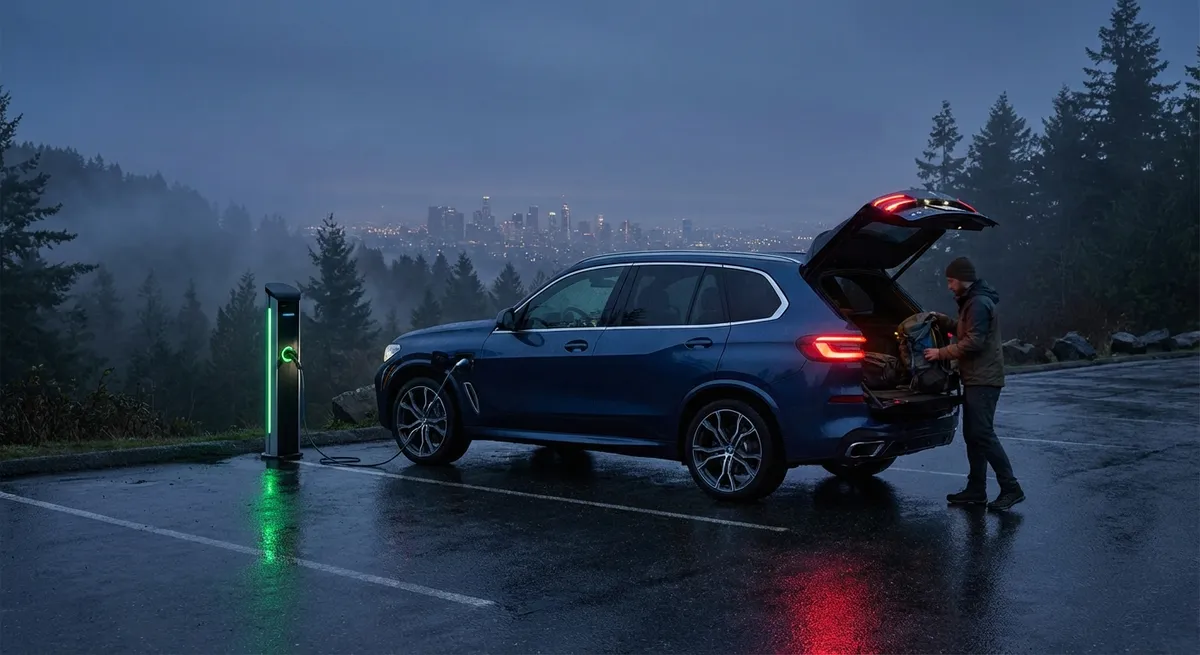
The BMW X5 has long been a benchmark for midsize luxury SUVs, and the 2025 X5 xDrive50e plug-in hybrid sharpens that reputation with more power, more electric range, and more tech. For shoppers deciding between a traditional gas SUV and a fully electric model, this plug-in hybrid lands squarely in the “best of both worlds” zone—on paper. In practice, the story is more nuanced. This review digs into how the 50e actually performs in the real world, where its engineering shines, and where buyers should think carefully before signing on the dotted line.
Powertrain and Performance: Where the Numbers Really Count
Under the hood, the 2025 X5 xDrive50e pairs a 3.0-liter turbocharged inline-six (BMW’s B58 engine) with an integrated electric motor and a high-voltage battery. System output is an impressive 483 hp and 516 lb-ft of torque, routed through an 8-speed automatic to all four wheels. That makes it significantly more potent than the previous 45e and meaningfully stronger than the conventional X5 xDrive40i.
BMW claims a 0–60 mph time in the low 4-second range, which feels believable on the road. The electric motor fills in torque instantly off the line, smoothing over any turbo lag and delivering a linear, confident surge. Passing at highway speeds is effortless; a gentle prod of the throttle is enough to slingshot from 60 to 80 mph, which will appeal to drivers who value brisk, drama-free overtakes.
The powertrain’s refinement is one of its standout traits. Transitions between EV-only and hybrid operation are well controlled, especially in the default Hybrid mode. The inline-six remains one of the smoothest engines in the class, and while it can be heard under heavy load, it never sounds strained or coarse. For buyers cross-shopping a pure EV, the 50e’s smoothness and instant torque do a good job of narrowing the refinement gap while maintaining the familiar feel of an internal-combustion engine.
Chassis tuning leans toward the sporty side for the segment, particularly if equipped with the optional adaptive M suspension. Turn-in is sharper than you’d expect in a 5,600+ lb SUV, and body roll is contained without feeling harsh over broken pavement. Steering is light but accurate, with more precision than true feedback. Enthusiasts won’t confuse the X5 for an M3, but among midsize luxury SUVs, the 50e stands out as one of the more engaging options without sacrificing daily comfort.
Electric Range, Efficiency, and Everyday Charging Reality
A key reason to consider the xDrive50e over other X5 variants is its improved plug-in hybrid system. BMW fits a battery pack with a usable capacity of roughly 25.7 kWh, more than doubling the previous generation’s usable energy. According to BMW and EPA estimates, the 2025 model delivers an all-electric range in the 35–40 mile ballpark (final numbers can vary slightly by wheel size and configuration).
In practical terms, this means many owners can complete daily commutes and local errands without using any gasoline, as long as they plug in regularly. Around-town efficiency can rival or even beat some dedicated EVs if you have consistent access to Level 2 charging at home or work. When the battery is depleted, the vehicle transitions to conventional hybrid operation, typically delivering combined fuel economy in the high 20s mpg, depending on driving style and conditions.
Charging hardware is straightforward but not cutting-edge. The X5 xDrive50e supports AC charging up to 7.4 kW, which on a 240V Level 2 outlet typically equates to about 3–4 hours from low state-of-charge to full. There is no DC fast-charging capability, which is important for buyers to understand—this is not a vehicle designed for high-speed public charging on road trips. On long journeys, it operates primarily as an efficient gasoline-hybrid SUV rather than an EV you “quick charge.”
For prospective owners, the real value comes from integrating charging into a daily routine. Those who can reliably plug in overnight will see meaningful fuel savings and a quieter, emissions-free drive most days. Those without regular charging access will still benefit from strong performance and hybrid efficiency, but they may be better served by the simpler and less expensive X5 xDrive40i.
Interior, Technology, and User Experience
Inside, the 2025 X5 xDrive50e delivers the expected BMW mix of understated luxury and tech-forward design. Materials are top-tier: soft-touch surfaces, real metal trim, and high-quality leathers or synthetic alternatives. Fit and finish are excellent, and the X5’s cabin remains one of the more solid, rattle-free environments in the segment, even over poor road surfaces.
The centerpiece is BMW’s Curved Display—a 12.3-inch digital instrument cluster paired with a 14.9-inch central touchscreen, all running BMW Operating System 8.5. Graphics are crisp, and animations are fluid. The interface is fast, but the learning curve can be steep for first-time BMW owners. Many frequently accessed functions, including climate controls and drive modes, are now nested in touchscreen menus, which can be less intuitive while driving than traditional physical buttons.
On the plus side, the system supports over-the-air software updates, wireless Apple CarPlay and Android Auto, cloud-based navigation, and an optional head-up display. Voice control, activated by “Hey BMW,” is more responsive than past iterations and can handle tasks like navigation input, temperature adjustments, and media selection with decent reliability.
The plug-in hybrid components are well-integrated into the cabin experience. Dedicated menus display energy flow, EV range, and charge status, and you can select drive modes like Hybrid, Electric, and Battery Hold. In Electric mode, the cabin becomes impressively quiet at city speeds, enhancing the perception of luxury. The only minor downside is that some buyers may find the number of selectable modes and settings overwhelming at first; it pays to spend time customizing profiles and getting familiar with the primary configurations you’ll actually use.
Overall, tech-focused shoppers will find the X5 50e competitive with other German luxury SUVs, though those who prefer a simpler, more button-heavy layout may gravitate toward rivals like the Lexus RX.
Practicality, Space, and Ride Comfort
Despite its electrified hardware, the X5 xDrive50e remains a highly functional family SUV. Seating is standard for five; the plug-in hybrid model does not offer the optional third row available on some other X5 variants. Front seats are supportive and widely adjustable, with available multi-contour designs, ventilation, and massage depending on trim and packages. Rear-seat space is generous for two adults, with enough legroom and headroom for tall passengers, though the center seat remains best suited to shorter trips.
The battery pack is packaged under the floor and does slightly impact cargo capacity versus non-hybrid X5 models. However, the difference is modest, and the load space remains wide and useable, with enough room for multiple suitcases, strollers, or sports gear. The signature split tailgate (top section lifts, bottom section folds down) is still present, making loading bulky items easier and providing a convenient seating or loading surface.
Ride comfort is a strong point. With the standard suspension tuning, the X5 50e soaks up potholes and expansion joints with composure, even on 20-inch and 21-inch wheels. Optional air suspension (availability can vary by market) adds another layer of compliance and allows for adjustable ride height, which can be useful for driveway ramps or mild off-pavement use. Road and wind noise are well suppressed, and when operating in EV mode around town, cabin serenity rivals some flagship sedans.
Towing capacity, an often-overlooked aspect of plug-in hybrids, remains competitive. Properly equipped, the X5 xDrive50e can tow up to around 5,952–7,200 lbs (market- and configuration-dependent), which covers small to medium campers, boats, and utility trailers. For buyers who need serious towing muscle on a regular basis, a diesel or full-size SUV might still be preferable, but the 50e is capable enough for most recreational needs.
For families, the key considerations are straightforward: if you don’t need a third row and you appreciate a refined but responsive ride, the 50e ticks a lot of boxes, with the added benefit of low-emission commuting when plugged in.
Value, Ownership Costs, and Who This SUV Suits Best
Pricing for the 2025 BMW X5 xDrive50e positions it above the X5 xDrive40i but below the V8-powered M60i. As a plug-in hybrid, it may qualify for certain federal, state, or local incentives depending on market and evolving regulations, though U.S. federal tax credit eligibility can change frequently and may hinge on final assembly and battery sourcing. Buyers should verify current incentives through official government channels before purchase.
From an ownership-cost perspective, the X5 50e’s sweet spot is for drivers who:
- Have reliable access to overnight Level 2 charging
- Drive frequent short to medium daily distances (e.g., 15–40 miles)
- Take occasional longer trips where gasoline-hybrid mode is acceptable
In that use case, fuel savings compared to a pure gasoline SUV can be substantial over several years, particularly with high fuel prices. Maintenance requirements are broadly similar to a conventional X5, though there is additional high-voltage hardware. BMW typically offers warranties for hybrid components that exceed the standard powertrain coverage, and in many regions, the battery is covered up to 8 years or 100,000+ miles (exact terms are region-specific).
Depreciation is a more complex topic. Plug-in hybrids generally sit between gasoline models and full EVs in terms of resale predictability. Some buyers are wary of older high-voltage batteries, while others value the flexibility of PHEVs as charging infrastructure and regulations evolve. BMW’s strong brand reputation and the X5’s longstanding popularity should help buoy residual values, but shoppers should expect typical luxury-SUV depreciation patterns rather than rock-bottom cost per mile.
The 2025 X5 xDrive50e is best suited to:
- Tech-focused buyers who want an electrified driving experience without committing to full EV infrastructure.
- Drivers who value strong performance and refined dynamics but also care about reducing fuel consumption and emissions.
- Families needing two solid seating rows, ample cargo space, and strong safety and driver-assistance tech, but not a third row.
Those who can’t charge regularly, prioritize cabin simplicity over tech, or require maximum towing/third-row capacity may find better fits elsewhere in the segment.
Conclusion
The 2025 BMW X5 xDrive50e is a compelling answer to a very modern question: how do you blend performance, luxury, and meaningful electrification without accepting the compromises of early charging networks or pure-EV range anxiety? BMW’s approach—pairing a potent inline-six with a sizable battery and polished software—delivers a driving experience that feels both familiar and future-ready.
It’s not the cheapest way to move a family of five, nor the simplest SUV to understand at a glance. But for buyers willing to engage with its plug-in capabilities, the X5 50e can be quiet, efficient, and emissions-free for most daily miles, then effortlessly transform into a long-haul cruiser for weekends away. If your lifestyle and charging situation match its strengths, the 2025 X5 xDrive50e should sit high on your midsize luxury SUV shortlist.
Sources
- BMW USA – 2025 BMW X5 Plug-in Hybrid (xDrive50e) Specifications - Official powertrain, range, and feature information from BMW
- U.S. Department of Energy – Fueleconomy.gov Plug-in Hybrid Vehicles - Technical overview of plug-in hybrid operation, efficiency, and charging
- EPA – Green Vehicle Guide - Federal data and guidance on emissions, fuel economy, and vehicle classifications
- IIHS – Midsize Luxury SUV Safety Ratings - Independent crash-test and safety rating information for comparable SUVs
- J.D. Power – 2024 BMW X5 Quality and Reliability Ratings - Owner-reported reliability, quality, and satisfaction data relevant to X5 buyers
Key Takeaway
The most important thing to remember from this article is that this information can change how you think about Reviews.