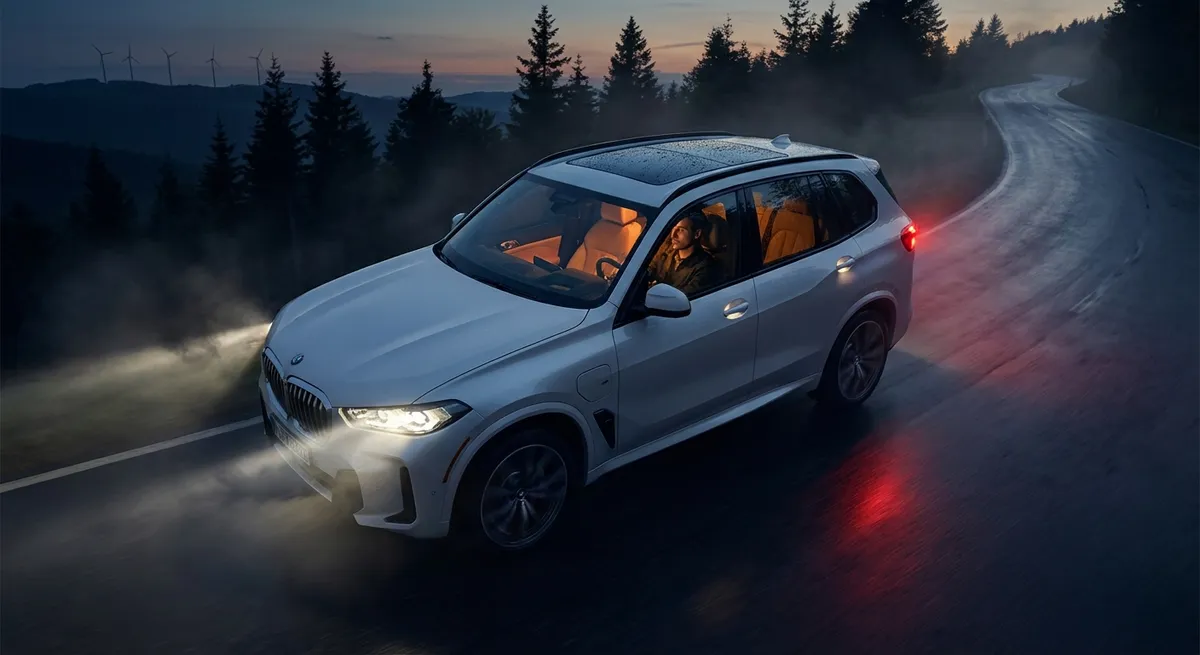
BMW’s latest plug-in hybrid SUV, the 2025 X5 xDrive50e, arrives at a moment when buyers want efficiency without sacrificing performance or luxury. Positioned between the conventional six‑cylinder xDrive40i and the high-performance V8 M60i, the 50e aims to deliver electric commuting, long‑range touring, and classic BMW dynamics in one package. This review dives into how well it delivers in the real world, beyond the brochure numbers.
Powertrain and Performance: Straight-Line Pace with Subtle EV Sophistication
Under the hood, the X5 xDrive50e pairs a 3.0‑liter turbocharged inline‑six (B58) with a single integrated electric motor and a 25.7 kWh (usable) lithium‑ion battery pack. System output is rated at approximately 483 hp and 516 lb‑ft of torque, routed through an updated ZF 8‑speed automatic to BMW’s rear-biased xDrive all-wheel drive system.
On paper, the 0–60 mph time of about 4.6 seconds places the 50e firmly in “fast SUV” territory, essentially matching many previous‑generation performance models. What’s notable in real-world driving is how much of that performance is immediately accessible at part throttle thanks to the electric motor’s instant torque, especially in the 20–50 mph range where highway merges and passing maneuvers happen. There’s no waiting for downshifts; the e‑motor fills in the torque curve before the turbocharged six even needs to build boost.
The calibration between combustion and electric propulsion is one of this SUV’s strengths. In Hybrid mode, the transition between electric and gasoline power is generally seamless; you’ll sense the engine coming online more from the sound than from any driveline vibration. The only time the powertrain feels slightly busy is under sustained heavy load in hilly terrain, where the system juggles battery state of charge, engine output, and regeneration. Even then, the result is strong, consistent thrust rather than the rubber-band feel some PHEVs exhibit.
Enthusiasts will appreciate that Sport mode doesn’t just sharpen throttle response; it also increases the baseline engine contribution and keeps the battery buffer higher to deliver repeatable accelerations. Paddle‑shift control over the 8‑speed auto remains one of the segment benchmarks, with quick, clean shifts and intelligent downshift logic under braking.
Ride, Handling, and Braking: Balancing Mass with Chassis Intelligence
Even with the added weight of the high-voltage battery pack (roughly 700+ lbs versus a comparable non‑plug‑in variant), the X5 xDrive50e feels more athletic than its curb weight suggests. The battery is mounted low and centrally within the chassis, which improves the SUV’s center of gravity and mitigates some of the mass penalty in quick transitions.
Equipped with the optional adaptive air suspension and active damper control, the 50e can switch from relaxed long‑distance cruiser to respectful back‑road performer. In Comfort mode, body motions are well-controlled without the float or secondary bounce that can plague some air‑suspended rivals. The system softens sharp edges over broken pavement but never feels overly soft or vague.
Switch to Sport mode and the suspension lowers slightly, the dampers firm up, and the steering gains noticeable heft. While you’re always aware that you’re piloting a mid-size luxury SUV, turn‑in is crisp, and mid‑corner composure is impressive given the vehicle’s height and weight. Front-end grip is strong, helped by the rear-biased xDrive calibration that allows the SUV to rotate naturally instead of pushing into understeer at the first hint of speed.
Braking performance is where plug‑in hybrids often stumble because of the blending between regenerative braking and friction brakes. BMW’s tuning in the 50e is among the better executions: the pedal has a progressive, predictable feel once you acclimate. The initial few millimeters of pedal travel are mostly regen, and under harder braking the friction brakes join seamlessly. For buyers coming from non‑electrified SUVs, the learning curve is minimal, and the payoff is significant energy recovery in city driving.
Electric Range, Charging, and Real-World Efficiency
BMW quotes an electric-only range in the 35–40 mile ballpark under EPA methodology, depending on wheel and tire configuration. In mixed real‑world driving—suburban traffic, some highway, climate control in normal use—that range is generally achievable if you don’t drive aggressively. Around-town commuters with daily round trips under 30 miles can realistically operate in near‑EV mode most weekdays, only waking the engine for longer trips.
The onboard AC charger supports up to 7.4 kW, which means a typical 240V Level 2 home charger can replenish the battery from roughly 0–100% in about 3–4 hours. There is no DC fast‑charging capability, which aligns with how most PHEV owners actually charge: at home or work, not at public fast chargers. Unlike a full battery electric SUV, the 50e is indifferent to long-distance planning—once the battery is depleted, it behaves like a powerful, efficient gasoline hybrid.
In Hybrid mode with regular overnight charging, many owners can see gasoline consumption well beyond 50 MPGe in city‑heavy usage. On long highway journeys with a depleted battery, expect fuel economy closer to a mid‑20s mpg figure, similar to a well‑tuned six‑cylinder luxury SUV. The takeaway for prospective buyers: you only unlock the platform’s full efficiency potential if you commit to regular charging. Treat it purely as a gas SUV and you’re essentially paying extra for performance and low‑speed refinement rather than fuel savings.
For colder climates, be aware that winter conditions reduce electric range due to cabin heating demands and lower battery efficiency. However, the gasoline engine’s ability to provide waste heat means comfort is never compromised; the effect is primarily seen in how soon the engine starts and how far you can drive in EV mode.
Interior, Technology, and Everyday Usability
The 2025 X5 xDrive50e adopts BMW’s latest interior design language: a curved dual‑screen layout (instrument cluster and central display), minimal physical buttons, and a strong emphasis on digital configurability. Material quality is appropriately premium—soft-touch surfaces where they should be, available open‑pore wood or metal trim, and high-grade leather or leather‑like upholstery, depending on spec.
Front-seat comfort is a standout. Multi‑way adjustable seats with available ventilation and massage functions make long days behind the wheel genuinely easy. The driving position is more “crossover” than old‑school SUV—reassuringly elevated but not truck-like—and visibility to the front and sides is excellent. The thick rear pillars and sloping rear glass mean you’ll rely on the excellent camera systems for tight parking maneuvers, but that’s true across this class.
Second-row space is generous for adults, with ample legroom and headroom even with the optional panoramic roof. BMW no longer offers a third-row seat on the plug‑in hybrid X5 in many markets, and that’s a key consideration for larger families. The advantage is an uncompromised second row and a flat, well-shaped cargo area. The luggage compartment remains competitive in volume, as the battery is packaged below the floor; only underfloor storage is slightly reduced versus non‑PHEV models.
BMW’s iDrive 8‑series software remains feature-rich but polarizing. The learning curve is steeper than some rivals due to the density of menus and settings, yet once configured, the system is powerful. Wireless Apple CarPlay and Android Auto are standard, over‑the‑air updates are supported, and the available head‑up display is crisp with clear navigation prompts. Enthusiast drivers may appreciate customizable drive mode presets that tie together powertrain response, suspension, steering, and even brake regeneration behavior.
Practical touches include a split tailgate (upper glass and lower section), which still makes loading heavy items easier, multiple USB‑C ports throughout the cabin, and a solid suite of storage cubbies. For daily family use—school runs, Costco trips, weekend outings—the X5 50e feels every inch a versatile premium SUV rather than a science experiment.
Safety, Driver Assistance, and Ownership Considerations
From a safety standpoint, the X5 xDrive50e benefits from the same basic crash structure and engineering as the rest of the X5 lineup, which has historically performed well in both U.S. and European testing. While specific 2025 PHEV variant ratings may lag behind in publication, prospective buyers can look to the broader X5 range’s strong results for a realistic expectation of occupant protection.
Standard active safety equipment typically includes forward collision warning with automatic emergency braking, lane departure warning, blind-spot monitoring, and rear cross‑traffic alert. The available Driving Assistance Professional Package adds adaptive cruise control with stop‑and‑go, lane‑keeping assist, and more advanced highway driving aids. In practice, BMW’s lane-centering is competent but more conservative than some of the most assertive systems on the market: it tends to hug lanes carefully and disengages readily when the driver resists steering input.
Ownership of a plug‑in hybrid SUV brings specific considerations. Battery warranty coverage—often 8 years/80,000–100,000 miles depending on market and regulations—protects against major high-voltage failures, which should reassure buyers worried about long‑term durability. Routine maintenance for the combustion engine (oil changes, filters, coolant, brake fluid) remains, but brake wear can be reduced thanks to frequent regenerative deceleration, especially in urban use.
Resale value for PHEVs has historically trailed conventional models in some segments due to shifting technology and consumer preferences. However, in a regulatory environment increasingly favoring low‑emissions vehicles, well‑equipped PHEV SUVs like the X5 50e may remain attractive to second‑hand buyers who want EV experience without charging‑infrastructure anxiety. The key factors likely to impact future value are battery health, documented maintenance, and the presence of desirable options like advanced driver assistance, upgraded audio, and premium seating packages.
For shoppers cross‑shopping full EV SUVs, the X5 xDrive50e occupies a clear niche: it offers meaningful electric range for daily life, traditional long‑distance flexibility, and engaging driving dynamics. For those not yet ready to commit to a full battery electric vehicle—or who regularly drive in regions with sparse charging networks—it represents a sophisticated, high‑performance compromise.
Conclusion
The 2025 BMW X5 xDrive50e demonstrates how far plug‑in hybrid SUVs have advanced: it delivers strong real‑world performance, useful electric range, and the comfort and refinement expected of a premium mid‑size utility vehicle. Its dynamic capabilities largely overcome the weight penalty of electrification, and its cabin quality and technology remain competitive at the top end of the segment.
It is not the right answer for everyone. Buyers who never plug in will miss its main efficiency advantage, and those needing three rows may need to look elsewhere. But for drivers who can charge at home, value genuine highway pace, and want an SUV that feels as adept on back roads as it does in daily commuting, the X5 xDrive50e stands out as one of the most compelling plug‑in hybrid SUVs on the market today.
Sources
- BMW USA – 2025 BMW X5 Plug-in Hybrid (xDrive50e) Specifications – Official manufacturer data on powertrain, range, equipment, and charging
- U.S. Department of Energy – Fueleconomy.gov: Plug‑in Hybrid Electric Vehicles – Explains how PHEVs work, efficiency metrics, and real‑world usage considerations
- IIHS – BMW X5 Crashworthiness and Safety Ratings – Independent safety evaluations for the current-generation X5 platform
- EPA – Green Vehicle Guide: Understanding MPGe and Range – Context on EV/PHEV efficiency measurements and what they mean for owners
- National Renewable Energy Laboratory (NREL) – PHEV Charging Behavior and Impacts – Research on how plug‑in hybrid owners charge and the implications for fuel use and emissions
Key Takeaway
The most important thing to remember from this article is that this information can change how you think about Reviews.