The 2025 BMW X5 xDrive50e plug-in hybrid enters a fiercely competitive luxury SUV field with a sharpened design, a major tech overhaul, and a significantly upgraded electrified powertrain. For buyers who want authentic performance, day-to-day usability, and genuine fuel savings without going full EV, this is one of the most technically intriguing SUVs on sale. This review dives deep into how it drives, how far it really goes on electricity, what the cabin is like to live with, and where it stands against rivals.
Powertrain & Performance: Where Hybrid Meets Highway Muscle
The heart of the 2025 X5 xDrive50e is a seriously revised plug-in hybrid system that blends traditional BMW muscle with modern efficiency. Under the hood sits a 3.0-liter turbocharged inline-six (B58 family) paired with an updated electric motor integrated into the 8-speed automatic transmission. Combined output is rated at around 483 hp and 516 lb-ft of torque, noticeably stronger than the previous-generation plug-in X5.
Acceleration is brisk, with BMW quoting approximately 4.6 seconds from 0–60 mph—numbers that put this plug-in SUV near the pace of older V8-powered performance models. The torque-rich electric assistance fills in any low-rpm gaps from the turbocharged engine, so passing at highway speeds is immediate and largely drama-free. Enthusiasts will appreciate that the xDrive all-wheel-drive system maintains a rear-biased feel when pushed, preserving a hint of BMW’s classic driving dynamics despite the vehicle’s size and weight.
Regenerative braking is well-calibrated for daily use. BMW avoids the ultra-aggressive single-pedal style some EVs favor; instead, the brake pedal feel is consistent and progressive, making it easier for drivers transitioning from conventional SUVs. The adaptive suspension system and optional air suspension allow the X5 to juggle firm, controlled handling in Sport mode with a surprisingly plush, composed ride in Comfort. The steering is precise if somewhat filtered, with variable weighting but limited road feedback—typical of modern luxury SUVs but still better executed than many rivals.
For towing and utility-minded buyers, the xDrive50e retains meaningful capability. Properly equipped, towing capacity can reach up to approximately 5,952 lbs (depending on market and configuration), adequate for small boats, track toys, or a compact camper. The hybrid system’s instant torque is beneficial when merging or climbing grades with a trailer, though repeated heavy towing will naturally favor hybrid operation over pure EV mode.
Electric Range, Efficiency & Real-World Usability
The most significant upgrade over the previous plug-in X5 lies in the battery and electric drive capability. BMW fits a larger lithium-ion battery pack with a usable capacity around 25.7 kWh, which nearly doubles the all-electric range versus the outgoing X5 PHEV. Officially, the 2025 X5 xDrive50e is rated for roughly 40–40+ miles of electric-only range (EPA figures may vary slightly by wheel size and spec), making true EV commuting practical for many owners.
In moderate driving, especially in urban and suburban environments, that range is realistic. Light throttle input, smart use of Eco Pro mode, and preconditioning the cabin while plugged in can routinely keep energy consumption within an efficient band. In colder climates or at higher highway speeds, expect a notable drop in EV range—more like 25–30 miles in winter on fast highways, which is consistent with how temperature and aerodynamics impact all plug-in hybrids and EVs.
Once the battery is depleted, the X5 reverts to operating as a traditional hybrid, using its gasoline engine and smaller battery buffer to improve efficiency. Real-world combined consumption in hybrid mode will vary, but many owners can see fuel economy figures comfortably ahead of a comparable non-hybrid X5, particularly in stop-and-go conditions where regeneration plays a larger role. For drivers who can plug in at home and/or at work, total fuel consumption over a week can be dramatically lower than conventional luxury SUVs, even with occasional longer trips.
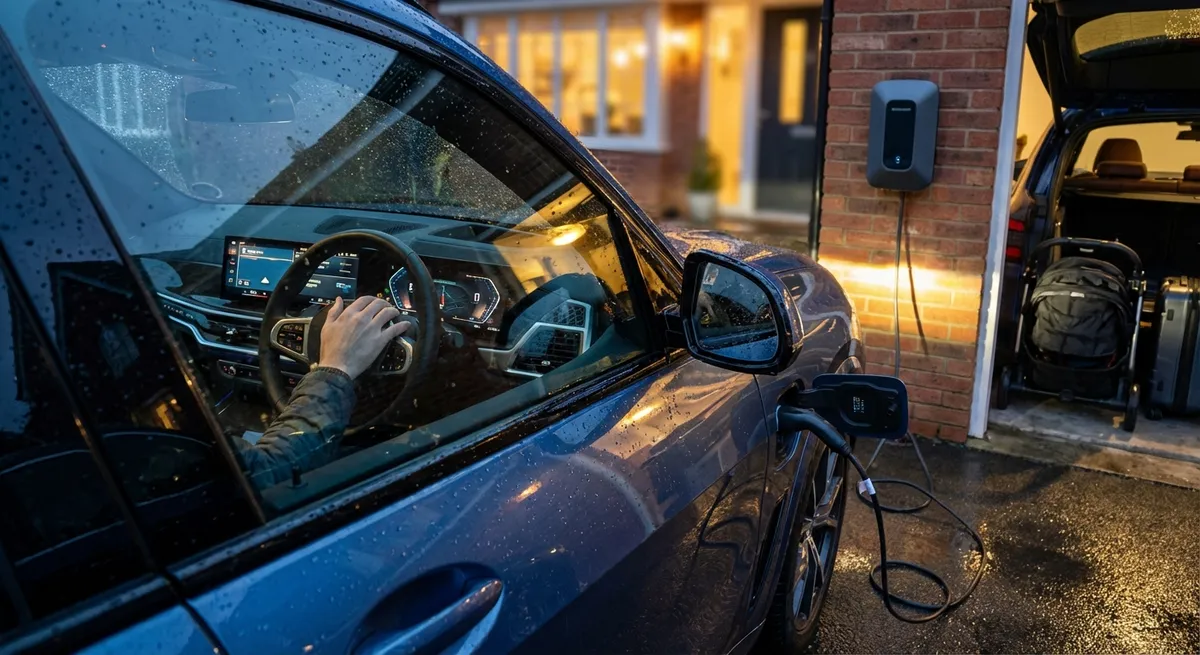
Charging is handled via an onboard AC charger—up to 7.4 kW in many markets. On a typical 240V Level 2 home charger, a full charge from near empty generally takes around 3–4 hours, making it easy to recharge overnight or during part of the workday. There is no DC fast-charging capability, which is standard for plug-in hybrids; the intent is regular overnight charging rather than road-trip-style quick top-ups. For many buyers, the X5 xDrive50e functions as an EV Monday through Friday and a long-range hybrid SUV on weekends, which is arguably the sweet spot for today’s infrastructure.
Interior, Tech & Infotainment: A Digital-Forward Luxury Cabin
Inside, the 2025 X5 xDrive50e showcases BMW’s latest cabin design philosophy: a blend of clean lines, high-quality materials, and a strong emphasis on digital interfaces. Front and center is the curved dual-screen setup—typically a 12.3-inch digital instrument cluster paired with a 14.9-inch central touchscreen running BMW Operating System 8.5 (or similar version depending on launch timing). The screens are crisp, bright, and highly configurable, with multiple layout options for performance data, maps, and hybrid system information.
The infotainment system is powerful and feature-rich but can be complex at first contact. Navigation integrates real-time traffic, online search, and EV-centric features like charging station locations and route planning that accounts for electric range. Wireless Apple CarPlay and Android Auto are standard in most markets, and BMW’s voice assistant (“Hey BMW”) has matured, allowing natural language commands for navigation, climate, and some vehicle settings.
Physically, the cabin materials feel appropriate for the segment: soft-touch surfaces, optional open-pore wood, metal accents, and, on higher trims, crystal-style controls. Seat comfort is excellent, with multi-contour adjustments and available ventilation and massage features. The driving position is high yet car-like, providing a commanding view without feeling like a truck. Rear passengers benefit from generous legroom and headroom, and the flat-ish rear floor improves middle-seat comfort.
Cargo space remains one of the X5’s strengths, even with the hybrid hardware. The battery pack is packaged to preserve a nearly flat load floor, though total volume is slightly less than purely combustion-powered variants. The split tailgate (where fitted) is a clever touch for loading heavy items or sitting at a tailgate event. Interior storage is well thought-out, with large door pockets, a useful center console, and dedicated places for smartphones and key fobs, including available wireless charging.
For tech-minded buyers, options such as the head-up display, Harman Kardon or Bowers & Wilkins premium audio, and ambient interior lighting add to the sense of sophistication. However, prospective owners should be prepared for some learning curve as more traditional buttons and knobs give way to touchscreen menus and haptic controls—a shift that may not appeal to every driver.
Safety, Driver Assistance & Everyday Confidence
The 2025 BMW X5 xDrive50e arrives with a comprehensive suite of standard and available safety and driver-assistance technologies designed to reduce fatigue and enhance confidence in daily driving. Core features typically include forward collision warning with automatic emergency braking, lane departure warning, blind-spot monitoring, rear cross-traffic alert, and parking sensors. Many markets also offer a standard backup camera and optional 360-degree surround-view system with 3D visualization, which is especially helpful given the X5’s size.
Moving up the options ladder, the available Driving Assistance Professional Package (name varies by region) can add adaptive cruise control with stop-and-go functionality, lane-keeping assist, traffic jam assist, and automatic lane change capabilities on certain highways. These semi-automated features don’t turn the X5 into a self-driving SUV, but when used responsibly, they reduce fatigue during long commutes and congested traffic. BMW’s implementation tends to be assertive yet smooth, with well-calibrated lane centering that avoids the ping-pong effect found in some rivals.
The plug-in hybrid system also interacts intelligently with the navigation and driver-assistance systems. For instance, predictive energy management can adjust the blend of electric and combustion power based on route topography, speed limits, and even upcoming low-emission zones in certain markets. This ensures that electric range is preserved for city centers where it is most beneficial, while the gasoline engine assists on faster rural or highway sections where it is more efficient.
Crash-test ratings for the refreshed X5 line have historically been strong, with prior model years earning top marks from bodies such as the IIHS and Euro NCAP. While official ratings for every configuration of the 2025 xDrive50e may still be pending at the time of writing, the structural design, multiple airbags, and active safety systems suggest it will remain competitive in occupant protection and crash avoidance metrics.
For families, the X5 offers well-designed LATCH anchor points, wide-opening rear doors, and sufficient rear headroom to accommodate child seats without compromising front passenger comfort. The available night vision system (on some markets) and advanced adaptive LED or laser headlights enhance visibility in low-light conditions, contributing to overall safety, particularly in rural or poorly lit areas.
Ownership Experience, Costs & Who This SUV Really Suits
Beyond the spec sheet, the 2025 BMW X5 xDrive50e’s value proposition depends heavily on the buyer’s usage pattern. For drivers who can plug in regularly and whose daily commute falls within the 30–40-mile EV window, this SUV can function primarily as an electric vehicle during the workweek, significantly cutting fuel costs and local emissions. Occasional long trips are still hassle-free, thanks to a conventional fuel tank and nationwide gas infrastructure—no dependency on high-speed charging networks.
Upfront pricing will be higher than a non-hybrid X5 equivalent, and the plug-in system adds complexity that may influence long-term maintenance considerations. However, BMW’s warranty coverage for high-voltage components (often around 8 years / 80,000–100,000 miles in many markets) provides reassurance. In some regions, buyers may also qualify for tax incentives or rebates for plug-in hybrids, further improving the financial case.
Routine maintenance largely mirrors other BMW models—oil changes, filters, brake service, and software updates—but regenerative braking can extend pad and rotor life in mixed driving. Electricity costs vs. gasoline prices are a crucial factor; in areas with affordable residential electricity and high fuel prices, the xDrive50e’s cost advantage over time can be substantial. Those with access to workplace or public Level 2 charging benefit even more.
From a lifestyle perspective, the X5 xDrive50e best suits buyers who want:
- A genuinely quick, refined luxury SUV with near-silent EV capability for short trips.
- Premium cabin quality and advanced tech without stepping into full EV territory.
- Flexibility to tow, road trip, or tackle winter conditions with AWD confidence.
- A stepping stone toward electrification that doesn’t require adapting to DC fast-charging infrastructure.
Enthusiasts who prioritize raw exhaust sound and steering feel may still gravitate toward performance-oriented combustion or M-badged models, and buyers seeking maximum cargo or three-row flexibility may look instead at larger SUVs. But for many, the xDrive50e hits a nuanced balance between performance, efficiency, and everyday practicality that few competitors match as effectively.
Conclusion
The 2025 BMW X5 xDrive50e stands out in the luxury SUV segment by offering serious performance, a much-improved electric range, and a highly digital, comfortable interior—without forcing buyers to abandon the convenience of a gasoline engine. Its plug-in hybrid system is no longer a niche add-on; it’s central to the vehicle’s character, allowing it to operate as an EV for many trips yet still behave like a traditional BMW SUV on long journeys.
For car enthusiasts, the xDrive50e’s strong powertrain, composed chassis, and smart integration of hybrid tech make it a compelling alternative to both conventional luxury SUVs and fully electric options. For practical buyers, its combination of efficiency, space, safety, and usability delivers a well-rounded package that fits real-world needs. If your lifestyle aligns with regular charging and you want one vehicle that can credibly do it all—from quiet electric commuting to spirited mountain drives—the 2025 X5 xDrive50e deserves a spot at the top of your test-drive list.
Sources
- [BMW USA – 2025 BMW X5 Overview](https://www.bmwusa.com/vehicles/x-models/x5/sports-activity-vehicle/overview.html) – Official specifications, powertrain details, and feature highlights for the latest X5 lineup
- [BMW Group Global – BMW X5 Plug-in Hybrid Technical Information](https://www.bmwgroup.com/en.html) – Corporate site with press releases and technical data on BMW’s electrified drivetrains
- [U.S. Department of Energy – Fueleconomy.gov Plug-in Hybrid Basics](https://www.fueleconomy.gov/feg/phevtech.shtml) – Explanation of plug-in hybrid technology, charging, and efficiency considerations
- [Insurance Institute for Highway Safety (IIHS) – BMW X5 Ratings](https://www.iihs.org/ratings/by-make/bmw/x5) – Safety ratings, crash-test results, and safety equipment information for the X5
- [EPA – Green Vehicle Guide](https://www.epa.gov/greenvehicles) – Background on emissions, EV and PHEV efficiency metrics, and regulatory context for electrified vehicles
Key Takeaway
The most important thing to remember from this article is that this information can change how you think about Reviews.