The 2025 BMW X5 xDrive50e lands squarely in the middle of one of the most competitive luxury SUV segments, but it brings a compelling mix of plug-in efficiency, real performance, and high-end comfort. Positioned between conventional gasoline crossovers and full EVs, this plug-in hybrid SUV appeals to buyers who want electric commuting without giving up long-trip flexibility. For enthusiasts and practical shoppers alike, the xDrive50e raises an important question: is this the most balanced luxury SUV you can buy today?
Powertrain, Performance, and Driving Character
At the core of the 2025 X5 xDrive50e is a sophisticated plug-in hybrid powertrain that pairs a 3.0-liter turbocharged inline-six gasoline engine with an integrated electric motor, all routed through an 8‑speed automatic transmission to BMW’s xDrive all-wheel-drive system. Combined system output is rated at approximately 483 horsepower and 516 lb-ft of torque, placing it well above the base X5 40i and in the same power neighborhood as older V8 models, but with far better efficiency. The result is strong, effortless acceleration that feels linear, with the electric motor filling in torque at low rpm and smoothing out shifts under light to moderate throttle.
Enthusiasts will appreciate the xDrive50e’s chassis tuning, which preserves much of the “BMW feel” despite the added battery mass. Optional adaptive M suspension and rear-axle steering sharpen responses, reducing body roll in corners and making this nearly 5,500‑pound SUV feel far more agile than its curb weight suggests. Steering is precise, if somewhat filtered compared with older hydraulic systems, but still class-leading in accuracy among modern luxury SUVs. Regenerative braking blends seamlessly with the conventional friction brakes in most driving scenarios, though some drivers may notice a slightly nonlinear pedal feel at very low speeds. Overall, the X5 xDrive50e delivers a composed, athletic drive that stands out in a segment increasingly dominated by comfort-first tuning.
Electric Range, Efficiency, and Real-World Use
One of the most appealing aspects of the 2025 xDrive50e is its usable electric-only capability. BMW equips the SUV with a lithium-ion battery pack of roughly 25.7 kWh gross capacity, a significant increase over the previous-generation plug-in X5. This translates to an estimated electric-only range in the neighborhood of 40 miles (EPA rating may vary slightly depending on wheel and tire configuration), which is enough for many commutes and daily errand circuits without ever waking the gasoline engine. For buyers with a home Level 2 charger, the X5 can serve effectively as a “weekday EV” and “weekend road-trip SUV” in one vehicle.
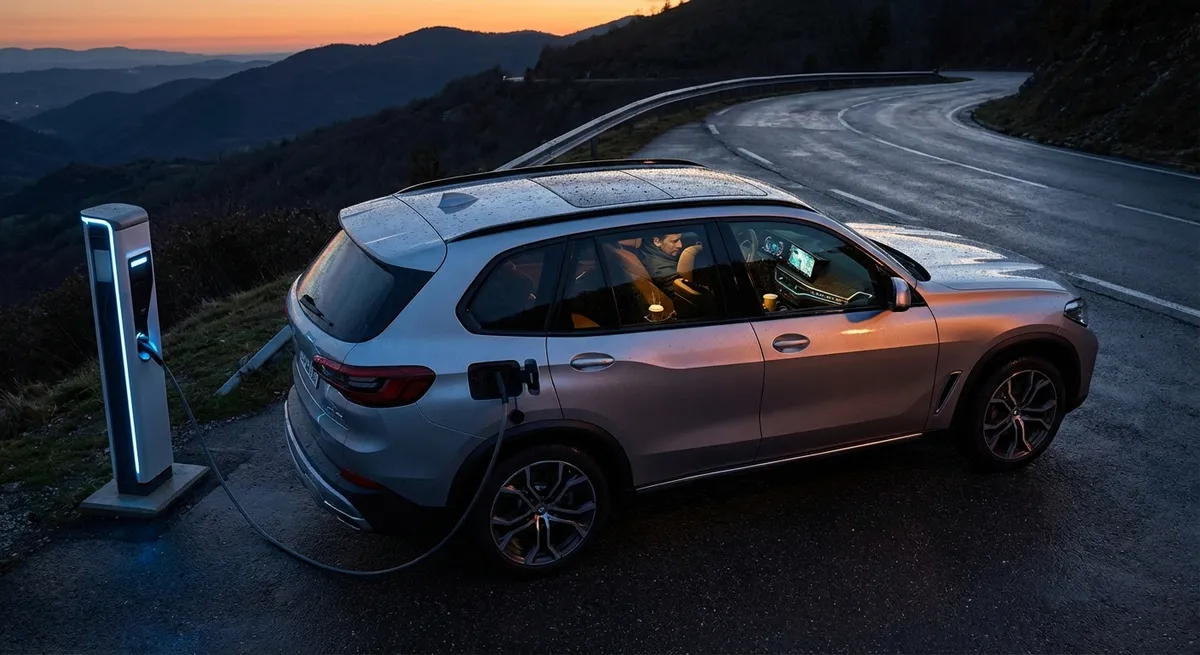
Charging performance is oriented toward overnight home use, not DC fast charging. The onboard AC charger supports up to 7.4 kW, allowing a full recharge from empty in around 3 to 4 hours on a 240‑volt Level 2 connection. On a standard 120‑volt outlet, you should expect a full charge to take well over 10 hours, which may still work for some owners who plug in consistently every evening. When the battery is depleted, the X5 xDrive50e behaves much like a conventional hybrid, using the electric motor to support the gasoline engine and recapturing energy under braking, which helps maintain respectable fuel economy for a midsize luxury SUV. For shoppers cross-shopping full EVs, it’s worth emphasizing that the xDrive50e removes range anxiety on long trips: when the battery runs low, the gas engine simply takes over, and refueling is as quick as any gasoline vehicle.
Interior Design, Space, and Technology Experience
Inside, the 2025 X5 xDrive50e presents a cabin that blends contemporary tech with traditional luxury cues. High-quality materials dominate the touch points, with soft-touch plastics, open-pore wood trims, and available Vernasca or Merino leather upholstery. Fit and finish are excellent, and the overall layout feels driver-focused, with a subtly canted center stack and intuitive switchgear for frequently used functions like drive modes and climate control. Despite the plug-in hardware, passenger space remains generous: front seats offer wide ranges of adjustment and strong lateral support, while rear passengers benefit from ample legroom and headroom, even with the available panoramic glass roof.
The centerpiece of the interior technology experience is BMW’s Curved Display system, which joins a 12.3‑inch digital instrument cluster with a 14.9‑inch central touchscreen under a single sculpted glass pane. Running the latest BMW iDrive 8.5 software, the interface supports natural-language voice commands, over-the-air software updates, and a wide array of customizable widgets. Wireless Apple CarPlay and Android Auto are standard, and the system can integrate driver profiles, navigation, and climate preferences. While the touchscreen-centric design does shift some traditional physical buttons into digital menus, BMW retains enough tactile controls—including a volume knob and shortcut buttons—to avoid the frustration found in some rivals that rely almost entirely on capacitive touch surfaces. Cargo capacity does take a modest hit compared with non-plug-in X5 models due to the battery packaging under the rear floor, but the space remains highly usable with a flat load bay and split-folding rear seats.
Safety, Driver Assistance, and Daily Usability
In keeping with its premium positioning, the 2025 X5 xDrive50e includes a robust suite of standard and available active safety and driver-assistance technologies. Forward collision warning with automatic emergency braking, lane departure warning, blind-spot monitoring, rear cross-traffic alert, and parking sensors are typically standard equipment. Optional packages add more advanced features such as adaptive cruise control with stop-and-go capability, lane-keeping assistance, traffic-jam assist, and a surround-view camera system with 3D visualization, which is particularly helpful when maneuvering this sizeable SUV in tight urban environments or narrow garages.
From a daily usability standpoint, these systems aim to reduce cognitive load rather than take control away from the driver. Adaptive cruise and lane-centering work smoothly on highways, but BMW intentionally tunes them to keep the driver engaged, requiring regular steering input and attention. Some buyers may find the lane-keeping alerts overly conservative on narrow secondary roads; thankfully, most of these systems can be configured or toggled off through the iDrive menus or steering-wheel controls. Visibility is generally good, though the thick rear pillars common to modern SUVs can obscure over-the-shoulder views, making the optional 360‑degree camera and cross-traffic alerts worthwhile upgrades. For families, the rear outboard seats feature well-positioned ISOFIX/LATCH anchor points, and the ride quality—even on larger wheel options—remains compliant enough for long journeys.
Value, Positioning, and Who the X5 xDrive50e Best Suits
The 2025 BMW X5 xDrive50e occupies an interesting space in the luxury SUV market, priced above the gasoline-only X5 40i but below high-performance V8 variants, while costing roughly on par with some fully electric competitors when similarly equipped. The plug-in hybrid system adds complexity and weight, but it also brings the potential for significantly lower running costs for drivers who maximize electric driving and have access to affordable home electricity rates. In regions offering incentives or tax credits for plug-in hybrids, the xDrive50e’s financial equation becomes even more attractive, narrowing or erasing the premium over a comparably equipped non-hybrid SUV.
For potential buyers, the key is realistically assessing driving patterns. Drivers with short, repeatable daily commutes and the ability to charge at home (or work) stand to benefit most; many may complete the majority of weekly miles on electric power alone. Long-distance travelers who frequently tow or drive in remote areas may still prefer a conventional gasoline X5 or a diesel SUV (where available), although the xDrive50e’s hybrid assistance does provide better fuel efficiency on the highway than traditional V6 or V8 rivals. Enthusiasts looking for a blend of real performance, advanced tech, and everyday practicality will find the xDrive50e compelling, particularly if they value the instant torque and smoothness that the electric motor provides. Viewed as a bridge between gasoline and full EV ownership, the 2025 X5 xDrive50e is one of the most well-rounded, future-facing luxury SUVs on sale today.
Conclusion
The 2025 BMW X5 xDrive50e demonstrates how far plug-in hybrid SUVs have evolved from niche experiments into serious contenders for the luxury mainstream. By combining a powerful inline-six engine with a substantial electric motor and meaningful EV range, it offers both enthusiast-grade performance and real-world efficiency. Its refined interior, advanced tech suite, and comprehensive safety features help justify its premium pricing, while its dual personality as an electric commuter and long-distance cruiser broadens its appeal. For buyers not yet ready to commit to a full EV but wanting a step toward electrified driving, the X5 xDrive50e stands out as a sophisticated, well-balanced choice in a crowded segment.
Sources
- [BMW USA – 2025 BMW X5 Plug-in Hybrid (xDrive50e) Overview](https://www.bmwusa.com/vehicles/x-models/x5/sports-activity-vehicle/overview.html) – Official specifications, features, and options from BMW
- [EPA – Fuel Economy Data for Plug-In Hybrid Vehicles](https://www.fueleconomy.gov/feg/phevtech.shtml) – Technical background on PHEV operation, efficiency, and range metrics
- [IIHS – Large Luxury SUVs Crashworthiness and Safety Ratings](https://www.iihs.org/ratings/by-class/large-luxury-suv) – Independent crash test and safety evaluation data for comparable models
- [U.S. Department of Energy – Alternative Fuels Data Center: Charging at Home](https://afdc.energy.gov/fuels/electricity_charging_home.html) – Guidance on home charging requirements and expected charge times
- [Consumer Reports – Guide to Plug-In Hybrid Vehicles](https://www.consumerreports.org/cars/hybrids-evs/guide-to-plug-in-hybrid-vehicles-a9024361740/) – Overview of PHEV benefits, trade-offs, and ownership considerations
Key Takeaway
The most important thing to remember from this article is that this information can change how you think about Reviews.