The 2025 BMW X5 xDrive50e arrives at a pivotal moment for performance SUVs, where buyers want power and efficiency without sacrificing refinement. Sitting between pure ICE bruisers and full EVs, this plug-in hybrid X5 aims to deliver serious pace, long-distance comfort, and credible electric range in a single package. For enthusiasts and pragmatic buyers alike, the question is simple: does the xDrive50e truly feel like the best-balanced X5, or is it a compromise from every angle?
Powertrain and Performance: Where Hybrid Actually Means Faster
The xDrive50e replaces the previous xDrive45e and brings a substantial bump in output. Under the hood is a 3.0-liter turbocharged inline-six (B58 family) paired with an electric motor integrated into the 8-speed ZF automatic transmission. Combined system output is rated at approximately 483 hp and 516 lb-ft of torque, up from around 389 hp in the prior PHEV iteration. All-wheel drive is standard via BMW’s xDrive system, with an electronically controlled multi-plate clutch shuffling torque front-to-rear.
On the road, this translates into brisk acceleration that rivals or beats many V8-powered SUVs in the real world. BMW quotes a 0–60 mph time in the low-4-second range when launch conditions are ideal, largely due to the instant torque from the electric motor filling in any turbo lag. The transition between electric assist and combustion power is impressively seamless, with the only giveaway being a slight growl as the inline-six wakes up under heavier throttle. For daily driving, EV torque at low rpm makes the X5 feel more responsive than a comparable non-hybrid six-cylinder SUV, especially in stop‑and‑go traffic.
The 8-speed automatic remains one of the best in segment, delivering smooth, nearly imperceptible upshifts in Comfort mode and holding gears decisively when Sport mode is engaged. Paddle shifters allow manual control, though the calibration is so well-judged that most drivers will likely leave it in auto. What stands out for enthusiasts is the powertrain’s composure when driven hard: electric and gasoline power work together rather than feeling like separate personalities bolted into one chassis.
Battery, Electric Range, and Real-World Efficiency
The heart of the plug-in system is a significantly larger lithium-ion battery pack compared with previous X5 PHEVs. Gross capacity sits in the mid-20 kWh range (with usable capacity slightly lower), allowing BMW to target electric-only range in the 35–40 mile window under EPA testing, depending on wheel size and configuration. That’s enough for many owners to complete a full day’s commuting without engaging the gasoline engine at all, assuming regular home charging.
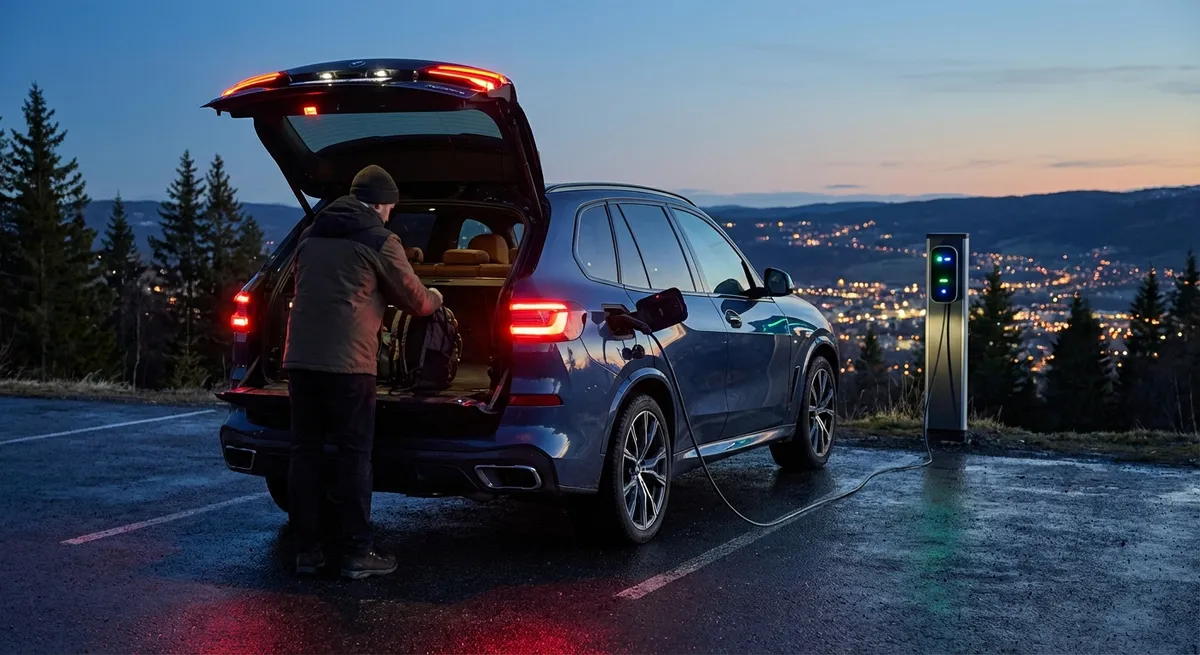
Charging performance is oriented toward overnight replenishment rather than DC fast-charging. The onboard AC charger supports up to around 7.4 kW on a Level 2 home or public charger, enabling a full charge from near empty in about 3–4 hours. On a standard 120V household outlet, owners should anticipate roughly 10–12 hours for a full refill, making it more of a top-off solution than a primary charging strategy. There is no DC fast-charging capability, which is consistent with most current PHEV SUVs.
In hybrid mode, the xDrive50e behaves like a highly efficient six-cylinder luxury SUV. When driven conservatively and charged regularly, many owners can see exceptionally low fuel consumption figures because the gasoline engine runs less often—particularly for short trips. However, once the battery is depleted and the vehicle is running predominantly on gasoline, efficiency aligns more closely with a mild‑hybrid six-cylinder SUV, especially at highway speeds where the electric motor’s contribution is smaller. Enthusiasts who care about long-term operating costs will find that the real efficiency advantage appears only if they plug in consistently and use the EV range as intended.
Chassis Dynamics, Ride Quality, and Off-Pavement Capability
From a driving dynamics perspective, the X5 has long been the benchmark for handling in the midsize luxury SUV segment, and the xDrive50e maintains that reputation. The extra mass from the battery pack is largely contained in the floor, which lowers the center of gravity and helps cornering stability. Depending on configuration, the xDrive50e can be equipped with adaptive dampers and, in some markets, optional air suspension on the rear axle, giving it the ability to switch from compliant ride to firm body control at the press of a button.
On winding roads, the steering is precise and well-weighted by segment standards, though still filtered compared to traditional sports sedans. In Comfort mode, body motions are relaxed but well controlled, ideal for highway touring. Switching to Sport mode tightens the damping, reduces roll, and firms up steering effort, allowing the X5 to be driven with surprising aggression for a nearly 5,500‑pound SUV. Enthusiasts will notice that it never entirely hides its mass, but it masks it better than nearly any direct competitor.
Off pavement, the xDrive50e remains more of a soft-roader than a true overlander. Ground clearance is reasonable for gravel roads, mild trails, and winter conditions, and the xDrive system can smartly apportion torque in low-traction scenarios. However, the lack of low-range gearing, rugged all-terrain tires, and underbody protection in most trims means this is not the X5 you’d choose for sustained rock crawling or deep mud. For most buyers, the capability envelope—snow, unpaved roads to a cabin, light trail work—is perfectly adequate, but serious off-road enthusiasts will want to look to more purpose-built platforms.
Braking performance is strong, with regenerative braking working in concert with friction brakes. The pedal feel is well-tuned, avoiding the vague transition that plagues many hybrids. Regeneration is primarily automatic, adjusting based on driving conditions and selected modes, though it lacks the aggressive “one-pedal” feel of some EVs. For drivers who enjoy spirited descents on mountain roads, the combination of engine braking, regen, and robust friction brakes inspires confidence.
Interior Tech, Space, and Everyday Usability
Inside, the 2025 X5 xDrive50e adopts BMW’s latest iDrive architecture with a curved display spanning the instrument cluster and central infotainment screen. The digital instrument cluster provides hybrid-specific information such as battery state-of-charge, estimated EV range, and power flow diagrams. The central display supports wireless Apple CarPlay and Android Auto, alongside native navigation that can optimize route planning and energy usage, such as preconditioning the battery and cabin for efficiency or comfort.
Material quality is in line with expectations for a premium German SUV: real leather (or high-grade synthetic options, depending on specification), soft-touch surfaces, and genuine metal or wood trim. Ambient lighting and configurable themes add a layer of personalization, while optional features such as massaging front seats, four-zone climate control, and high-end audio (e.g., Bowers & Wilkins in some markets) cater to buyers who treat long drives as a luxury experience.
Critically, the plug-in hybrid packaging has only a modest impact on practicality. The battery sits mostly beneath the floor, so passenger space is comparable to other X5 variants. Cargo volume is slightly reduced versus non-hybrid models due to the placement of the high-voltage components and fuel tank, but the load area remains competitive within the segment and more than sufficient for family use, road trips, and sports gear. The split tailgate design remains a standout feature for loading heavy items and serving as a seat or platform at events.
For daily usability, the X5’s driving position is excellent, with a commanding view of the road and a wide range of seating adjustments. Visibility is generally good, though the rising beltline and thicker rear pillars mean that the standard suite of driver aids (parking sensors, reversing camera, and optional 360° cameras) are invaluable in tight urban environments. Enthusiasts who prize ergonomics will appreciate that, despite the heavy digitization, BMW retains a sensible layout with physical controls for high‑frequency functions like climate and volume, depending on trim and region.
Safety, Driver Assistance, and Ownership Considerations
The 2025 X5 range, including the xDrive50e, is equipped with a robust suite of active and passive safety features. Standard equipment typically includes automated emergency braking with pedestrian detection, lane departure warning, blind-spot monitoring, and a comprehensive array of airbags. Optional packages can add adaptive cruise control with stop-and-go, lane-keeping assist, traffic jam assist, and advanced parking functions that can store and repeat parking maneuvers in confined spaces.
From a structural standpoint, the X5 platform has performed well in crash testing historically, with strong results from both the IIHS and NHTSA in prior model years. While 2025-specific ratings may still be pending in some regions, the architecture is largely carried over with incremental refinements, and there is no indication that the PHEV variant compromises crash performance. The additional battery structure even adds some rigidity in certain areas, though BMW has also had to engineer robust protective measures to shield the high-voltage system in the event of a collision.
For ownership, the xDrive50e introduces a different cost profile than a conventional X5. Upfront pricing is higher than a comparable purely combustion-powered six-cylinder, but government incentives and tax credits (where available) can significantly offset that delta. Operating costs depend heavily on charging behavior and local electricity/fuel prices: owners who charge at home with reasonable electricity rates and mostly drive within the EV range may experience materially lower running costs. Those who seldom plug in may not realize enough fuel savings to justify the hybrid premium.
Battery and hybrid component warranties are typically longer than the standard powertrain coverage—commonly around 8 years or 80,000–100,000 miles for high-voltage components in many markets. For buyers planning to keep the X5 long-term, this provides some reassurance about battery longevity, though real-world degradation will vary based on climate, charging habits, and use patterns. Enthusiasts who buy used will want to verify service records, charging behavior from prior owners, and any software updates that affect hybrid operation and range estimates.
Overall, the 2025 BMW X5 xDrive50e positions itself as the most rounded variant in the X5 lineup: strong performance, usable electric range, refined long-distance comfort, and only modest compromises in practicality. For enthusiasts who aren’t ready to move to a full EV but want a technologically advanced, performance-oriented SUV that meaningfully cuts fuel use in daily driving, it may well be the most compelling configuration in BMW’s midsize portfolio.
Conclusion
The 2025 BMW X5 xDrive50e is not a half-step toward electrification—it’s a genuinely quick, polished, and versatile SUV that happens to plug in. Its powertrain offers the kind of effortless, torque-rich performance enthusiasts appreciate, while its EV range and hybrid efficiency make sense for real-world commuting and family life. The chassis remains one of the sharpest in the segment, the interior is packed with modern tech and high-quality materials, and safety and driver-assistance systems are thoroughly up to date. For buyers who want a performance-focused luxury SUV that can run quietly on electrons during the week yet feel every bit like a BMW on the weekend, the xDrive50e earns serious consideration as the X5 to beat.
Sources
- BMW USA – 2025 BMW X5 Plug-In Hybrid Overview – Official specifications, feature breakdown, and powertrain details for the X5 PHEV
- U.S. Department of Energy – Fueleconomy.gov Plug-In Hybrid Information – Technical background on PHEV operation, efficiency, and charging behavior
- IIHS – BMW X5 Crash Test Ratings – Safety ratings and crash test results for the current-generation BMW X5
- EPA – Green Vehicle Guide – Overview of environmental and efficiency considerations for plug-in hybrid vehicles
- BMW Group PressClub – New BMW X5 Product Communication – Official technical and product information on the latest X5 lineup
Key Takeaway
The most important thing to remember from this article is that this information can change how you think about Reviews.