The 2025 BMW X5 xDrive50e isn’t just a mid-cycle refresh—it’s BMW’s clearest statement yet on what a modern luxury SUV should be: powerful, electrified, deeply digital, and still unmistakably driver-focused. Positioned between pure ICE rivals and full EV alternatives, the plug-in hybrid X5 aims to deliver real-world electric commuting, long-distance touring, and high-end comfort in a single package. This review dives into the specifics that matter to enthusiasts and serious buyers: powertrain engineering, chassis dynamics, interior tech, efficiency, and long-term ownership considerations.
Powertrain & Performance: Where Electrification Meets Classic BMW Dynamics
The xDrive50e replaces the previous xDrive45e with a significantly reworked plug-in hybrid system. Under the hood is a 3.0-liter turbocharged inline-six (B58) paired with an integrated electric motor and an enlarged battery pack. Combined output stands at about 483 hp and 516 lb-ft of torque, routed through an 8‑speed automatic to BMW’s xDrive all-wheel-drive system.
From behind the wheel, the powertrain feels more seamless than most PHEVs. The electric motor is integrated into the transmission, allowing smooth blending of torque rather than the “on/off” sensation common in dual-motor, e-axle layouts. Launch control is available, and BMW claims a 0–60 mph time in the low 4‑second range, which aligns with independent tests. That’s genuine performance-SUV territory, without stepping into full M division territory.
The inline-six remains a highlight: it’s refined, eager to rev, and retains the classic BMW sound character, even if it’s now more heavily filtered by turbocharging and cabin insulation. Under strong acceleration, the engine and motor work together to deliver an elastic surge of torque, with very little hesitation when switching from EV to hybrid power. For buyers coming from older X5 models or competitors’ turbo V6s, the jump in responsiveness—especially in Sport modes—is immediately noticeable.
Regenerative braking is well tuned and not overly aggressive. It doesn’t allow full one-pedal driving, but the system is calibrated to feel natural to drivers used to conventional SUVs. Enthusiasts will appreciate the consistent pedal feel, although some may wish for configurable regen levels like those in dedicated EVs. Overall, the xDrive50e’s powertrain strikes a rare balance: electric enough for calm, efficient daily use, potent enough to justify the BMW badge on its own dynamic terms.
Chassis, Handling & Ride: Comfort-First With Real Athletic Capability
The 2025 X5 remains built on BMW’s CLAR platform, a modular architecture shared with several BMW sedans and SUVs. In xDrive50e form, the X5 is not light—the hybrid hardware and battery add substantial mass—but BMW’s suspension tuning and optional chassis systems do an impressive job masking the weight in normal driving.
Standard steel springs with adaptive dampers offer a firm-but-composed ride, suited for drivers who prioritize precision over plushness. Optional two-axle air suspension and available Integral Active Steering (rear-wheel steering) further expand the X5’s dual personality. In Comfort mode, the SUV absorbs rough urban pavement and highway expansion joints with minimal cabin disturbance; engage Sport mode and body control tightens noticeably, with reduced roll and more immediate steering response.
Despite the mass, turn-in is accurate and predictable. The steering is not the most communicative in the segment—BMW has gradually traded pure feedback for refinement—but it is precise and well weighted. Enthusiasts will appreciate the confident mid-corner composure at speed; the X5 feels more like a tall wagon than a bulky SUV when driven quickly on a good road.
xDrive all-wheel drive defaults to a rear-biased torque split, contributing to a more agile and neutral cornering balance. Traction is abundant in all conditions, with the stability control systems tuning power delivery smoothly rather than abruptly cutting torque. The limiting factor in spirited driving isn’t grip but mass—ask too much of the X5, and you’re reminded you’re piloting a large luxury SUV, not a sports sedan. Still, within realistic road speeds, it feels impressively secure, with a level of dynamic polish that many competitors struggle to match.
Electrification & Real-World Efficiency: A PHEV That Actually Works for Daily Life
Where many plug-in hybrids feel like transitional tech, the X5 xDrive50e delivers a genuinely usable electric experience. BMW has increased the battery capacity significantly over the previous generation, to a net usable capacity in the neighborhood of 25–29 kWh (varies by documentation and testing). That translates to an EPA-rated electric-only range of roughly 40–40+ miles, depending on configuration and wheel size.
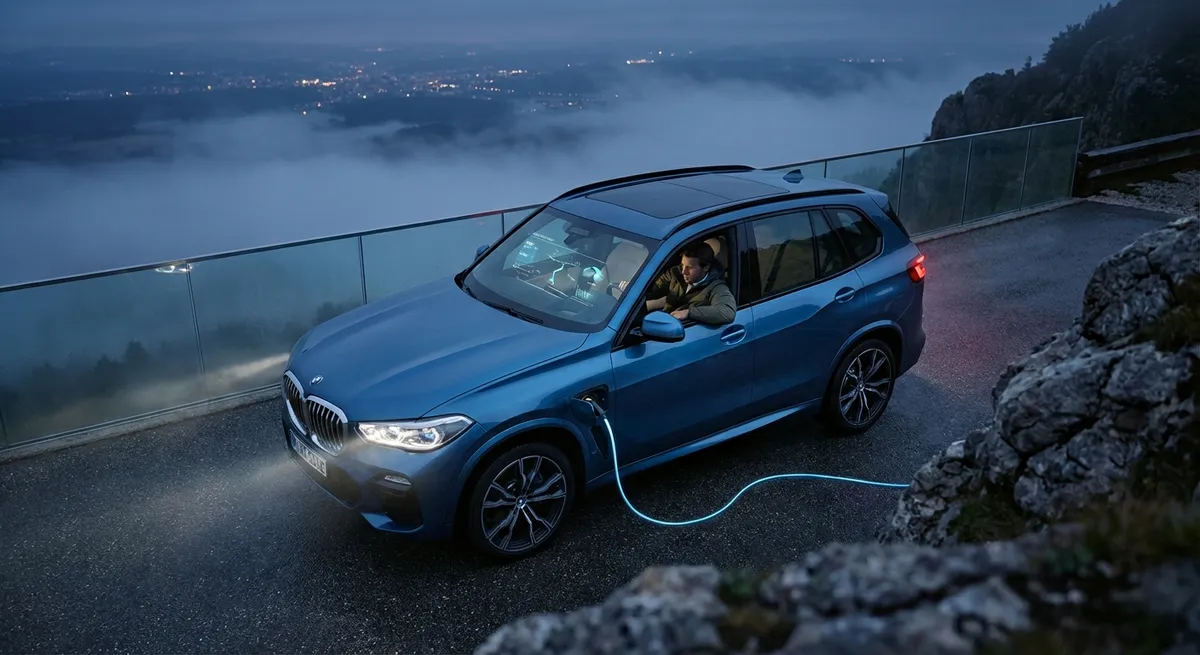
In practice, this means many owners with typical commuting patterns can operate almost entirely on electricity during the workweek, recharging overnight on a Level 2 home charger. The onboard AC charger supports up to 7.4 kW, allowing a full charge in about 3–4 hours on a 240V circuit. There is no DC fast charging, but for a PHEV this is generally unnecessary, as long-distance travel can rely on the gasoline engine.
In Hybrid mode, the X5 intelligently manages the battery, reserving electric power for low-speed driving and stop‑and‑go traffic, while leaning more on the inline-six at highway speeds where its efficiency is superior. For drivers who plug in regularly, overall fuel economy can be impressive—well above a comparable non-hybrid X5, and potentially double the MPG for short-trip city usage. For those who never plug in, however, the powertrain becomes essentially a heavy hybrid, with fuel economy that may not justify the extra complexity.
The key for owners is behavioral: those willing to treat the xDrive50e as an EV for local use and a hybrid for road trips will unlock its full benefit. For buyers not yet ready to commit to a full EV—because of charging infrastructure, road-trip patterns, or cold-climate concerns—the X5 xDrive50e represents a balanced and future-conscious compromise.
Interior, Technology & Infotainment: High-End Tech With a Learning Curve
Inside, the 2025 X5 adopts BMW’s latest curved display setup, combining a 12.3‑inch digital instrument cluster with a 14.9‑inch central touchscreen under a single glass panel. The system runs BMW’s Operating System 8.5 (or newer), bringing a tile-based, widget-heavy layout and expanded OTA (over-the-air) capabilities. It’s visually clean and highly configurable, but there is a learning curve, especially for drivers accustomed to traditional buttons and dials.
Climate controls, drive modes, and many secondary functions are now handled through the central touchscreen or via voice commands. Enthusiasts may lament the loss of dedicated physical buttons, but BMW has at least attempted to maintain a logical menu structure. Wireless Apple CarPlay and Android Auto are standard, and the integration is seamless, with quick pairing and minimal lag. The optional Bowers & Wilkins audio system delivers detailed sound with strong imaging, matching the expectations of a premium SUV at this price point.
Material quality is excellent. Soft-touch surfaces, real leather (or high-quality synthetic alternatives in some markets), and precise switchgear contribute to a solid, almost architectural feel. Optional glass controls, open-pore wood trims, and ambient lighting schemes add to the sense of occasion. Front seats offer a wide range of adjustment, strong lateral support, and available ventilation and massage functions, making long-distance travel genuinely relaxing.
Digital driver aids are extensive and well integrated. Adaptive cruise control with lane centering, traffic jam assist, automatic parking systems, and an array of camera views (including a 3D surround view and trailer-assist functions) make the X5 easier to manage in tight city environments than its size suggests. The head-up display is crisp and bright, displaying navigation cues, driver-assistance status, and speed limits clearly.
Rear-seat space is generous for two adults and adequate for three across; the plug-in hybrid packaging does not severely compromise passenger room. Cargo volume is slightly reduced compared to non-hybrid X5s due to the battery location, but the load floor remains practical, and the signature split tailgate is retained in many markets, making loading heavy items easier and providing a convenient seating or loading surface.
Ownership, Use Case & Buyer Profile: Who the X5 xDrive50e Suits Best
The 2025 BMW X5 xDrive50e occupies a specific niche in the luxury SUV landscape. It’s ideal for buyers who:
- Have reliable access to home or workplace Level 2 charging
- Want to reduce fuel consumption and emissions without sacrificing performance
- Prioritize comfort, refinement, and technology over hardcore off-road ability
- Regularly combine city commuting with occasional long-distance trips
For this profile, the xDrive50e can serve as an “all-in-one” solution: electric enough to feel future-ready, yet conventional enough to be worry-free on long journeys or in areas with sparse charging infrastructure. Enthusiasts will appreciate the engine’s character, the chassis composure, and the fact that performance is not sacrificed at the altar of efficiency.
On the other hand, buyers who rarely plug in would be better served by a conventional X5 with a gasoline engine or a mild-hybrid variant. Those who prioritize pure off-road performance and ruggedness might gravitate toward models like the Land Rover Defender or Lexus GX. And drivers ready to fully embrace electrification may find more compelling long-term value in a dedicated EV SUV, despite charging network considerations.
Pricing places the xDrive50e squarely in the premium bracket, especially once desirable options (air suspension, premium audio, advanced driver assistance packages, and luxury interior packages) are added. Resale value will likely benefit from its electrified powertrain, given tightening emissions regulations and the growing demand for lower-CO₂ vehicles in the used market. Nonetheless, the complexity of the hybrid system underscores the importance of proper maintenance and, for used buyers, comprehensive service history and warranty coverage.
From a brand perspective, the 2025 X5 xDrive50e is one of BMW’s most rounded SUV offerings. It illustrates how plug-in hybrid technology can be implemented without diluting the core BMW attributes of performance, balance, and driver engagement, while adding a practical layer of electric usability that fits modern driving patterns.
Conclusion
The 2025 BMW X5 xDrive50e stands out as a sophisticated, high-performance plug-in hybrid SUV that delivers on its promise of dual-purpose capability. It blends a charismatic inline-six engine with meaningful electric range, an advanced chassis, and a tech-rich cabin that feels decisively modern. For buyers who want a luxury SUV capable of electric commuting, effortless long-distance travel, and genuinely engaging driving dynamics, it sets a high bar in the plug-in hybrid segment.
It isn’t perfect—the learning curve for the infotainment system, the reliance on touch controls, and the need to plug in regularly to unlock its efficiency advantages will not suit every driver. But for the right owner, the xDrive50e is more than a compromise; it’s a compelling vision of what a performance-oriented, electrified luxury SUV can be right now—without waiting for the charging ecosystem to catch up everywhere.
Sources
- BMW USA – 2025 BMW X5 Overview – Official specifications, powertrain details, and feature listings for the 2025 X5 lineup
- EPA – Fueleconomy.gov: Plug-in Hybrid Vehicles – Technical background on how PHEV systems work, including efficiency considerations and usage patterns
- Car and Driver – 2024 BMW X5 Review – Independent testing, performance data, and driving impressions for the current-generation X5, including plug-in hybrid variants
- IIHS – BMW X5 Crashworthiness and Safety Ratings – Safety scores and crash-test results relevant to prospective buyers evaluating SUV safety performance
- U.S. Department of Energy – Alternative Fuels Data Center: Benefits and Considerations of Plug-In Hybrids – Objective analysis of PHEV ownership, including charging behavior, emissions, and cost implications
Key Takeaway
The most important thing to remember from this article is that this information can change how you think about Reviews.