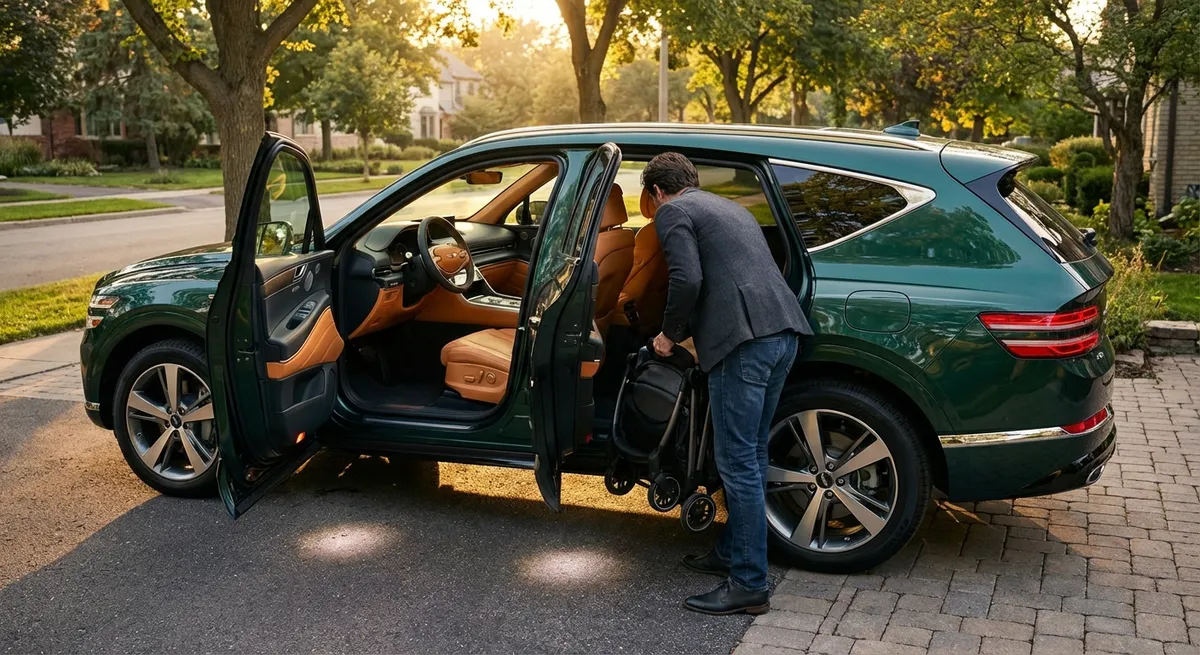
The 2025 Genesis GV80 sits in one of the most competitive corners of the SUV market: the midsize luxury segment dominated by German badges and increasingly challenged by electric newcomers. Genesis has positioned the GV80 as a refinement-first, tech-rich alternative to the usual suspects—without the six-figure price tags that well-equipped European rivals often demand. This review takes a focused, enthusiast-leaning look at what the GV80 does well, where it falls short, and how it fits into the current landscape for buyers who care about both driving dynamics and day-to-day practicality.
Powertrain and Driving Dynamics: Composed, Not Combative
Genesis offers the GV80 with two primary engines (availability may vary by market), both paired to an 8‑speed automatic transmission and available all-wheel drive:
- A 2.5‑liter turbocharged inline‑4, typically around 300 hp and 311 lb‑ft of torque
- A 3.5‑liter twin‑turbo V6, typically around 375 hp and 391 lb‑ft of torque
For most buyers, the 2.5T will feel more than adequate. Torque delivery is early and consistent, giving the GV80 enough punch for highway merges without sounding strained. The 8‑speed transmission prioritizes smoothness over aggression, slipping through ratios with minimal head-toss or hesitation. Enthusiasts may wish for quicker kickdowns in Sport mode, but the calibration is clearly tuned for refinement rather than track-day antics.
The 3.5T V6 transforms the GV80 from “well-powered” to genuinely rapid. Midrange response is strong, and passing at highway speeds feels effortless even with a full load of passengers. The V6’s additional weight over the front axle is noticeable if you push hard into corners—turn-in is slightly less crisp than the four-cylinder variant—but for spirited highway driving and long-distance touring, the V6 feels like the most natural fit.
Chassis tuning is firmly in the comfort camp, with Genesis using a multi-link rear suspension and available electronically controlled dampers (often tied to higher trims or packages). In models equipped with the “road preview” system (using cameras to pre-scan the road and adjust damping in real time), the GV80 delivers an almost air-suspension-like calm over broken pavement. Body roll is well-managed, and the GV80 remains composed in sweeping curves, but there’s no mistaking its mission: this is a cruiser, not a corner-carver.
Braking performance is solid, with a progressive pedal and enough bite for repeated high-speed stops without immediate fade in normal use. Steering is light and accurate, though largely devoid of road feel—expected for the segment, but worth noting if you’re coming from a more communicative performance SUV.
Interior Design and Material Quality: Flagship-Level Execution
One of the GV80’s standout strengths is its interior. Genesis leans heavily into a clean, horizontal design language, with a mix of high-quality soft-touch surfaces, available open-pore wood, and metal trim that looks and feels more expensive than its price segment suggests.
The dashboard is dominated by a wide-format infotainment display (around 14.5 inches, depending on spec), integrated cleanly rather than floating tablet-style above the dash. Physical controls are limited but thoughtfully laid out: a slender climate control interface with haptic buttons, a nicely weighted volume knob, and a rotary controller for the infotainment system positioned next to the electronic gear selector.
Seat comfort is a highlight. Front seats are generously bolstered without being confining, and higher trims offer multi-way power adjustment with available massage functions, adjustable side bolsters, and an “ergo motion” system that subtly changes support points on longer drives to reduce fatigue. Materials range from high-grade synthetic leather in lower trims to richly finished Nappa leather at the top end, with intricate stitching and quilting patterns that visually set the cabin apart from more conservative German rivals.
Noise insulation is excellent. Double-glazed front side windows and extensive sound-deadening keep wind and road noise impressively low. The result is a cabin that feels genuinely premium at highway speeds—an important differentiator for buyers cross-shopping more established luxury brands.
Fit and finish are generally superb, though some lower cabin plastics (such as seat bases or rear door pockets) remind you this is not a six-figure SUV. Still, for the segment and price point, the GV80’s interior punches above its weight, especially when optioned with the more opulent trim packages.
Technology and Infotainment: Strong Feature Set, Learning Curve Included
Technology is central to the GV80’s appeal, and Genesis has loaded the SUV with both convenience and safety systems that will matter to informed buyers.
The infotainment system, running on a wide touchscreen, supports Apple CarPlay and Android Auto (wired in many markets, though wireless adoption is expanding across the industry). The interface is visually crisp and responsive, but the breadth of menus and submenus can present a learning curve. Genesis partially mitigates this with a rotary controller and shortcut keys, which many drivers will prefer using while on the move rather than reaching for the far corner of the touchscreen.
A digital instrument cluster (often 12.3 inches on higher trims) provides configurable layouts, including a 3D-effect display in some versions. The graphics are sharp, and the integration with driver-assistance systems—lane markings, adaptive cruise data, and traffic-aware animations—is intuitive once you get used to the layout.
Available tech highlights include:
- Head-Up Display (HUD): Projects speed, navigation, and driver-assistance info directly onto the windshield, reducing the need to glance down.
- Surround-View Monitor: High-resolution top-down and 3D exterior views help with tight urban parking and off-center obstacles.
- Premium Audio (Lexicon in many trims): Multi-speaker array with a dedicated subwoofer and carefully tuned cabin acoustics for a balanced soundstage.
On the safety and driver-assistance front, the GV80 offers a comprehensive suite: forward collision avoidance, blind-spot monitoring (with available blind-view cameras that display in the gauge cluster), lane-keeping assist, rear cross-traffic alert, and adaptive cruise control with lane-centering. The adaptive system pairs with navigation data to adjust vehicle speed proactively in some conditions, such as highway curves and known speed-limit changes (in supported markets).
While not a full hands-free system like GM’s Super Cruise or Ford’s BlueCruise, Genesis’s Highway Driving Assist is one of the more polished lane-centering and adaptive cruise integrations in this class, especially on well-marked roads. For buyers spending significant time on the highway, it noticeably reduces fatigue.
Over-the-air software update coverage is expanding across the Hyundai–Genesis ecosystem, though the GV80 may still rely on dealer updates for certain modules depending on model year and region. This is an area worth verifying at the dealer level if you care about long-term feature upgrades.
Space, Practicality, and Ride Comfort: Family-Capable, With Caveats
The GV80 is positioned as a midsize luxury SUV with available three-row seating in some configurations. In practice, it functions best as a very comfortable two-row with a large cargo area; the optional third row is better viewed as an occasional-use feature.
Front-row space is generous, with ample headroom and legroom even for taller drivers. The driving position feels slightly elevated without that “towering” sensation you get from some body-on-frame SUVs, which many drivers appreciate for urban maneuverability and garage compatibility.
In the second row, adults will find plenty of knee and toe room, and the seat base offers good under-thigh support. Reclining and sliding functionality (where equipped) allows passengers to tailor their angle and legroom. Available features such as rear seat heating, sunshades, and climate controls elevate long-distance comfort.
The third row, however, is where limitations appear. Access is workable using sliding and folding second-row seats, but the space itself is best suited for children or shorter trips. If you truly need frequent adult-ready three-row capacity, a larger SUV may fit better.
Cargo capacity is competitive for the segment. With the third row folded (or in two-row models), the cargo floor is flat, and the opening is wide enough for bulky items such as strollers or larger suitcases. Underfloor storage helps keep smaller items secure and out of sight. Power-folding functionality for rear seats, where available, makes configuration changes easy from the cargo area.
Ride comfort is a major GV80 strength. Even on larger wheels, the suspension filters out sharp impacts and expansion joints with poise, especially in models with adaptive damping. For families who regularly travel on mixed-quality roads, this composure is a significant selling point. Ground clearance is sufficient for light off-pavement use—gravel roads, trailhead access—but the GV80 is not designed as a hardcore off-roader. Its value lies in refined everyday capability, not rock-crawling.
Value, Reliability Outlook, and Ownership Considerations
From a value perspective, the GV80 undercuts many of its European competitors on price while matching or exceeding them on standard equipment. Features that are optional on rivals—advanced driver assistance, high-end audio, panoramic sunroof, or larger displays—are often bundled or standard at lower trim levels in the Genesis.
Genesis also typically includes a strong warranty package, which in recent years has featured:
- 10‑year/100,000‑mile powertrain limited warranty (U.S. market)
- 5‑year/60,000‑mile new vehicle limited warranty
- Complimentary maintenance and roadside assistance for a limited term (varies by region and year)
This comprehensive coverage significantly reduces the cost of ownership in the early years and provides reassurance to buyers wary of emerging luxury brands.
Reliability data for Genesis is still maturing compared with longer-established luxury marques, but early indicators from independent surveys and owner reports place the brand favorably in terms of initial quality and dependability. As with any turbocharged, tech-heavy SUV, long-term durability will depend heavily on adherence to maintenance schedules and the quality of service.
Fuel economy is competitive but not groundbreaking. The 2.5T models generally return better MPG figures, particularly with rear-wheel drive (where offered), while the 3.5T’s real-world consumption can dip significantly in urban stop-and-go driving. For buyers prioritizing efficiency, it’s worth comparing GV80 ratings against emerging plug-in hybrid and fully electric options in this segment, though those often come with higher upfront prices or charging infrastructure requirements.
Resale value is an evolving story. Established German rivals still tend to hold value better, partly on brand recognition. However, increasing market awareness of Genesis, strong warranty coverage, and positive media/owner feedback are beginning to narrow that gap. For buyers planning to keep the vehicle beyond the typical three-year lease horizon, the overall cost equation can favor the GV80.
Conclusion
The 2025 Genesis GV80 delivers what many midsize luxury SUV buyers actually want: a quiet, comfortable ride; a truly premium interior; robust technology; and strong safety credentials, all wrapped in a design that stands out without shouting. It leans more toward serene touring than sharp-edged performance, which will suit the vast majority of real-world use cases, from commuting to family road trips.
For enthusiasts, the 3.5T V6 and well-tuned chassis provide enough power and composure to keep drives engaging, even if the steering feel and transmission calibration don’t invite back-road heroics. For families and practical-minded buyers, the spacious two-row configuration, advanced driver-assistance suite, and long warranty coverage create a compelling case against more expensive, more common badges.
The key question is not whether the GV80 can match the established luxury players—it largely does—but whether you value brand prestige over tangible product execution. For many shoppers willing to judge it on its merits, the GV80 may represent one of the most rational and rewarding choices in the current luxury SUV market.
Sources
- [Genesis Official GV80 Page](https://www.genesis.com/us/en/models/luxury-suv-genesis/gv80) - Manufacturer specifications, features, trims, and warranty information for the GV80
- [IIHS – Genesis GV80 Crashworthiness and Safety Ratings](https://www.iihs.org/ratings/vehicle/genesis/gv80-4-door-suv) - Independent crash-test data and safety evaluations
- [U.S. Department of Energy – Fueleconomy.gov GV80 Listings](https://www.fueleconomy.gov/feg/byclass/Luxury_Midsize_SUV2019.shtml) - Fuel economy ratings and comparisons within the midsize luxury SUV class
- [J.D. Power – Genesis Brand Overview](https://www.jdpower.com/cars/ratings/genesis) - Brand-level quality and dependability insights relevant to ownership and reliability expectations
- [Consumer Reports – Genesis GV80 Road Test Overview](https://www.consumerreports.org/cars/genesis/gv80/) - Independent testing impressions and owner-focused evaluation of ride, comfort, and usability
Key Takeaway
The most important thing to remember from this article is that this information can change how you think about Reviews.