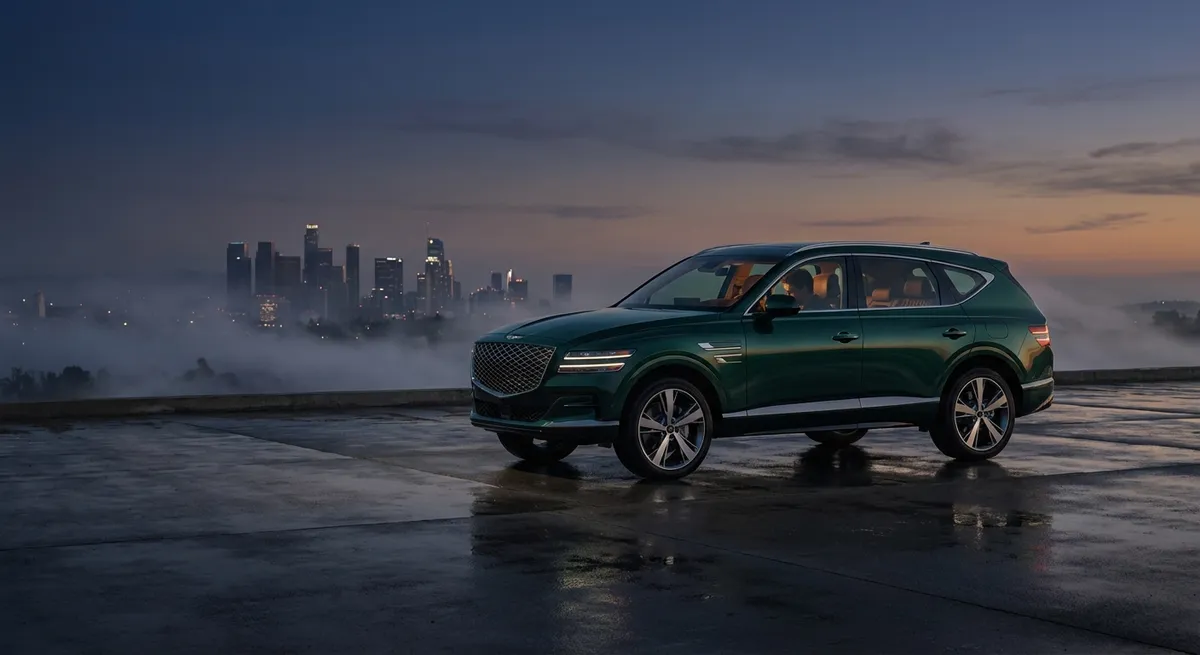
The 2025 Genesis GV80 is one of the clearest signals yet that the luxury SUV hierarchy is shifting. Once a segment dominated almost exclusively by German badges, this Korean-built contender has evolved into a polished, tech-heavy, and surprisingly engaging SUV aimed squarely at buyers who value refinement as much as a well-executed chassis. This review takes a deep, enthusiast-focused look at where the GV80 stands in 2025 and what potential buyers should pay attention to beyond the brochure highlights.
Powertrain and Driving Dynamics: Effortless Torque, Tuned for Real Roads
Under the hood, the 2025 Genesis GV80 continues with the familiar powertrain lineup: a turbocharged 2.5‑liter inline‑four and a twin‑turbocharged 3.5‑liter V6. Both engines are paired with an 8‑speed automatic transmission and available rear- or all-wheel drive depending on market and trim.
The 2.5T produces around 300 hp and roughly 311 lb‑ft of torque, a figure that matters more in day‑to‑day driving than peak horsepower. Turbocharged midrange torque is robust enough to make highway merging and two-lane passing feel confident without needing to hunt through the gearbox. For urban and suburban use, this engine is more than sufficient, and enthusiasts who place a premium on chassis balance over outright acceleration may prefer its lighter nose.
The 3.5T V6 steps the game up significantly, with about 375 hp and 391 lb‑ft of torque. The torque plateau arrives low in the rev range thanks to twin turbochargers, giving the GV80 an easy, almost lazy thrust that suits its luxury brief. The 8‑speed automatic is calibrated more for smoothness than aggression; shifts are quick but deliberately unobtrusive, downshifting proactively when braking into corners and holding gears sensibly when accelerating onto ramps.
Chassis tuning is one of the GV80’s quiet strengths. The structure is notably rigid, and the suspension is tuned to filter out high‑frequency impacts (expansion joints, sharp potholes) without allowing excessive body motion. Higher trims with the electronically controlled suspension and road preview function use a forward-facing camera to read the road surface and pre‑adjust damping. The result is not “floaty” softness, but a controlled, calm ride that still resists excessive roll and pitch when pushed on a back road.
Steering is electrically assisted, with a light, precise feel that prioritizes stability over hyperactive feedback. Enthusiasts won’t get the kind of granular road texture you might find in some German rivals, but the on‑center stability at highway speeds and accurate turn‑in make long-distance cruising particularly relaxing.
For buyers who care about towing, the GV80’s properly equipped V6 models offer competitive towing capacity in the luxury midsize class, enough for a pair of motorcycles, a small boat, or a compact camper when outfitted with the correct hitch and cooling package. Torque delivery and transmission programming make towing feel composed rather than strained.
Interior Execution: Materials, Ergonomics, and NVH Refinement
Step into the 2025 GV80 and it’s immediately clear that Genesis is leaning hard into the “quiet luxury” ethos. The cabin favors clean horizontal lines, minimal visual clutter, and meticulous material selection. Real open‑pore wood, knurled metal controls, and high‑grade leathers are used in key touchpoints, and the color and trim combinations look closer to concept-car showpieces than typical options packages.
Fit and finish are impressively tight. Panel gaps inside are consistent, switchgear has a satisfying mechanical detent, and even secondary controls—like seat adjustment switches and stalks—feel engineered rather than cost‑reduced. Enthusiasts who care about tactile feedback in the cabin will appreciate the deliberate weighting of knobs and buttons.
Noise, vibration, and harshness (NVH) isolation is where the GV80 truly feels premium. Acoustic-laminated glass for the windshield and front windows, extensive sound‑deadening material in the firewall and floor, and careful engine mount tuning contribute to a remarkably quiet cabin. At highway speeds, wind noise is hushed, and tire roar is only mildly detectable over coarse pavement. Both engines remain subdued; even under full throttle the V6 delivers a muted growl rather than an intrusive roar.
Ergonomically, the GV80 sits at the intersection of analog familiarity and digital modernity. The driving position is upright but not truck-like, with an expansive windshield and relatively slim A‑pillars providing good forward visibility. Seat adjustability is extensive, especially on higher trims with multi‑way power adjustment, lumbar support, and available massage functions. Enthusiasts with longer torsos or broader frames will find ample side bolstering without the constrictive feel of performance buckets.
Second-row space is generous in both legroom and headroom, and recline/slide functionality adds flexibility for passengers or cargo. A third row is available in some configurations, but it’s best viewed as contingency seating for children or short trips rather than adult-friendly long-haul space. Buyers who regularly require a usable third row may want to test this area carefully during shopping.
Storage solutions are well thought out, with a large center console, sizeable door bins, and under‑floor cargo compartments. The rear cargo area provides a flat load floor with the second row folded, and power-folding rear seats on higher trims make configuration changes easy.
Infotainment, Digital Interfaces, and Driver Assistance Tech
Genesis has been steadily improving its digital experience, and the 2025 GV80 showcases this effort. A large central touchscreen (over 14 inches in many trims) sits atop the dash, serving as the primary interface for navigation, audio, and vehicle settings. The graphics are crisp, with high‑contrast themes that remain easily legible in direct sunlight. Response times are fast, and menu structures are logically nested, reducing the need for excessive taps.
Crucially, Genesis still provides physical redundancy where it matters. A rotary controller on the center console can operate the infotainment system without having to reach for the screen, which is especially useful while driving. Dedicated buttons for climate, volume, and quick navigation functions help minimize distraction. Enthusiasts often complain about “touchscreen everything” designs; the GV80 strikes a more balanced compromise.
Apple CarPlay and Android Auto are standard, though in some markets they may still require a wired connection rather than being fully wireless. Multiple USB-C ports, a wireless charging pad, and optional premium audio systems from name-brand suppliers give tech-focused buyers plenty of features to explore. High-end trims include 3D digital instrument clusters and customizable layouts, allowing drivers to prioritize information like navigation, driver assistance status, or performance metrics.
On the advanced driver assistance side, the GV80 is equipped with an extensive suite: forward collision avoidance with pedestrian and cyclist detection, blind‑spot monitoring with active assistance, rear cross-traffic avoidance, lane keeping and lane following assist, and adaptive cruise control with stop‑and‑go capability. Genesis’s Highway Driving Assist (HDA) combines lane centering and adaptive cruise, working best on well-marked freeways. It doesn’t turn the GV80 into a self‑driving vehicle, but it meaningfully reduces workload in heavy traffic and long commutes.
Calibration of these systems is generally smooth. Lane centering tends to favor natural, gentle corrections rather than abrupt ping‑ponging between lane markers. The adaptive cruise is able to maintain following gaps comfortably without sudden throttle or brake inputs. Enthusiasts who typically disable overbearing driver assistance may find themselves leaving most of these systems on, which speaks to Genesis’s tuning effort.
Over-the-air (OTA) software updates are increasingly supported, allowing Genesis to refine system behavior and add features post‑purchase in some regions. Buyers should verify with dealers what OTA capabilities are enabled in their market.
Safety Engineering and Structural Integrity
Beyond driver assistance, the GV80’s fundamental safety engineering is a key selling point. The platform is designed with an emphasis on torsional rigidity, load-path management, and occupant protection. High-strength and ultra-high-strength steels are used strategically in the body‑in‑white, particularly around the passenger cell and critical impact zones, improving both crash performance and chassis feel.
Independent crash tests from major agencies like the Insurance Institute for Highway Safety (IIHS) and the National Highway Traffic Safety Administration (NHTSA) have historically scored the GV80 and similar Genesis models well, thanks to robust structural performance and comprehensive standard safety equipment. Head‑on collision structures, side-impact beams, and roof strength are benchmarks enthusiasts and families alike should pay attention to, particularly when cross‑shopping older platforms still in production.
The GV80’s airbag coverage is extensive, including frontal, side‑impact, side curtain, and in some markets, front center airbags designed to reduce occupant‑to‑occupant contact in side collisions. Seatbelt pre-tensioners and load limiters further manage forces on occupants during severe impacts.
Genesis also employs active safety strategies like evasive steering assist and junction‑turning collision avoidance, designed to help mitigate or avoid impacts when drivers are turning across traffic or making lane changes. While these systems are not substitutes for attentive driving, they represent a layering approach: structural integrity first, passive protection second, and active intervention third.
For families, child-seat installation is straightforward. LATCH anchor points are easily accessible, and rear door openings are wide enough to maneuver bulky child seats without contortion. The relatively flat rear bench and good seat belt geometry further aid in proper installation, an overlooked yet critical aspect of real‑world safety.
Ownership Experience, Value Positioning, and Long-Term Considerations
One of Genesis’s strongest differentiators remains its ownership package and value proposition. The GV80 is priced to undercut many established European luxury SUVs while offering a comparable or richer feature set. For buyers looking at total cost of ownership rather than just MSRP, warranty coverage is a key factor: Genesis continues to offer one of the longer powertrain warranties in the luxury market, reducing long‑term mechanical risk perception.
Scheduled maintenance coverage and concierge-style services (in select regions) add to the premium experience. Features like pick‑up and delivery for service visits are more than just convenience; they demonstrate Genesis’s effort to match or exceed the hospitality of more established luxury brands. For buyers transitioning out of mainstream brands, this can make the leap into the luxury segment more seamless.
Depreciation has historically been steeper for newer luxury marques compared with legacy badges, and the GV80 is not immune to this trend. However, as Genesis builds brand recognition and a track record of reliability, residual values have shown signs of stabilizing. Enthusiasts who lease may find favorable terms, while long-term keepers benefit from the strong warranty and comparatively lower acquisition cost.
On the reliability front, early data and owner reports suggest the GV80 is competitive, though buyers should always check the latest reliability ratings and technical service bulletins. The twin‑turbo V6, as with any forced-induction engine, will reward strict adherence to maintenance schedules, proper oil quality, and respect for warm‑up and cool‑down cycles—details enthusiast owners tend to observe instinctively.
Finally, for buyers interested in future‑proofing, the GV80 sits at an interesting intersection. It uses a conventional internal combustion platform but integrates modern electronics, over‑the‑air update potential, and comprehensive driver assistance. For those not yet ready to commit to a plug‑in hybrid or full EV, the GV80 offers a technologically current yet mechanically familiar package.
Conclusion
The 2025 Genesis GV80 is no longer a curious newcomer—it is a fully credible luxury SUV that competes on engineering merit, cabin refinement, and technology integration rather than on price alone. Enthusiasts will appreciate its solid chassis, strong torque delivery, and carefully tuned NVH, while families and daily drivers will value its comfort, safety engineering, and thoughtful interior execution.
For potential buyers cross‑shopping established German and Japanese luxury SUVs, the GV80 deserves a serious, back‑to‑back evaluation, not as an outsider but as a genuine peer. If your priorities include a serene cabin, modern assistance tech that doesn’t feel intrusive, and a value equation that still favors the buyer, the 2025 GV80 should be high on your test-drive list.
Sources
- [Genesis Official GV80 Page](https://www.genesis.com/us/en/models/luxury-suv-genesis/gv80) - Manufacturer specifications, features, and official imagery for the GV80 lineup
- [U.S. News & World Report – Genesis GV80 Review](https://cars.usnews.com/cars-trucks/genesis/gv80) - Independent rankings, pricing insights, and competitive comparisons
- [IIHS – Genesis GV80 Crash Test Ratings](https://www.iihs.org/ratings/vehicle/genesis/gv80-4-door-suv) - Detailed safety ratings, crash test results, and safety equipment notes
- [NHTSA – Vehicle Safety Information](https://www.nhtsa.gov/vehicle/2024/GENESIS/GV80/SUV%252FAWD) - Federal crash-test data and safety recall information (model year reference)
- [Edmunds – Genesis GV80 Expert Review](https://www.edmunds.com/genesis/gv80/) - Road test impressions, real-world fuel economy observations, and ownership cost analysis
Key Takeaway
The most important thing to remember from this article is that this information can change how you think about Reviews.