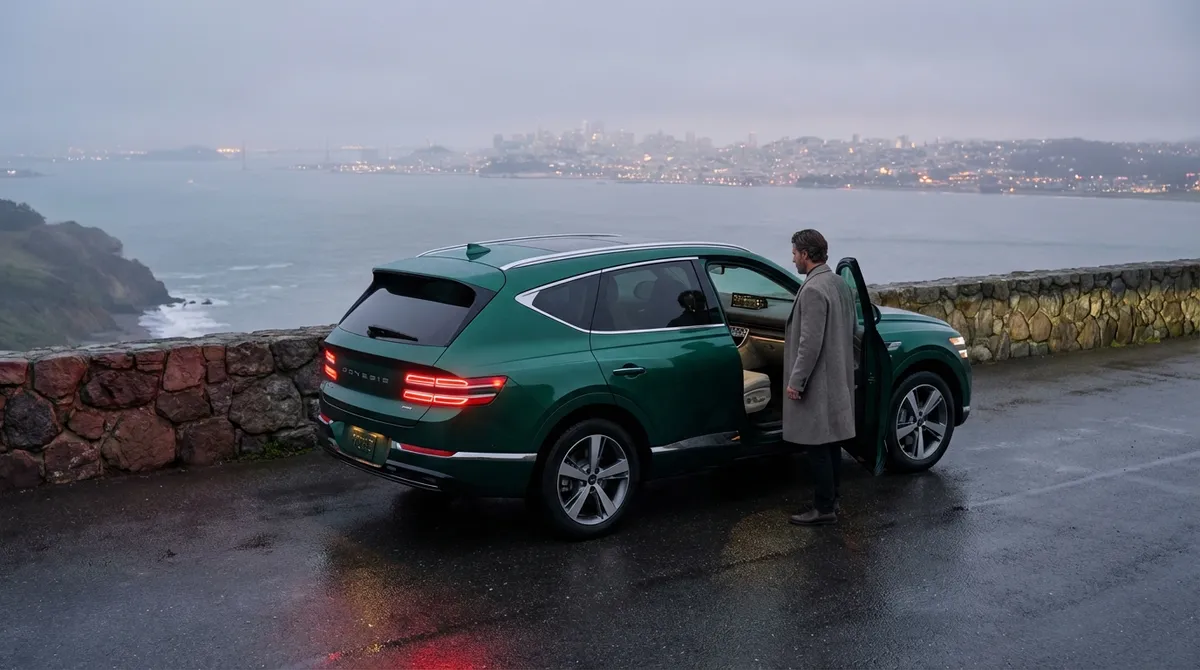
The 2025 Genesis GV80 arrives in a fiercely competitive midsize luxury SUV segment dominated by German and Japanese heavyweights. Rather than simply undercutting rivals on price, Genesis aims to redefine what “quiet luxury” feels like: a focus on refinement, technology depth, and smooth performance without the flash or gimmicks. For buyers cross-shopping BMW X5, Mercedes GLE, Lexus RX, or Audi Q7, the GV80 now deserves a serious look—not as a budget alternative, but as a genuine contender on engineering and execution.
This review focuses on five core areas that matter most to enthusiasts and informed shoppers: powertrain and driving character, ride and NVH refinement, interior design and tech, space and practicality, and value versus the established players.
Powertrains and Driving Character
The 2025 Genesis GV80 offers a lineup that is straightforward but technically well-considered. Most markets center around two engines:
- A 2.5-liter turbocharged inline-four
- A 3.5-liter twin-turbocharged V6 (3.5T)
The 2.5T engine typically delivers around 300 hp and 311 lb-ft of torque, routed through an 8-speed automatic. While power levels don’t lead the class, the torque plateau arrives low in the rev range, making the GV80 feel responsive in city driving and highway merging. The 8-speed unit is tuned for smoothness rather than aggressive shifts; in Comfort mode, upshifts are barely perceptible, aligning with the vehicle’s luxury focus.
The 3.5T V6 is where enthusiasts’ interest spikes. With roughly 375 hp and 391 lb-ft of torque, it moves the GV80 with genuine authority, even when loaded with passengers and cargo. Twin turbochargers help maintain torque delivery across a broad band, reducing the need for downshifts during freeway passes or climbing grades. In Sport mode, the transmission logic tightens, holding gears longer and responding more eagerly to throttle inputs.
Steering is electrically assisted, as expected in this segment. Genesis opts for a slightly lighter effort than a BMW X5 but with more on-center stability than many rivals. The rack is quick enough to make the GV80 feel smaller than it is in tight urban maneuvers, though this is not a “driver’s SUV” in the same vein as some German competitors. Enthusiasts will appreciate the predictable, linear brake pedal and fade resistance under repeated stops, thanks to generously sized rotors and multi-piston calipers on higher trims.
All-wheel drive is standard on most configurations in North America, with an electronically controlled center differential that can proactively send torque to the front or rear depending on traction demands. While the GV80 isn’t designed for hardcore off-roading, it manages gravel roads, snow, and light trails with composure, aided by traction and stability systems that intervene progressively rather than abruptly.
Ride Comfort, Chassis Tuning, and NVH
The GV80’s real strength lies in its refinement. Rather than chasing pure performance metrics, Genesis put substantial engineering effort into chassis tuning and noise, vibration, and harshness (NVH) control.
The front uses a MacPherson strut setup, while the rear uses a multi-link arrangement—typical for the class—but Genesis layers in adaptive dampers on higher trims. These dampers continuously adjust compression and rebound in response to road inputs and driver-selected modes. In Comfort or Eco mode, the SUV glides over expansion joints and patchy pavement with minimal secondary motions. There is a distinct sense of composure, even on 20- or 22-inch wheels.
On certain trims, a “road preview” adaptive suspension uses a front-facing camera to scan the pavement and pre-adjust damper firmness before the wheels encounter a bump or pothole. This predictive approach, first popularized in high-end German sedans, materially reduces sharp impacts and helps maintain cabin stability. Enthusiasts may wish for a more aggressive Sport setting, but the GV80’s chassis remains well-controlled without becoming harsh.
Noise isolation is a standout. Extensive use of laminated glass, strategic insulation in the firewall and floor, and carefully tuned body seals result in a cabin that remains hushed at freeway speeds. Wind noise around the A-pillars and mirrors is impressively low, and the engines (especially the 3.5T) are well-muted until pushed near the top of the rev range. For long-distance cruising, this refinement is a key differentiator and one of the GV80’s most appealing attributes.
Body rigidity is another quiet victory. The GV80’s platform uses high-strength steel and structural adhesives to enhance torsional stiffness. In practice, that means fewer squeaks and rattles over time, quicker suspension reaction to inputs, and a more precise feeling over uneven surfaces. It’s the kind of engineering that doesn’t jump out on a test drive but contributes significantly to perceived quality after years of ownership.
Interior Design, Materials, and Technology
Open the door of the 2025 GV80 and the first impression is that Genesis has prioritized tactile quality and cohesive design. The cabin leans into a horizontal, uncluttered layout with a low cowl and broad dashboard, promoting an airy feel. Soft-touch materials cover most surfaces within reach, and higher trims introduce genuine open-pore wood, Nappa leather, and knurled metal switchgear that would not be out of place in a higher-priced European SUV.
The centerpiece is a widescreen infotainment display (around 14.5 inches in many trims) running Genesis’s latest software interface. The system blends touch input with a rotary controller on the center console, accommodating both drivers who prefer tapping and those who want eyes-up operation. Graphics are crisp, menu structures are logical, and voice recognition handles common commands like navigation inputs or climate adjustments with reasonable accuracy.
Car enthusiasts and tech-savvy buyers will appreciate the depth of digital instrumentation. A fully digital gauge cluster is available, often with a 3D-effect option that uses eye-tracking to create virtual depth in the dials. More functionally useful is the integration of blind-spot view monitors: when the turn signal is activated, the cluster displays a camera feed of the corresponding blind spot—an elegant, real-time adjunct to conventional mirrors.
Audio systems range from competent base units to a premium setup branded by Lexicon, a respected name in professional audio. The higher-end system incorporates multiple speakers with dedicated subwoofers and a well-engineered amplifier, producing clear, dynamic sound with minimal distortion at high volumes. Cabin acoustics benefit from the aforementioned NVH work, enabling low listening levels without sacrificing detail.
Climate control is split into multi-zone configurations, and rear passengers get their own vents and available controls. Seat comfort is another highlight; both front seats can feature heating, ventilation, and multi-way power adjustment with adjustable thigh support and lumbar. On some trims, an “Ergo Motion” driver’s seat uses air cells to subtly adjust pressure points on long drives, reducing fatigue.
The software stack supports over-the-air (OTA) updates for certain vehicle systems, enabling Genesis to roll out bug fixes and feature enhancements without dealer visits. Deep integration with Apple CarPlay and Android Auto (wired or wireless depending on configuration and region) rounds out the tech story, though full-screen CarPlay/Android Auto implementation may vary by market and software version.
Space, Practicality, and Everyday Usability
Luxury SUVs still need to function as family vehicles, and the GV80 approaches practicality with an emphasis on comfort rather than maximum capacity. Two-row and three-row configurations are available in many markets. The optional third row is best suited for children or short adults on shorter trips; legroom and headroom are limited compared with full-size SUV alternatives. For families that occasionally use all seven seats, it’s a useful flexibility feature, but frequent three-row users may prefer a larger platform.
In the first and second rows, however, space is generous. The rear bench in the two-row configuration provides ample legroom and a relatively flat floor, making it easier to seat three across for shorter journeys. The seatbacks recline, and in three-row versions, the second row slides fore and aft to balance legroom between rows. Entry and exit are aided by wide-opening doors and step-in height that hits a sweet spot between sedan-low and truck-high.
Cargo volume behind the second row is competitive within the midsize luxury class, easily swallowing several suitcases, strollers, or sports gear. Folding the second row down yields a nearly flat load floor, helpful for large items like bicycles or flat-pack furniture. Power-folding second and (where equipped) third rows reduce the physical effort required and can often be controlled from switches in the cargo area, enhancing convenience.
Small-item storage is thoughtfully addressed. The center console offers a deep bin, cupholders, and a configurable space that can handle phones, wallets, or compact cameras. Door pockets are sized for bottles and tablets, and there’s usually a covered storage area under the cargo floor for hiding smaller valuables or stowing emergency gear.
Towing capability varies by engine and market, but the 3.5T with the proper package can typically handle around 6,000 pounds (check local specs), allowing for medium-sized trailers, small boats, or dual-axle utility trailers. Trailer stability assist and an available surround-view camera system make hitching and maneuvering less stressful, particularly for newer tow users.
Parking and low-speed maneuvering benefit from 360-degree camera coverage with high-resolution imagery and multiple selectable views, including a top-down “bird’s-eye” perspective. Ultrasonic sensors at the front and rear provide progressive audible and visual alerts, and certain trims support remote smart parking assistance, where the vehicle can be moved forward or backward from outside via the key fob—useful for tight garages.
Value, Ownership Experience, and Safety Tech
Value has been central to the Genesis proposition from the brand’s inception, and the 2025 GV80 continues this strategy with a blend of equipment density and ownership coverage. While sticker prices are no longer “bargain-basement,” the amount of standard content relative to German peers remains impressive. Many advanced safety features, which can be extra-cost options elsewhere, are standard or widely available at lower trim levels on the GV80.
Advanced driver assistance systems (ADAS) form a comprehensive suite:
- Forward collision-avoidance assist with pedestrian and cyclist detection
- Blind-spot collision-avoidance assist
- Rear cross-traffic collision-avoidance assist
- Lane keeping assist and lane following assist
- Driver attention warning
- Smart cruise control with stop-and-go and machine learning-based adaptation to driver habits in some configurations
Genesis’s Highway Driving Assist (HDA) system integrates adaptive cruise control and lane centering to ease fatigue on long highway stretches. While not a hands-free system, it does a credible job of maintaining lane discipline and following distance, feeling more natural than many mass-market systems. Enthusiasts may leave it off for spirited drives, but for daily commuting and cross-country trips, it’s a valuable asset.
Crash safety performance for prior GV80 model years has been strong, with top scores from the Insurance Institute for Highway Safety (IIHS) and solid results in National Highway Traffic Safety Administration (NHTSA) testing. The 2025 model builds on the same structural fundamentals with incremental improvements in software calibration and feature integration. Prospective buyers should verify the latest ratings for the exact model year and configuration, but the trend is reassuring.
Ownership economics are another differentiator. Genesis has historically bundled generous warranties—often a 10-year/100,000-mile powertrain warranty and a 5-year limited warranty in the U.S.—along with complimentary maintenance and concierge services for a set period. While exact coverage details can vary by market and model year, the net effect is reduced running costs and fewer out-of-pocket surprises during the first several years of ownership.
Depreciation for new luxury brands can be a concern, but Genesis residual values have been improving as brand recognition and product quality climb. For buyers keeping a vehicle 7–10 years, the initial value proposition plus warranty coverage can outweigh resale concerns; for shorter-term lessees, competitive lease programs and rising brand perception make the GV80 increasingly viable.
From a total-package standpoint—purchase price, included equipment, warranty, and safety tech—the 2025 GV80 undercuts many established rivals without feeling like a compromise. For shoppers who prioritize refinement, safety, and design over brand prestige alone, that equation is compelling.
Conclusion
The 2025 Genesis GV80 isn’t trying to out-German the Germans on Nürburgring lap times. Instead, it doubles down on the core attributes that matter to most luxury SUV buyers: a serene ride, a quiet and beautifully finished cabin, strong and refined powertrains, comprehensive safety tech, and a value story that genuinely holds up under scrutiny.
Enthusiasts will appreciate the torque-rich 3.5T engine, solid chassis tuning, and thoughtful driver aids, even if this isn’t the sharpest-handling SUV in the class. Families will gravitate toward the spacious first and second rows, intuitive technology, and peace of mind that comes with extensive standard safety features and a long warranty.
For buyers willing to look beyond the traditional badges, the 2025 Genesis GV80 has matured into a legitimate benchmark for quiet, modern luxury—and it’s no longer just the “smart alternative.” It’s a top-tier choice on its own merits.
Sources
- Genesis Official GV80 Page - Manufacturer specifications, features, trims, and warranty details for the GV80 lineup
- Insurance Institute for Highway Safety – Large Luxury SUVs - Crash test ratings and safety evaluations for the GV80 and its competitive set
- NHTSA Vehicle Ratings Search - Official U.S. government safety ratings and recall information (search “Genesis GV80” by year)
- J.D. Power Genesis Brand Overview - Brand-level reliability, quality studies, and customer satisfaction data
- Consumer Reports – Luxury SUV Buying Guide - Context on how the GV80 fits into the broader luxury SUV market in terms of performance, comfort, and reliability
Key Takeaway
The most important thing to remember from this article is that this information can change how you think about Reviews.