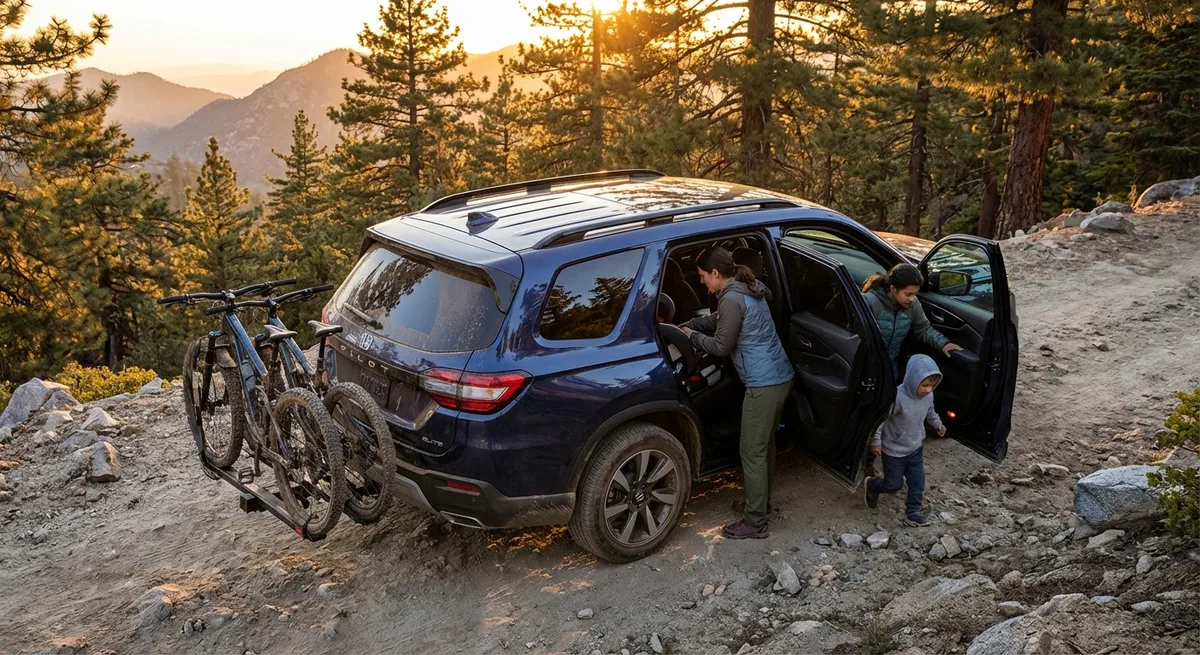
The three-row SUV segment is crowded, but the 2025 Honda Pilot Elite positions itself as a premium, family-focused option with genuine usability and understated capability. Rather than chasing flashy gimmicks, Honda leans on a carefully tuned V6, an impressively spacious cabin, and a chassis that feels more composed than its spec sheet suggests. For shoppers comparing it to the Toyota Highlander, Kia Telluride, Hyundai Palisade, and Chevy Traverse, the Pilot Elite makes its case through refinement and consistency rather than one headline-grabbing feature.
Powertrain and Driving Dynamics
Under the hood, the 2025 Pilot Elite carries over Honda’s 3.5-liter naturally aspirated V6, rated at approximately 285 horsepower and 262 lb-ft of torque, paired with a 10-speed automatic transmission and standard all-wheel drive in the Elite trim. Unlike many turbocharged competitors, the V6 delivers its power smoothly and predictably, with a linear throttle response that’s easy to modulate in stop-and-go traffic and confident during highway merging. The 10-speed gearbox is tuned to keep the engine in its sweet spot without excessive hunting between gears; downshifts are prompt under hard acceleration, yet nearly imperceptible in normal driving.
The Pilot’s unibody construction and front-strut/rear multi-link suspension are engineered for comfort first, but Honda’s traditional focus on chassis tuning shows through. Steering is light at parking-lot speeds but gains reassuring weight as speed rises, providing a sense of stability on the highway that many crossovers in this class still struggle to match. Body roll is well contained for a large three-row SUV, aided by a relatively stiff structure and careful damper calibration. While the Pilot Elite is not tuned as a sporty SUV, it feels more controlled on back roads than some softer-riding rivals.
Equipped with Honda’s torque-vectoring i-VTM4 all-wheel-drive system, the Pilot Elite can send a significant portion of torque to the rear wheels and actively distribute power left to right for improved traction and cornering stability. In slippery conditions, the system engages quickly and unobtrusively, minimizing wheelspin on snow or wet pavement. With multiple drive modes—Normal, Econ, Sport, Snow, and Tow—the throttle map, shift strategy, and all-wheel-drive logic are adjusted to suit conditions, making the Pilot adaptable without asking the driver to manage complex settings.
Interior Packaging, Comfort, and Practicality
Where the Pilot Elite really distinguishes itself is in its packaging. Honda’s focus on interior usability results in a cabin that feels larger than many spec sheets suggest. The Elite trim offers seating for seven or eight, depending on configuration, with second-row captain’s chairs or a removable middle seat/console combo. In the eight-passenger configuration, the center seat can be removed and stowed, allowing owners to quickly switch between maximum seating and easier third-row access without leaving bulky components in the garage.
Front seats are generously padded with good lateral and thigh support, and the driving position is upright with a wide range of adjustment for both seat and steering wheel. Taller drivers will appreciate the headroom, even with the standard panoramic roof. In the second row, legroom is ample, and seat cushions are mounted at a reasonable height to avoid the “knees-up” posture that plagues some competitors. The third row is still best suited for kids and teens, but adults can fit for shorter trips thanks to a sliding second row that can be moved forward while still preserving acceptable space.
Cargo capacity is one of the Pilot’s strengths. Behind the third row, there is enough room for multiple suitcases, and a useful underfloor storage compartment adds secure space for smaller items. With the third row folded, the load floor is broad and nearly flat, making it easy to slide in strollers, bikes, or bulkier cargo. Folding both rear rows opens up a spacious cargo area, rivaling or exceeding many in the segment. Numerous storage cubbies, large door pockets, and a well-thought-out center console give families places to stash devices, snacks, and everyday gear.
Cabin materials in the Elite trim lean toward the premium side of mainstream: soft-touch surfaces on the dash and door tops, well-grained plastics in lower areas, and tasteful use of contrast stitching. While it does not fully match luxury-brand SUVs in material richness, fit and finish are solid, panel gaps are tight, and there are few if any creaks or rattles over rough pavement. Sound insulation is effective, keeping wind and road noise at bay, while the V6’s engine note remains subdued at cruise and pleasantly muted even under harder acceleration.
Technology, Infotainment, and User Experience
Honda equips the 2025 Pilot Elite with a technology suite aimed at being comprehensive without overwhelming the driver with complexity. The centerpiece is a large touchscreen infotainment system (around 9 inches in most trims, larger in some configurations), featuring wireless Apple CarPlay and Android Auto. The interface is structured with clear menus and straightforward icons, with a home screen that can be personalized to keep frequently used functions close at hand. Reaction times are generally quick, though not class-leading, and Honda includes physical knobs for volume and some key functions, reducing frustration for users who dislike touch-only controls.
The digital instrument cluster provides configurable views of speed, driver-assist status, navigation prompts, and trip data. It’s legible in all lighting conditions, and the Elite’s head-up display further reduces the need to glance away from the road. Higher trim audio in the Elite offers an upgraded multi-speaker system that delivers clean, balanced sound; audiophiles may not be blown away, but it is a noticeable step up from base systems in lower trims.
Rear occupants are not forgotten in the tech equation. Available rear USB ports in all three rows, along with dedicated climate controls for the second row, help keep passengers comfortable and devices charged. Some configurations may include a rear-seat entertainment option or at least support for tablet mounting and device connectivity, acknowledging the realities of family road trips and daily carpool duties.
Practical tech extends beyond just screens and speakers. The Pilot Elite includes a hands-free power tailgate, remote start, and a digital key or enhanced keyless entry in some markets, simplifying access and daily use. Integrated navigation uses real-time traffic data where available, and voice commands have improved in natural-language recognition compared with older Honda systems, allowing drivers to request destinations, adjust climate settings, or control audio with fewer misinterpretations.
Safety, Driver Assistance, and Ratings Context
Honda Sensing, the brand’s suite of driver-assistance technologies, comes standard on the 2025 Pilot Elite. It generally includes forward collision warning, automatic emergency braking, lane-keeping assist, road departure mitigation, adaptive cruise control with low-speed follow, and traffic sign recognition. These systems are tuned to be more natural than earlier versions, particularly in terms of lane-keeping and adaptive cruise smoothness. The steering assistance gently centers the vehicle within its lane without feeling overly intrusive, and adaptive cruise now manages cut-ins and braking more progressively than older implementations.
Blind-spot monitoring with rear cross-traffic alert is standard on the Elite, which is essential for a vehicle of this size, particularly in crowded parking lots or busy urban environments. Front and rear parking sensors, along with a multi-angle rearview camera and an available 360-degree camera system, make tight maneuvers more manageable and reduce the risk of low-speed bumps. The view from the driver’s seat is already quite good thanks to relatively thin A-pillars for the class and large side mirrors, but the camera suite adds confidence.
While official crash test ratings may still be updating for the newest model year, the previous-generation Pilot and closely related Honda models have typically earned strong results from the National Highway Traffic Safety Administration (NHTSA) and the Insurance Institute for Highway Safety (IIHS). Shoppers should look for the latest ratings, but given Honda’s emphasis on crash structure and active safety, the 2025 Pilot Elite is expected to remain highly competitive in this area. Advanced airbag designs, including side curtain airbags covering all three rows, and carefully engineered crumple zones contribute to occupant protection in serious collisions.
For families and safety-conscious buyers, the value of these systems is not just in preventing crashes but also in reducing fatigue on long highway drives. Adaptive cruise with lane-keep assistance can significantly ease the burden of maintaining speed and lane position on extended trips, encouraging drivers to remain more alert. At the same time, Honda clearly emphasizes that these features are assistive, not autonomous, requiring continuous driver supervision and attention.
Ownership Experience, Efficiency, and Competitive Positioning
From an ownership standpoint, the 2025 Pilot Elite is aimed at buyers who plan to keep their vehicle for the long haul. Honda’s reputation for powertrain durability and chassis robustness is a key part of the Pilot’s appeal, particularly when compared with some rivals that offer more power or flashier interiors but have shorter track records for long-term reliability. Routine maintenance is straightforward, and many components are shared with other Honda models, which may help with parts availability and cost over time.
Fuel economy for a three-row SUV with a naturally aspirated V6 and all-wheel drive is competitive but not class-leading. EPA figures for recent Pilots typically hover in the low-to-mid 20s mpg combined, depending on configuration. In real-world use, buyers can expect that number to fluctuate based on passenger load, driving style, and the amount of city versus highway driving. The absence of a hybrid option in the Pilot lineup means that fuel-conscious shoppers may look to competitors like the Toyota Highlander Hybrid or upcoming electrified options, but for those prioritizing smooth V6 power and predictable performance, the trade-off is understandable.
Towing capacity for the Pilot Elite is generally rated up to 5,000 pounds when properly equipped, which is adequate for small boats, pop-up campers, or utility trailers. The dedicated Tow mode adjusts shift programming and all-wheel-drive behavior to optimize stability under load. While buyers with frequent heavy towing needs might still gravitate toward body-on-frame SUVs or full-size trucks, the Pilot’s capacity will cover the requirements of many suburban and active-lifestyle owners.
In the broader landscape, the 2025 Pilot Elite positions itself as an understated, refined alternative to more stylized competitors. It may not have the bold design flair of a Kia Telluride or the plush cabin of a fully loaded Hyundai Palisade, but it offers a cohesive package: a carefully tuned, naturally aspirated V6; a well-thought-out interior; an intuitive tech suite; and a safety package that checks all the right boxes. For shoppers prioritizing long-term comfort, practicality, and a driving experience that remains composed even when fully loaded with passengers and cargo, the Pilot Elite remains a compelling entry in the three-row SUV market.
Conclusion
The 2025 Honda Pilot Elite does not chase every trend in the three-row SUV segment, and that’s precisely its appeal. It focuses on the fundamentals that matter most to families and long-term owners: a smooth and predictable powertrain, generous and flexible interior space, user-friendly technology, and comprehensive safety features. While it faces fierce competition from both Japanese and Korean rivals, its blend of refinement, capability, and anticipated reliability gives it a clear identity in a crowded field.
For buyers who value a well-engineered, quietly competent SUV over one that simply grabs attention on the lot, the Pilot Elite deserves a close look and an extended test drive. It may not be the loudest voice in the segment, but for many households, it will be the one that fits their daily lives with the least compromise.
Sources
- [Honda Official 2025 Pilot Information](https://automobiles.honda.com/pilot) - Manufacturer specifications, features, and trim details for the latest Honda Pilot
- [U.S. EPA Fuel Economy – Honda Pilot](https://www.fueleconomy.gov/feg/bymodel/2024_Honda_Pilot.shtml) - Official government fuel economy ratings and comparison data for recent Pilot model years
- [NHTSA – Honda Pilot Safety Ratings](https://www.nhtsa.gov/vehicle/2024/HONDA/PILOT/SUV/FWD) - Crash test results, recalls, and safety information from the National Highway Traffic Safety Administration
- [IIHS – Honda Pilot Crashworthiness](https://www.iihs.org/ratings/vehicle/honda/pilot-4-door-suv) - Independent crash-test evaluations and safety technology assessments from the Insurance Institute for Highway Safety
- [Consumer Reports – Honda Pilot Overview](https://www.consumerreports.org/cars/honda/pilot/) - Long-term reliability data, road-test impressions, and owner satisfaction insights for the Honda Pilot
Key Takeaway
The most important thing to remember from this article is that this information can change how you think about Reviews.