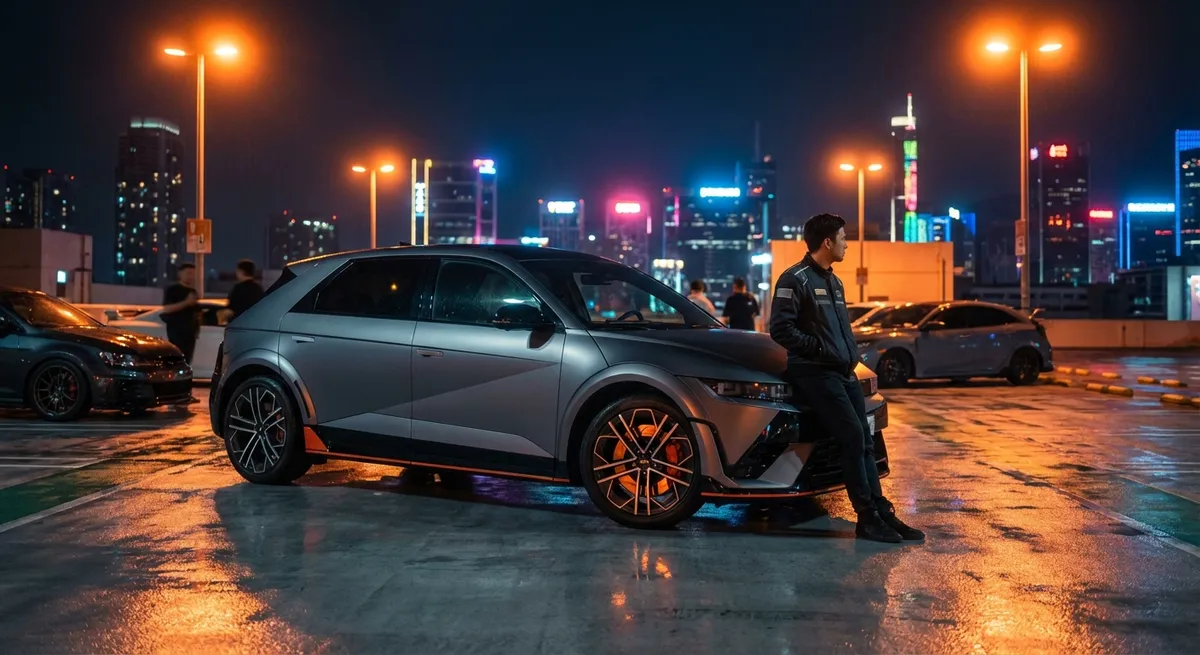
The performance-SUV space has been crowded with badges, body kits, and big numbers that don’t always translate into real-world excitement. Hyundai’s 2025 Ioniq 5 N changes that equation, arriving as one of the first electric crossovers that genuinely feels engineered for enthusiastic drivers rather than just spec-sheet supremacy. For shoppers cross-shopping performance SUVs, premium crossovers, and even traditional hot hatches, this EV raises serious questions about what a “performance SUV” should be.
This review focuses on what matters to detail‑oriented enthusiasts and technical buyers: chassis behavior, powertrain calibration, thermal management, usability, and long-term livability. Is the Ioniq 5 N the first electric SUV that can credibly replace a performance ICE daily driver?
Performance & Powertrain: More Than Just a Big Number
Hyundai didn’t just turn up the wick on the standard Ioniq 5; it re-engineered the powertrain and control software for sustained high-output performance. On paper, the numbers are headline-worthy:
- Dual-motor all-wheel drive
- 166 kW front motor, 282 kW rear motor (approximate global figures; U.S. specs may vary slightly)
- Up to around 641 hp (with N Grin Boost) and roughly 568 lb-ft of torque
- 0–60 mph estimated in the mid-3‑second range, depending on conditions
Where most performance SUVs use a simple “more power, more boost” approach, the Ioniq 5 N’s N Grin Boost (NGB) mode is built for repeatability. You get a short overboost window (about 10 seconds) that ramps available output for overtakes or launches, but the car balances that with active thermal and current management to prevent rapid derating.
Key points for enthusiasts:
- Rear-bias torque distribution: Even though it’s AWD, the control logic is tuned to feel rear‑driven in dynamic modes, with significant torque sent aft under acceleration.
- Fine-grained traction logic: Instead of blunt intervention, the system modulates both motor torque and brake-based vectoring to maintain slip angles appropriate for the selected drive mode.
- One-pedal and blended regen tuning: In performance contexts, overly aggressive regeneration can unsettle the chassis. Hyundai allows multiple regen profiles, letting you tailor lift-off behavior for track versus street use.
The result is an EV SUV that delivers drama and control simultaneously. It accelerates with the ferocity of a performance sedan but feels more connected and less digitally filtered than many rivals.
Chassis, Steering, and Braking: Can It Really Handle Like a Sports Car?
The engineering challenge with any performance SUV—especially an EV—is managing mass. The Ioniq 5 N weighs significantly more than a conventional hot hatch, yet it aims to mimic that agility. Hyundai’s N division tackled this with a combination of structural changes, hardware upgrades, and sophisticated control software.
Chassis & Structure
- Additional body reinforcements increase torsional rigidity over the standard Ioniq 5, improving steering precision and reducing flex under high lateral loads.
- N‑specific suspension subframes and mounting points are designed to handle repeated high‑g cornering and aggressive curb strikes on track.
Suspension & Damping
- Electronically controlled dampers feature N-specific calibration with broader bandwidth between comfort-oriented and track-oriented settings.
- Spring and anti-roll bar rates are increased but paired with adaptive damping logic to maintain acceptable ride quality in normal driving.
- Geometry tweaks target more neutral behavior at the limit, with turn-in sharpening and mid-corner stability prioritized.
Steering
- The rack is quicker and heavier than the standard model’s, but still progressive, reducing the on-center numbness that plagues many EV SUVs.
- Calibration focuses on linear buildup of effort and predictable response rather than artificial heaviness.
Braking
- Large performance brake package with multi-piston front calipers and bigger rotors.
- Integrated brake-by-wire and regenerative braking management designed to deliver consistent pedal feel even as regen blending varies with battery state.
- Thermal robustness is a standout focus: the system is tuned for repeated high-speed stops, not just one dramatic emergency stop for marketing figures.
On a winding road, the Ioniq 5 N feels surprisingly composed. Weight is still present—you can’t cheat physics—but roll and pitch are well contained, grip is abundant, and the chassis communicates enough to inspire confidence. Against traditional ICE performance SUVs, its balance and response are competitive; against most current EV crossovers, it’s in a different league.
Thermal Management, Battery, and Track Endurance
Many performance EVs are brutally fast for a lap or two, then quickly pull power as temperatures climb. Hyundai is explicitly positioning the Ioniq 5 N as “track-capable,” so what’s happening under the skin matters to serious buyers.
Battery & Architecture
- Utilizes Hyundai’s 800V-class E-GMP architecture, enabling high-power DC fast charging and reduced current for a given power level.
- N‑specific battery pack tuning includes revised cooling circuits and control strategies.
- Target is not just peak output, but the ability to sustain repeated high-demand use without severe power limits.
Cooling & Thermal Strategy
- Upgraded cooling circuits for both battery and power electronics, including more aggressive coolant flow and improved heat exchangers.
- Software allows a pre-conditioning function that brings the battery into an optimal temperature window before spirited driving or track sessions (subject to regional features and app integration).
- Thermal modeling is integrated into drive modes: in more aggressive “N” modes, the car prioritizes preserving peak performance for longer sessions, altering regen and power strategies accordingly.
Real-World Implications for Enthusiasts
- Expect more consistent lap-to-lap performance than most mainstream EV SUVs, especially in moderate climates.
- Aggressive continuous lapping in high ambient temperatures will still reveal limitations—this is not a full race car—but the drop-off should be gentler and more predictable.
- For canyon runs, back-road drives, and occasional track days, the Ioniq 5 N’s thermal package is designed to maintain the character you feel on the first pull.
For buyers used to ICE performance SUVs, it’s worth reframing expectations: instead of fuel starvation or brake fade, your primary constraints will be battery temperature and state of charge. Hyundai’s work here doesn’t remove those constraints, but makes them much more manageable for real enthusiasts.
Everyday Usability: Living with a Track-Tuned EV SUV
Performance credentials are only half the story for Top SUV News readers. The Ioniq 5 N still has to function as a daily driver, family hauler, and road-trip partner. Objectively, it retains most of the practicality of the standard Ioniq 5, but with a few trade-offs.
Space and Packaging
- Wheelbase is unchanged from the regular Ioniq 5, preserving generous rear legroom and a flat floor.
- The roofline and overall profile remain more crossover than full-size SUV, but loading and ingress/egress are easy for adults.
- Cargo capacity is similar to the base model, though minor differences may arise due to underfloor packaging changes for the N hardware. For most families, the luggage space will be entirely adequate for trips and sport gear.
Ride Quality & NVH
- Even in comfort mode, the suspension is firmer than the standard model. Road imperfections are more noticeable, especially on lower-quality surfaces.
- That said, compared with traditional performance SUVs on large wheels, the Ioniq 5 N remains livable; the adaptive dampers work to smooth high-frequency harshness.
- Cabin isolation is strong, but with no engine soundtrack, tire and wind noise become more apparent at highway speeds, as with most EVs.
Range, Charging, and Efficiency
- Range will be lower than the most efficient Ioniq 5 trims due to more powerful motors, stickier tires, and performance tuning.
- The 800V system enables high DC fast-charging power (often quoted up to 350 kW capability on suitable chargers), potentially recovering 10–80% battery in around 18–20 minutes under ideal conditions.
- For commuters, home Level 2 charging will easily cover daily use; for enthusiasts, the rapid DC charging allows track days or spirited weekends without impractical downtime, assuming access to competent charging infrastructure.
Tech & Interface
- N‑specific drive mode controls, performance displays, and configurable settings for steering, damping, power delivery, and sound profiles.
- Full suite of advanced driver-assistance systems (ADAS), including adaptive cruise control, lane guidance, and collision-avoidance functions, similar to the regular Ioniq 5.
- The UI leans toward tech-forward and minimalist; owners coming from German brands may find the graphic style different but the functionality competitive.
In daily use, the Ioniq 5 N behaves like a well-equipped, slightly firmer EV crossover, with the added benefit of instant, effortless overtaking performance. The main compromises are ride firmness and range versus the most efficient EVs—but both are reasonable trade-offs for enthusiasts.
Character and Value: Who Is the Ioniq 5 N Really For?
Beyond numbers and hardware, the Ioniq 5 N has a distinct personality. Hyundai’s N division is trying to bottle the playful, engaging feel of classic hot hatches and performance sedans in an EV SUV footprint.
Driving Character
- Multiple “N” modes alter not just throttle and steering, but the entire demeanor of the car—torque split, stability thresholds, sound generation, and transmission emulation.
- Features like simulated gearshifts and performance “sound” are polarizing for purists but can make the experience more relatable for drivers transitioning from ICE. These settings are typically configurable or defeatable, allowing owners to choose a purist or more theatrical character.
- The rear-biased torque distribution and torque-vectoring logic allow for playful rotation in safe environments, a rarity among EV SUVs.
Value Positioning
- Pricing slots it into contention with premium compact performance SUVs and high-spec mainstream crossovers.
- Performance per dollar is substantial when compared to similarly quick ICE SUVs, especially considering the instant torque and lower running costs typical of EVs (electricity vs. fuel, reduced routine maintenance).
- Depreciation and long-term battery health remain key unknowns; buyers should consider warranty coverage, battery guarantees, and potential software update support. Hyundai typically offers competitive EV battery warranties, which is an advantage.
Target Buyer
The Ioniq 5 N is best suited for:
- Enthusiasts who want EV performance and engagement but still need SUV-like practicality.
- Owners of hot hatches or performance sedans who now require more space yet refuse to give up dynamic character.
- Early adopters who are comfortable with EV charging infrastructure and understand the trade-offs of performance-focused EV tuning.
Buyers seeking maximum range, absolute ride comfort, or a traditional luxury ambiance may be better served by other trims or models. But for those who prioritize driving involvement, the Ioniq 5 N stands out as one of the first EV SUVs that genuinely speaks the enthusiast’s language rather than just quoting big power figures.
Conclusion
The 2025 Hyundai Ioniq 5 N marks a turning point: it’s not just another quick electric SUV, but a deliberately engineered performance machine that happens to wear a crossover body. With a robust dual-motor powertrain, carefully tuned chassis, serious thermal management, and credible daily usability, it demonstrates that EV SUVs can be about more than silent speed and upright seating.
For car enthusiasts and analytical buyers, the Ioniq 5 N offers a rare combination: hot-hatch attitude, sports-sedan pace, and EV practicality. It will not satisfy everyone—range-focused drivers and comfort purists will find better fits elsewhere—but as a statement of what an electric performance SUV can be, it’s one of the most compelling entries on the market today.
Sources
- Hyundai Worldwide – IONIQ 5 N Product Overview – Official specifications, features, and N‑specific technology details from Hyundai
- Hyundai USA – IONIQ 5 Model Information – U.S. market Ioniq 5 platform and tech background, useful for understanding the base architecture
- U.S. Department of Energy – Alternative Fuels Data Center: Electric Vehicles – Technical context on EV efficiency, charging, and operational considerations relevant to performance EV SUVs
- EPA – Electric Vehicle Myths – Clarifies common misconceptions about EV range, charging, and environmental impact, framing expectations for EV SUV ownership
- Car and Driver – 2025 Hyundai Ioniq 5 N First Drive – Independent first-drive impressions and performance observations that complement the technical overview above
Key Takeaway
The most important thing to remember from this article is that this information can change how you think about Reviews.