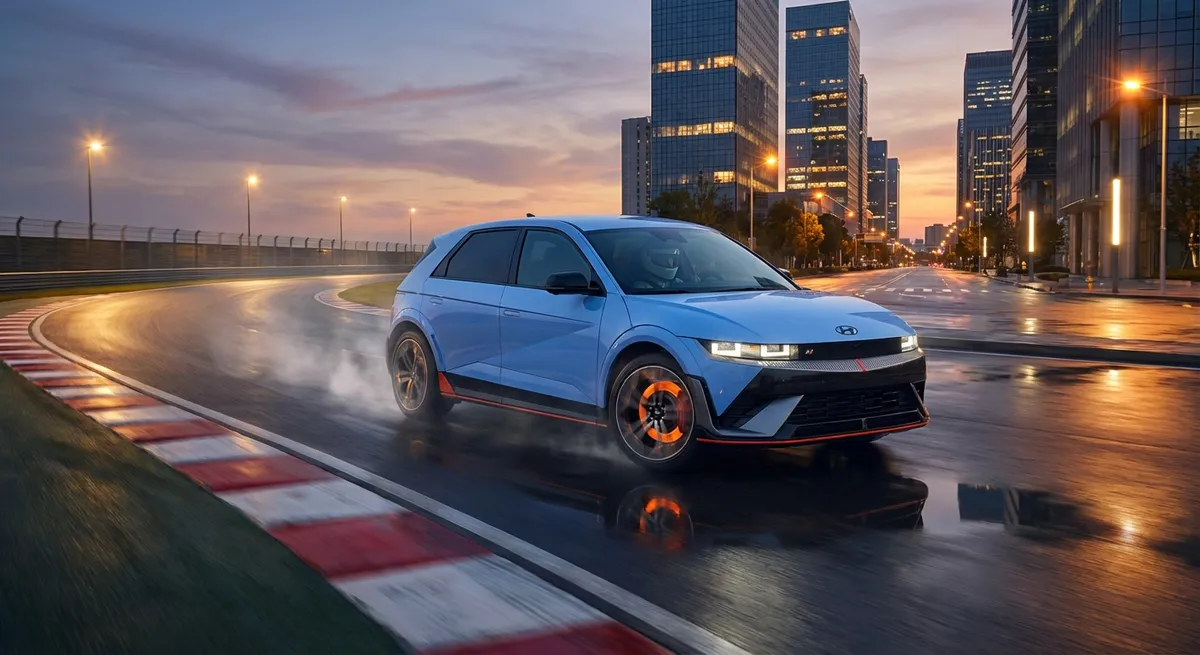
Hyundai’s N division has taken its most distinctive electric crossover, the Ioniq 5, and turned it into a genuine performance SUV that can embarrass sports cars while still running school runs and Costco trips. The 2025 Hyundai Ioniq 5 N isn’t just a power bump; it’s a ground‑up rework of the chassis, software, and thermal systems aimed at drivers who actually push their vehicles hard. This review looks beyond the headline horsepower to evaluate whether the Ioniq 5 N delivers a coherent package for enthusiasts who also need real-world utility.
Powertrain and Performance: More Than Just a Big Number
At the heart of the Ioniq 5 N is a dual‑motor, all‑wheel‑drive setup producing up to 641 hp (with N Grin Boost engaged) and around 568 lb‑ft of torque, depending on market calibration. That’s a massive jump over the standard dual‑motor Ioniq 5 and puts it squarely in competition with performance EV SUVs from premium German brands, despite wearing a mainstream badge.
Acceleration is brutal but controllable. Expect 0–60 mph in the low 3‑second range on a prepared surface, thanks to the instant torque and sophisticated traction control logic. Hyundai’s N engineers have introduced a multi‑stage torque distribution system, allowing finely tuned front‑rear torque splits to maximize grip on both dry and wet pavement.
More important for enthusiasts is how power is deployed over time. Unlike some EVs that deliver a huge punch then taper off, the Ioniq 5 N’s revised inverters and performance‑tuned battery management system maintain strong acceleration deeper into the speedometer. Power delivery in N Mode becomes more progressive, making it easier to modulate throttle mid‑corner rather than dealing with an on‑off surge.
Hyundai also adds N Grin Shift / N Grin Boost, a time‑limited overboost feature that temporarily unlocks maximum power for overtakes or hot laps. While this type of system can feel gimmicky in lesser applications, here it’s integrated with the cooling strategy and traction logic, so the car remains composed during repeated activations in spirited driving, not just on a single drag run.
Chassis, Braking, and Track Durability: Built for Repeated Abuse
Most performance SUVs claim track capability; very few can do multiple hot laps without power fade or brake issues. The Ioniq 5 N has been engineered specifically to address these EV pain points. Hyundai reinforced mounting points, stiffened the body‑in‑white, and revised subframe connections to handle much higher lateral loads than the standard model.
The adaptive suspension is unique to the N variant, with model‑specific damper tuning and stiffer springs. This yields noticeably flatter cornering and quicker response to steering inputs while still preserving compliance over broken pavement in Comfort mode. The electronically controlled limited‑slip differential at the rear further sharpens rotation, especially in intermediate modes that blend stability with mild oversteer on throttle.
Braking hardware is upgraded significantly: large diameter ventilated discs at all four corners, multi‑piston front calipers, and track‑focused brake pads. Equally critical is the recalibrated brake‑by‑wire system, which manages the blend between regenerative and friction braking. In N modes, the car prioritizes consistent pedal feel over maximum energy recovery, minimizing the “step change” some EVs suffer when friction brakes take over unexpectedly during aggressive stops.
Thermal management is a major differentiator. A larger‑capacity cooling circuit, increased heat exchanger surface area, and dedicated N‑Mode cooling logic work together to keep both the battery pack and motors within optimal temperature windows during repeated hard laps. Where many EV crossovers rapidly roll back power when overheated, the Ioniq 5 N is designed to sustain high performance over a usable session. For buyers who actually attend HPDE events or canyon drives, this is a substantial advantage.
Battery, Range, and Charging: Performance Without Completely Sacrificing Practicality
The Ioniq 5 N uses an enhanced version of Hyundai’s E‑GMP platform battery, with capacity in the mid‑70 kWh range (final figures vary by region) and upgraded internal structure to support sustained high discharge rates. With its performance focus, range inevitably drops compared to the more efficiency‑oriented Ioniq 5 trims, but Hyundai leverages the 800‑volt electrical architecture to make recharging exceptionally quick.
On a high‑power DC fast charger (350 kW class), the Ioniq 5 N can recoup roughly 10–80% charge in under 20 minutes under ideal conditions. This mitigates the shorter range by making mid‑journey top‑ups less of a time penalty. Preconditioning logic tied to the navigation system will prep the battery for optimal charging speed on approach to a known DC fast‑charging station, a feature still missing from some competing EV SUVs.
For buyers cross‑shopping traditional performance SUVs, the trade‑off is clear: you’ll visit chargers more often if you regularly exploit the N’s capabilities, but day‑to‑day commuting and mixed driving remain well within a single‑charge envelope. Efficient modes dial back power and adjust climate and ancillary loads to stretch range, and the high‑regeneration settings can regain substantial energy in urban traffic.
Hyundai retains its Vehicle‑to‑Load (V2L) functionality, allowing the Ioniq 5 N to power external devices—handy for track‑side tire warmers, tools, or camping equipment. This versatility underscores the dual mission of the car: hardcore performance when asked, but also a rolling power bank and family hauler when needed.
Interior, Ergonomics, and Technology: Purposeful Without Losing Comfort
Inside, the Ioniq 5 N differentiates itself clearly from the standard model. The driving position is lower and more focused, with heavily bolstered sport seats that provide genuine lateral support without being punishing on longer drives. N‑specific steering wheel, pedals, and trim elements make it immediately clear you’re in the halo performance model, but the cabin still feels airy thanks to the Ioniq 5’s generous glass area and flat floor.
Critical touch points are tuned for fast driving. The steering wheel features programmable N buttons for quick access to preferred drive modes, and paddle shifters are repurposed to control regenerative braking intensity or, in some settings, to simulate gear changes via the N e‑Shift feature. While simulated shifts in an EV are divisive among purists, Hyundai’s implementation aims to give drivers additional rhythm and control rather than just artificially adding theatrics.
The dual 12.3‑inch displays are loaded with N‑specific content: real‑time power distribution, G‑meters, brake temperature approximations, tire pressures, and lap timing functions. Unlike some overloaded performance UIs, Hyundai’s software is relatively intuitive, and key driving‑related functions are not buried multiple menus deep. Wired and wireless smartphone integration remain standard, and a high‑power audio system is available for those who value in‑cabin sound as much as synthesized exhaust notes.
Crucially, the SUV practicality remains intact. The flat‑floor architecture preserves rear legroom, and the cargo area is competitive with other compact‑to‑midsize crossovers. The rear bench folds nearly flat for larger items, and the slightly taller ride height versus a traditional hot hatch makes loading easier. Families can realistically treat this as their primary vehicle, not just a weekend toy, which is a major selling point over lower‑slung performance EVs.
Driving Experience and Ownership Value: Enthusiast Focus at a Strategic Price Point
On the road, the Ioniq 5 N distinguishes itself by feeling engineered by enthusiasts, not just marketers. Steering weighting is natural in its sportier modes, with more feedback than many electric crossovers. The car rotates eagerly into corners but remains stable under power, and the various N drive modes offer meaningful differentiation instead of minor tweaks to throttle mapping.
For buyers, the value proposition hinges on how much they care about this dynamic polish. The Ioniq 5 N is expected to undercut many European performance EV SUVs in price while offering comparable or higher output, similar charging speeds, and a more comprehensive track‑oriented engineering package. That positions it as a “thinking enthusiast’s” choice: not the cheapest EV, nor the most traditionally luxurious, but a highly focused performance tool that still does normal‑life duties well.
Ownership benefits include Hyundai’s strong EV warranty coverage and a growing support ecosystem for high‑voltage service. For track‑day regulars, the combination of factory‑engineered cooling, brake hardware, and software controls means less reliance on aftermarket modifications to achieve reliable performance.
Potential downsides for some buyers include the more aggressive styling, firmer ride in sport settings, and the fact that maximum capability is only fully unlocked when you accept increased energy consumption and more frequent charging. But for enthusiasts who’ve been waiting for an EV SUV that can genuinely replace their gas hot hatch or performance sedan while adding space and practicality, the Ioniq 5 N stands out as one of the most coherent executions to date.
Conclusion
The 2025 Hyundai Ioniq 5 N is not just a quicker version of an existing EV crossover; it’s a purpose‑built performance SUV that makes few compromises when pushed hard, yet remains usable as a daily family vehicle. Its sophisticated thermal management, serious braking package, and track‑oriented software set it apart in a segment where “sporty” often means just a stiffer suspension and a power increase. Coupled with ultra‑fast charging and a spacious, tech‑rich interior, the Ioniq 5 N delivers a compelling blend of speed, practicality, and value that should put it on the shortlist for any performance‑minded SUV shopper considering the jump to electric.
Sources
- [Hyundai Global – IONIQ 5 N World Premiere](https://www.hyundai.com/worldwide/en/company/newsroom/hyundai-motor-unveils-ioniq-5-n-0000018103) - Official technical overview and key specs directly from Hyundai
- [Hyundai Motor Group E-GMP Platform Overview](https://www.hyundaimotorgroup.com/innovation/e-gmp.do) - Detailed information on the 800‑V EV platform underpinning the Ioniq 5 N
- [EPA – Electric Vehicle Basics](https://www.fueleconomy.gov/feg/evtech.shtml) - Background on EV efficiency, range, and charging relevant to understanding trade‑offs in performance EVs
- [IIHS – SUV Size and Safety Considerations](https://www.iihs.org/topics/suvs) - Context on SUV dynamics and safety that informs how performance SUVs are engineered
- [SAE International – Brake Systems in Electric Vehicles](https://www.sae.org/news/2020/04/brake-systems-for-evs) - Technical discussion of regenerative and friction braking integration in EVs
Key Takeaway
The most important thing to remember from this article is that this information can change how you think about Reviews.