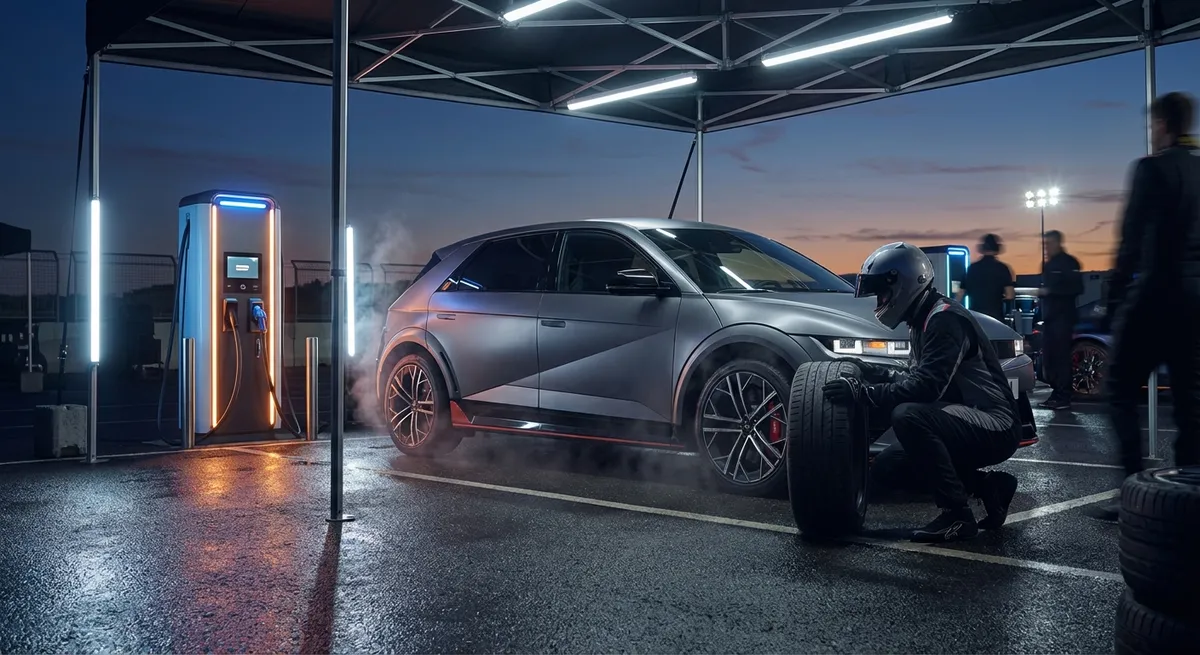
Hyundai’s N division has been steadily earning credibility among enthusiasts, but the 2025 Ioniq 5 N is the brand’s boldest move yet: a performance-focused, electric, SUV-shaped crossover aimed at people who care as much about lap times and steering feel as they do about rear-seat space and charging speed. This isn’t just an Ioniq 5 with more power—it’s a comprehensive re-engineering of the platform, targeting drivers who might otherwise gravitate toward a performance Tesla Model Y, Mustang Mach-E GT, or even a hot hatch they’ve outgrown. Below, we break down what makes the Ioniq 5 N distinct, and where it truly delivers for enthusiasts and real-world buyers.
Performance Engineering: More Than Just a Power Bump
On paper, the numbers are immediately serious. The dual-motor all-wheel-drive system in the Ioniq 5 N delivers up to 448 kW (641 hp) in “N Grin Boost” mode and around 601 hp in standard performance tune, paired with 568 lb-ft of torque. Hyundai uses a heavily revised version of the E-GMP architecture, upgrading power electronics and cooling to handle repeated high-load use—crucial for track days and aggressive canyon driving.
What separates this SUV from mainstream EVs is how its performance is structured. The front and rear motors are tuned for precise torque distribution, with software that can bias more power to the rear to simulate classic rear-drive dynamics. Hyundai has recalibrated the inverters and battery output for rapid, repeatable acceleration, not just a single headline 0–60 mph run. Thermal management is more robust than the standard Ioniq 5, with additional radiators, optimized coolant routing, and a dedicated “Track” mode that preconditions the battery for high-load stints.
From a driver’s standpoint, the instant torque is managed through carefully mapped throttle response, avoiding the “light switch” feel of some powerful EVs. Multiple drive modes alter pedal mapping, torque distribution, and stability system thresholds, so the same SUV can feel docile in traffic or aggressively responsive on a back road. The result is performance that isn’t just about straight-line shock value—it’s about sustaining speed and control when the road gets demanding.
Chassis, Suspension, and Braking: SUV Body, Near-Hot-Hatch Precision
The Ioniq 5 N stands taller than a traditional hatchback, but Hyundai’s engineers have worked to make the chassis behave like something far smaller and lighter than its curb weight suggests. Key to this is a multi-stage approach: a more rigid body structure, model-specific suspension hardware, and deeply integrated software control.
The body-in-white receives additional structural adhesives and reinforcements at critical points such as the front subframe mounts, rear suspension towers, and underbody bracing. This stiffness allows the adaptive dampers—electronically controlled at each corner—to react with precision rather than masking flex. The suspension geometry is tuned specifically for the N variant, including revised spring rates, thicker anti-roll bars, and different bushing compounds that prioritize feedback over isolation.
Steering is a variable-ratio, electrically assisted rack with an N-specific calibration. Assist is reduced and resistance increased in the sportiest modes to keep the driver connected to front tire grip levels, and the system is tuned to minimize the “rubber band” feel some EVs suffer from. Braking hardware is serious: large ventilated rotors with multi-piston calipers up front, combined with aggressive brake-by-wire software that blends regen and friction seamlessly. Hyundai has programmed the system to maintain consistent pedal feel whether the car is relying more on regenerative braking (for efficiency) or friction braking (for repeated high-speed stops).
The combination of low center of gravity (thanks to the underfloor battery pack), stiffer chassis, and precise suspension calibration means the Ioniq 5 N can carve corners more like a tall hot hatch than a typical family SUV. For enthusiasts, the key takeaway is that this is not just a fast EV—it’s one that actively invites you to explore grip limits.
Battery, Range, and Charging: Balancing Speed with Real-World Use
Underneath the performance persona, the Ioniq 5 N still has to function as a daily SUV. Hyundai equips it with a large-capacity battery pack (around 84 kWh usable, depending on final market specs), using advanced thermal management and updated chemistry to withstand repeated high-power use. Expect EPA range to be lower than the standard Ioniq 5 due to more aggressive tires, higher-output motors, and performance-focused aerodynamics, but still adequate for commuting and weekend drives.
The E-GMP platform’s 800-volt architecture remains a standout advantage. On a compatible DC fast charger, the Ioniq 5 N can theoretically go from around 10% to 80% in approximately 18–25 minutes under ideal conditions, similar to the standard Ioniq 5. This high-voltage design allows charging at over 200 kW peak, which matters for enthusiasts who may drive hard and need a quick recharge before heading home or back on track.
Battery cooling and preconditioning are critical if you plan to use rapid charging frequently. The N’s software includes modes that warm the battery to an optimal temperature before a fast-charging stop, especially when navigation is set to a DC fast charger. This not only shortens charging time but also helps protect long-term battery health. Additionally, Hyundai continues to offer vehicle-to-load (V2L) capability, letting you power tools, camping gear, or track-day accessories from the SUV’s battery when parked.
For buyers, the most important point is that performance does reduce range, but the charging speed and thermal strategy help offset that penalty in real-world ownership. If your typical use is mixed city and highway driving with occasional spirited runs, the Ioniq 5 N’s energy efficiency remains reasonable, given the power on tap.
Interior, Tech, and Daily Usability: Enthusiast-Focused Without Sacrificing Comfort
While the exterior styling gets more aggressive bodywork, functional aero elements, and unique wheels, the interior is where the “dual personality” really shows. The cabin layout is familiar from the regular Ioniq 5, with a wide digital display array and flat floor, but the N variant adds deeply bolstered sport seats, a thicker steering wheel, and physical N-mode buttons that provide quick access to performance settings.
Materials are upgraded with suede-like surfaces, contrasting stitching, and N-specific color accents. The front seats are shaped to support lateral loads in spirited driving while still being comfortable for multi-hour highway stints. Rear-seat legroom remains generous thanks to the long wheelbase, and the boxy roofline preserves headroom—key advantages over more coupe-like performance crossovers. Cargo space in the rear is sufficient for family gear or track-day tires and tools, and the split-folding rear bench increases flexibility.
Tech-wise, Hyundai’s infotainment system offers crisp graphics, responsive touch inputs, and standard smartphone integration (Apple CarPlay and Android Auto, wired or wireless depending on region). N pages within the infotainment suite display key performance metrics: battery temperature, motor output, G-meter, lap timing, and customizable profiles for steering, suspension, ESC intervention, and synthetic sound.
Driver-assistance features are comprehensive, including adaptive cruise control, lane-keeping assist, blind-spot monitoring, and available Highway Driving Assist for semi-automated freeway driving. Importantly for enthusiasts, the most aggressive performance modes can scale back or disable some aids when you want a purer driving experience, while default modes keep the full safety suite active for daily use.
Ownership, Value, and Who This SUV Really Suits
Performance EVs with usable family space are no longer rare, but the Ioniq 5 N occupies a specific niche: it’s for drivers who prioritize engagement and character over maximum range or stripped-down track purity. Pricing (depending on market and final equipment) will place it among higher-spec crossovers and near premium-brand performance EVs, but Hyundai counters with an extensive warranty, typically including long coverage on battery and electric drivetrain components.
Running costs will depend heavily on how and where you drive. Frequent fast charging and aggressive driving will increase energy use and tire wear; wide, sticky tires and large brakes are not inexpensive consumables. However, compared with a similarly quick gasoline performance SUV, you avoid fuel costs and much of the traditional powertrain maintenance—no oil changes, fewer moving parts, and regenerative braking that can reduce pad and rotor wear in normal driving.
For potential buyers, the key questions are: do you want an EV that feels genuinely engineered for enthusiastic driving rather than just “made faster,” and do you need SUV-level space? If the answer to both is yes, the Ioniq 5 N deserves a spot on your shortlist. It won’t deliver the longest range in its segment, and its styling will be more extroverted than some prefer, but the depth of engineering underneath makes it one of the most interesting performance-oriented SUVs currently entering the market.
Enthusiasts coming from hot hatches or performance sedans will appreciate the way the N treatment transforms the base Ioniq 5 platform, while families will find the everyday hardware—charging, safety tech, space—competitive with more conventional crossovers. It’s a rare performance EV that doesn’t ask you to choose between fun and functionality.
Conclusion
The 2025 Hyundai Ioniq 5 N shows how far performance SUVs have come in the EV era. It combines serious hardware, thoughtful software tuning, and practical packaging in a way that can satisfy both a demanding driver and a busy household. While it won’t be the right choice for buyers chasing maximum range or lowest price, it stands out as a driver-focused electric SUV that doesn’t abandon the core expectations of the segment: space, safety, and everyday usability. For shoppers cross-shopping performance crossovers and high-output EVs, the Ioniq 5 N is a compelling sign that the “enthusiast SUV” can survive—and even thrive—in a fully electric future.
Sources
- [Hyundai Worldwide – Ioniq 5 N Global Reveal](https://www.hyundai.com/worldwide/en/company/newsroom/hyundai-motor-unveils-ioniq-5-n--its-first-high-performance-ev-0000016872) - Official technical and feature overview from Hyundai’s global press site
- [Hyundai USA – E-GMP Platform Overview](https://www.hyundaiusa.com/us/en/vehicles/ioniq-5/e-gmp-platform) - Background on the 800-volt architecture, charging capabilities, and chassis layout
- [U.S. Department of Energy – Alternative Fuels Data Center](https://afdc.energy.gov/vehicles/electric.html) - Context on EV efficiency, charging, and operating considerations compared to internal-combustion vehicles
- [EPA – Electric Vehicle Basics](https://www.epa.gov/greenvehicles/electric-vehicle-myths) - Information on EV range, charging, and battery impacts relevant to performance EV ownership
- [IIHS – Vehicle Safety Ratings](https://www.iihs.org/iihs/ratings) - Reference for safety expectations and test procedures applicable to modern SUVs
Key Takeaway
The most important thing to remember from this article is that this information can change how you think about Reviews.