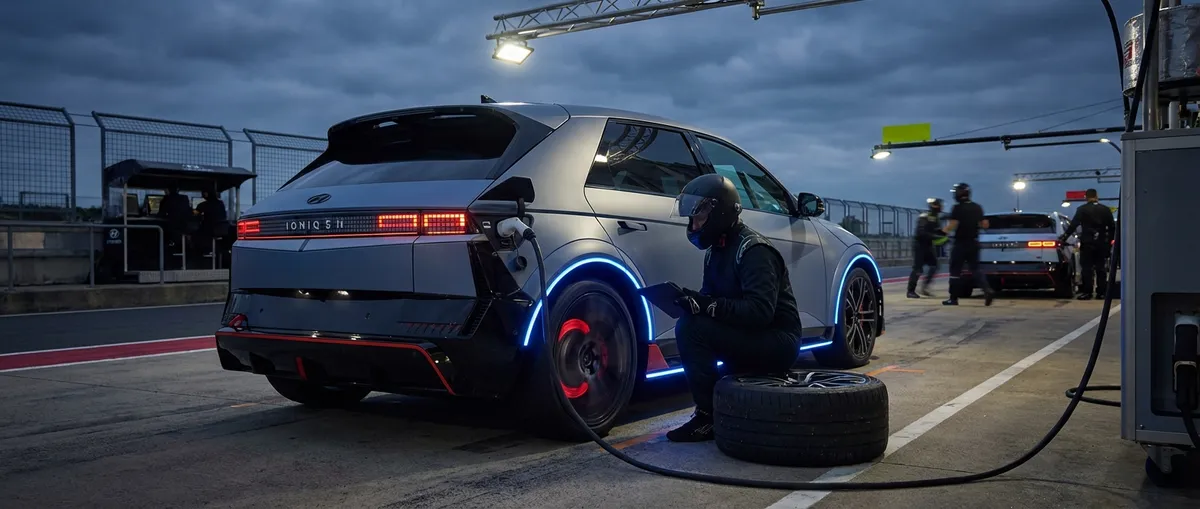
Hyundai’s N division has built its reputation on rowdy hot hatches and sedans, but the 2025 Ioniq 5 N is the brand’s first attempt to inject that same personality into an electric SUV. It’s not just a quicker version of the standard Ioniq 5; this is a purpose‑built performance EV that tries to merge daily practicality with track‑ready hardware and software. For SUV shoppers who love driving as much as they value cargo space and charging ports, the Ioniq 5 N is one of the most technically interesting new models on the market.
Below is a detailed review focused on five areas enthusiasts and serious buyers will care about: powertrain and performance, chassis and steering, thermal and battery management, interior and usability, and charging and ownership trade‑offs.
Powertrain and Performance: EV Speed With Engineered Drama
The Ioniq 5 N uses a dual‑motor, all‑wheel‑drive setup based on Hyundai’s E‑GMP platform, but nearly every performance‑critical element has been reworked. The front and rear motors have unique windings and inverters, and together they deliver up to 641 hp (478 kW) and 568 lb‑ft of torque in N Grin Boost, a temporary overboost mode activated via the steering wheel. Standard output is slightly lower, but still well over 600 hp—numbers that put this compact SUV in the same league as many super‑sedans and premium performance SUVs.
Acceleration is predictably vicious. Hyundai claims a 0–62 mph (0–100 km/h) time of around 3.4 seconds when launch control is used with a fully charged battery, and independent instrumented tests are likely to verify sub‑3.5‑second 0–60 mph runs. Top speed is rated at 162 mph, unusually high for an EV in this class, reflecting the car’s track‑oriented brief. Importantly, the Ioniq 5 N doesn’t just rely on raw thrust; Hyundai has programmed N‑specific driving modes that change torque distribution, throttle mapping, and stability‑control thresholds to create distinct personalities for road, canyon, and circuit driving.
One of the more controversial features is N e‑Shift, a software layer that simulates an 8‑speed dual‑clutch transmission by modulating torque and adding “shift shocks.” Paired with N Active Sound+, which pipes synthesized engine‑like sound through the speakers, the SUV tries to recreate the familiar rhythm of ICE performance cars. Enthusiasts will either appreciate the engagement—or turn everything off and enjoy seamless EV thrust. The key takeaway is that Hyundai isn’t just chasing numbers; it’s trying to engineer subjective feel into the EV performance experience.
Chassis, Steering, and Braking: A Sharper Edge Than Typical EV SUVs
Most EV SUVs are tuned for comfort and straight‑line speed, not precision. The Ioniq 5 N breaks that mold with a thorough chassis overhaul that goes well beyond stiffer springs. The body‑in‑white gets additional welding points and structural adhesives for improved torsional rigidity, while front and rear subframes are reinforced to handle higher cornering loads. Wider tracks, unique N suspension components, and electronically controlled dampers with N‑specific calibration all contribute to noticeably sharper responses than the standard Ioniq 5.
Steering feel, often a weak point in EVs, is another focus area. The N‑tuned rack features revised assist curves and quicker ratios, delivering more weight and a more linear response around center. In practice, the SUV feels smaller than its footprint suggests, especially in tighter corners where the front end bites eagerly. Hyundai’s N Torque Distribution system can send up to 100% of available rear torque to either wheel, enabling quasi‑torque‑vectoring behavior that tightens cornering lines and helps rotate the car under power.
Braking hardware is equally serious. Massive four‑piston front calipers clamp onto large‑diameter, ventilated rotors, and the Ioniq 5 N uses a sophisticated blended braking strategy that prioritizes regenerative deceleration but seamlessly adds friction braking when needed. The goal is consistent pedal feel and fade‑resistant stopping power during repeated high‑speed braking events—something that has historically challenged performance EVs. Optional track‑oriented tires further elevate grip levels but will exact a price in wear rates and noise; buyers should be honest with themselves about how aggressively they plan to drive.
Thermal and Battery Management: Built to Survive Track Sessions
One of the biggest questions around performance EVs is not how fast they are in a single sprint, but how long they can sustain that pace. The Ioniq 5 N addresses this with upgraded thermal management and a revised 84‑kWh battery pack (usable capacity may vary slightly by market). A strengthened battery structure improves mechanical robustness, while dual‑stage thermal circuits, an enlarged cooling area, and an N‑specific radiator and coolant path help maintain stable temperatures during repeated laps.
Hyundai offers selectable “N Race” modes—Endurance and Sprint—that alter how aggressively the system deploys the battery’s power. Sprint prioritizes maximum performance for short sessions, while Endurance trims peak output slightly in exchange for more consistent lap‑to‑lap performance and lower thermal stress. This is a rare level of control in an EV SUV and demonstrates that Hyundai expects customers to actually drive the car on track, not just bench‑race online.
Regenerative braking is also tuned with circuit use in mind. Multiple regen levels, including strong one‑pedal deceleration, allow the driver to recover a substantial amount of energy and reduce heat buildup in the mechanical brakes. The software manages battery charging limits dynamically based on temperature, preventing the kind of sudden power derating that can sour the track experience in less sophisticated performance EVs. For owners, this means more predictable performance and less anxiety about the car “going limp” after a handful of hard laps.
Interior, Practicality, and Daily Usability: A Dual‑Personality Cabin
Despite its track ambitions, the Ioniq 5 N remains an SUV at its core, sharing the same general body and interior dimensions as the regular Ioniq 5. That means a long wheelbase, generous rear legroom, and a flat floor enabled by the E‑GMP platform. The boxy silhouette translates into good headroom front and rear, and the cargo area is still competitive for the segment, even with minor packaging changes to accommodate performance hardware. This isn’t a low‑roof performance crossover that sacrifices practicality purely for style.
Inside, N‑specific front bucket seats offer deeper bolstering, integrated headrests, and additional support for lateral loads, while still remaining comfortable enough for daily commuting. The steering wheel gains configurable N buttons for rapid access to performance modes and functions like N Grin Boost, while unique pedals, trim colors, and seat stitching distinguish the cabin from the standard model. Materials quality is generally on par with other upper‑trim Ioniq 5 variants: a mix of soft‑touch surfaces, durable plastics, and eco‑friendly materials that reflect Hyundai’s broader sustainability messaging.
The dual 12.3‑inch screens run Hyundai’s latest infotainment and digital‑instrument software, augmented with N‑specific performance pages that display lap times, temperature readouts, g‑meters, and torque distribution graphics. Apple CarPlay and Android Auto remain supported (wired in some markets, wireless in others), and a full suite of driver‑assistance systems—adaptive cruise control, lane‑centering, blind‑spot monitoring, rear cross‑traffic alert, and more—come standard or are widely available. The result is a cabin that can pivot from data‑rich track cockpit to family hauler with little compromise.
However, buyers should be aware that the extra structural bracing, performance seats, and larger wheels do introduce trade‑offs. Ride quality, while not punishing, is noticeably firmer than a regular Ioniq 5, especially in the sportier damper settings. Noise levels from sticky performance tires are higher on coarse pavement, and some drivers may find the heavily bolstered seats less accommodating for very long highway trips. These are expected compromises when moving into the performance‑SUV end of the market, and shoppers should test‑drive back‑to‑back with non‑N trims if comfort is a top priority.
Charging, Range, and Ownership Trade‑Offs: Living With a High‑Output EV SUV
The Ioniq 5 N leverages one of the E‑GMP platform’s biggest advantages: an 800‑V electrical architecture that supports ultra‑fast DC charging. Under ideal conditions on a high‑power charger, the battery can reportedly go from 10% to 80% in roughly 18 minutes, assuming compatible infrastructure and a properly conditioned battery. Hyundai also supports battery pre‑conditioning tied to navigation—if you route to a DC fast charger or a racetrack, the car can adjust pack temperature en route to optimize charging or performance.
Range will be a crucial consideration. Official EPA figures for the Ioniq 5 N will likely be lower than those of regular dual‑motor Ioniq 5 trims due to wider tires, more aggressive aero elements, and performance‑oriented software tuning. Prospective buyers should expect a realistic mixed‑driving range that is adequate for daily use but not class‑leading among EV SUVs. Hard driving or extended track sessions will accelerate consumption dramatically; owners planning regular track days should factor in time for charging between sessions or consider access to on‑site chargers.
On the plus side, the Ioniq 5 N retains vehicle‑to‑load (V2L) capability, allowing the SUV to power external devices through an onboard outlet or adapter. This can be useful at track events (powering tools, laptops, tire warmers) or for recreational use (camping, tailgating, emergency backup). Warranty coverage and battery guarantees typically mirror Hyundai’s broader EV portfolio, which is competitive in the industry and provides some peace of mind for first‑time EV buyers.
From an ownership‑cost perspective, the Ioniq 5 N will likely carry a substantial price premium over mainstream Ioniq 5 trims and may overlap with lower‑end luxury performance SUVs. However, “fuel” and maintenance costs should remain lower than those of similarly quick gasoline performance vehicles—there’s no engine oil, spark plugs, or exhaust system to maintain, and regenerative braking reduces wear on pads and rotors in everyday driving. Enthusiasts should weigh the higher upfront price against the long‑term operating‑cost advantages and the unique driving experience on offer.
Conclusion
The 2025 Hyundai Ioniq 5 N is one of the clearest signs yet that performance SUVs in the EV era don’t have to be sterile appliances. By combining a high‑output dual‑motor powertrain with serious chassis upgrades, advanced thermal management, and a still‑practical SUV body, Hyundai has created a compelling option for drivers who want track‑capable hardware without giving up daily usability. Its simulated shifts and artificial soundscape may divide opinion, but they underscore a broader point: manufacturers are actively experimenting with how to make electric performance engaging, not just fast.
For enthusiasts and potential buyers, the Ioniq 5 N is worth a close look—and a thorough test drive that includes both rough city streets and your favorite backroad. It demands some compromises in range and ride comfort, but it delivers something rare in the EV SUV space: a genuine sense of character backed by robust technical engineering.
Sources
- Hyundai Global – IONIQ 5 N Product Overview – Official technical and feature information on the Ioniq 5 N from Hyundai
- Hyundai Motor Group – E-GMP Platform Details – In‑depth explanation of the 800‑V E‑GMP architecture, charging, and packaging
- EPA – Electric Vehicle Basics – Background on EV efficiency, range, and charging that helps contextualize Ioniq 5 N ownership
- U.S. Department of Energy – Alternative Fuels Data Center – Data on charging infrastructure and EV fueling considerations relevant to performance EV SUVs
- Car and Driver – 2023 Hyundai Ioniq 5 Review – Baseline reference for the standard Ioniq 5’s driving dynamics, packaging, and technology
Key Takeaway
The most important thing to remember from this article is that this information can change how you think about Reviews.