Hyundai is preparing to move from EV contender to family-hauling heavyweight with the 2025 Ioniq 7, a three-row electric SUV designed to tackle everything from school runs to long-distance road trips. Built on the same E-GMP platform as the Ioniq 5 and Kia EV9, the Ioniq 7 targets buyers who want genuine space, advanced tech, and credible range without stepping into luxury-brand pricing. This first-look review breaks down what matters most for enthusiasts and serious shoppers, with a focus on usable performance, charging reality, and everyday practicality.
Powertrain, Performance, and Driving Dynamics
Hyundai is expected to offer the Ioniq 7 with multiple powertrain configurations, broadly mirroring what we’ve already seen on the E-GMP platform: a single-motor rear‑wheel‑drive (RWD) variant for efficiency, and a dual‑motor all‑wheel‑drive (AWD) model prioritizing traction and performance.
The RWD version will likely use a rear-mounted permanent-magnet synchronous motor in the 215–230 hp range, tuned for smooth torque delivery and low energy consumption rather than outright speed. The dual‑motor AWD configuration should climb into the 300–380 hp bracket, depending on final calibration, with torque split electronically between the axles. Expect sub-6‑second 0–60 mph runs in higher-output trims, putting it squarely in line with other performance‑oriented family EVs.
E-GMP’s integrated drive units and low-mounted battery pack contribute to a low center of gravity and near-ideal weight distribution, helping counteract the tall profile typical of three-row SUVs. Multi-link rear suspension and frequency-selective dampers (or adaptive dampers on upper trims) should balance comfort and body control, especially under full load. Regenerative braking will be adjustable via steering wheel paddles, allowing drivers to choose between coasting and near one‑pedal driving. Enthusiasts will appreciate the likely inclusion of Hyundai’s “i-Pedal” mode and different drive modes that adjust throttle mapping, steering assist, and motor behavior for Eco, Normal, Sport, and Snow scenarios.
Noise, vibration, and harshness (NVH) will be critical in such a large EV, and Hyundai has been steadily improving cabin isolation. Acoustic glass, subframe isolation bushings, and active sound design (to provide synthetic powertrain sound if desired) are expected, along with robust underbody aero shielding to cut wind and road noise. The result should be a quiet, composed highway cruiser that still feels responsive when you lean on the accelerator.
Battery, Range, and Real-World Charging Usability
The Ioniq 7 will ride on Hyundai’s 800‑volt E-GMP electrical architecture, a core technical advantage in this segment. This enables ultra-fast DC charging on compatible high‑power chargers. Based on existing E-GMP models, Hyundai targets 10–80% charge in roughly 20–25 minutes when plugged into a 350 kW DC fast charger, assuming optimal conditions. For buyers who actually road trip, that’s the difference between EV ownership feeling like a compromise and feeling genuinely convenient.
Battery capacity is expected to land in the 90–100 kWh usable range for long-wheelbase, three-row duty. Hyundai has signaled an all‑day‑usable EPA range target in the neighborhood of 270–320 miles, depending on configuration, wheel size, and drive type. Rear‑drive versions on more conservative wheel/tire packages will likely post the best numbers, while AWD trims with larger wheels will pay a penalty. Prospective owners should mentally subtract 10–20% from official ratings for winter driving, high-speed highway travel, and heavy loads—common realities for a family SUV.
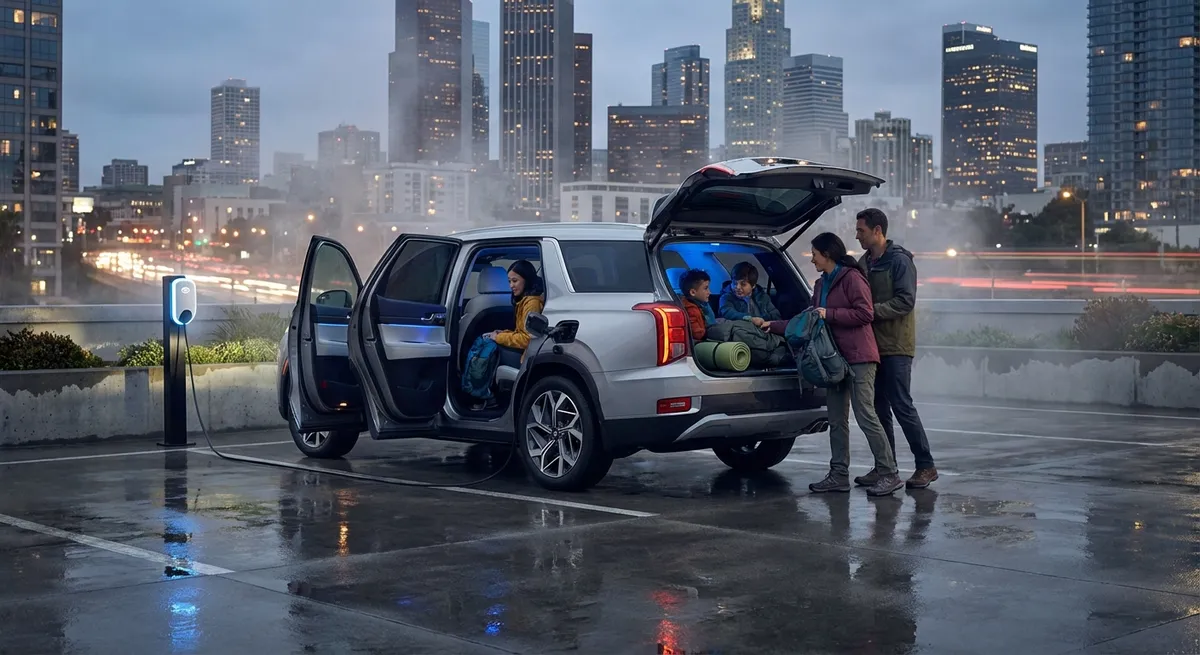
E-GMP also supports bi-directional charging, including vehicle-to-load (V2L) functionality. The Ioniq 7 is expected to offer onboard power outlets (likely 120V in North America) that can run tools, camping equipment, or even a home fridge during an outage, within power limits. This turns the SUV into a large mobile battery with practical applications for outdoor enthusiasts and homeowners alike.
On Level 2 AC charging (typical home or workplace setups at 7–11 kW), a full charge from near-empty will take roughly 8–12 hours, depending on onboard charger capacity and circuit rating. For most owners, that translates into overnight “refills” that easily cover daily commuting and errands without visiting a public charger at all.
Space, Packaging, and Everyday Family Practicality
The Ioniq 7’s mission is to be a genuine three-row family hauler, not a “2+kids” crossover with a token third row. The advantages of its dedicated EV platform are clear: a long wheelbase, short overhangs, flat floor, and no transmission tunnel free up interior volume in all three rows.
Expect generous legroom in the first and second rows, with sliding and reclining second‑row seats to optimize passenger or cargo space as needed. The third row should be adult‑capable for shorter trips, particularly thanks to the flat floor and high roofline, though, as with most three-row SUVs, it will be best suited to teens and children for longer journeys. Access is likely to be aided by wide-opening rear doors and easy-fold second-row mechanisms.
Cargo space will be a key metric. With all three rows up, capacity may be modest but still adequate for grocery runs or carry‑on luggage for the family. Fold the third row, and you’re looking at a large, flat load area capable of swallowing strollers, sports gear, or multiple suitcases. With both second and third rows folded, the Ioniq 7 should rival midsize crossovers for total volume, usable for hauling small furniture or home improvement supplies. A small front trunk (frunk) is expected, ideal for charge cables, emergency kits, or dirty gear you’d rather not keep in the cabin.
Cabin storage solutions—multiple USB‑C ports, large door bins, covered center console space, and configurable cup holders—will matter day-to-day just as much as headline cargo specs. Hyundai has been paying attention to these details in recent models, and the Ioniq 7 will be under pressure to match or exceed rivals like the Kia EV9, Tesla Model X, and upcoming three-row EVs from traditional brands. Families should pay attention to seat height and step‑in ergonomics as well: an SUV that’s too high or too low can be a chore for kids, older adults, or anyone installing child seats regularly.
Tech, Infotainment, and Driver Assistance Systems
Hyundai is positioning the Ioniq 7 as a technology showcase, and its interior will be anchored by a wide, integrated digital display spanning instrument cluster and infotainment. Expect a 12.3–15‑inch central touchscreen paired with a 12.3‑inch digital gauge cluster, running Hyundai’s latest connected car software with over‑the‑air (OTA) update capability. This enables ongoing improvements to navigation, charging route planning, infotainment apps, and even some vehicle functions without dealer visits.
Wireless Apple CarPlay and Android Auto are likely, although Hyundai’s current implementation varies by market and trim. Built-in navigation will be particularly important in an EV, as it can coordinate with the battery management system to pre-condition the pack ahead of fast charging, significantly improving charging speed and consistency. A head-up display with augmented reality overlays may appear on higher trims, projecting navigation and safety information into the driver’s line of sight.
For rear passengers, multiple USB-C ports, optional rear climate controls, and potentially entertainment or device-mounting solutions will help keep long trips manageable. Premium audio options (such as a Bose or Harman/Kardon system) will aim to justify upper-trim pricing and take advantage of the quiet EV cabin.
On the driver assistance front, Hyundai’s latest suite (often branded as Hyundai SmartSense) will be standard or widely available. That typically includes:
- Adaptive cruise control with stop-and-go functionality
- Lane keeping assist and lane centering
- Blind-spot monitoring with rear cross-traffic alert
- Highway Driving Assist (combining adaptive cruise and lane centering on mapped highways)
- Surround-view camera with 3D visualization
- Remote Smart Parking Assist for tight spaces
Higher trims may introduce more advanced semi-automated driving features, potentially incorporating lane-change assist and improved junction support, depending on regulatory approval. It’s important to recognize these as Level 2 systems: they can reduce driver workload but still require full driver attention and hands on the wheel.
Ownership Costs, Positioning, and Who the Ioniq 7 Really Suits
Hyundai’s strategy with the Ioniq 7 is to occupy a “near-premium” space: more polished and feature-rich than mainstream internal-combustion three-row SUVs, but priced below luxury EVs. While official pricing was not finalized at time of writing, positioning in the upper $50,000s to mid‑$70,000s (USD) before incentives for North America would align with both the EV9 and upcoming competitive set.
Total cost of ownership will depend heavily on local electricity rates, charging habits, and available incentives. For drivers who can regularly charge at home off-peak, energy costs per mile should significantly undercut gasoline, especially compared with a similarly sized V6 or turbocharged three-row SUV. Maintenance should be comparatively low, with no oil changes, fewer moving parts in the powertrain, and reduced brake wear thanks to regenerative braking. Tire wear may be higher than average due to vehicle weight and instant torque—something to factor into long-term budgeting.
Potential federal tax credits or local incentives can alter the value equation considerably. In the U.S., eligibility will hinge on final assembly location and battery sourcing rules under evolving clean vehicle credit regulations. Prospective buyers should verify current incentive status at time of purchase, as these programs are in flux and vary by market.
The Ioniq 7 will best suit:
- Families needing real three-row space who are ready to transition to an EV
- Drivers who value fast‑charging capability for regular long-distance travel
- Enthusiasts who appreciate smooth, instant torque and modern tech without paying luxury-brand premiums
- Homeowners with access to Level 2 charging, maximizing convenience and lower running costs
Shoppers who frequently tow near maximum capacity, routinely travel far from charging infrastructure, or require heavy off-road capability may still be better served by a traditional body-on-frame SUV or plug-in hybrid—at least until charging networks become more ubiquitous in remote regions.
Conclusion
The 2025 Hyundai Ioniq 7 signals how quickly the SUV landscape is evolving: what used to require a large gasoline V8 or turbodiesel—space, comfort, and long-distance capability—is now being reimagined around high-voltage batteries and electric motors. With its E-GMP architecture, fast charging, three-row packaging, and advanced tech suite, the Ioniq 7 is shaping up as a serious contender for families and enthusiasts who want to move into an electric future without sacrificing practicality.
Final verdicts will have to wait for full instrumented testing and real-world range evaluation, but on paper the Ioniq 7 looks like one of the most balanced approaches to the electric family SUV yet: technically sophisticated, realistically usable, and targeted at the heart of the mainstream rather than the extremes of luxury or off-road specialization.
Sources
- Hyundai Global – E-GMP Platform Overview - Technical background on the electric platform underpinning the Ioniq 7 and its capabilities
- U.S. Department of Energy – Alternative Fuels Data Center: Charging - Explains home and public charging levels, charging times, and practical considerations
- EPA – Electric Vehicle Fuel Economy and Range - Details how EV range and efficiency are measured and what affects real-world performance
- IIHS – Vehicle Ratings and Safety Information - Comprehensive safety ratings resource to consult once the Ioniq 7 is crash-tested
- Kelley Blue Book – Hyundai Ioniq 7 Preview Coverage - Ongoing reporting and early specifications on the upcoming Ioniq 7 three-row electric SUV
Key Takeaway
The most important thing to remember from this article is that this information can change how you think about Reviews.