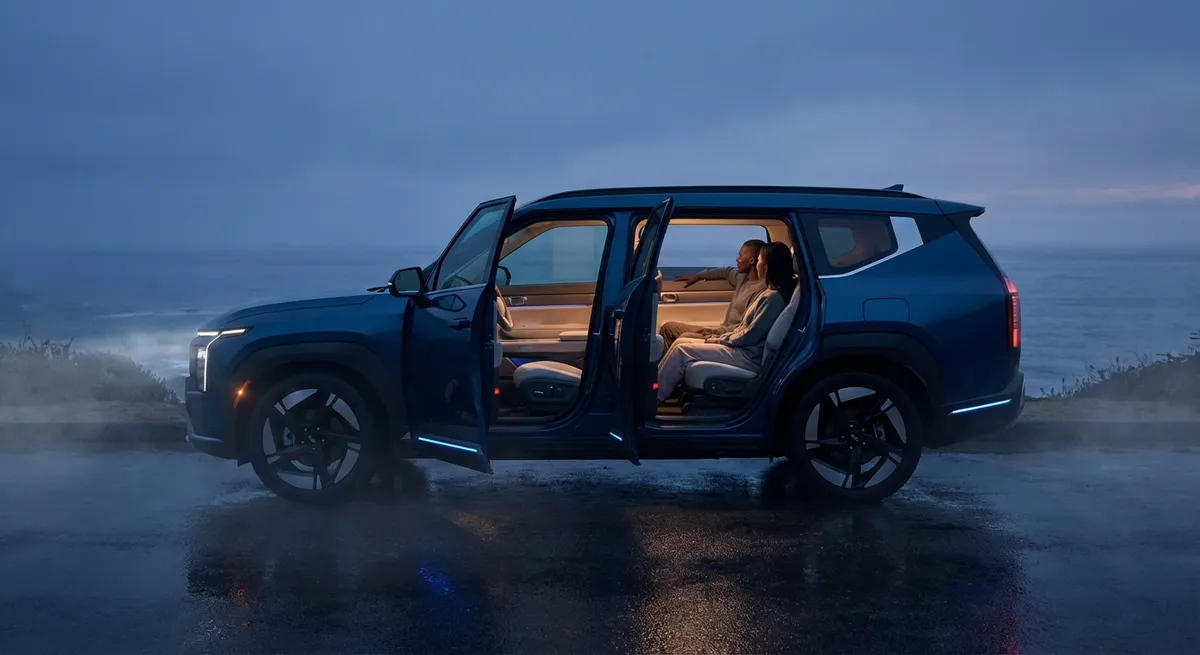
Hyundai’s upcoming 2025 Ioniq 7 (expected to be badged as the production Hyundai IONIQ 7 or a closely related nameplate) is positioned to be the brand’s flagship electric SUV, sitting above the Ioniq 5 and challenging three-row benchmarks like the Kia EV9, Tesla Model X, and traditional gas-powered family haulers. Built on Hyundai Motor Group’s E-GMP dedicated EV platform, it promises long-range capability, ultra-fast charging, and a cabin designed more like a lounge than a conventional SUV. This review focuses on what matters most to serious shoppers and enthusiasts: platform fundamentals, performance and range, charging reality, cabin engineering, and long-term ownership considerations.
1. Platform and Packaging: What the E-GMP Architecture Delivers
Hyundai’s E-GMP (Electric-Global Modular Platform) is the backbone of the Ioniq 7, and understanding it helps explain why this SUV is such a big departure from gas-based three-rows.
First, the skateboard-style layout — flat battery pack between the axles, motors at one or both ends — yields a long wheelbase and short overhangs. Expect a wheelbase in the same neighborhood as the Kia EV9 (3,100 mm/122 in), which translates into near-minivan levels of cabin length without an oversized exterior footprint. For buyers, that means more legroom in all three rows and a genuinely usable third row for adults.
Second, E-GMP uses an 800-volt electrical architecture (with support for 400V systems via built-in switching). This enables very high DC fast-charging rates while keeping current (and thus heat and cable thickness) under control. Fewer thermal constraints at the architecture level usually mean more consistent fast-charging performance during a typical road trip.
Third, the platform uses a multi-link rear suspension and, on higher trims, is likely to support electronically controlled dampers and possibly air suspension. Combined with a low center of gravity from the underfloor battery, this should give the Ioniq 7 the planted feel EV enthusiasts value, while still delivering the compliance families expect over broken pavement and highway expansion joints.
Finally, E-GMP is engineered for structural rigidity and crash performance with tailored hot-stamped steel and strategic use of high-strength steel in crash load paths. That rigidity not only helps with safety ratings but also supports quieter operation and more precise suspension tuning — factors that separate a premium-feeling EV SUV from a budget one.
2. Powertrain, Performance, and Range: Balancing Muscle and Efficiency
Hyundai has not released final production specifications as of early 2026, but based on E-GMP siblings and company statements, we can make informed observations about what enthusiasts and shoppers should expect.
The Ioniq 7 will almost certainly offer:
- A dual-motor all-wheel-drive variant with output likely in the 300–375 hp range, similar to the EV9 and high-spec Ioniq 5/6 models. With instant EV torque, that should translate to a 0–60 mph time in the 5–6 second bracket, brisk for a large family SUV.
- A single-motor rear-wheel-drive configuration with lower power but higher efficiency, likely appealing to buyers in warmer climates and fleet customers.
Battery capacity is expected to be in the 90–100 kWh usable range, again echoing the EV9. For a three-row SUV with a big frontal area, that puts realistic EPA range estimates in the 260–310 mile window depending on configuration, wheel size, and climate. Enthusiasts should note that 21–22 inch wheel options, while visually striking, typically cost 15–30 miles of range versus more modest wheel/tire packages.
Hyundai’s ongoing refinement of its motor and inverter technology is significant. Expect:
- Hairpin-wound motors optimized for efficiency and power density.
- An integrated drive unit where the inverter, motor, and reduction gear are packaged together to reduce weight and improve cooling.
- Software-tuned torque distribution for AWD models that can heavily favor the rear axle in many scenarios, improving both efficiency and driving character.
Driving modes will likely include Eco, Normal, Sport, and a configurable Custom mode. On an EV this size, those modes will materially change throttle mapping, steering weight, climate performance, and possibly active suspension characteristics on higher trims. Buyers should test Sport vs Normal back-to-back — not just for acceleration feel, but for how the mode impacts ride and range.
3. Charging Reality: Road-Trip Viability and Daily Use
Hyundai has been vocal about E-GMP’s charging capabilities, and real-world testing on existing models gives a strong preview of what to expect from the Ioniq 7.
On an 800V-capable DC fast charger, current E-GMP SUVs can add roughly 10–80% state of charge in about 18–25 minutes under ideal conditions. If the Ioniq 7 maintains this profile with its larger pack, expect:
- Peak charging rates in the 230–260 kW range on compatible chargers.
- A relatively flat charging curve that holds high power up to around 50–60% before tapering.
- Roughly 150–200 miles of highway range added in a 20-minute stop, depending on trim and conditions.
For daily use, onboard AC charging will likely be 10.9–11 kW using a Level 2 home EVSE (240V, 48A), enough to fully recharge a depleted battery overnight in 8–10 hours. Shoppers should budget for a professionally installed 240V circuit; relying solely on 120V household outlets would severely limit usability given the pack size.
A standout E-GMP feature is bidirectional charging (Vehicle-to-Load, and potential Vehicle-to-Home with proper hardware). The Ioniq 7 is expected to support:
- V2L via an external adapter or dedicated outlet, capable of powering tools, camping gear, or even a small household load during an outage.
- Future expansion to V2G/V2H (vehicle-to-grid / vehicle-to-home) programs where regulations and infrastructure permit, effectively turning the SUV into a large mobile battery bank.
For buyers, this shifts the Ioniq 7 from “just a vehicle” to an energy asset. Early adopters in regions where utilities support dynamic tariffs may eventually use the SUV to arbitrage off-peak and peak power, though this will depend on policy and equipment availability.
4. Interior Engineering, Comfort, and Tech: The Lounge-On-Wheels Concept
Hyundai has positioned the Ioniq 7 as a rolling living space, and the engineering choices behind that are crucial for shoppers who care about long-term comfort and usability, not just a flashy show-car cabin.
The flat floor and long wheelbase allow for genuinely open space in the first two rows. Expect:
- Generous second-row legroom even with the front seats pushed back for tall drivers.
- Available second-row captain’s chairs with reclining, heating, and ventilation, turning the middle row into the most comfortable seats in the house.
- A third row with more knee room than most ICE-based three-row crossovers, though the largest adults may still prefer the second row for long trips.
Materials will likely emphasize sustainable themes: bio-based plastics, recycled textiles, and low-VOC adhesives. The challenge is balancing eco-materials with perceived luxury. Buyers should pay attention to:
- Tactile feel of switchgear, door panels, and steering wheel surfaces.
- Rattle suppression and panel fit over rough roads; EVs’ quiet drivetrains make any trim buzz more obvious.
- Seat support over an extended test drive; wide, flat EV seats can sometimes feel plush initially but lack long-distance support.
Tech-wise, Hyundai is expected to deploy:
- A panoramic, dual-screen setup (instrument cluster plus central infotainment) running its latest interface, with frequent over-the-air (OTA) updates for both features and bug fixes.
- Standard wireless Apple CarPlay/Android Auto in some markets, though integration policies in North America have been evolving; buyers should verify compatibility at purchase time.
- A robust suite of driver-assistance systems branded under Hyundai SmartSense, including adaptive cruise control with lane-centering, highway driving assist, automatic emergency braking with pedestrian and cyclist detection, blind-spot monitoring, and cross-traffic alert.
Enthusiasts should evaluate how intrusive these systems feel. The best setups provide strong centering and lane-keeping without “ping-ponging” in the lane or making sudden steering corrections. A mixed urban and highway test route is ideal for assessing the calibration.
Cabin noise is another critical metric in an EV SUV. Without engine noise to mask wind and tire roar, Hyundai must rely on:
- Double-laminated glass in front (and possibly rear) windows on higher trims.
- Extensive acoustic insulation in floor and firewall areas.
- Aerodynamic side-mirror and A-pillar design to limit wind rush at freeway speeds.
A/B testing with a traditional ICE SUV on the same road is an effective way to perceive the improvement the Ioniq 7 offers.
5. Ownership Experience, Reliability Outlook, and Value Positioning
Beyond specs and first impressions, EV SUV buyers should think through the ownership arc — from residual value and warranty coverage to software updates and dealer service.
Hyundai’s EV warranty structure is typically among the strongest in the segment, often including:
- 10-year/100,000-mile coverage on electric powertrain components (motor, inverter, reduction gear).
- Long-term battery warranties guaranteeing a minimum state-of-health (often around 70%) for a set mileage or time period.
- 5-year/60,000-mile limited vehicle warranty, plus roadside assistance, though terms vary by market.
Battery longevity depends heavily on thermal management and charging behavior. E-GMP vehicles use liquid-cooled battery packs with active temperature control, a significant advantage over air-cooled systems when it comes to preserving capacity in hot climates and under frequent DC fast-charging.
Software is another pillar of modern reliability. OTA updates can:
- Fix bugs in infotainment or driver-assistance systems without a dealer visit.
- Improve charging curves, efficiency, or even acceleration through revised control algorithms.
- Add features after purchase (e.g., additional drive modes, enhanced navigation functions), potentially improving resale value.
However, over-the-air capabilities also mean the driving experience can change over time. Enthusiasts should monitor release notes and owner forums to understand how updates affect ride, steering, or assist systems.
On value, Hyundai tends to undercut German premium brands while approaching them on tech and refinement. The Ioniq 7 is likely to:
- Price below comparable Tesla Model X and premium German three-row EVs, especially when evaluating similarly equipped trims.
- Compete closely with its platform cousin, the Kia EV9, with differentiation via styling, interior design language, and feature packaging.
- Offer strong total-cost-of-ownership when federal, state, or provincial EV incentives are available, plus reduced maintenance compared with gas SUVs (no oil changes, fewer moving parts in the drivetrain, and regenerative braking reducing pad/rotor wear).
Buyers should run a 5–8 year TCO comparison that factors in:
- Home charging vs public charging costs.
- Local electricity rates vs gasoline prices.
- Insurance premiums for a high-value EV SUV.
- Potential battery or high-voltage system repairs beyond warranty (and how likely they are, based on E-GMP’s track record in smaller models).
Overall, if Hyundai delivers on its stated goals, the 2025 Ioniq 7 stands to be a compelling choice for families and enthusiasts who want three-row practicality, serious EV tech, and a near-luxury cabin without stepping into full luxury brand pricing.
Conclusion
The 2025 Hyundai Ioniq 7 is shaping up as a pivotal model: a true three-row electric SUV built on a dedicated EV platform, with charging speeds, cabin space, and driver-assistance tech that directly challenge both legacy gas SUVs and established EV players. For shoppers, the key is to look past concept-car styling and focus on fundamentals — platform engineering, charging curve behavior, interior usability, and long-term ownership support. If Hyundai’s production model closely matches the promise of its platform siblings, the Ioniq 7 will not just be another electric SUV entry; it will be one of the most complete family EVs on the market.
Sources
- Hyundai Global – E-GMP Platform Overview - Technical background on the Electric-Global Modular Platform underpinning Hyundai’s next-gen EVs
- Hyundai USA – Ioniq 5 Specifications - Reference for current E-GMP-based SUV performance, charging, and warranty details
- Kia Global – EV9 Technical Highlights - Insight into expected three-row E-GMP SUV capabilities, including battery sizes, charging, and interior packaging
- U.S. Department of Energy – Alternative Fuels Data Center - Independent information on EV charging, energy costs, and vehicle efficiency considerations
- Insurance Institute for Highway Safety (IIHS) – Vehicle Ratings - Authoritative crash-test and safety-technology evaluations relevant to large SUVs and upcoming EV models
Key Takeaway
The most important thing to remember from this article is that this information can change how you think about Reviews.