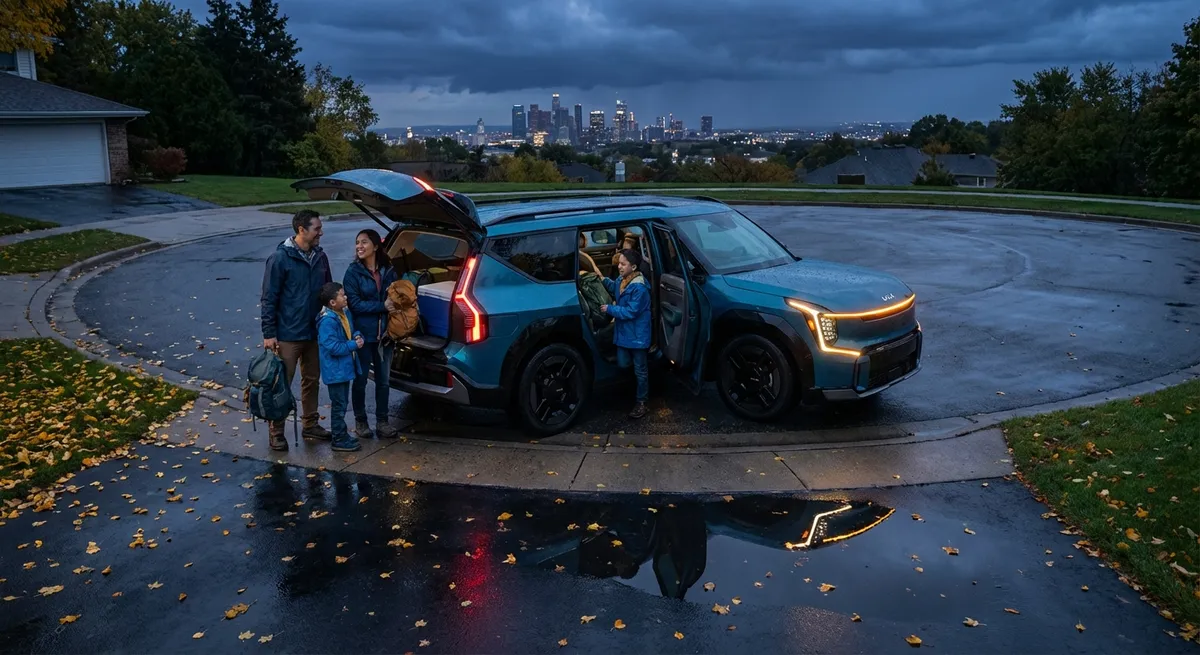
Kia’s 2025 EV9 isn’t just another three-row SUV—it’s a strategic statement. As one of the first fully electric, mass-market, three-row crossovers, it aims to bridge the gap between practical family hauler and upscale flagship. This review goes beyond surface impressions to analyze how the EV9 drives, charges, hauls, and competes in a rapidly evolving segment. If you’re a detail‑focused SUV shopper—or simply curious how viable full-size electric family transport has become—this is where the EV9 either earns or loses its spot on your shortlist.
Powertrain, Performance, and Driving Dynamics
From a technical standpoint, the EV9 is built on Hyundai Motor Group’s E-GMP platform, shared with the Hyundai Ioniq 5, Kia EV6, and Genesis GV60. That means an 800‑volt electrical architecture, a flat skateboard battery, and integrated power electronics that prioritize efficiency and fast charging.
The U.S. lineup centers on a 99.8 kWh battery (usable capacity is slightly lower but undisclosed) with multiple motor configurations. The rear‑wheel‑drive (RWD) variant offers around 201–215 hp (varies by market) and 258 lb‑ft of torque, adequate for relaxed commuting and light highway work, but not thrilling under full load. The dual‑motor all‑wheel‑drive (AWD) versions step up dramatically, with 379 hp and up to 516 lb‑ft of torque in “Boost” mode, making highway merges and passing feel instant and decisive, even with passengers and cargo on board.
Despite its mass—well over 5,700 lb depending on trim—the EV9 feels composed rather than ponderous. The battery’s low mounting lowers the center of gravity, so body roll is present but reasonably controlled for a three‑row family SUV. Steering is light and somewhat isolated, tailored more to comfort than engagement. Braking hardware is strong, and the blended friction/regenerative system is smooth once you acclimate, with selectable regen levels (including one‑pedal driving) via steering‑wheel paddles.
Noise isolation is a highlight. At typical U.S. highway speeds, wind and tire noise are very well suppressed, emphasizing the inherent quiet of an electric drivetrain. Higher trims layer in dual‑pane acoustic glass and additional sound deadening. The result is a calm, premium ambience that reinforces its flagship positioning—even though the badge says Kia, the NVH (noise, vibration, and harshness) profile is closer to entry‑luxury crossovers from established premium brands.
Range, Charging, and Real-World Usability
One of the EV9’s defining technical advantages is its 800‑volt charging system, which enables high peak DC fast‑charge rates given an appropriately capable charger. Kia advertises a peak of up to 210 kW on compatible DC fast chargers. In ideal conditions, that allows a 10–80% charge in roughly 24 minutes, according to Kia’s own estimates, putting it among the quickest‑charging three‑row EVs currently offered.
EPA‑rated range figures vary by trim, wheel size, and drivetrain. Long‑range RWD versions can crest the mid‑300‑mile mark (around 304–310 miles on 19‑inch wheels, market‑dependent), while dual‑motor AWD variants fall closer to the mid‑ to high‑200‑mile range. Larger 21‑inch wheels, added weight from options, and colder climates will realistically drop those numbers. For a typical mixed commute plus family errands, charging every 2–3 days from home on a Level 2 unit will be workable for most owners, with DC fast charging handling long‑distance trips.
Kia’s integration with the broader charging ecosystem is evolving. The brand has announced adoption of the NACS (North American Charging Standard) connector, which will eventually open access to a larger portion of Tesla’s Supercharger network for EV9 owners via an adapter and, later, native ports. Until then, the car relies on CCS infrastructure from networks like Electrify America, EVgo, and others. As always with EVs, your experience will be heavily informed by regional charging availability and reliability; urban and suburban corridors are generally well‑served, while rural coverage can be patchy.
One distinctive usability feature is vehicle‑to‑load (V2L) capability. The EV9 can supply AC power to external devices—laptops, tools, camping gear—via onboard outlets or an external adapter, drawing from the high‑voltage battery. This makes it particularly appealing for road‑trip enthusiasts, contractors, or families who want backup power during outages, turning the SUV into a rolling energy reservoir with practical real‑world benefits beyond simply driving range.
Interior Design, Space, and Technology
Inside, the EV9 leans strongly into its role as a modern flagship, with a cabin that feels architected for families who spend long stretches in their vehicle. The dashboard is dominated by a connected screen array—typically a 12.3‑inch digital instrument cluster, a central 12.3‑inch infotainment display, and a 5‑inch climate control segment between them. Physical buttons are minimized but not eliminated; Kia retains key toggles for volume and HVAC, which is a welcome nod to usability.
Material quality scales cleanly with trim. Base models use durable fabrics and soft‑touch plastics, while upper trims showcase synthetic leather (or optional genuine leather in some markets), ambient lighting, and more intricate surface treatments. Recycled and plant‑based materials are used widely, aligning with Kia’s sustainability messaging. Seat comfort is a strong suit: front seats in higher trims can be ventilated and feature relaxation functions, while captain’s chairs in the second row (where fitted) can recline and even swivel, depending on market and configuration.
Crucially, the EV9’s packaging benefits from its EV‑only platform. With no engine bay intruding into the cabin and a flat floor, passenger space is generous in all three rows. Adults up to around 6 feet can realistically use the third row for moderate trips—unusual for this class, where the third row often feels like a penalty box. Cargo capacity remains respectable even with all three rows up, enough for groceries and a set of soft bags; folding the third row opens a very usable load bay, and with the second row folded, the EV9 behaves like a capacious cargo van.
Infotainment and connectivity are competitive. Kia’s latest software supports over‑the‑air (OTA) updates, native navigation with EV‑optimized route planning, and familiar smartphone integrations like Apple CarPlay and Android Auto (currently wired in some regions, with wireless support planned or rolling out). A premium audio option from Meridian adds fidelity for those who care about in‑car sound. Multiple USB‑C ports across all rows, wireless charging pads, and thoughtful storage solutions (including a large center console and under‑floor bin) make the cabin daily‑life friendly.
Safety, Driver Assistance, and Autonomy Features
The EV9 arrives loaded with advanced driver‑assistance systems (ADAS), reflecting both regulator expectations and buyer preferences in this price bracket. Standard safety tech typically includes forward collision warning, automatic emergency braking with pedestrian and cyclist detection, lane‑keeping assist, blind‑spot monitoring, rear cross‑traffic alert, and adaptive cruise control with stop‑and‑go functionality. These systems work together to reduce driver workload, especially in dense traffic or long highway slogs.
One of the most significant technological talking points is Kia’s Highway Driving Assist and the availability (on certain trims/markets) of more advanced hands‑free driving capabilities under specific conditions. While brand naming and feature sets vary globally, the concept mirrors competitors: on mapped, divided highways, the car can maintain lane position, following distance, and speed with minimal driver input, though attentive supervision remains legally and practically required. The system uses a combination of cameras, radar, and in some cases lidar or high‑definition maps, depending on market implementation.
From a hardware standpoint, multiple cameras around the vehicle feed into a 360‑degree view system, making low‑speed maneuvers and parking more intuitive, particularly given the EV9’s substantial footprint. Rear AEB (automatic emergency braking) and safe‑exit assist (which prevents doors from being opened into approaching traffic or cyclists) showcase how software‑driven safety layers can meaningfully improve day‑to‑day security.
Crash‑test data is still being published as agencies complete their evaluations, but Kia’s E‑GMP platform has already demonstrated strong structural performance in related models. The EV9’s body incorporates high‑strength steels, optimized load paths, and a battery protection structure designed to minimize intrusion in severe collisions. As full NHTSA and IIHS ratings become available, they’re expected to be a central part of Kia’s marketing narrative and should be reviewed by any safety‑focused shopper before finalizing a purchase.
Pricing, Value Proposition, and Competitive Landscape
Positioning the EV9 correctly is critical to understanding its appeal. It sits in a space that overlaps with both mainstream three‑row crossover staples (like the Hyundai Palisade, Kia Telluride, and Toyota Highlander) and emerging three‑row EV rivals (such as the Volvo EX90, Mercedes‑Benz EQS SUV, and Tesla Model X). In the U.S., pricing starts in the mid‑$50,000s for lower‑spec RWD trims and can climb into the low‑ to mid‑$70,000s for well‑equipped AWD models.
On a feature‑per‑dollar basis, the EV9 is aggressive. You’re getting a large, genuinely three‑row cabin, a big battery with fast DC charging, robust ADAS, and a near‑luxury interior for less money than many German or Swedish electric SUVs. Kia’s warranty—typically a 10‑year/100,000‑mile powertrain and battery coverage in the U.S.—further strengthens its value equation, particularly for buyers concerned about long‑term EV ownership costs and degradation.
Operating costs are where the EV9 can shine, depending on your energy rates and incentives. Electricity is generally cheaper per mile than gasoline, especially if you charge off‑peak or have access to residential solar. Routine maintenance on EVs is also lower: no oil changes, fewer moving parts in the powertrain, and reduced wear on friction brakes due to regenerative braking. However, insurance premiums for new EVs can be higher, and tire replacement can be more frequent due to weight and torque, so budgeting should reflect those realities.
In the competitive set, the EV9’s most direct mainstream rival is arguably its own corporate cousin, the upcoming Hyundai Ioniq 7 (or equivalent large Hyundai EV SUV), as well as longer‑range versions of the Tesla Model Y for buyers who don’t absolutely need a true adult‑usable third row. Against premium options like the Volvo EX90 or Mercedes‑Benz EQS SUV, the EV9 generally undercuts price while matching or exceeding in fast‑charging speed and interior space, though it concedes some brand cachet and ultra‑luxury finishes.
For buyers, the key question becomes: do you value badge prestige and ultra‑high‑end materials, or are you looking for a technologically current, space‑efficient, and comparatively attainable path into full‑size electric SUV ownership? For many families, the EV9’s balance of cost, equipment, and real‑world usability makes a compelling argument.
Conclusion
The 2025 Kia EV9 stands at an intersection of ambition and practicality. It brings a genuinely usable three‑row layout, competitive range, high‑speed charging, and a well‑equipped, quiet cabin into a segment still undersupplied with credible options. It is not the sportiest EV, nor the most opulent, but it confidently delivers what many families actually need: space, comfort, safety tech, and a clear path away from gasoline without stepping into six‑figure territory.
If you’re cross‑shopping large crossovers and considering an EV leap, the EV9 deserves a meticulous test drive—ideally loaded with family, luggage, and a planned route that includes a DC fast‑charge stop. How it fits your daily routine, trip patterns, and charging realities will determine whether this ambitious flagship is simply impressive on paper or becomes the new default in your driveway.
Sources
- [Kia Global Press Releases – EV9](https://press.kia.com/global/en/models/ev9) - Official technical specifications, platform details, and feature summaries from Kia
- [U.S. EPA – Fueleconomy.gov EV Listings](https://www.fueleconomy.gov/feg/evsbs.shtml) - Provides official range, efficiency, and energy‑cost data for EVs sold in the U.S.
- [IIHS – Vehicle Ratings](https://www.iihs.org/ratings) - Crash‑test results and safety ratings for SUVs, including electric models when tested
- [U.S. Department of Energy – Alternative Fuels Data Center](https://afdc.energy.gov/fuels/electricity.html) - Context on EV charging, infrastructure, and energy‑cost comparisons versus gasoline
- [Electrify America – Network Map and Charging Info](https://www.electrifyamerica.com/locate-charger/) - Real‑world view of current DC fast‑charging network coverage relevant to EV9 ownership
Key Takeaway
The most important thing to remember from this article is that this information can change how you think about Reviews.