The 2025 Kia EV9 arrives with a clear mission: prove that a three-row electric SUV can be more than a compliance car or a luxury indulgence. It targets families who actually use all three rows, tech-focused drivers who want ultra-fast charging, and buyers cross-shopping premium brands without paying six-figure money. This review goes well beyond brochure highlights, focusing on how the EV9’s engineering, packaging, and real-world usability stack up for serious SUV shoppers.
Powertrain and Performance: Not Just About 0–60
From the outset, Kia built the EV9 on Hyundai Motor Group’s E-GMP dedicated EV platform, which brings an 800-volt electrical architecture, flat battery floor, and rear- or all-wheel-drive layouts. In North America, the core variants are:
- RWD Light / Light Long Range: Single motor on the rear axle, 215–225 hp range depending on market, prioritizing efficiency and range over outright speed.
- AWD Wind / Land / GT-Line: Dual-motor setup providing up to 379 hp and 516 lb-ft of torque in GT-Line trim with Boost mode, giving it brisk performance even when fully loaded.
In real-world use, the dual-motor EV9 feels more like a traditional V6-powered SUV than a silent eco-box. The instant torque compensates for its substantial curb weight (around 5,700–5,900 lbs depending on trim), and passing power at highway speeds is strong. The rear-drive models are calmer and more measured, but still ready for quick urban merges.
Key technical points that matter to enthusiasts and practical buyers alike:
- 800-Volt Architecture: Enables very high DC fast-charging rates (Kia quotes up to 210 kW), meaning you can add dozens of miles of range in a short highway stop under ideal conditions.
- Regenerative Braking Tuning: Multiple regen levels, including an “i-PEDAL” mode for near one-pedal driving. For drivers coming from performance or premium SUVs, the ability to fine-tune deceleration feel is a genuine comfort and control benefit.
- Drive Modes and Power Delivery: Eco, Normal, Sport, and (on some trims) Snow modes adjust throttle response, steering weight, and stability control logic. The difference between Eco and Sport is noticeable—Sport sharpens responses and unlocks the EV9’s more playful side, especially in dual-motor versions.
The suspension tuning balances composure with comfort: it is not as softly sprung as some gasoline family SUVs, and the extra weight of the battery pack is evident over broken pavement. But body control in corners is better than you’d expect for a three-row EV, thanks in part to the low center of gravity and sophisticated stability systems. This is not a performance SUV in the sense of lap times, but it is a confident, long-distance machine that hides its mass well.
Range, Charging, and Real-World Energy Use
Range and charging behavior determine whether an electric SUV is easy to live with or a constant planning exercise. The EV9’s figures will vary by configuration, but the engineering framework is consistent:
- Battery Pack: Large-capacity pack (roughly 99.8 kWh usable in long-range versions) mounted under the floor, contributing to a flat interior and helping structural rigidity.
- EPA-Estimated Range (U.S. trims): Depending on wheel size, drive configuration, and trim, Kia targets roughly 270–300+ miles per charge for the most efficient variants. Larger wheels and dual-motor setups reduce these numbers, as expected.
- Charging Curve: One of the EV9’s critical advantages is the ability to accept very high DC fast-charge power for a significant portion of the charging session. On a capable 350 kW charger, Kia quotes roughly a 10–80% charge in around 24 minutes under optimal conditions.
For buyers, the key questions are less about peak numbers and more about consistency:
- Highway Cruising Efficiency: At 70–75 mph, EVs face significant aerodynamic drag. The EV9’s bluff SUV shape and three-row size mean consumption will be higher than a compact EV hatchback, but still competitive within its segment. Planning on about 2.4–2.8 mi/kWh on the highway is a reasonable expectation depending on weather, load, and wheels.
- Cold-Weather Impact: Like all EVs, the EV9’s winter range will drop due to cabin heating, battery chemistry, and denser air. Kia’s use of a heat pump (on many trims/markets) and preconditioning features helps mitigate this, but winter buyers should size their range expectations conservatively.
- Home Charging Practicality: The EV9 supports AC charging at up to 11 kW with a capable Level 2 home charger, topping up the pack overnight with ease. For many families, this means starting every day with a “full tank,” making range anxiety largely irrelevant for local use.
For road-tripping, the combination of a big battery, fast-charging hardware, and a growing high-speed charging network gives the EV9 a real shot at replacing a gasoline family SUV without significantly altering travel habits—especially if you plan charging stops around natural meal and rest breaks.
Interior Packaging, Comfort, and Tech Integration
The EV9’s cabin shows where Kia wants to position this SUV: not just as a family hauler, but as a showcase for its highest-end technology and materials. The layout emphasizes clean lines and a nearly continuous digital display, while physical controls remain for frequently used functions.
Highlights that matter to both enthusiasts and everyday drivers:
- Seating and Space:
- Available in six- or seven-seat configurations.
- Second-row options include traditional bench seating or captain’s chairs with available relaxation and swivel functions in some markets.
- Adult-usable third row: unlike many midsize crossovers, the EV9’s third row can accommodate average-height adults on shorter trips, and kids comfortably on longer journeys.
- Materials and Build: Soft-touch surfaces, available vegan leather, and recycled materials signal an eco-conscious approach while maintaining an upscale feel. Panel fit and finishing are competitive with premium mainstream and some entry-luxury brands.
- Infotainment:
- Dual large displays (instrument cluster and central touchscreen) under one glass panel deliver sharp graphics and quick response.
- Wireless smartphone integration (availability may vary by region), plus a head-up display on higher trims.
- Over-the-air (OTA) update capability allows Kia to refine software, add features, and address bugs without dealership visits.
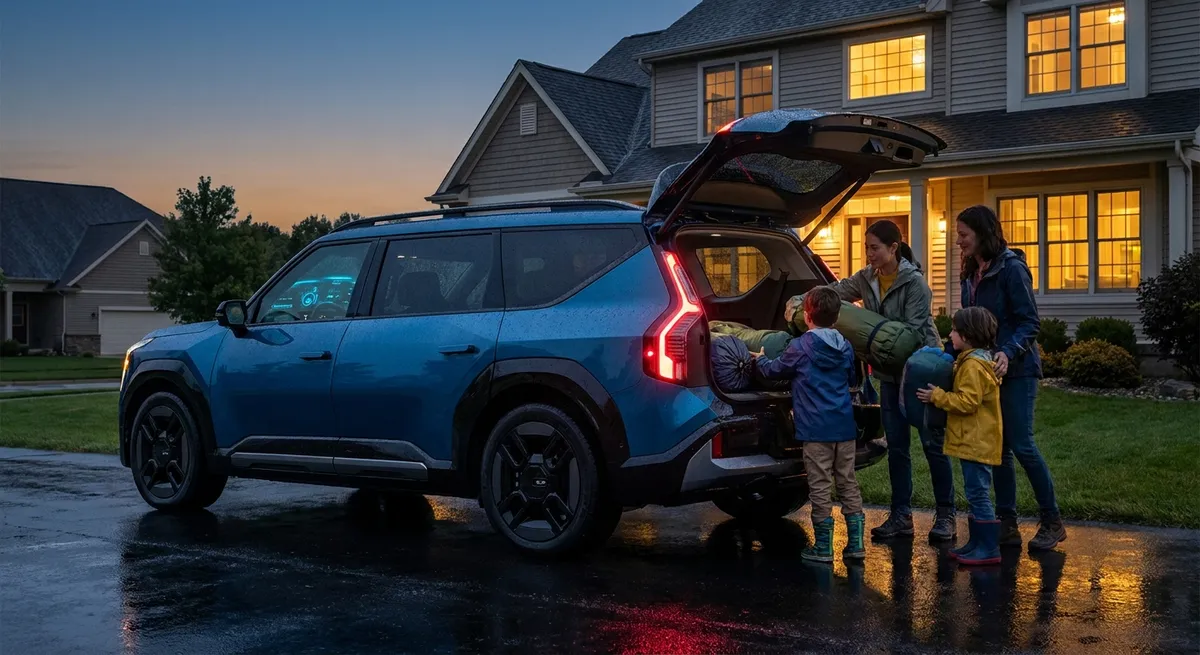
Families will appreciate the number of USB-C ports, thoughtful storage solutions, and available power outlets. The flat floor enhances legroom, and the wide door openings make it easier to install child seats or access the third row. Cabin noise is well-controlled, with the absence of an internal combustion engine revealing only road and wind noise, which Kia has worked to minimize with aero optimization and strategic sound insulation.
The tech also extends beyond entertainment:
- Digital Key Functions: Allow certain smartphones to serve as vehicle keys, shareable with other drivers.
- Advanced Driver Profiles: Store seat, mirror, climate, and even infotainment preferences linked to keys or accounts.
- Vehicle-to-Load (V2L): On some markets/trims, the EV9 can power external devices—from camping gear to power tools—using its high-capacity battery pack as a mobile energy source.
Safety, Driver Assistance, and Long-Term Ownership
Kia has been aggressive with active safety features, and the EV9 arrives as one of the brand’s technology flagships. Its structure benefits from the E-GMP platform’s integrated battery protection and crash management design, while its suite of sensors feeds robust driver-assistance systems.
Key safety and assistance technologies (availability varies by trim/region):
- Forward Collision-Avoidance Assist with pedestrian, cyclist, and junction-turning detection.
- Blind-Spot Collision-Avoidance and Rear Cross-Traffic Avoidance systems that actively intervene rather than simply warn.
- Highway Driving Assist / Navigation-based Smart Cruise that can help center the vehicle in its lane and adjust speed based on traffic and speed limits.
- Surround-View Cameras and Remote Smart Parking on higher trims to ease tight parking maneuvers in urban environments.
Structurally, the EV9 leverages high-strength steel, battery casing reinforcement, and carefully engineered crumple zones. Official crash-test data from agencies like the IIHS and NHTSA is either emerging or anticipated; given the platform’s performance in related EVs such as the Hyundai Ioniq 5 and Kia EV6, expectations for crash safety are strong, though buyers should consult the latest ratings once available.
From an ownership perspective, considerations include:
- Battery and Powertrain Warranty: Kia typically offers competitive long-duration warranties on EV components, which can significantly reduce anxiety around battery degradation.
- Software Support: OTA updates mean the EV9 may receive improved efficiency maps, enhanced driver-assistance tuning, or new infotainment features over time. This can help keep the vehicle feeling “current” longer than traditional models.
- Service Network: While EVs require less routine maintenance than ICE vehicles, buyers should confirm local dealer familiarity with high-voltage systems and availability of EV-certified technicians.
Insurance costs will reflect the EV9’s high-tech content and repair complexity, but savings in fuel and reduced routine service can offset a notable portion of total cost of ownership, especially for high-mileage families transitioning from thirsty V6 or V8 SUVs.
Real-World Utility: Cargo, Towing, and Everyday Use
Underneath the tech and design, the EV9 still needs to deliver on traditional SUV expectations: hauling people and stuff, sometimes in difficult conditions. Here, its electric architecture adds some quirks but largely complements its role.
Practical highlights:
- Cargo Capacity: With the third row up, the EV9 offers usable space for groceries, strollers, or weekend bags—more than many three-row crossovers. Fold the third row flat and you unlock substantial cargo room for family road trips or DIY runs. Folding both second and third rows yields a long, flat load floor capable of handling larger items.
- Towing Capability: Properly equipped AWD trims offer a competitive towing rating for an EV in this class (figures vary by market, but around 5,000 lbs is widely cited for North America). This is sufficient for small to medium trailers, boats, and many recreational toys. Buyers should note that towing significantly reduces range, so planning for charging stops becomes more critical.
- All-Weather Confidence: Dual-motor all-wheel drive variants distribute torque between axles for improved traction in rain, snow, or on gravel. Paired with appropriate tires and the Snow drive mode, the EV9 can be a capable year-round family vehicle in harsher climates.
- Maneuverability: Despite its size, steering calibration and camera systems make parking and low-speed maneuvers manageable. The turning circle is not as tight as a compact SUV, but competitive with other three-row models.
Everyday livability also benefits from:
- Frunk (Front Trunk): Modest in size, but useful for charging cables, emergency kits, or small bags, freeing main cargo space.
- Charge Port Location: Positioned for easier alignment with most public chargers, though cable length and charger layout will still matter.
- Energy Management Tools: In-car and app-based energy monitoring help you understand your consumption patterns and adjust driving or charging strategies accordingly.
For many SUV shoppers, the EV9’s combination of three-row seating, usable cargo space, respectable towing, and robust all-weather capability will be the deciding factors. It behaves like a conventional family SUV in terms of utility while adding the refinement, quiet, and low-running-cost benefits of an EV.
Conclusion
The 2025 Kia EV9 is more than a technological statement; it is a fully realized three-row SUV that happens to be electric. Its strengths lie in a well-engineered powertrain with advanced 800-volt charging, a thoughtfully packaged interior that prioritizes real passenger and cargo space, and an extensive safety and driver-assistance suite. For families and enthusiasts who need genuine SUV capability but want to move away from gasoline without sacrificing range or comfort, the EV9 belongs on the short list.
It does not eliminate all EV compromises—towing cuts range, winter conditions still demand planning, and charging infrastructure quality varies by region. But taken as a whole, the EV9 demonstrates that a battery-electric three-row SUV can serve as a primary family vehicle, not just a second car. For buyers ready to transition to electric without abandoning the flexibility of a full-size SUV, the EV9 represents one of the most compelling options currently on the market.
Sources
- [Kia Global – EV9 Product Overview](https://www.kia.com/worldwide/vehicles/ev9/features) – Official specifications, powertrain details, and feature breakdown from Kia.
- [U.S. Department of Energy – Alternative Fuels Data Center](https://afdc.energy.gov/vehicles/electric.html) – Background on EV technology, charging levels, and efficiency considerations relevant to understanding the EV9’s architecture.
- [EPA – Fueleconomy.gov Electric Vehicle Information](https://www.fueleconomy.gov/feg/evsbs.shtml) – Explains EV range, MPGe, and how driving conditions affect real-world efficiency.
- [IIHS – Electric Vehicle Safety and Testing](https://www.iihs.org/topics/electric-vehicles) – Context on EV crash safety, battery protection, and how electric SUVs like the EV9 are evaluated.
- [Hyundai Motor Group E-GMP Platform Overview](https://www.hyundaimotorgroup.com/newsroom/contents/eng-20201202-e-gmp) – Technical background on the shared EV platform underpinning the Kia EV9, including 800-volt architecture and charging capabilities.
Key Takeaway
The most important thing to remember from this article is that this information can change how you think about Reviews.