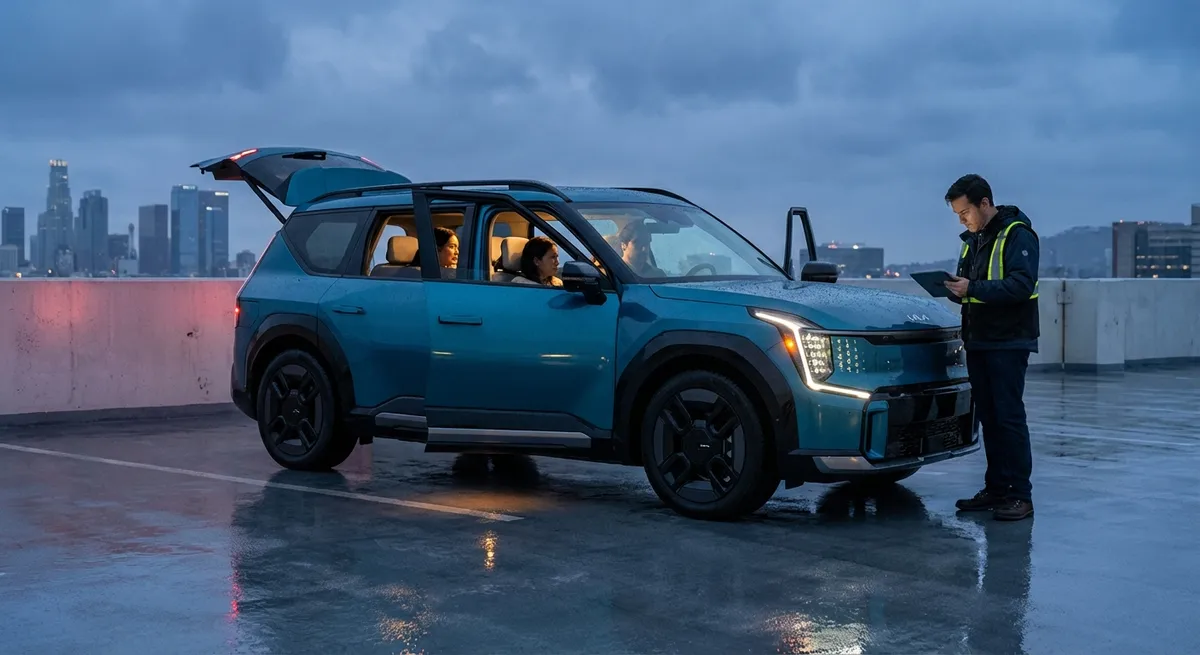
The 2025 Kia EV9 is one of the first mainstream, three-row electric SUVs targeting families who need real space without giving up zero‑emission driving. Instead of offering a quick first impression or a marketing-style overview, this review breaks down how the EV9 actually performs where it matters: range, charging, packaging, ride and handling, and technology. If you’re cross‑shopping it against large gasoline SUVs or newer electric competitors, these details should help clarify whether the EV9 fits your use case today—and over the next decade of ownership.
Powertrain, Performance, and Real-World Usability
Kia offers the EV9 with multiple configurations, and understanding the differences is crucial before you walk into a showroom.
The EV9 rides on Hyundai Motor Group’s E‑GMP dedicated EV platform, using an 800‑volt electrical architecture that supports high‑power DC fast charging. In the U.S., the key versions are:
- RWD Standard Range: Single rear motor, around 215 hp, 76.1 kWh battery. This is the lightest and least expensive variant, best for buyers with moderate range needs and frequent home charging.
- RWD Long Range: Single rear motor (similar output), 99.8 kWh battery. Prioritizes maximum range and efficiency over outright power, well suited to suburban commuters and highway cruisers.
- AWD Dual Motor: Front + rear motors with up to roughly 379 hp and substantial torque, supporting a rated 0–60 mph time in the low‑5‑second range in GT‑Line trim. This configuration is aimed at buyers who want confident all‑weather traction and quick acceleration, closer to performance SUVs.
In daily use, the dual‑motor EV9 delivers brisk, almost effortless passing power, especially from 30–70 mph where heavy SUVs often feel sluggish. The immediate torque of electric motors helps mask the EV9’s substantial curb weight (well over 5,500 lb depending on trim). However, enthusiasts should note that sustained high‑speed driving or repeated hard acceleration will reduce range more noticeably than in a lighter crossover EV.
Kia’s i‑Pedal regenerative braking system allows nearly one‑pedal driving when configured to maximum regen, and multiple regen levels can be toggled via steering‑wheel paddles. This flexibility is valuable: you can use strong regen in stop‑and‑go traffic, then dial it back on the highway for a more traditional coasting feel. For buyers transitioning from gasoline, this tunability makes the EV9 easier to adapt to than EVs with fixed regen strategies.
Range, Efficiency, and Charging Strategy
Range figures for the EV9 vary by trim, wheel size, and drivetrain, so it’s important to look beyond a single headline number.
- The RWD Long Range model with smaller wheels targets EPA range estimates in the low‑ to mid‑300‑mile bracket, depending on final certification and configuration.
- Dual‑motor AWD models, especially those with larger 21–22 inch wheels and more aggressive tires, see a meaningful range penalty—expect ratings closer to the mid‑200‑mile range for performance‑oriented trims.
For most families, anything above ~260 real‑world miles is sufficient if there’s home charging available. The key is understanding how your pattern of use—climate, speed, load, and towing—affects those numbers:
- Cold climates: Battery chemistry is less efficient in low temperatures; plan on 20–30% range loss in winter without preconditioning.
- High speeds: At 75–80 mph, aerodynamic drag grows exponentially; real‑world highway range can drop significantly vs. EPA ratings.
- Passengers and cargo: A fully loaded three‑row SUV presents more mass to move; range suffers somewhat, especially on hilly routes.
Where the EV9 distinguishes itself is charging. Thanks to its 800‑volt system, it can support DC fast charging peaks (under ideal conditions) up to around 210–230 kW. On a high‑power DC fast charger:
- Kia claims a 10–80% charge in the vicinity of 20–25 minutes for the larger pack, under optimal conditions.
- In practice, you’ll see a charging curve that ramps up quickly, holds a high plateau, then tapers down as it approaches 80%. This allows relatively short highway stops if you plan around chargers.
For home use, the EV9 supports AC charging up to 11 kW with a capable Level 2 charger, refilling a largely depleted pack overnight. Serious buyers should factor home charging installation into the total cost calculation: a 40–60A circuit in the garage or driveway can make EV ownership dramatically more convenient, especially with a large three‑row SUV battery.
Interior Packaging, Seating, and Cargo Practicality
Where many electric SUVs still feel like first‑generation experiments, the EV9’s cabin and packaging show clear attention to traditional SUV priorities.
The EV9’s exterior footprint is comparable to a midsize/large three‑row SUV, but its long wheelbase and flat floor (no transmission tunnel) give it a surprisingly open, almost minivan‑like interior. Key points for families and utility‑minded buyers:
- Seating configurations: Depending on trim and market, you can get a seven‑seat layout (bench in the second row) or six‑seat configuration with captain’s chairs. Some trims offer second‑row “relaxation” seats with leg rests, designed for comfort while charging.
- Third row usability: Adults can realistically sit in the third row for moderate trips—legroom and headroom are better than in many “token” third rows. Getting in and out is aided by wide rear doors and a sliding second row.
- Cargo volume: With all three rows in use, cargo space is usable but not vast—typical for the class. Fold the third row flat and you unlock a substantial load floor; fold both rear rows and the EV9 behaves like a large cargo van. For buyers regularly hauling sports gear, strollers, or camping equipment, the squared‑off rear design is more functional than style‑focused coupe‑SUVs.
- Towing: Properly equipped AWD models are rated to tow up to roughly 5,000 lb, allowing for small campers, boats, or utility trailers. However, towing an aerodynamic brick will significantly cut range, sometimes by half, so trip planning is more critical than with a gasoline SUV.
Material quality is competitive with premium‑leaning mainstream rivals. Kia emphasizes sustainable and recycled materials, but the surfaces you touch most—steering wheel, armrests, switchgear—feel solid rather than experimental. Buyers cross‑shopping luxury brands will notice that some lower cabin plastics remind you it’s not a full‑luxury product, but overall fit and finish are strong for the price bracket.
Interior noise levels are low, aided by the lack of an engine and good wind isolation. Tire noise can be more noticeable with larger wheel/tire packages; if highway comfort is a priority, consider trims with smaller wheels and higher‑profile tires.
Ride, Handling, and Driving Character
The EV9 is a large, heavy, three‑row SUV, and expecting sports‑car agility is unrealistic. That said, its driving character is more composed and confidence‑inspiring than many similarly sized gasoline SUVs.
The low placement of the battery pack drops the center of gravity relative to tall body-on-frame SUVs. This helps the EV9 resist excessive body roll in corners and provides a planted feel in high‑speed lane changes. Steering is electric and variable‑assist; effort is light at low speeds for easy parking and tight urban maneuvers, then firms up on the highway. Enthusiasts may wish for more feedback, but the calibration is appropriate for the target audience.
Ride quality depends heavily on wheel size and suspension tuning:
- Comfort‑oriented trims with smaller wheels provide a supple, controlled ride that soaks up broken pavement well, though you will still feel sharper impacts given the vehicle’s mass.
- Sportier trims and larger wheels trade some compliance for a firmer, more controlled feel at speed. On smooth highways, this can feel “European,” but on rougher roads, it can transmit more vertical motion into the cabin.
Braking performance is a key safety factor in such a heavy EV. The EV9 blends regenerative and friction braking, and Kia’s tuning does a credible job of providing a consistent pedal feel. Enthusiasts will notice that, under hard stops, you feel the mass—but stopping distances remain competitive for the class. For mountain driving with a full load, the strong regen capability helps manage speed on descents, reducing reliance on the friction brakes and limiting fade.
All‑wheel drive models use electronic torque distribution rather than a mechanical transfer case, allowing quick adjustments based on traction needs. While the EV9 isn’t aimed at hardcore off‑roading, its ground clearance and available drive modes (including snow and light off‑road settings) are adequate for dirt roads, trailheads, and poor weather—precisely where family SUVs commonly go.
Technology, Safety, and Ownership Considerations
The EV9’s technology suite is one of its key selling points, but buyers should understand both its capabilities and its dependencies on software and connectivity.
Up front, the dashboard is dominated by wide, integrated display screens: a digital instrument cluster and a central infotainment screen, with touch‑sensitive climate and function controls below. Important considerations:
- Infotainment and UX: Kia’s latest interface supports over‑the‑air (OTA) updates, meaning features and performance can improve—or change—over time. Wireless Apple CarPlay/Android Auto availability can vary by region and trim, so verify this on the specific model you’re considering.
- Driver assistance: Advanced systems like highway driving assist, adaptive cruise control, lane centering, and blind‑spot monitoring come standard or are available on most trims. In some markets, highway driving assist 2 can support semi‑automated lane changes under certain conditions. These remain Level 2 systems: they assist but require active driver supervision at all times.
- Parking and low‑speed aids: Surround‑view cameras, parking sensors, and in some trims remote smart parking assist reduce the stress of maneuvering a large SUV in tight spaces—important if you regularly deal with city garages or narrow driveways.
On the ownership side, warranty and battery coverage are critical:
- Kia traditionally offers a strong powertrain and battery warranty (often 10 years/100,000 miles in the U.S.), which can reduce long‑term risk concerns for first‑time EV buyers. Confirm exact coverage and transferability in your market.
- Battery health over time is influenced by charging behavior. Frequent DC fast charging at high states of charge (above ~80%) and prolonged storage at 100% can accelerate degradation. For most daily use, charging to 70–80% and using Level 2 home charging is a balanced strategy.
From a cost perspective, buyers should consider:
- Available incentives: EV tax credits or rebates can materially affect the effective price. In markets like the U.S., eligibility may depend on final assembly location, battery sourcing, MSRP caps, and income thresholds.
- Running costs: Electricity is usually cheaper per mile than gasoline, especially with off‑peak residential rates. However, insurance may be higher due to the EV9’s newness and repair costs, and tires for a heavy, high‑torque EV can wear faster than on lighter crossovers.
For tech‑savvy buyers, the EV9’s OTA‑updatable platform, digital services, and user‑configurable driving modes add a sense of future‑proofing. More conservative buyers should be aware that software‑centric vehicles can see feature changes over time, sometimes tied to subscriptions; clarifying which functions are permanent and which are subscription‑based is wise before signing a contract.
Conclusion
The 2025 Kia EV9 pushes the three‑row SUV format into electric territory with genuine practicality, competitive range, and a technology suite that rivals more expensive brands. It’s not a budget EV, nor is it a full luxury flagship, but it lands in a compelling middle ground: enough performance for enthusiasts, enough space and towing for family duty, and enough charging speed to make road trips feasible with planning.
For shoppers moving from large gasoline SUVs, the EV9’s greatest strengths are its calm, torque‑rich driving character, quiet cabin, and thoughtful packaging. Its biggest trade‑offs are weight‑related efficiency penalties at high speed, range loss when towing, and the ongoing need to plan around charging infrastructure. If your daily routine includes home charging and you value both usable third‑row space and modern driver‑assist tech, the EV9 deserves a serious place on your short list.
Sources
- [Kia Global – EV9 Product Page](https://worldwide.kia.com/int/vehicles/ev9/features) - Official manufacturer details on EV9 powertrains, technology, and features
- [U.S. Environmental Protection Agency (EPA) – Fuel Economy](https://www.fueleconomy.gov/feg/Find.do?action=browseByClass&vehicleType=Large+SUV) - Comparative efficiency and range data for large SUVs, including EVs where listed
- [U.S. Department of Energy – Alternative Fuels Data Center](https://afdc.energy.gov/fuels/electricity.html) - Background on electric vehicle charging, energy use, and cost considerations
- [IIHS – SUV Safety Ratings](https://www.iihs.org/ratings/by-class/suv) - Crash test ratings and safety evaluations for SUVs, useful for benchmarking the EV9
- [U.S. Department of Energy – EV Incentives](https://www.fueleconomy.gov/feg/taxevb.shtml) - Current information on federal electric vehicle tax credits and eligibility criteria
Key Takeaway
The most important thing to remember from this article is that this information can change how you think about Reviews.