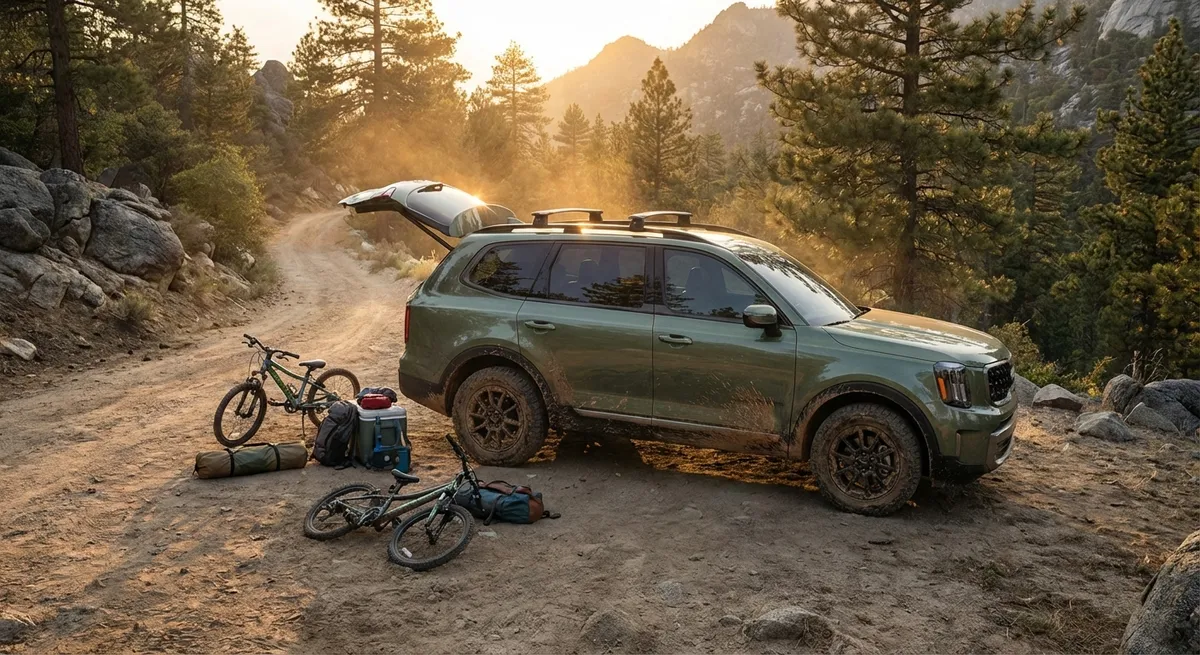
The 2025 Kia Telluride SX‑Prestige X‑Pro arrives at a moment when many three‑row SUVs talk about “adventure” but rarely back it up with meaningful capability. Kia’s range‑topping off‑road‑flavored trim promises something different: genuine towing strength, mild trail competence, and luxury‑leaning comfort, all at a price that still undercuts many rivals. This review focuses on how the Telluride X‑Pro actually performs as a daily family workhorse and as a weekend escape vehicle, with particular attention to powertrain behavior, ride and handling, cabin usability, off‑pavement hardware, and ownership considerations.
Powertrain and Towing: V6 Muscle With Real‑World Tradeoffs
Under the hood, the 2025 Telluride continues with Kia’s 3.8‑liter naturally aspirated V6, rated at 291 hp and 262 lb‑ft of torque, paired to an 8‑speed automatic transmission and standard all‑wheel drive on the X‑Pro trim. This powertrain favors smoothness and linear response over outright punch. Around town, throttle calibration is relaxed; the first bit of pedal travel yields gentle acceleration, ideal for passengers who dislike jerky starts, but it can feel a touch lazy if you’re used to turbocharged torque.
The 8‑speed automatic is tuned for unobtrusiveness. Upshifts are early in normal driving to keep revs low, minimizing engine noise and helping fuel consumption. Downshifts, however, can occasionally hesitate when you demand a burst of power for a highway pass; switching into Sport mode tightens the response window and holds gears longer, making the Telluride feel livelier without becoming frenetic. Enthusiasts may wish for paddle shifters with a more aggressive shift map, but the majority of buyers will appreciate the transmission’s refinement.
What distinguishes the X‑Pro from standard trims from a mechanical standpoint is its elevated towing capacity—up to 5,500 pounds when properly equipped, versus 5,000 pounds on other Telluride models. Kia accomplishes this with an upgraded self‑leveling rear suspension and specific cooling provisions. In practice, the Telluride feels composed with a 3,000–4,000‑pound trailer: the V6 needs revs on steep grades, but body control remains firm, and the AWD system is quick to manage wheel slip during wet‑pavement launches with a load attached.
Fuel economy is the clear compromise. The EPA estimates for the AWD V6 configuration typically hover in the low‑to‑mid‑20s mpg combined, depending on wheel/tire setup, and the X‑Pro’s all‑terrain‑oriented rubber and higher ride height can shave 1–2 mpg in real‑world use. Around town with mixed suburban driving, 18–20 mpg is realistic; steady highway cruising at legal speeds can crack into the 23–24 mpg range. Buyers prioritizing long‑distance fuel efficiency may want to cross‑shop hybrid or turbo‑four alternatives, but the Telluride’s naturally aspirated character—no lag, predictable response—remains a strong draw for those who prefer traditional drivetrains.
Ride, Handling, and Noise: Comfort‑Biased but Not Floaty
The Telluride SX‑Prestige X‑Pro rides on slightly taller sidewalls and all‑terrain‑style tires compared with its road‑oriented siblings. Combined with a modest suspension lift, that hardware changes the ride and handling profile more than you might expect. At city speeds, the additional compliance is welcome; expansion joints, patched asphalt, and speed bumps are rounded off with a nicely damped secondary motion. The chassis never feels brittle, even over broken surfaces, which is crucial for families shuttling kids and gear over imperfect suburban roads.
On the highway, the Telluride leans toward the “big‑SUV” side of the spectrum in feel. Straight‑line stability is excellent, and the steering on center is pleasantly weighted, but you are always aware that this is a long, tall vehicle. Moderate crosswinds do not upset the structure, though you may make small corrections due to the increased profile of the X‑Pro stance. Noise isolation is strong overall: wind noise is kept largely at bay by good door sealing and acoustic glass, while road noise from the more aggressive tire tread is noticeable but not intrusive. It’s a step up in rumble compared to a standard SX‑Prestige, but not enough to be a deal‑breaker if you value the added grip and capability.
In corners, the Telluride’s tuning favors predictable, confident behavior over sharp reflexes. Body roll is present but well‑controlled; the suspension settles quickly after turn‑in rather than continuing to wallow. The steering ratio is on the slower side, giving you a sense of security but requiring more input on tight back roads or parking lots. Enthusiast drivers will not find the same dynamic precision as in some German three‑row competitors, yet the Telluride’s composure and transparency make it easy to place, especially when fully loaded.
Brake pedal feel is a particular strong point. The initial bite is gentle, good for smooth stops, but there is progressive firmness as you dig deeper into the pedal, which inspires confidence when descending long grades with passengers and luggage aboard. The X‑Pro’s increased curb weight and tire choice do not significantly degrade stopping performance in everyday driving; fade resistance should be adequate for normal use, though repeated hard downhill braking with a full trailer would be a scenario where planning ahead and downshifting manually becomes prudent.
Interior Design and Practicality: Thoughtful Family Tech and Packaging
Kia has leaned heavily into an upscale, almost near‑luxury presentation inside the SX‑Prestige X‑Pro, and the cabin largely delivers. Materials across the dash and upper door cards are soft‑touch, with convincing metallic trim and contrast stitching. In the SX‑Prestige spec, Nappa leather upholstery, ventilated front seats, and heated/ventilated second‑row captain’s chairs create a mini‑luxury‑SUV environment. Enthusiasts who appreciate tactile quality will notice the tight panel gaps, consistent switchgear feel, and the absence of cheap, hollow plastics in obvious touchpoints.
The dash houses a wide, curved display layout that integrates a digital instrument cluster with a large central touchscreen. The user interface is clear, with logically organized menus and fast response times. Key functions—climate control, volume, defrost—retain physical buttons and knobs, which is a crucial usability win for drivers who prefer not to dig through touch menus while on the move. Wireless Apple CarPlay and Android Auto availability, multiple USB‑C ports in all three rows, and a high‑power household‑style outlet in the cargo area support modern device‑heavy families.
Seating geometry is well‑resolved. Driving position adjustability is broad, and taller drivers will appreciate generous legroom and headroom. The second row, especially in captain’s chair configuration, rivals some luxury SUVs for comfort, making long‑distance travel genuinely pleasant. The third row is usable for adults on short trips and fine for kids or teenagers on longer drives. Importantly, the floor is relatively low compared with body‑on‑frame SUVs, which means easier access for smaller passengers and less “knees‑up” seating in row three.
Cargo capacity is one of the Telluride’s standout advantages. With all three rows in place, there is enough room for groceries and a compact stroller; fold the third row flat, and the lengthy load floor can swallow multiple large suitcases or camping gear without drama. With both the second and third rows down, the space transforms into a quasi‑van, suitable for hauling bikes, small furniture, or bulky boxes. The load lip is modest in height, and the power tailgate operates quickly. Tie‑down points and under‑floor storage add real‑world utility that many owners will use weekly.
For parents, small details make a difference: rear doors that open wide, available rear‑seat sunshades, and an interior “intercom” function that amplifies the driver’s voice through rear speakers. These features shift the Telluride from merely “spacious” to “family‑optimized.” Enthusiast‑owners who also track data will appreciate that the infotainment system can surface detailed trip information—average consumption, driving time, and route statistics—useful for evaluating longer road trips or towing usage over time.
On‑ and Off‑Pavement Capability: Where the X‑Pro Hardware Actually Matters
The X‑Pro trim is more than just cosmetics. It brings a small but meaningful lift in ground clearance, more robust 18‑inch wheels shod with all‑terrain‑style tires, and an off‑road‑oriented drive mode calibration. Kia’s all‑wheel‑drive system is primarily front‑biased, engaging the rear axle as needed, but the software can proactively send torque rearward under acceleration or when you select Snow or Lock modes. A center “lock” function is electronic rather than a mechanical differential lock; it forces a 50:50 torque split up to certain speeds, improving traction in low‑mu conditions like mud, deep snow, or steep gravel climbs.
On maintained dirt roads and light trails, the Telluride X‑Pro feels secure and composed. The suspension tuning that yields a comfortable highway ride also helps absorb washboard surfaces and scattered rocks without harshness. The all‑terrain tires bite more effectively in loose gravel and soft dirt than standard highway tires, and the slightly taller sidewalls offer better protection against sharp edges. Approach and departure angles are improved versus garden‑variety crossovers, but this is still a unibody SUV with long overhangs; careful line choice is required on more rutted or uneven paths.
Hill descent control is available and works predictably, modulating braking to maintain a low, steady speed on steep downslopes. The system is not as granular as some dedicated off‑road SUVs, but for occasional use—forest roads, primitive campsites, wet boat ramps—it’s confidence‑inspiring. Enthusiasts who dabble in overlanding will find the Telluride X‑Pro best suited as a basecamp vehicle rather than a rock‑crawler; it can carry a family and gear to trailheads and dispersed camping spots that would intimidate a standard minivan, but it lacks features such as underbody skid plating across critical components or a two‑speed transfer case.
On‑road in poor weather, the X‑Pro hardware shines. The extra grip of the tires, combined with the AWD logic, means stable launches on wet or snowy pavement and predictable behavior when one side of the vehicle hits a low‑traction patch. Brake‑based torque vectoring helps mitigate understeer in slippery corners by subtly slowing an inside wheel, effectively “pivoting” the vehicle into the turn. Drivers who routinely face mixed climates—wet autumns, snowy winters, spring mud—will derive more practical value from these attributes than from the occasional trail run.
Safety, Value, and Ownership: A High‑Spec Package With Strategic Compromises
Kia positions the Telluride as a safety‑forward family SUV, and the 2025 model continues with an extensive suite of standard advanced driver‑assistance systems. Typical equipment includes forward collision‑avoidance with pedestrian and cyclist detection, lane‑keeping and lane‑centering assist, blind‑spot collision‑avoidance with rear cross‑traffic alert, and adaptive cruise control with stop‑and‑go functionality in many trims. Higher trims like the SX‑Prestige X‑Pro add highway driving assist features that blend adaptive cruise and lane centering to reduce fatigue on long freeway stretches, although attentive supervision is still required.
Crash‑test performance has historically been strong for the Telluride, with top ratings from the IIHS and NHTSA in recent years. Structural integrity is evident in the vehicle’s solid, rattle‑free demeanor even over rough surfaces. For shoppers prioritizing family safety, the availability of multiple LATCH points, clear anchor access, and wide‑opening rear doors simplify child‑seat installation and removal, a daily‑life consideration that often goes overlooked in spec sheets.
In terms of value, the SX‑Prestige X‑Pro sits near the top of the Telluride price ladder. That said, when you cross‑shop similarly equipped rivals—particularly those with comparable luxury features, three rows, and real towing capability—the Kia often undercuts them by several thousand dollars while providing a richer standard‑equipment list. The warranty package, typically including a 10‑year/100,000‑mile limited powertrain warranty for original owners, adds a strong long‑term cost‑of‑ownership argument, especially for buyers intending to keep the vehicle beyond its finance term.
Depreciation trends for the Telluride have been favorable relative to some mainstream competitors, thanks to sustained demand and limited discounting. Enthusiast‑owners who care about residual value will likely appreciate that a well‑maintained Telluride with full service records can command solid pricing on the used market. Routine maintenance intervals are straightforward; the naturally aspirated V6 avoids some of the complexity associated with turbocharged engines, which can be appealing to buyers concerned about long‑term reliability risks.
The major compromises revolve around fuel economy and the absence of a hybrid or plug‑in hybrid option. In a market increasingly populated by electrified three‑row SUVs, the Telluride’s V6 looks traditional. For buyers who prioritize lower operating costs or reduced emissions, that may be a deal‑breaker. For those who value mechanical simplicity, linear response, and strong towing confidence, it’s a deliberate trade they are willing to make.
Conclusion
The 2025 Kia Telluride SX‑Prestige X‑Pro succeeds by merging a genuinely comfortable, near‑luxury cabin with real‑world capability that extends beyond marketing rhetoric. Its V6 powertrain, while not the most efficient, provides predictable, smooth performance and credible towing strength. Ride quality, cabin refinement, and thoughtful packaging make it an outstanding daily family vehicle, while the X‑Pro hardware package adds enough off‑pavement competence to reach trailheads, campsites, and remote cabins with confidence.
For driving enthusiasts, the Telluride is more about composure and refinement than sharp dynamics—but its steering feel, braking consistency, and stable chassis tuning are satisfying within the context of a large, family‑oriented SUV. For potential buyers, the key evaluation is straightforward: if you want a three‑row SUV that feels premium, tows with authority, carries a full load in comfort, and can credibly handle light to moderate off‑road excursions, the Telluride SX‑Prestige X‑Pro belongs on your short list. Its blend of safety, value, warranty coverage, and everyday livability continues to set a benchmark in the three‑row crossover segment.
Sources
- Kia Telluride – Official U.S. Product Page - Manufacturer specifications, features, trims, and warranty information
- U.S. EPA – Fuel Economy Data for 2025 SUVs - Official fuel‑economy ratings and powertrain details for comparable SUVs
- IIHS – Kia Telluride Crash Test Ratings - Independent safety evaluations, crashworthiness, and crash‑avoidance performance
- NHTSA – Kia Telluride Safety Ratings - Federal crash‑test results and safety‑related data
- Consumer Reports – Large and Midsized SUV Reliability Trends - Reliability, owner satisfaction, and comparative data across the SUV segment
Key Takeaway
The most important thing to remember from this article is that this information can change how you think about Reviews.