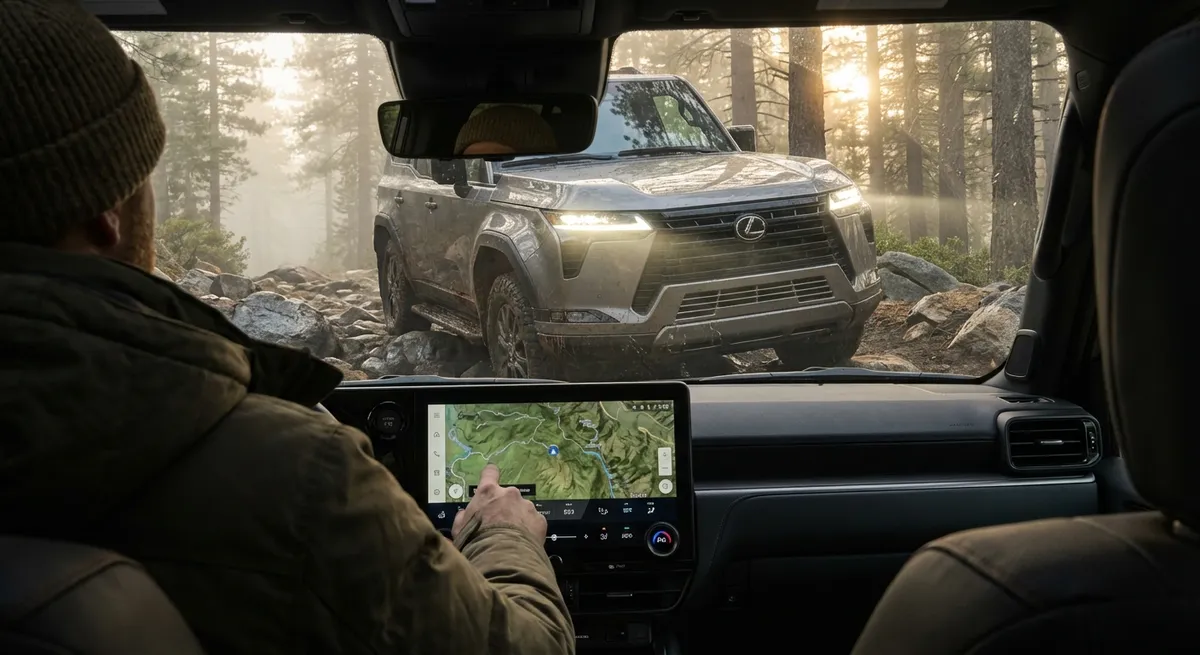
The 2025 Lexus GX 550 arrives at a moment when many midsize luxury SUVs are drifting toward soft-road comfort and away from genuine capability. Lexus took the opposite path: the new GX is built on a body‑on‑frame architecture, features a twin‑turbo V6 with real towing muscle, and adds a modern, tech‑heavy cabin aimed at families and enthusiasts who actually use 4WD systems for more than snowy driveways. This review goes beyond first impressions to unpack how the GX 550 really drives, how its technology works in practice, and what ownership looks like for buyers cross‑shopping everything from the Land Rover Defender 110 to the Mercedes‑Benz GLE and Jeep Grand Cherokee.
Chassis, Powertrain, and On‑Road Dynamics
Underneath the squared‑off bodywork, the 2025 GX 550 rides on Toyota’s GA‑F body‑on‑frame platform, shared with the latest Land Cruiser and Lexus LX. This ladder‑frame architecture is engineered for torsional rigidity and durability, but Lexus tuned it to behave more like a unibody on pavement. The result is an SUV that still feels substantial and truck‑like, but with tighter body control and less flex over broken pavement than the previous generation.
Power comes from a 3.4‑liter twin‑turbocharged V6 (often marketed as a 3.5L) producing about 349 hp and 479 lb‑ft of torque, paired with a 10‑speed automatic transmission. The torque plateau arrives early in the rev range, which significantly improves real‑world drivability compared with the outgoing naturally aspirated V8. Highway merges and two‑lane passing are confident even with a full load of passengers and cargo, and the 10‑speed gearbox is well calibrated to keep the turbos spooled without hunting between gears.
The standard full‑time 4WD system uses a Torsen center differential with a low‑range transfer case, and most trims include a locking center differential for demanding terrain. On road, the system defaults to a rear‑biased torque split that helps the GX feel more planted and less nose‑heavy in corners. Optional adaptive suspension on higher trims constantly adjusts damping to match road conditions, noticeably reducing fore‑aft pitch under braking and acceleration while smoothing sharp impacts.
Steering remains on the heavier side, in keeping with the GX’s off‑road mission, but on‑center feel is improved and lane changes require fewer small corrections than before. Braking performance is strong and linear, though pedal feel is tuned more for predictability than razor‑sharp initial bite. The tradeoff is that drivers transitioning from crossovers or sedans will need a short acclimation period to the GX’s higher center of gravity and extra mass, but once adjusted, the SUV feels remarkably composed for something with legitimate trail credentials.
Off‑Road Capability and Towing Performance
Where the GX 550 truly differentiates itself from most luxury competitors is off pavement. Ground clearance, approach, departure, and break‑over angles vary slightly by trim and tire package, but the key takeaway is that Lexus engineered this SUV to handle genuine off‑road duty. The available Overtrail and Overtrail+ trims add all‑terrain tires, an electronic locking rear differential, and additional underbody protection, plus an off‑road tuned suspension setup.
Lexus equips the GX with an electronic crawl control system that functions like low‑speed off‑road cruise control, managing throttle and braking over rocks, mud, and steep descents so the driver can concentrate on steering. Multi‑Terrain Select offers multiple drive modes (such as Mud & Sand, Rock, and Auto) that alter throttle response, traction control sensitivity, and differential behavior to optimize grip. A Multi‑Terrain Monitor uses cameras to project underbody and side views on the center display, effectively letting you “see” obstacles close to the front bumper or along the rocker panels that would otherwise be hidden from the driver’s seat.
For towing, the twin‑turbo V6’s torque is critical. When properly equipped, the GX 550 is rated to tow up to about 8,000 pounds, putting it in the same conversation as truck‑based rivals and ahead of many unibody luxury SUVs. The longer wheelbase and robust frame contribute to stable trailer behavior at highway speeds, and the transmission’s tow/haul mode adjusts shift points to keep the engine in the sweet spot on grades. Integrated trailer wiring, a factory hitch receiver, and available trailer sway control systems round out the towing package.
The unavoidable compromise is fuel economy. While the V6 is more efficient than the previous V8, the GX still carries considerable mass, a boxy profile, and full‑time 4WD. Buyers stepping out of unibody crossovers should expect notably higher fuel consumption, particularly when towing or spending extended time in low‑range off‑road environments. For enthusiasts who prioritize capability and durability over maximum efficiency, that’s a trade they’re often willing to make.
Interior Design, Seating, and Everyday Usability
Inside, the GX 550 represents a major step forward in ergonomics, materials, and technology compared with the prior generation, while still leaning into the upright, purposeful ethos of a genuine SUV. The dashboard centers around a large 14‑inch touchscreen paired with a fully digital instrument cluster, but Lexus deliberately retained a healthy array of physical knobs and switches for commonly used functions like climate control, drive modes, and off‑road settings.
Material quality is in line with Lexus expectations: soft‑touch surfaces across the dash and door tops, high‑grade leather on higher trims, and genuine metal or open‑pore wood accents depending on package. Switchgear has a satisfyingly solid action, and cabin insulation benefits from both acoustic glass and strategic sound deadening, making the GX quieter at highway speed than many truck‑based rivals. The driving position is upright with good outward visibility thanks to the squared‑off greenhouse, though the high beltline and substantial hood mean shorter drivers may appreciate the available seat and steering wheel memory with generous range of adjustment.
The GX offers three rows, though the third row is best for children or shorter trips with adults. The second row can be configured either as a bench or captain’s chairs depending on trim and market, and the seats are noticeably improved in contouring and support for long‑distance comfort. Cargo capacity is competitive for the class with the third row folded, and the more squared‑off rear shape allows for easier loading of bulky gear compared with coupe‑like SUVs that sacrifice volume to styling.
Lexus has finally replaced the side‑hinged tailgate of the previous GX with a more conventional top‑hinged liftgate in many markets, making tight parking lots and curbside loading more convenient. Tie‑down points, underfloor storage, and (on some trims) a 120V outlet make the GX friendly for road‑trip duty. Families will appreciate multiple USB‑C charge ports across all rows, along with thoughtful storage spaces for devices, water bottles, and small items that often get lost in less carefully designed cabins.
Infotainment, Driver Assistance, and Tech Experience
The latest generation Lexus Interface system powers the GX 550’s 14‑inch central touchscreen, bringing a modern software environment that supports wireless Apple CarPlay and Android Auto, natural‑language voice commands (“Hey Lexus”), and cloud‑based navigation with real‑time traffic in supported regions. The processor is more responsive than previous Lexus systems; menu transitions and map zooms are fluid, and the interface is laid out with large, easy‑to‑hit targets suitable for use on rough roads.
A premium Mark Levinson audio system is available and remains one of the standout options for audiophiles in this segment. It delivers detailed, balanced sound with strong imaging even at lower volumes, aided by the GX’s quiet cabin. Integration with streaming services via smartphone mirrors how most owners actually consume audio content today, and the system holds up whether you’re listening to compressed streams or higher‑quality files.
On the driver assistance front, the GX 550 comes standard with the latest Lexus Safety System+ suite. This typically includes adaptive cruise control with full‑speed range, lane departure alert with steering assist, lane tracing assist to help keep the vehicle centered, pre‑collision braking with pedestrian detection, and road sign assist that can display speed limits and select warnings in the cluster. In practice, adaptive cruise control maintains smooth following distances and transitions well in stop‑and‑go traffic, though the lane‑keeping assistance is tuned conservatively, intervening gently rather than aggressively pulling the vehicle back into the lane.
A 360‑degree camera system with high‑resolution imaging is available and particularly useful given the GX’s boxy dimensions. For parking in tight urban environments, parking sensors and automated braking help prevent low‑speed fender‑benders. Importantly, Lexus’s approach still places the driver firmly in control; the GX doesn’t chase the advanced hands‑free highway driving that some rivals offer, which may appeal to owners who prioritize predictability and a more “analog” driving experience in a technologically advanced vehicle.
Over‑the‑air (OTA) update capability is increasingly common, and the GX’s infotainment and some control modules can receive software updates without a dealer visit. This helps address bugs, refine driver assist behavior, and potentially add minor features over time. For long‑term owners, that translates to a vehicle whose tech stack is less likely to feel obsolete five years into ownership.
Ownership, Reliability Expectations, and Segment Positioning
The Lexus GX nameplate has built a reputation for long‑term durability, often sharing core components with Toyota’s global Land Cruiser family. While the 2025 GX 550 introduces a more complex twin‑turbo powertrain and a greater array of electronics, it still benefits from Toyota’s conservative engineering philosophy and global testing of the GA‑F platform under demanding conditions. For buyers who plan to hold onto their SUV beyond the typical three‑year lease window, that heritage matters—especially when compared with some European rivals that carry higher long‑term maintenance and repair costs.
Routine service intervals, parts availability, and dealer network coverage all work in the GX’s favor for North American buyers. Lexus dealerships are generally rated highly for service experience, and the brand’s track record in J.D. Power and other dependability studies suggests the GX will remain a safe bet for reliability, even as the segment moves toward more complex electrified drivetrains. That said, the twin‑turbo engine’s higher operating pressures and additional components (turbos, intercoolers, extra plumbing) will likely require more precise adherence to maintenance schedules than the old V8.
In terms of positioning, the GX 550 slots into a niche that blends traditional SUV robustness with modern luxury—competing more directly with vehicles like the Land Rover Defender 110 and Jeep Grand Cherokee in Trailhawk/Summit Reserve guise than with purely road‑biased crossovers like the BMW X5 or Mercedes‑Benz GLE. Buyers who prioritize maximum efficiency, car‑like handling, or cutting‑edge semi‑autonomous driving technology may find better fits elsewhere. Those who value the ability to tow a boat, tackle real trails, and still commute in comfort and quiet will see the GX as one of the most compelling packages in the midsize luxury SUV space.
Pricing will vary by trim and option packages, but the GX is expected to undercut some European competitors when comparably equipped, while potentially costing more than mainstream off‑roaders. Resale values for prior GX generations have been exceptionally strong, reflecting both demand and reliability; if that trend continues, total cost of ownership may be more favorable than the sticker price alone suggests. For enthusiasts and families who need an SUV that can credibly do it all—from school runs to overlanding—the 2025 Lexus GX 550 stands out as a rare combination of capability, refinement, and likely longevity.
Conclusion
The 2025 Lexus GX 550 is not just a facelift of a familiar name; it is a comprehensive rethinking of what a midsize luxury SUV can be when off‑road credibility and long‑term durability are treated as primary design goals rather than afterthoughts. Its twin‑turbo V6 and GA‑F frame deliver real towing and trail performance, while the updated cabin, modern tech stack, and improved on‑road manners make it fully competitive as a daily driver. It won’t be the right answer for every shopper, particularly those who prioritize fuel economy or cutting‑edge autonomous features, but for buyers who want substance beneath the sheet metal and a vehicle engineered to last, the GX 550 belongs on a very short test‑drive list.
Sources
- [Lexus USA – 2024/2025 GX Product Information](https://www.lexus.com/models/GX) – Official specifications, features, and packaging details from the manufacturer
- [Toyota Global – GA‑F Platform Overview](https://global.toyota/en/mobility/toyota-brand/features/tnga/lineup/ga-f/) – Technical background on the ladder‑frame architecture underpinning the GX
- [U.S. Environmental Protection Agency (EPA) – Fuel Economy Data](https://www.fueleconomy.gov/feg/findacar.shtml) – Authoritative fuel economy and emissions information for SUVs and light trucks
- [J.D. Power – Vehicle Dependability Study](https://www.jdpower.com/business/press-releases/2024-us-vehicle-dependability-study-vds) – Context on Lexus and Toyota reliability and long‑term ownership trends
- [IIHS – SUV Safety Ratings](https://www.iihs.org/ratings/by-series/suvs) – Independent crash test results and safety evaluations relevant to the segment
Key Takeaway
The most important thing to remember from this article is that this information can change how you think about Reviews.