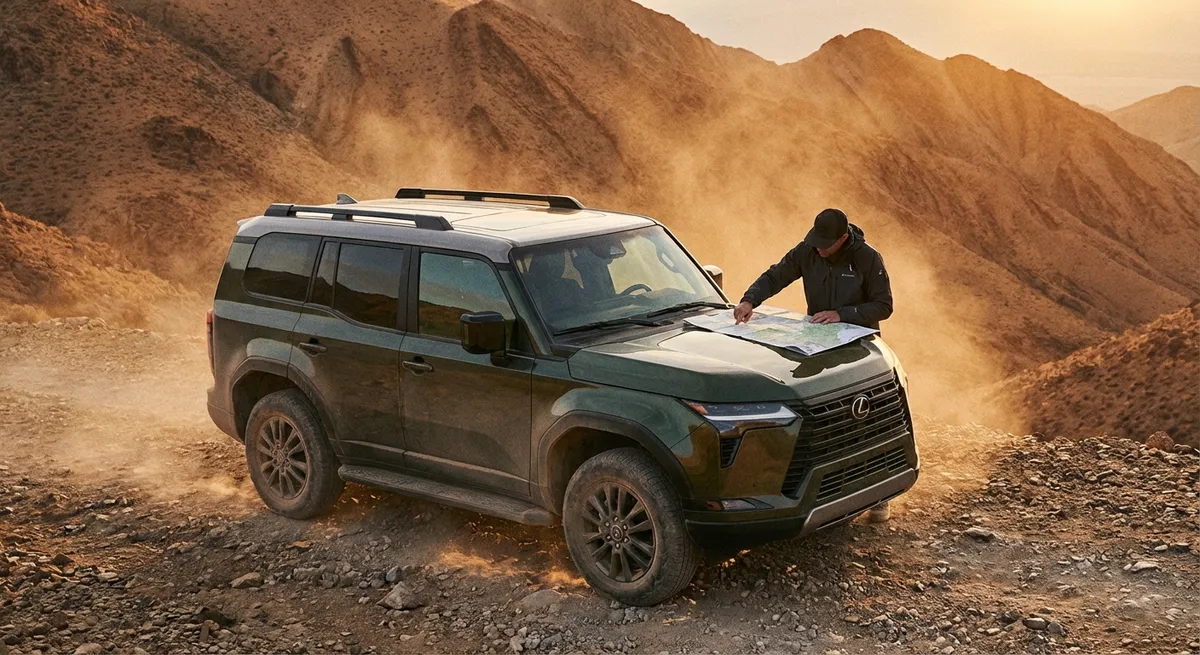
The 2025 Lexus GX 550 arrives at a time when most family SUVs are drifting toward car-like comfort and away from true off-road capability. Lexus has taken the opposite route here: body-on-frame construction, a twin-turbo V6, and genuine trail hardware wrapped in a premium, three-row package. For shoppers who need a vehicle that can tow, tackle bad roads, and still shuttle the family in comfort, the new GX is one of the most technically interesting SUVs of the year.
This review focuses on five key areas that matter to enthusiasts and serious buyers: platform and powertrain, on-road dynamics, off-road capability, interior packaging and tech, and running costs/ownership. Together, they paint a clear picture of where the GX 550 fits in a crowded luxury SUV market.
Platform & Powertrain: Traditional Bones With Modern Muscle
Underneath the squared-off bodywork, the 2025 GX 550 rides on Toyota’s TNGA-F body-on-frame platform, the same architecture used by the latest Land Cruiser, Tundra, and Sequoia. Compared with the previous-generation GX, the new frame is stiffer and makes extensive use of high-strength steel, improving both torsional rigidity and refinement. That rigidity is key for precise suspension tuning and better isolation from rough surfaces.
Power is supplied by a 3.4-liter twin-turbocharged V6, badged as a 3.5-liter in some markets but displacing 3,445 cc. In U.S. specification, it delivers 349 hp and 479 lb-ft of torque, a major jump over the outgoing naturally aspirated 4.6-liter V8’s 301 hp and 329 lb-ft. The torque plateau comes in low in the rev range, around 2,000 rpm, which is ideal for towing and off-road climbing. An eight-speed automatic transmission replaces the old six-speed unit, offering shorter low gears for response and taller high gears for quiet highway cruising and better fuel efficiency.
Full-time four-wheel drive with a Torsen center differential is standard. Drivers can lock the center diff for a 50:50 torque split in challenging conditions, and a two-speed transfer case provides low-range gearing for technical terrain. Towing capacity is rated up to 8,000 pounds when properly equipped, competitive with or better than most other three-row luxury SUVs that lack body-on-frame underpinnings. For buyers who intend to haul boats, campers, or enclosed trailers, this drivetrain is purpose-built and notably more robust than front-biased, transverse-based competitors.
On-Road Dynamics & Ride Comfort: Refinement Over Raw Sport
On pavement, the GX 550 feels unmistakably like a traditional SUV, but one that has been tuned for composure rather than float. The steering is hydraulic-assisted rather than fully electric, providing better feedback through the wheel than many crossovers, though effort is on the heavier side at low speeds. At highway velocity, the steering weights up nicely and helps the GX track confidently, with minimal wander despite its tall profile and relatively aggressive all-terrain tires on some trims.
Suspension hardware consists of an independent double-wishbone setup up front and a solid rear axle with a multi-link configuration at the back. Higher trims can be equipped with adaptive variable suspension that continuously adjusts damping based on vehicle speed, road conditions, and driver inputs. Compared with the previous-generation GX, there is a noticeable reduction in pitch and body roll during quick lane changes or on curvy roads; the stiffer frame and revised suspension geometry play a big role here. The ride quality is firm but controlled—this is not a soft, wallowy cruiser, but impacts are well-damped and secondary motions are limited.
Noise, vibration, and harshness (NVH) levels are impressively low. Acoustic glass, additional sound insulation, and careful sealing around the body structure contribute to a hushed cabin at 70 mph, even with the boxy exterior that naturally generates some wind noise. The twin-turbo V6 is quiet in steady-state cruising, only making its presence known under heavy throttle with a subdued but purposeful growl. Enthusiasts may miss the character of the old V8, but objectively, the new powertrain is stronger, smoother, and more efficient.
Off-Road Capability: Hardware That Actually Matters in the Dirt
The GX 550’s off-road credentials are more than marketing language. Ground clearance sits in the 8–9 inch range depending on trim and wheel/tire combination, and approach, breakover, and departure angles are competitive with serious trail-capable rigs, particularly in the Overtrail and Overtrail+ variants. These off-road-focused trims ride on 33-inch all-terrain tires, have additional underbody protection, and incorporate a standard electronic locking rear differential.
Toyota’s Multi-Terrain Select system is available, offering calibrated drive modes for surfaces such as mud, sand, rocks, and dirt. Each mode alters throttle response, traction control thresholds, and 4WD system behavior to optimize grip. Crawl Control functions effectively as a low-speed off-road cruise control, modulating throttle and braking in five selectable speed increments so the driver can focus on steering. A 360-degree camera with dedicated underbody and side views aids in placing the GX precisely on tight trails or when cresting blind obstacles.
The TNGA-F platform’s ladder-frame structure is fundamental to the GX’s durability off-road. It better tolerates the torsional flex and point loads that come from uneven terrain than most unibody crossovers. Combined with robust front and rear recovery points, ample skid plating, and available rock rails, the GX 550 is designed to be used off pavement without long-term structural complaints. For enthusiasts who actually air down tires and run technical trails, this hardware is more convincing than the cosmetic “rugged” packages seen on many soft-road competitors.
Interior, Space & Technology: Luxury Cabin With a Practical Edge
Inside, the GX 550 moves decisively upmarket from its predecessor while retaining a more upright, functional layout than some fashion-forward luxury SUVs. The dashboard is dominated by a 14-inch central touchscreen running the latest Lexus interface, flanked by physical knobs and buttons for high-use functions like climate control and audio volume. This mix of touch and tactile controls is appreciated on rougher roads where poking at small on-screen icons can be frustrating. Wireless Apple CarPlay and Android Auto are standard, along with multiple USB-C ports spread across all three rows.
Materials quality in the upper trims is genuinely premium: semi-aniline leather, real wood or metal accents, and soft-touch surfaces on nearly every point of contact. Even mid-level models feel upscale, with careful stitching and tight panel gaps throughout. Front seats offer generous adjustment ranges and optional heating, ventilation, and memory functions. Second-row captain’s chairs or a bench are available depending on configuration; both provide adult-friendly legroom and headroom thanks to the tall roofline and relatively upright seating positions.
The third row is usable, if not expansive, with adequate space for kids or shorter adults on shorter trips. Access is facilitated by slide-and-tilt second-row seats. Cargo capacity is respectable rather than class-leading; the body-on-frame architecture and rear suspension packaging slightly compromise floor height and loading depth, especially with the third row in use. Still, with the third row folded, the GX offers enough volume for family road trips, outdoor gear, or bulky items. Tech features like a configurable digital instrument cluster, head-up display, and advanced driver-assistance systems (Lexus Safety System+ 3.0) complete the package, offering lane-keeping assist, adaptive cruise control, blind-spot monitoring, and automatic emergency braking with pedestrian detection.
Efficiency, Running Costs & Ownership Considerations
From an efficiency standpoint, the GX 550 is realistic rather than revolutionary. Official EPA figures are still being finalized in some markets, but expectations fall in the mid-teens in the city and low-20s on the highway, depending on trim and tire selection. Compared with the outgoing V8, the twin-turbo V6 should deliver a meaningful improvement, but this remains a heavy, body-on-frame SUV with permanent 4WD—it will not match unibody, front-biased competitors in fuel economy. Enthusiasts who want the towing and off-road capability will likely accept this trade-off.
Maintenance intervals follow Toyota/Lexus norms, with extended oil change intervals and a focus on long-term durability. The twin-turbo layout introduces more complexity than the old naturally aspirated V8—two turbochargers, more plumbing, and higher specific output—but this powertrain shares components and architecture with high-volume Toyota trucks and SUVs, which bodes well for parts availability and long-term support. Lexus dealers are known for strong customer service and loaner programs, which can make ownership more convenient, particularly during warranty-covered years.
Insurance costs will vary by market but are likely to be in line with other mid-to-large luxury SUVs, with the GX’s robust safety suite potentially offsetting some of the size and power from a risk-pricing standpoint. Depreciation is historically favorable for body-on-frame Toyota/Lexus utilities; prior-generation GX models are known for holding value exceptionally well due to their off-road reputation and mechanical robustness. For buyers who plan to keep the vehicle long term or eventually sell into the enthusiast and overlanding communities, residual values are a strong part of the ownership story.
Conclusion
The 2025 Lexus GX 550 stands out in a segment dominated by increasingly soft, car-based SUVs. Its combination of a modern twin-turbo V6, genuinely capable 4WD hardware, a stiff ladder-frame platform, and a thoroughly upgraded interior makes it one of the most compelling choices for buyers who actually need their luxury SUV to work—tow, travel long distances, and handle trails—without sacrificing comfort or technology.
For enthusiasts, the GX 550 offers a rare mix: hydraulic steering feel, real low-range gearing, and a locking rear differential packaged with advanced driver assistance, a refined cabin, and the ownership experience Lexus is known for. For family buyers, it brings three-row versatility, strong safety tech, and long-term durability backed by Toyota’s truck architecture. It is not the most efficient, nor the sportiest on a twisty road, but if your priorities lean toward capability, longevity, and real-world utility with a premium finish, the 2025 GX 550 deserves a place near the top of your test-drive list.
Sources
- Lexus USA – 2024/2025 GX Overview - Official specifications, features, and platform details for the new GX lineup
- Toyota Global – TNGA-F Platform Technical Overview - Engineering background on the body-on-frame architecture used by the GX, Land Cruiser, and Tundra
- U.S. EPA – Fuel Economy Data & Trends - Reference data for SUV fuel economy ratings and comparisons
- IIHS – Vehicle Ratings - Information on crash-test performance and safety technology evaluations for SUVs
- Consumer Reports – Body-on-Frame vs. Unibody SUVs - Context on structural differences and how they affect ride, handling, and durability
Key Takeaway
The most important thing to remember from this article is that this information can change how you think about Reviews.