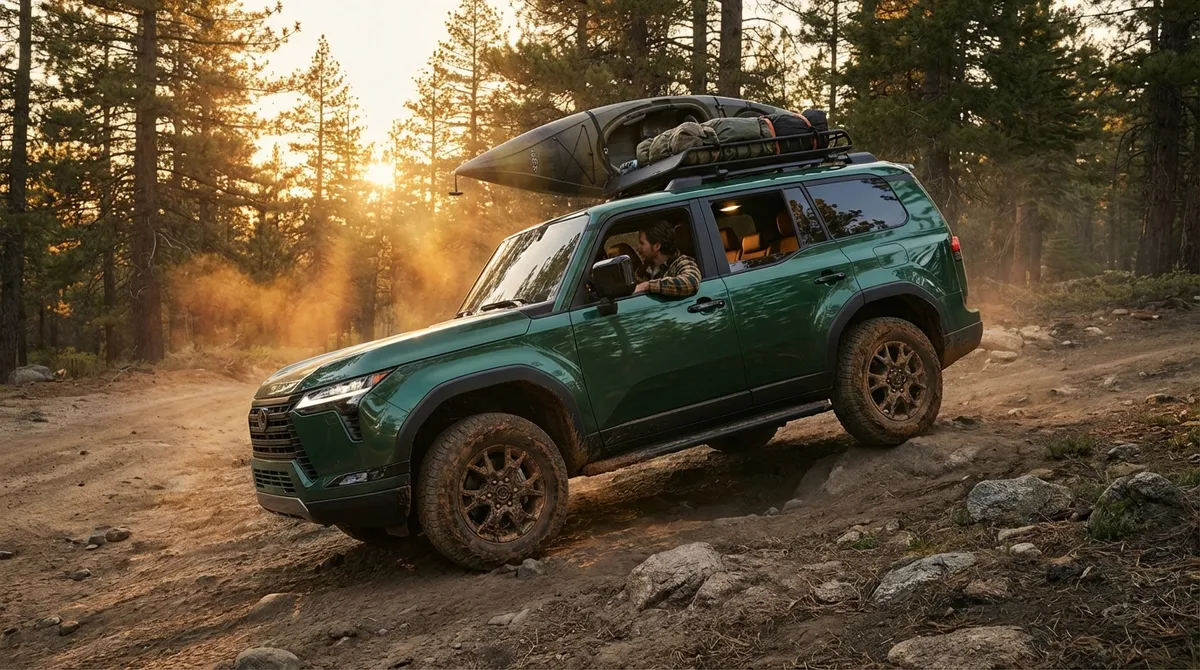
The Lexus GX has always catered to a niche audience: buyers who want a genuinely rugged, body-on-frame SUV with a luxury badge and serious off-road hardware. For 2025, the fully redesigned GX 550—especially in Overtrail trim—leans harder than ever into that identity. Instead of chasing the car-like comfort of crossovers, Lexus has doubled down on toughness while upgrading tech, refinement, and power. This review focuses on five key areas that matter most to enthusiasts and serious shoppers: platform and powertrain, off-road hardware, on-road manners, cabin and tech, and efficiency and ownership costs.
Platform, Chassis, and Powertrain: The Backbone of the New GX
Under the skin, the 2025 GX 550 rides on Toyota’s GA-F body-on-frame platform, shared with the latest Toyota Land Cruiser and Tundra. This is a traditional truck-style construction: the body is mounted on a separate ladder frame. Enthusiasts will appreciate that this design typically provides greater durability, better resistance to torsional stress, and superior suitability for heavy-duty off-road use and towing compared with unibody crossovers.
Power comes from a 3.4-liter twin-turbocharged V6 (officially a 3.5L in some documents, but 3.4L in displacement terms) producing around 349 hp and 479 lb-ft of torque, routed through a 10‑speed automatic transmission. This is a substantial upgrade from the outgoing GX’s naturally aspirated V8 in both power and torque, especially in the mid-range where turbocharged engines shine. Peak torque is available at relatively low rpm, which matters when climbing steep grades or towing.
The drivetrain layout is full-time four-wheel drive with a Torsen limited-slip center differential and a low-range transfer case. While many luxury SUVs have moved to part-time or automatic all-wheel drive without low range, the GX maintains a mechanical, off-road-focused setup that serious trail drivers will value. Towing capacity is competitive, rated up to approximately 8,000 pounds (depending on market and configuration), thanks to the strong ladder frame and torque-rich engine.
Technically minded buyers should note the suspension design: independent double-wishbone front suspension and a solid rear axle with multi-link setup. The rear solid axle is less sophisticated than fully independent layouts for pure on-road comfort, but it generally offers better articulation, durability, and load handling—key advantages when off-roading or towing. The Overtrail trim further optimizes this setup with off-road specific tuning.
Overtrail Hardware: Where the GX 550 Distances Itself Off-Road
The Overtrail and Overtrail+ trims are where the GX 550 really diverges from typical luxury SUVs. These variants are purpose-built for overlanding and off-road use, and the hardware list reads like an enthusiast wish list.
First, ground clearance is significantly increased over standard GX trims, and approach/departure angles are improved thanks to revised bumpers and underbody protection. While exact figures vary by wheel and tire packages, buyers can expect approach angles in the mid-20s (degrees) and departure angles in the low- to mid-20s, which is strong for a luxury SUV with three-row potential.
The Overtrail models ride on 18‑inch wheels wrapped in all-terrain tires, a choice that prioritizes sidewall height and compliance over flashy wheel designs. This matters: taller sidewalls are less prone to damage on rocks and allow lower pressures for traction in sand or mud. Lexus also equips the Overtrail with an electronic locking rear differential to maximize traction when one wheel is off the ground or on a low-traction surface.
Advanced off-road tech includes Multi-Terrain Select (adjusts throttle, traction, and ABS behavior for different surfaces), Crawl Control (a low-speed off-road cruise control), and Downhill Assist Control. Together, these systems reduce driver workload on technical terrain. A 3D Multi-Terrain Monitor uses cameras to provide views under and around the vehicle, critical for spotting obstacles that are otherwise hidden by the hood line or terrain.
Enthusiasts should especially note the adaptive suspension and available Electronic Kinetic Dynamic Suspension System (E-KDSS) on select trims. E‑KDSS can effectively decouple the sway bars off-road for increased wheel articulation, then re-engage them on-road to control body roll. This helps the GX achieve a rare duality: more wheel travel over obstacles without giving up too much cornering stability on pavement.
On-Road Dynamics: How the GX 550 Drives Day to Day
Given its hardcore credentials, the key question for many buyers is whether the GX 550 still works as a daily driver. The answer is yes, with some caveats that will be perfectly acceptable—or even desirable—to its target audience.
The twin-turbo V6 and 10‑speed automatic deliver smooth, confident acceleration. Turbo lag is well-controlled, and the transmission generally keeps the engine in its torque sweet spot. Highway passing power is substantially improved over the old V8, and the engine feels more responsive at altitude thanks to forced induction.
Steering is on the heavier side, with a truck-like feel that some drivers will appreciate for its stability and sense of solidity. The body-on-frame architecture and off-road suspension tuning mean the GX doesn’t handle like a unibody crossover; there’s more body motion in corners and a sense of mass that’s very different from something like a BMW X5. However, for buyers coming from pickups or older SUVs, the GX feels planted, predictable, and reassuring, particularly on long highway drives or rough secondary roads.
Ride quality in the Overtrail is firmer than in the more road-focused trims due to all-terrain tires and off-road-oriented suspension. Sharp impacts can be more noticeable, but the overall damping is well-tuned so that the vehicle doesn’t feel jittery. Adaptive dampers help smooth out variations in road surface and can adjust for different drive modes.
Noise levels are well-controlled thanks to improved insulation and the inherently quiet nature of a modern turbo V6. Wind noise is present due to the upright profile and roof rack options, but it’s conservative for such a boxy vehicle. Lexus has applied its typical focus on NVH (noise, vibration, harshness), so while you are always aware you’re in a body-on-frame truck, it never feels crude or unfinished.
Cabin, Packaging, and Tech: Where Luxury and Utility Intersect
Inside, the 2025 GX 550 takes a huge step forward from its predecessor. The design is more modern and horizontal, with a large, centrally mounted touchscreen (around 14 inches diagonally) running the latest Lexus Interface infotainment system. The interface supports wireless Apple CarPlay and Android Auto and uses cloud-based navigation where available.
Physical controls have not been abandoned. Critical functions such as climate control, off-road modes, and drive mode selection still use tactile switches and knobs, which is especially important when driving on rough terrain where using a touchscreen can be difficult. The shifter is a traditional mechanical-feeling lever, and the transfer-case controls are laid out clearly, underscoring the GX’s functional orientation.
Material quality is high, with soft-touch surfaces, available semi-aniline leather, and robust-feeling switchgear. The Overtrail trim adds durable materials and color schemes meant to hide dirt and wear, plus features like rubberized floor mats and unique seat designs. Seating comfort is strong in the first two rows, with supportive cushioning optimized for long-distance travel. Some configurations offer three-row seating, though space in the third row is best reserved for children or occasional adult use.
Tech features include a digital instrument cluster, multiple USB-C ports, head-up display (on higher trims), and an available premium Mark Levinson audio system. Lexus Safety System+ 3.0 comes standard, bundling adaptive cruise control, lane-keeping assistance, pre-collision braking with pedestrian detection, and road sign assist. For buyers interested in towing or off-road travel, camera systems and monitoring functions provide additional confidence.
Cargo space benefits from the more squared-off rear design. While exact measurements vary by market, the cargo area is more usable than before, with a more conventional top-hinged rear hatch (replacing the old side-hinged door in many markets) and available power features. The boxy silhouette isn’t just an aesthetic nod to classic SUVs—it enhances real-world usability by making it easier to load bulky gear, coolers, and camping equipment.
Efficiency, Range, and Ownership Considerations
For all its improvements, the GX 550 is still a large, heavy, body-on-frame SUV with a powerful turbocharged engine. Fuel economy reflects that. Official EPA figures (where available) place the GX in the mid- to high‑teens (mpg) in city driving and low‑20s on the highway, depending on trim and wheel/tire choices. The Overtrail’s all-terrain tires and off-road tuning can reduce efficiency slightly compared to more road-focused trims.
However, the turbo V6’s efficiency is still an improvement over the outgoing V8, particularly when driven gently or used for long highway trips. A sizable fuel tank helps maintain a practical driving range, important for off-road and overland adventures where refueling opportunities are limited. For buyers planning extended trips into remote areas, careful route and fuel planning remains essential.
Maintenance considerations are mixed. On one hand, the GX’s body-on-frame design and shared GA-F platform mean many components are robustly engineered for heavy-duty use. Toyota and Lexus have a well-earned reputation for long-term durability in their body-on-frame SUVs, evidenced by high-mileage Land Cruisers and GXs in global markets. On the other hand, the twin-turbo V6 is more complex than a naturally aspirated engine, with additional components (turbos, intercoolers, high-pressure fuel systems) that will require proper maintenance and high-quality fluids.
Ownership costs will be influenced by Lexus’s premium positioning: parts and service are likely to be more expensive than mainstream brands, but resale values for SUVs like the GX have historically been strong, offsetting some of the up-front cost over the vehicle’s lifecycle. For buyers who actually use the GX for towing, off-roading, or overland travel, the durability of the platform and drivetrain may pay off in fewer failures under harsh use compared with lighter-duty crossovers.
For environmentally conscious buyers, the lack of an immediate hybrid or plug-in hybrid option may be a drawback, especially as more competitors introduce electrified drivetrains. However, Toyota and Lexus have signaled a broader electrification strategy across their lineup, so a hybrid variant in future model years wouldn’t be surprising.
Conclusion
The 2025 Lexus GX 550 Overtrail is not trying to be all things to all people. Instead, it targets a specific buyer: someone who values authentic off-road capability, a robust truck-based platform, and the comfort and tech of a modern luxury SUV. The shift to a twin-turbo V6 and GA-F platform brings meaningful gains in power, refinement, and capability, while the Overtrail trim adds hardware that serious enthusiasts can actually use.
For shoppers cross-shopping unibody luxury crossovers, the GX will feel heavier and more truck-like. For buyers who prioritize durability, towing, overlanding, and long-term ownership, that’s exactly the point. The 2025 GX 550 Overtrail stands out as one of the few genuinely off-road-capable luxury SUVs that still takes its roots seriously—while finally delivering the modern tech and interior experience that today’s buyers expect.
Sources
- Lexus USA – 2024/2025 GX Overview - Official model information, specifications, and feature breakdown for the latest GX
- Toyota Global – GA-F Platform Technical Overview - Details on the body-on-frame GA-F platform shared with the GX, Land Cruiser, and Tundra
- U.S. EPA – Fuel Economy Data for Light-Duty Vehicles - Comparative fuel economy ratings for large 4WD SUVs, useful for benchmarking the GX
- IIHS – SUV Safety and Crashworthiness - Independent crash test results and safety evaluations for SUV models
- Consumer Reports – Body-on-Frame vs. Unibody SUVs - Explains the technical and practical differences between SUV construction types and how they affect driving and durability
Key Takeaway
The most important thing to remember from this article is that this information can change how you think about Reviews.