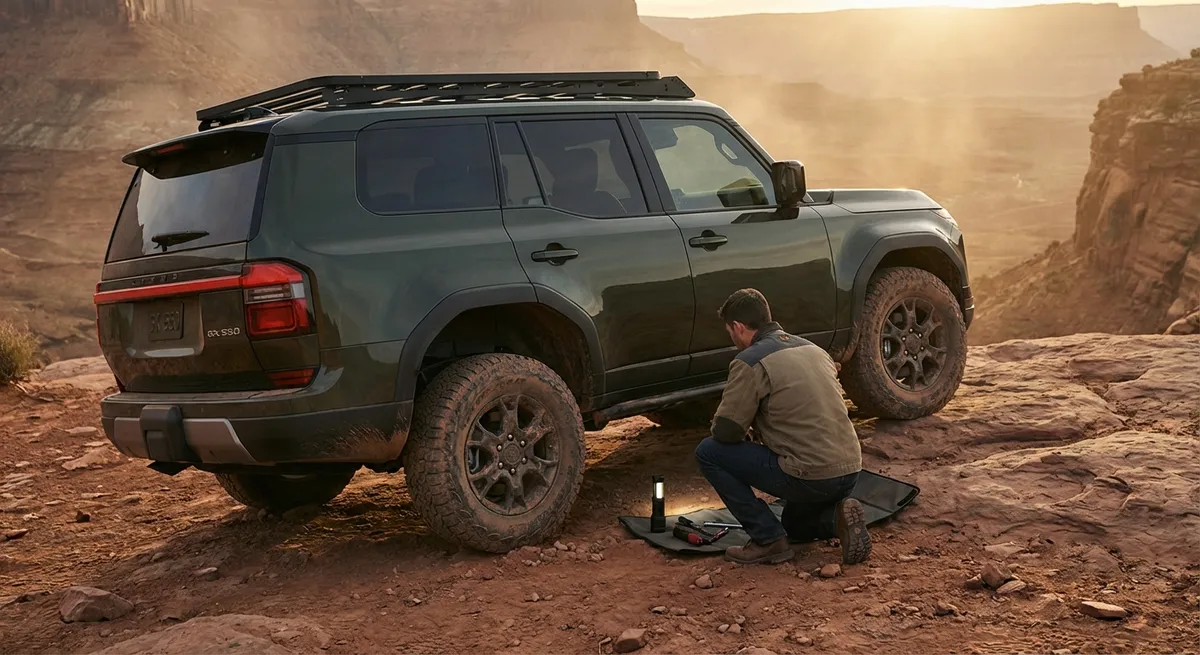
The 2025 Lexus GX 550 arrives at a moment when SUVs are expected to do everything—commute in comfort, haul families, tow heavy loads, and still look tough in the trailhead parking lot. Lexus has responded with a body‑on‑frame, twin‑turbo V6 luxury SUV that deliberately leans into its off‑road heritage while upgrading tech, refinement, and power. This review breaks down how the new GX 550—focusing especially on the Overtrail and Overtrail+ trims—performs in the real world and whether it delivers on its promise as a truly dual‑purpose luxury 4x4.
Chassis, Powertrain, and Off‑Road Hardware
Underneath the squared‑off bodywork, the GX 550 rides on Toyota’s GA‑F body‑on‑frame platform, shared with the latest Land Cruiser and Tundra. This architecture is designed around higher torsional rigidity and improved crash performance, while also trimming some weight compared with the outgoing GX 460. The ladder frame construction remains a clear statement: this is still a truck‑based SUV, not a unibody crossover.
Power comes from a 3.4‑liter twin‑turbocharged V6 (3.445 L), producing around 349 hp and 479 lb‑ft of torque, paired to a 10‑speed automatic transmission. Compared with the previous 4.6‑liter naturally aspirated V8, the torque curve is much fatter and peaks earlier, which is noticeable in both city driving and low‑speed off‑road work. The 10‑speed’s closely spaced ratios help keep the V6 in its sweet spot, but buyers should expect occasional hunting under light throttle until the transmission “learns” their driving style.
Full‑time 4WD is standard, with a 2‑speed transfer case and a Torsen center differential. A locking rear differential is exclusive (or standard, depending on market) on Overtrail trims, significantly enhancing traction on loose or uneven surfaces. The Overtrail also adds an electronic Kinetic Dynamic Suspension System (e‑KDSS) that hydraulically disconnects stabilizer bars off‑road to increase wheel articulation, while re‑engaging them on pavement to control body roll. Combined with available Multi‑Terrain Select, Crawl Control, and a 360‑degree camera with underbody views, the GX 550 Overtrail is engineered to tackle rocky, rutted trails with confidence.
On‑Road Comfort, Handling, and Noise Isolation
On pavement, the GX 550 clearly feels more refined than the outgoing model, but it still drives like a traditional body‑on‑frame SUV. The steering is reasonably direct but not overly quick, which suits the vehicle’s mass and intended use. There is more body movement in quick transitions than in a German unibody luxury SUV, especially on the softer‑tuned Overtrail models with off‑road‑biased tires, yet the suspension does a commendable job of controlling large bumps and expansion joints.
Where the GX 550 really steps up is in noise, vibration, and harshness (NVH) control. The cabin remains impressively quiet at highway speeds thanks to better door seals, more acoustic glass, and carefully tuned engine mounts. The twin‑turbo V6 is audible under hard acceleration with a subdued growl rather than a V8‑style roar; some will miss the character of the old engine, but the trade‑off is livelier performance and less effort in passing situations. Wind noise around the upright A‑pillars is present but well managed, and the off‑road tires on Overtrail models add a faint hum, still acceptable by luxury‑segment standards.
Ride quality will vary by trim. Non‑Overtrail variants on more road‑friendly 20‑inch wheels and tires favor everyday comfort and highway smoothness, making them better suited to buyers who stay mostly on pavement. The Overtrail’s all‑terrain tires and specific dampers prioritize impact absorption over absolute flat‑cornering composure. This is an intentional trade‑off: the GX 550 is not trying to mimic a sport wagon on stilts; it’s designed to feel secure and predictable while maintaining enough suspension travel to be genuinely useful off‑road.
Interior Design, Ergonomics, and Useable Space
Inside, the 2025 GX moves decisively into modern Lexus territory while retaining a straightforward, functional layout. A 14‑inch central touchscreen anchors the dashboard, running the latest Lexus Interface software with natural‑language voice commands, integrated navigation, and standard wireless Apple CarPlay and Android Auto. Physical knobs for climate temperature and audio volume remain, a welcome choice for those frustrated with fully touch‑based interfaces. The climate control stack and drive‑mode switches are robust and logically placed, a nod to owners who may actually wear gloves on the trail.
Material quality is largely in line with segment expectations. Soft‑touch surfaces, stitched leather (or NuLuxe synthetic on lower trims), and available semi‑aniline leather on higher grades elevate the cabin. Overtrail models introduce more utilitarian finishes—rubberized floor mats, grippier trim textures, and color schemes that better hide dirt—without feeling cheap. Switchgear has a solid, mechanical feel that communicates durability, which is especially important for a vehicle marketed as a long‑term adventure platform.
Front seating is notably improved: wider cushions, generous bolstering, and available 10‑way or more power adjustment with heating and ventilation. The ergonomics are straightforward, with a relatively upright seating position and good outward visibility thanks to a flat hood and squared window openings. The second row can be configured with either a bench or captain’s chairs, offering adult‑friendly legroom and headroom thanks to the boxy roofline. The optional third row remains best suited for children or shorter adults on shorter trips; it’s useful, but not as spacious as some full‑size luxury SUVs.
Cargo space benefits from the more pragmatic exterior shape. With the third row folded, the floor is wide and largely flat, easing loading of bulky items like camping gear, strollers, or coolers. Lexus has moved away from the side‑hinged rear door of earlier GX generations in favor of a conventional top‑hinged liftgate, greatly improving usability in tight parking spaces or garages. A power liftgate is available, and the square aperture makes better use of vertical space than many swoopy‑roof rivals.
Tech, Safety Systems, and Driver Assistance
Lexus equips the new GX 550 with the Lexus Safety System+ 3.0 suite as standard, bundling advanced driver‑assistance technologies expected in this price segment. Key features typically include a pre‑collision system with pedestrian detection, lane departure alert with steering assist, lane tracing assist (lane‑centering), full‑speed dynamic radar cruise control, and road sign assist. On the road, these systems work together to reduce driver workload on longer trips, particularly when adaptive cruise and lane tracing assist are used on well‑marked highways.
The tuning of these assists is generally conservative. Lane‑centering keeps the GX appropriately within its lane but may occasionally “ping‑pong” on poorly marked roads, a trait common across many automakers’ Level 2 driver‑assist suites. The radar cruise control maintains smooth, predictable following distances, though the default gap is on the longer side; drivers can usually adjust this in the settings menu. Blind‑spot monitoring and rear cross‑traffic alert are standard or widely available, a practical necessity given the vehicle’s size and the possibility of gear blocking rear sightlines.
Off‑road‑oriented tech adds another dimension. Multi‑Terrain Monitor provides underfloor and front wheel views via cameras, making it easier to place the vehicle over rocks or through tight obstacles. Multi‑Terrain Select tailors the traction and stability control systems to specific surfaces—mud, sand, rock—while Crawl Control acts like an off‑road cruise control, managing throttle and braking over rough terrain. These systems extend the capability of the hardware but still reward drivers who understand the fundamentals of tire placement, throttle modulation, and momentum.
Infotainment performance is markedly improved relative to earlier Lexus systems in terms of responsiveness and graphical clarity. Over‑the‑air (OTA) update capability helps keep maps and software current without dealer visits, a growing expectation in this segment. Audiophiles can specify a premium Mark Levinson sound system with numerous speakers, which benefits from the quiet cabin to deliver high‑fidelity audio on long journeys.
Towing, Payload, and Real‑World Ownership Considerations
One of the GX 550’s most tangible upgrades is its towing capacity. Properly equipped, it is rated to tow up to around 9,000 pounds, a substantial figure for a luxury SUV of this size. The strong low‑end torque of the twin‑turbo V6 and the 10‑speed automatic’s lower gears improve launch performance with a trailer, and integrated trailer sway control contributes to stability. Buyers intending to tow mid‑size travel trailers, boats, or toy haulers will find the GX’s ratings competitive with or superior to many unibody competitors.
Payload capacity, while sufficient for a family and their gear, still needs to be carefully considered by those planning to add rooftop tents, steel bumpers, winches, or additional skid plates. Overtrail trims in particular will attract owners interested in “overlanding” builds, and each accessory consumes part of the available payload. Thinking in terms of gross vehicle weight rating (GVWR) and actual scale weights is important for safety and for preserving braking performance and handling.
Fuel economy is improved over the old GX 460, but this remains a heavy, powerful 4WD SUV with a brick‑like profile. Official EPA numbers (once fully published for all trims) are expected to lag behind lighter unibody rivals and hybrid alternatives. For buyers who prioritize low operating costs or primarily urban use, the GX’s consumption will feel old‑school; for those cross‑shopping with full‑size trucks or similar ladder‑frame SUVs, the numbers will be acceptable given the capabilities on offer.
Ownership experience is an area where Lexus traditionally excels. The brand has a long‑standing reputation for reliability and dealer service quality, supported by independent reliability surveys. While the twin‑turbo V6 and more complex electronics inherently add more failure points than the older, simpler V8, Toyota and Lexus have already fielded variations of this engine and platform in other models, giving them a growing track record. Routine maintenance will cost more than on mass‑market SUVs but generally less than on some European luxury competitors.
Finally, pricing puts the GX 550 in an interesting niche. It will sit above mainstream 3‑row crossovers and at or below many German luxury rivals, depending on options. Considering the body‑on‑frame construction, serious 4WD hardware, and Lexus brand equity, it presents a compelling proposition for buyers who actually value capability and long‑term durability over purely on‑road dynamics or badge status alone.
Conclusion
The 2025 Lexus GX 550—especially in Overtrail guise—represents a deliberate pivot back toward authentic off‑road capability, without abandoning the refinement and technology expected in a modern luxury SUV. Its body‑on‑frame architecture, full‑time 4WD with low range, locking rear differential, and advanced off‑road driver aids give it real substance behind the rugged styling. At the same time, improved NVH, a far more contemporary interior, up‑to‑date safety tech, and serious towing capacity make it a versatile choice for families who divide their time between highways and backcountry.
It is not the most fuel‑efficient or the sharpest‑handling SUV in the luxury space, and buyers must accept some body‑on‑frame compromises in everyday driving. Yet for enthusiasts and adventurers who want a premium 4x4 that can serve as both a comfortable daily driver and a credible trail vehicle, the GX 550 stands out as one of the few options that genuinely straddles both worlds.
Sources
- Lexus USA – 2024–2025 GX Product Information – Official specifications, features, and trim details for the latest GX
- Toyota Global – GA‑F Platform Overview – Technical background on the ladder‑frame platform that underpins the GX, Land Cruiser, and related models
- U.S. Department of Energy – Fuel Economy Data – EPA fuel economy figures and comparative data for SUVs and light trucks
- IIHS – Vehicle Ratings and Safety Information – Crash test results and safety ratings for SUVs in the GX’s segment
- Consumer Reports – Car Reliability and Owner Satisfaction – Independent data on brand reliability trends and ownership experiences across Lexus and competing manufacturers
Key Takeaway
The most important thing to remember from this article is that this information can change how you think about Reviews.