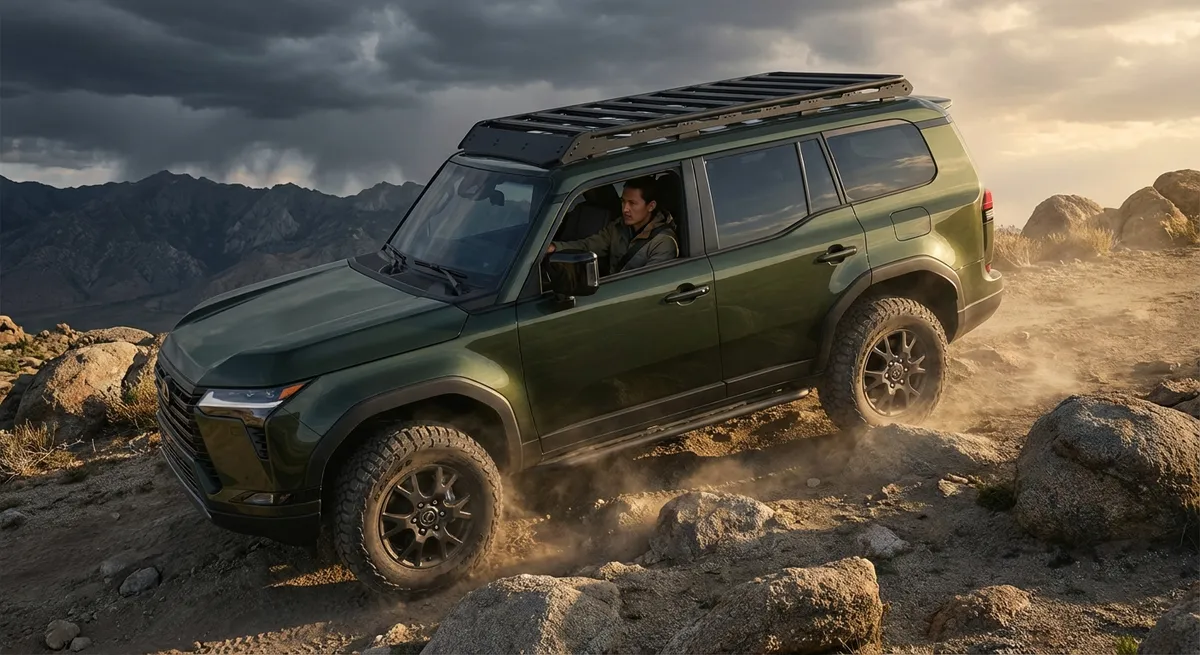
Lexus has overhauled one of its longest-running nameplates, and the 2025 GX 550 is no mild refresh. It’s a body‑on‑frame, twin‑turbo V6 SUV that unapologetically leans into its off‑road roots while trying to deliver modern luxury, safety tech, and towing capability. For shoppers cross‑shopping premium three‑row crossovers with real 4x4s, the GX 550 lands in a shrinking but highly desirable niche. This review dives into the aspects that genuinely matter to enthusiasts and serious buyers: platform, powertrain, off‑road hardware, interior execution, and ownership realities.
Platform and Chassis: Why the TNGA‑F Frame Matters
Underneath the reshaped sheet metal, the 2025 GX 550 rides on Toyota’s TNGA‑F body‑on‑frame architecture, the same platform underpinning the latest Toyota Land Cruiser, Sequoia, Tundra and Lexus LX. That connection is not just marketing—structurally, it dictates how the GX behaves on‑ and off‑road.
TNGA‑F uses a fully boxed ladder frame with increased rigidity compared with the outgoing GX platform, which contributes to sharper steering response and more predictable behavior over rough surfaces. A stiffer frame allows suspension tuning to focus on ride comfort without compensating for chassis flex; that’s particularly important in a tall SUV with a high center of gravity. Lexus pairs this with an independent double‑wishbone front suspension and a solid rear axle with multi‑link location, a traditional setup that prioritizes durability, articulation, and towing stability.
The geometry is tuned for real trail use: approach, breakover, and departure angles are meaningfully improved over the prior generation, especially in Overtrail trims, thanks to specific bumpers and increased ride height. Compared with unibody crossovers, the frame and suspension layout are better suited to repeated off‑road impacts and potential accessory installs (skid plates, rock rails, winches). The tradeoff is extra curb weight versus a comparable unibody SUV, but buyers seeking a GX are usually prioritizing capability and longevity over maximum fuel economy or on‑road sportiness.
Powertrain and Towing: Twin‑Turbo V6 with Real‑World Muscle
Lexus has retired the venerable naturally aspirated V8, replacing it with a 3.4‑liter (often marketed as 3.5L) twin‑turbocharged V6 paired to a 10‑speed automatic transmission. Output in the GX 550 is rated at approximately 349 horsepower and 479 lb‑ft of torque, a substantial torque increase over the outgoing 4.6‑liter V8 while improving efficiency.
The torque curve is the headline here: peak torque arrives low in the rev range, which is critical for moving a heavy, three‑row SUV with passengers, cargo, or a trailer. In daily driving, that translates to strong, relaxed acceleration and fewer gear hunting moments from the 10‑speed. The wide spread of ratios lets Lexus keep the engine in its torque band when climbing grades or passing, while maintaining low revs at highway speeds to reduce noise and fuel consumption.
Full‑time 4WD with a lockable center differential is standard, along with a traditional 2‑speed transfer case. This is increasingly rare in the luxury segment, where many SUVs rely on slip‑and‑grip AWD systems without a true low range. For towing, this matters: the combination of low range gearing, abundant low‑rpm torque, and a robust ladder frame contributes to a maximum towing capacity around 8,000 pounds when properly equipped. That puts the GX 550 in the upper tier of midsize luxury SUVs for trailer duty, comparable to some full‑size models.
Fuel economy estimates are still modest compared with lighter unibody competitors; the GX is not an efficiency play. But the balance of power, refinement, and capability is far more modern than the outgoing V8, and the twin‑turbo setup aligns with where the broader industry is heading for torque‑rich, downsized engines.
Off‑Road Hardware: Overtrail, Crawl Control and Real 4x4 Cred
The GX 550’s appeal to enthusiasts largely hinges on its off‑road toolkit, and Lexus has leaned into that angle with the Overtrail and Overtrail+ trims. These variants add hardware and software that move the GX from “capable for a luxury SUV” to legitimately trail‑focused.
Key mechanical upgrades include an electronically controlled locking rear differential, increased ground clearance, and 33‑inch all‑terrain tires on 18‑inch wheels—an important detail, as the taller sidewalls allow for more deflection and grip over rocks and ruts. Underbody protection, including skid plates, is enhanced in Overtrail trims to protect vulnerable components like the engine sump and transfer case.
On the electronic side, Lexus integrates Multi‑Terrain Select (with specific modes for mud, sand, rock, etc.), Crawl Control (a low‑speed off‑road cruise control that modulates throttle and braking), and Downhill Assist Control. Combined with a multi‑terrain monitor using cameras around the vehicle, drivers can place wheels accurately when obstacles disappear from direct view. Wheel articulation and traction management are still limited by the inherent physics of a heavy, tall SUV, but in the context of its segment, the GX 550 Overtrail is one of the most off‑road‑ready options you can buy with a luxury badge.
Air suspension is not offered in the same way as on some European competitors, which reduces complexity but means ride height is fixed rather than adjustable. For many off‑roaders, the simplicity is a benefit: fewer pneumatic components to fail far from service. From an enthusiast standpoint, the GX 550 is a compelling alternative to modifying a Land Cruiser or 4Runner, with much of the hardware and protection pre-integrated and fully warranted.
Interior, Tech and Packaging: Function Over Flash
Inside, the GX 550 attempts to reconcile two audiences: families wanting comfort and connectivity, and enthusiasts who actually use the third pedal on the left (figuratively speaking) and care about visibility and ergonomics on the trail. Lexus has moved away from the aging dashboard layout of the previous generation to a cleaner, more horizontal design dominated by a large central touchscreen (around 14 inches) running the latest Lexus Interface software.
Physical controls are still present for high‑frequency functions like climate control, drive mode selection, and 4WD operation—a crucial point for buyers who dislike screen‑only interfaces, especially when wearing gloves in cold or off‑road environments. Materials quality is appropriately premium, with available semi‑aniline leather, real metal accents, and carefully damped switchgear. However, the aesthetic skews more robust and squared‑off than the softer, lounge‑like ambience of some German rivals; it’s thematically closer to an overbuilt expedition vehicle than a luxury lounge.
Seating can be configured with either a second‑row bench or captain’s chairs, and a third row remains available. The boxy roofline pays dividends: headroom in the second row is generous, and cargo capacity with rows folded is competitive. The third row is best suited for children or short trips for adults, a common limitation in this class. Sound insulation is noticeably improved over the outgoing model, aided by laminated glass and better body sealing, which helps offset whatever additional tire noise all‑terrain rubber might introduce on Overtrail trims.
Tech-wise, wireless Apple CarPlay and Android Auto, multiple USB‑C ports, and available premium audio are table stakes and present here. The latest Lexus Safety System+ suite brings adaptive cruise control, lane keeping, pre‑collision braking with pedestrian detection, and more. Importantly, the calibration of these systems has matured in recent Toyota/Lexus products: lane centering and adaptive cruise behave more naturally than earlier iterations, which can matter on long highway drives to and from trailheads.
Ownership Reality: Reliability, Maintenance and Use‑Case Fit
For buyers coming from German or British premium SUVs, one of the GX 550’s core selling points is Lexus’ reputation for long‑term reliability and dealer support. The brand consistently performs well in vehicle dependability studies, and its body‑on‑frame trucks in particular have earned a reputation for longevity in harsh environments. Sharing core architecture and powertrain elements with high‑volume Toyota trucks means parts availability and technician familiarity are likely to be strong over the life of the vehicle.
Maintenance will not be inexpensive—it’s still a complex, twin‑turbo V6 luxury SUV—but the probability of major, surprise failures has historically been lower with Lexus body‑on‑frame products than some European rivals. Enthusiasts intending to keep a vehicle beyond 100,000 miles or to modify it for overlanding have strong reasons to favor a platform with widespread support in the aftermarket and dealership network.
From a use‑case standpoint, the GX 550 is best for owners who:
- Tow regularly and want the stability and low‑range gearing of a proper 4x4
- Drive on poor roads or off‑road trails often enough to justify the hardware
- Prioritize durability and capability over maximum efficiency and on‑road sharpness
- Value a luxurious but purposeful interior rather than an overtly sporty or minimalist one
If your driving is almost exclusively suburban commuting with occasional highway trips, and you’ll never use low range or tow anything serious, a unibody luxury crossover may ride more smoothly and consume less fuel. But for those who genuinely need the GX’s strengths—or simply want the peace of mind that comes with built‑in overkill—the 2025 GX 550 is one of the most compelling entries in a very specialized corner of the SUV market.
Conclusion
The 2025 Lexus GX 550 is not trying to be everything to everyone, and that’s precisely its appeal. By doubling down on a rigid ladder frame, full‑time 4WD with low range, and serious off‑road hardware while updating the cabin and tech to modern luxury expectations, Lexus has created a rare proposition: a premium SUV that feels equally at home on a mountain pass, a construction site, or a downtown valet stand. It sacrifices some fuel efficiency and razor‑edge on‑road dynamics in favor of robustness and capability, but for the buyers it targets, those tradeoffs will feel not only acceptable, but desirable.
Sources
- Lexus USA – 2025 GX Overview - Official product information, specifications, trim details, and feature summaries for the latest GX.
- Toyota Global – TNGA‑F Platform Technical Overview - Background on the TNGA architecture family, including the body‑on‑frame TNGA‑F platform used by Lexus GX and related models.
- J.D. Power – 2023 U.S. Vehicle Dependability Study - Industry data on brand reliability and long‑term dependability trends, including Lexus performance.
- IIHS – Large SUVs Ratings and Crash Test Data - Safety ratings and crash test results for comparable large and midsize SUVs, useful for context on segment safety performance.
- U.S. Department of Energy – Fuel Economy Guide - Official fuel economy ratings and comparisons for SUVs, including body‑on‑frame and unibody competitors.
Key Takeaway
The most important thing to remember from this article is that this information can change how you think about Reviews.