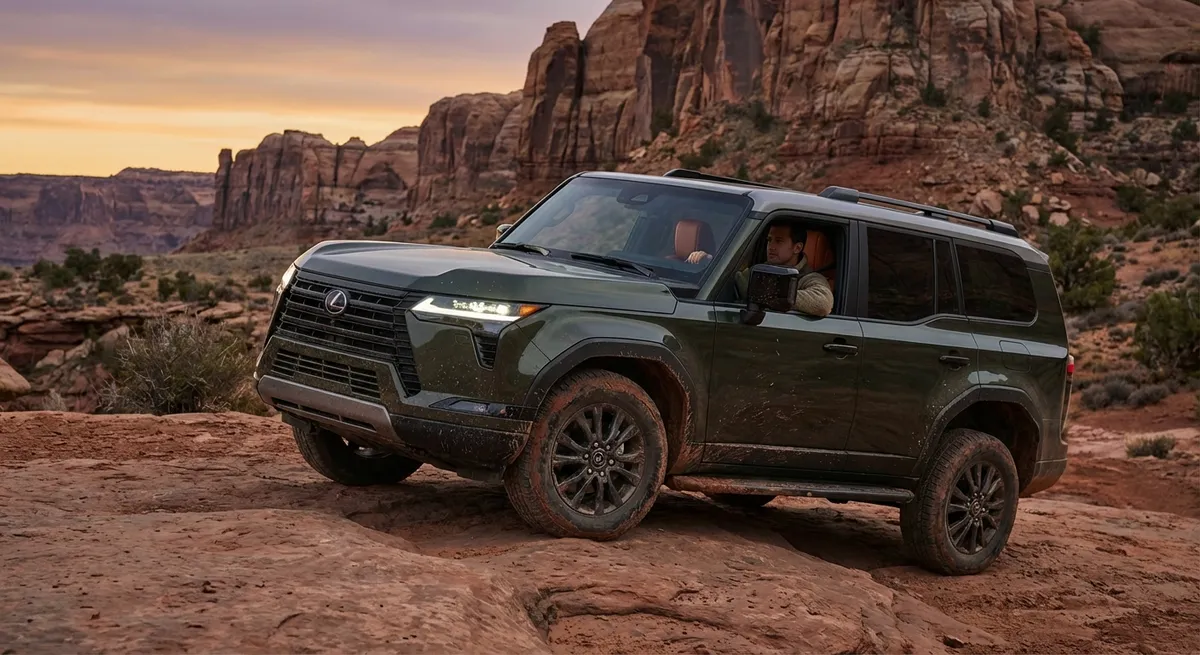
The 2025 Lexus GX 550 is one of the most consequential SUV launches in years for buyers who actually care about off‑road hardware as much as leather and ambient lighting. Lexus has rebuilt its long‑running body‑on‑frame SUV on Toyota’s latest truck platform, added a modern twin‑turbo V6, and finally given it a cabin that feels current in both design and tech. For enthusiasts and serious shoppers, the GX 550 poses a compelling question: can a genuinely capable, ladder‑frame SUV still work as a quiet, efficient, and comfortable daily driver?
This review digs into the GX 550 from an enthusiast’s perspective, focusing on five core areas: platform and powertrain, on‑road behavior, off‑road capability, interior and technology, and ownership realities. If you’re cross‑shopping midsize luxury SUVs or considering stepping up from a unibody crossover, this is where the GX 550 stands out—and where it doesn’t.
Platform, Engine, and Drivetrain: Old‑School Bones, New‑Age Power
The 2025 GX 550 rides on Toyota’s TNGA‑F platform, the same body‑on‑frame architecture underpinning the latest Land Cruiser, Tundra, and Sequoia. This is a fully boxed ladder frame designed for high torsional rigidity and improved crash performance compared with the previous generation GX, while still allowing the long‑travel suspension and articulation a serious SUV needs off pavement.
Under the hood, Lexus has retired the long‑serving naturally aspirated 4.6‑liter V8 in favor of a 3.4‑liter (often rounded to 3.5L) twin‑turbocharged V6. Output is rated at approximately 349 hp and 479 lb‑ft of torque, delivered through a 10‑speed automatic transmission. The power curve is a major shift from the old engine: peak torque arrives low in the rev range, giving the GX much stronger mid‑range pull for highway passing, towing, and steep grades. A full‑time 4WD system with a lockable center differential is standard, and most trims include a low‑range transfer case geared for serious off‑road work.
Compared with the outgoing V8, the twin‑turbo V6 brings two tangible benefits: better fuel efficiency and noticeably stronger acceleration, especially when loaded or towing. However, buyers who prize throttle linearity and mechanical simplicity may miss the naturally aspirated feel. Turbocharged engines introduce added complexity—intercoolers, more sensors, higher under‑hood temperatures—which can affect long‑term maintenance considerations. Lexus counters this with conservative tuning and robust cooling, but for buyers planning to keep the vehicle beyond 10 years, it’s worth factoring in.
Towing capacity is up to 8,000 pounds (properly equipped), placing the GX 550 near the top of the midsize luxury SUV segment. Combined with the new frame’s increased stiffness and the 10‑speed’s shorter first gear, trailering stability and launch performance are significantly improved over the old GX. For buyers who need an SUV that can tow a boat, mid‑size camper, or dual‑axle utility trailer, the new drivetrain and frame geometry form a much more confident package than the prior generation.
On‑Road Dynamics: How the GX 550 Behaves in the Real World
On the road, the 2025 GX 550 still feels like a body‑on‑frame truck at its core, but the TNGA‑F platform and modern suspension tuning have narrowed the gap to unibody rivals. The front uses a double‑wishbone setup, while the rear retains a solid axle with multi‑link location—chosen for durability and articulation rather than ultimate ride isolation. Engineers have optimized bushing compliance, shock valving, and frame mounting points to reduce harshness without losing the controlled movement needed for off‑road use.
Steering effort is on the heavier side compared with typical crossovers, which many enthusiasts will appreciate. Electric power steering is tuned for a reassuring on‑center feel, an improvement over the previous GX’s sometimes vague front end. Body roll is present—this is still a tall, heavy SUV—but better‑controlled, especially in Sport driving modes where damping is firmed up. Optional adaptive suspension significantly helps keep the GX composed in quick transitions, freeway ramps, and when loaded with passengers and cargo.
Noise, vibration, and harshness (NVH) levels are impressively low for a ladder‑frame vehicle. Strategic use of sound‑deadening materials, acoustic glass, and revised engine mounts give the GX 550 a refined highway demeanor. Engine noise is most noticeable under heavy throttle, where the twin‑turbo V6 produces a muted but purposeful growl. Wind noise is well controlled, though the boxy, upright design and large side mirrors understandably generate more aero noise than coupes or low‑slung crossovers at higher speeds.
Braking performance is strong and confidence‑inspiring. Larger rotors and upgraded calipers, along with a more modern brake‑by‑wire calibration, make the GX feel more in line with contemporary luxury SUVs. Pedal feel is firm and progressive, avoiding the sponginess that can plague heavy, tall vehicles. This is particularly welcome when towing or descending long grades, where fade resistance and predictable modulation matter.
Daily drivability is where the GX 550 balances its dual personality. In city use, the tall driving position and squared‑off hood give clear sightlines, but its size and turning radius are noticeable in tight parking garages and crowded urban streets. The 10‑speed automatic shifts smoothly and unobtrusively in normal modes, hunting less than some rivals thanks to the engine’s broad torque band. For buyers upgrading from a unibody crossover, the GX will feel more substantial and truck‑like; for those coming from an older body‑on‑frame SUV, it will feel markedly more refined.
Off‑Road Hardware and Capability: Built for More Than a Gravel Driveway
The defining advantage of the GX 550 over many luxury SUVs is the authenticity of its off‑road hardware. Rather than relying solely on software‑based traction aids, Lexus has equipped the GX with the mechanical fundamentals that serious off‑roaders look for: robust frame, low‑range transfer case, and available locking differentials, depending on trim and market.
Ground clearance, approach, departure, and breakover angles vary by trim and wheel/tire package, but are significantly improved versus the old GX. The squared‑off, “Land Cruiser–inspired” bodywork isn’t just styling—it shortens overhangs and allows better clearance on steep ascents and departures. Skid plates protect key components like the engine, transmission, and transfer case, while higher trims often add more comprehensive underbody protection.
The off‑road electronics are equally noteworthy. Lexus offers features such as Multi‑Terrain Select (adjusting throttle, braking, and traction control for surfaces like mud, sand, or rock), Crawl Control (a low‑speed off‑road cruise control), and Multi‑Terrain Monitor (camera views to help place wheels accurately on obstacles). These systems, borrowed and refined from Toyota’s off‑road portfolio, can significantly narrow the skill gap for newer drivers tackling challenging terrain.
Wheel and tire choices are critical. Many GX 550 trims are delivered with 20‑ or 22‑inch wheels for aesthetic and on‑road comfort reasons, but the most trail‑focused versions can be equipped with 18‑inch wheels and more aggressive all‑terrain tires. Enthusiasts should prioritize sidewall height and tread pattern over sheer wheel diameter; the additional sidewall flex improves ride on rough trails and provides better protection against pinch‑flats and rock damage.
Articulation and suspension travel are where the TNGA‑F frame and solid rear axle shine. Compared with crossovers that rely on traction control and independent suspension, the GX 550 can maintain tire contact in more extreme situations. Combined with a two‑speed transfer case and optional differential lock, this allows controlled, low‑speed crawling over ruts, ledges, and rock gardens. For buyers planning serious trail use—overlanding or remote backcountry travel—the GX 550 is much closer to a traditional Land Cruiser in capability than many might expect from its Lexus badge.
Interior, Technology, and Practicality: Modern Luxury Meets Boxy Utility
Inside, the 2025 GX 550 finally feels like it belongs in the mid‑2020s rather than the early 2010s. The dashboard design is upright and functional but layered with premium materials: soft‑touch surfaces where hands naturally rest, available semi‑aniline leather, real metal accents, and high‑quality switchgear. Lexus has retained physical buttons and knobs for the most frequently used functions—climate, drive modes, volume—striking a rare balance between modern touch interfaces and tactile controls that can be operated with gloves or without taking eyes off the road.
A large central touchscreen (in the 14‑inch range, depending on market) runs the latest Lexus interface, with wireless Apple CarPlay and Android Auto, natural‑language voice commands, and over‑the‑air update capability. The system is significantly faster and more intuitive than Lexus’s older mouse‑ or touchpad‑based setups. Crucially, response times and menu structure are optimized so essentials like camera views, seat heaters, and drive modes are never more than a tap or two away, improving both safety and usability.
Seating is a strong point. The GX 550 offers standard three‑row seating in many trims, with the second row available as either a 60/40 bench or individual captain’s chairs. The boxier roofline increases headroom compared with many sloped‑roof crossovers, and the upright seating position helps with long‑distance comfort. The third row is usable for adults on shorter trips and more comfortable than in many similarly sized SUVs, though it still favors children or smaller passengers for extended journeys.
Cargo space benefits from the squared‑off tailgate and high roof. With the third row folded, the GX offers a flat, wide load floor that can accommodate bulky gear, dog crates, and overlanding equipment. The move from the old swing‑out side‑hinged tailgate to a conventional top‑hinged liftgate (with an opening rear glass on some versions) is a major usability improvement in parking lots and tight spaces. Tie‑down points and underfloor storage add versatility, particularly for buyers who routinely carry recovery gear, coolers, or camping equipment.
Safety and driver assistance technology aligns with current expectations for a premium SUV. Lexus Safety System+ includes adaptive cruise control, lane‑keeping assist, automatic emergency braking with pedestrian detection, blind‑spot monitoring, and rear cross‑traffic alert. Importantly, calibration leans toward unobtrusive operation; lane‑keeping, for example, gently assists rather than aggressively “ping‑ponging” between lane markings. Surround‑view cameras and off‑road‑specific perspectives are available and especially useful given the GX’s size and mission.
Ownership, Efficiency, and the Enthusiast Equation
From an ownership perspective, the 2025 GX 550 sits at the intersection of Toyota’s well‑earned reputation for durability and Lexus’s focus on refinement and dealer experience. The TNGA‑F platform, shared components with other high‑volume Toyota trucks, and conservative powertrain tuning all suggest strong long‑term reliability potential, though the twin‑turbo V6 is still newer and inherently more complex than the previous V8. For enthusiasts planning long‑term builds—lift kits, armor, overlanding setups—shared components with the Land Cruiser and Tacoma ecosystems should translate into a robust aftermarket over time.
Fuel economy is improved but still reflects the realities of a heavy, boxy, permanent‑4WD SUV. Official EPA numbers (where available) show better combined mpg than the old GX, thanks to the V6’s forced induction and 10‑speed gearing, but it remains less efficient than lighter, unibody crossovers or hybrid competitors. Buyers prioritizing minimal fuel consumption should look closely at their annual mileage, driving patterns, and whether upcoming hybrid or electrified variants might better suit their needs.
Maintenance intervals and costs will likely be typical for a luxury SUV: synthetic oil changes, more expensive tires (especially if equipped with larger wheels or all‑terrain rubber), and potentially higher costs down the line for turbo‑related components. However, Lexus’s warranty coverage and dealer service reputation help mitigate some of the anxiety that can accompany a complex, luxury‑grade vehicle. For buyers who plan to use the GX extensively off‑road, regular inspections of suspension bushings, shocks, underbody armor, and drivetrain seals are advisable.
Resale value is an area where the GX has historically excelled. Previous generations of GX have shown strong residuals due to their reputation for durability and their desirability among off‑road and overlanding communities. Given the new model’s improved capabilities and global platform, it is reasonable to expect continued strong resale, especially for well‑maintained, lower‑mile examples. Enthusiasts who plan to modify their GX should be selective and retain stock parts to preserve resale flexibility.
Ultimately, the enthusiast equation boils down to this: the 2025 Lexus GX 550 is not the quietest, most fuel‑efficient, or most agile SUV in its class, but it offers a uniquely honest blend of real off‑road hardware, daily livability, and luxury appointments. For buyers who actually take their vehicles beyond pavement—or who simply value knowing their SUV can handle more than mall duty—the GX 550 stands apart from many competitors that prioritize styling and on‑road dynamics over genuine capability.
Conclusion
The 2025 Lexus GX 550 represents a meaningful evolution of the traditional luxury SUV formula. By pairing a thoroughly modern powertrain and technology suite with a genuinely capable body‑on‑frame platform, Lexus has created an SUV that respects its Land Cruiser‑adjacent heritage while addressing long‑standing criticisms of the outgoing model’s dated cabin and powertrain.
For car enthusiasts and serious shoppers, the GX 550 is most compelling if you value mechanical robustness, towing strength, and off‑road credibility as much as you value a quiet, well‑equipped interior. It won’t be the right choice for every buyer—those seeking maximum efficiency or car‑like handling may be better served by a unibody crossover or a plug‑in hybrid—but for drivers who want one vehicle that can tackle family duty, highway miles, and remote trails with equal confidence, the GX 550 is one of the most interesting and well‑rounded options in the current SUV landscape.
Sources
- Lexus USA – 2025 GX Overview – Official specifications, feature lists, and model details direct from Lexus
- Toyota Global – TNGA‑F Platform Information – Technical background on the body‑on‑frame architecture that underpins the GX 550
- U.S. Environmental Protection Agency – Fuel Economy Data – Official fuel economy ratings and comparative data for SUVs sold in the U.S.
- NHTSA – Vehicle Safety Ratings – Crash test results and safety information for SUVs and light trucks
- IIHS – Crashworthiness and Safety Technology Evaluations – Independent safety assessments and ratings for current SUV models
Key Takeaway
The most important thing to remember from this article is that this information can change how you think about Reviews.