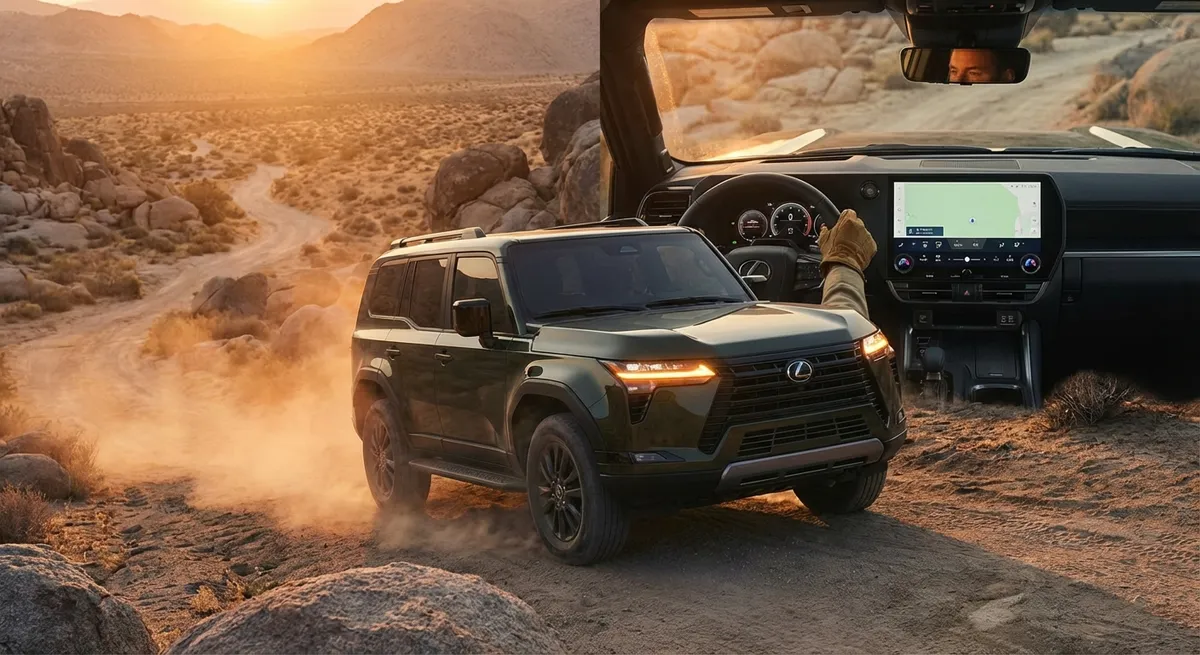
The three-row, body-on-frame SUV is rapidly evolving, and the 2025 Lexus GX 550 is one of the most talked-about examples of that shift. It blends real off-road hardware with the comfort, refinement, and technology expected from a modern luxury vehicle. For shoppers who want genuine capability without sacrificing a premium cabin, the GX 550 deserves close scrutiny. This review examines the key areas that matter most to enthusiasts and serious buyers: platform and engineering, powertrain performance, off-road hardware, interior and technology, and real-world ownership considerations.
Platform, Chassis, and Engineering Fundamentals
The 2025 GX 550 is built on Toyota’s TNGA-F body-on-frame platform, shared with the latest Toyota Land Cruiser, Tundra, and Sequoia. This architecture is designed to increase rigidity while allowing for improved ride comfort and NVH (noise, vibration, harshness) control compared to the previous generation. The ladder frame is stiffer than before, which helps with both on-road handling and off-road durability, particularly when tackling torsional stress from uneven terrain.
Suspension design is a core differentiator from crossovers that only look rugged. The GX 550 uses a double-wishbone front suspension and a multi-link rear setup with coil springs, tuned specifically for a balance between articulation and highway composure. In higher trims, adaptive variable suspension fine-tunes damping based on drive mode and driving conditions, dynamically adjusting for body control during cornering and when transitioning from pavement to dirt. Steering remains hydraulically assisted, which enthusiasts often prefer in off-road applications due to better feedback and robustness under load.
The GX 550’s wheelbase and overall dimensions are engineered with departure and breakover angles in mind, limiting excessive rear overhang while still enabling three-row seating. Compared with car-based SUVs, this packaging inevitably results in a higher step-in height and a more upright driving position, but that’s intentional: the vehicle prioritizes line-of-sight visibility and approach angles over a low-slung crossover stance. For buyers who routinely traverse rough roads, unpaved access trails, or tow heavy loads, the underlying engineering of the GX 550 makes it more than just a style statement.
Twin-Turbo V6, Transmission, and Performance Character
Under the hood, the 2025 GX 550 replaces the old naturally aspirated V8 with a 3.4‑liter twin‑turbocharged V6 (often referenced as 3.5L in some markets), paired with a 10‑speed automatic transmission. Output is robust: approximately 349 horsepower and 479 lb‑ft of torque (figures can vary slightly by market and calibration). The key change is the torque curve—peak torque arrives much lower in the rev range than the outgoing V8, which improves low-speed drivability, towing performance, and off-road tractability.
The 10‑speed gearbox is programmed to keep the engine in its sweet spot, often short-shifting under moderate acceleration and dropping multiple gears when more power is demanded. Tall upper gears help bring engine rpm down at highway speeds, which contributes to reduced cabin noise and improved fuel efficiency. While this SUV isn’t tuned to be a performance machine, the combination of torque and gearing makes passing maneuvers on the highway and merging with traffic feel effortless, even when loaded with passengers and cargo.
Enthusiasts will appreciate that the full-time 4WD system, low-range transfer case, and robust cooling systems are engineered to handle sustained loads. For buyers coming from older V8 platforms, the turbocharged V6’s character will feel different—more surge and immediate torque rather than linear, revvy power—but in everyday and off-road use, the added torque is a clear functional upgrade. Fuel economy still won’t rival a unibody hybrid crossover, but relative to traditional, naturally aspirated V8 body-on-frame SUVs, the GX 550 delivers a more modern balance between power delivery and consumption.
Off-Road Capability: Hardware That Matches the Image
The 2025 GX 550 is not merely styled to look rugged; its feature set confirms serious off-road intent. Full-time four-wheel drive is standard, with a Torsen center differential and a 2‑speed transfer case that provides low-range gearing for steep climbs, technical rock sections, or controlled descents. Many trims offer a locking rear differential, which dramatically improves traction when diagonally opposite wheels lose grip.
Ground clearance, approach, breakover, and departure angles are competitive with dedicated off-road SUVs. Depending on wheel and tire choice, approach angles can exceed 25 degrees, with departure angles in a similar range. Skid plates protect key underbody components like the engine, transfer case, and fuel tank, a critical detail for anyone regularly encountering rocky terrain. Wheel sizes and tire choices are also more off-road oriented in certain trims, with higher sidewalls for better compliance and puncture resistance.
Advanced driver assistance tailored for off-road use includes features such as Multi‑Terrain Select and Crawl Control (branding and availability may vary by trim and market). These systems modulate throttle and brake inputs to maintain steady progress over loose surfaces, deep sand, or uneven rock fields, while allowing the driver to concentrate on steering. Off-road camera systems, including front, side, and underbody views, assist with placing the wheels accurately and avoiding hidden obstacles.
For buyers who will rarely leave pavement, some of this hardware may seem like overkill. But for those planning overlanding trips, remote camping excursions, or regular off-pavement driving, the GX 550’s configuration is far more capable than most “adventure” crossovers—putting it closer to the Land Cruiser and 4Runner ethos than typical luxury SUVs. When cross-shopping, it’s worth looking closely at whether competitors offer a true low-range transfer case and locking differential; many do not.
Interior, Packaging, and Technology Experience
Inside, the GX 550 tries to reconcile its tough, ladder-frame roots with the expectations of a modern luxury clientele. The cabin layout is upright and squared-off, echoing traditional off-roaders, but materials and fit-and-finish are decidedly premium: soft-touch surfaces, available semi‑aniline leather, real metal accents, and carefully damped switchgear. Trim differentiation is stark—some models lean toward rugged design motifs, while higher trims emphasize a more refined, lounge-like ambiance.
Seating is typically offered in six- or seven-passenger configurations, with available second-row captain’s chairs or a bench. The first and second rows provide generous headroom and an authoritative, high seating position that many SUV buyers seek. The third row is serviceable for children or short adults on shorter trips, but as with many midsize-to-large SUVs that preserve off-road angles, it is not as spacious as some of the biggest unibody three-rows. Cargo space with all rows up is modest; fold the third row for a more practical load area suitable for luggage, sports equipment, or camping gear.
Technology is anchored by a large central touchscreen infotainment system running the latest Lexus software, with wireless Apple CarPlay and Android Auto typically standard. Physical knobs for volume and climate controls remain, which is a usability advantage over touchscreen-only systems. A digital instrument cluster, head‑up display (in higher trims), and multi‑color ambient lighting give the interior a contemporary feel.
Active safety and driver-assistance technologies are comprehensive, including adaptive cruise control, lane-keeping assist, automatic emergency braking, blind-spot monitoring, and rear cross-traffic alert. The calibration of these systems continues to improve, offering smoother acceleration and braking in traffic than earlier generations of Lexus Safety System. For buyers in harsh climates or those regularly traveling on long highway stretches, the combination of driver aids, structural rigidity, and extensive airbag coverage makes the GX 550 a strong candidate from a safety perspective.
Real-World Ownership, Towing, and Buyer Fit
Beyond specifications, the 2025 GX 550’s appeal hinges on how it fits into real-world use. Towing capacity is a notable strength: properly equipped models can tow up to around 8,000 pounds, placing the GX 550 in contention for buyers needing to pull medium-sized trailers, boats, or campers. The torque-rich V6 and robust cooling hardware are critical here, providing confidence on steep grades and in hot weather.
Ride quality is firmer and more “truck-like” than in a typical unibody luxury crossover, especially on trims with off-road-focused tires and suspension tuning. However, the adaptive suspension and careful cabin isolation mean that day-to-day comfort is high, particularly at highway speeds. Urban maneuvering is constrained more by height and width than steering effort—camera systems and parking sensors mitigate much of the stress in tight spaces, but this is not a compact SUV, and potential buyers should be comfortable with its physical footprint.
From a cost perspective, the GX 550 sits at the intersection of premium and specialty. Purchase price and likely insurance costs will be higher than for mainstream three-row crossovers, but resale value for Lexus body-on-frame SUVs has historically been strong, aided by a reputation for durability and long-term reliability. For those who keep vehicles beyond the warranty period, Lexus’s track record with body-on-frame models and widely shared components with Toyota trucks and SUVs is an important factor; it generally means good parts availability and a large knowledge base across dealerships and independent shops.
The GX 550 is best suited for buyers who:
- Need or genuinely want body-on-frame construction and low‑range 4WD
- Tow regularly or carry heavy cargo
- Value long-term durability and resale as much as cutting-edge styling
- Prefer a luxurious but upright, purpose-driven cabin over a low, coupe-like SUV design
For shoppers who prioritize maximum on-road comfort, fuel efficiency, and a car-like driving experience with occasional light dirt-road use, a unibody luxury crossover or plug-in hybrid SUV may be a better match. For those who demand real off-road capability and towing strength wrapped in a premium package, the 2025 Lexus GX 550 lands in a relatively small but highly desirable niche.
Conclusion
The 2025 Lexus GX 550 is a carefully engineered evolution of a proven formula: authentic off-road hardware, ladder-frame strength, and high towing capacity, now combined with contemporary turbocharged power, advanced safety tech, and a thoroughly modern cabin. It does not chase every crossover trend; instead, it doubles down on capability while refining the comfort and technology that buyers expect from a luxury brand.
For car enthusiasts and serious shoppers, the GX 550’s value lies in its depth of engineering and its clarity of purpose. It is not the quietest, most efficient, or flashiest SUV in its segment, but it is one of the few that can credibly handle remote trails, family road trips, and weekend towing duty without sacrificing the refinement and reliability that Lexus is known for. Buyers who understand and truly need what this platform offers will find the GX 550 a compelling, long-term partner rather than just another fashion-oriented SUV.
Sources
- Lexus USA – 2024/2025 Lexus GX Overview – Official specifications, features, and trim details for the latest GX
- Toyota Global – TNGA-F Platform Technical Overview – Background on the ladder-frame platform underpinning the GX and related models
- IIHS – Vehicle Ratings – Safety ratings and crash test results for SUVs in the same class (GX data posted as available)
- U.S. Department of Energy – Fuel Economy – Comparative fuel economy data for 4WD large SUVs
- Consumer Reports – SUV Reliability and Owner Satisfaction – Long-term reliability trends and ownership insights for SUVs, including Lexus models
Key Takeaway
The most important thing to remember from this article is that this information can change how you think about Reviews.