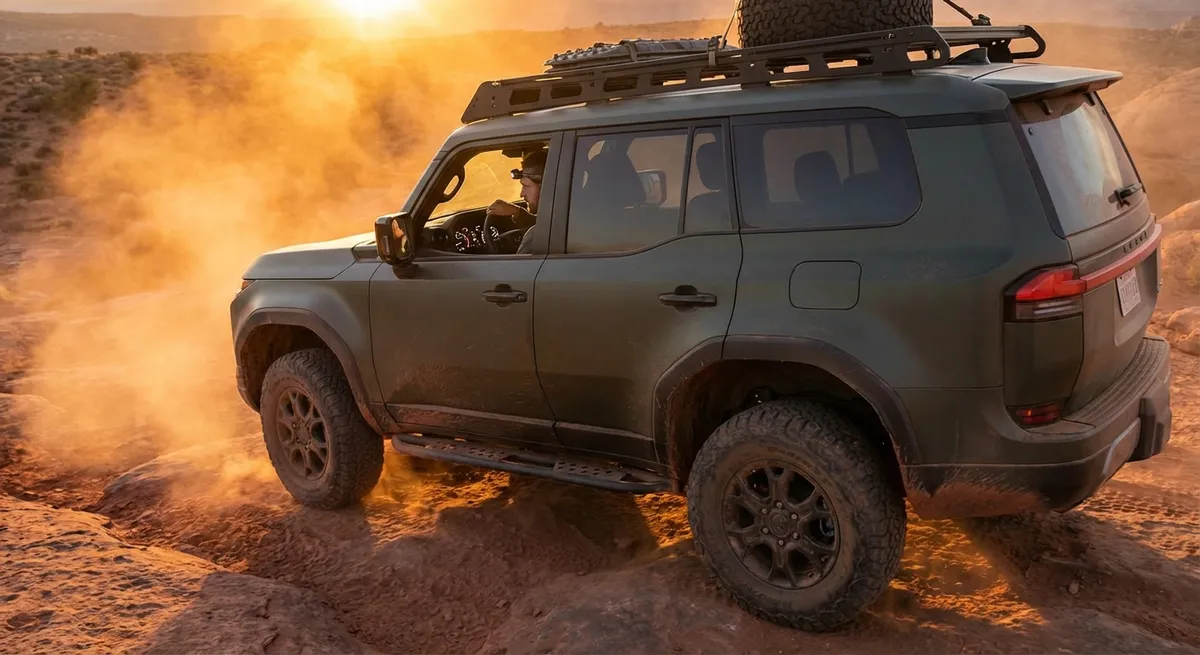
The 2025 Lexus GX 550 arrives at a moment when many SUVs are shedding their off-road roots in favor of softer, car-like manners. Lexus has gone in the opposite direction: this is a thoroughly modern, tech-laden luxury SUV that still rides on a body-on-frame platform and carries a genuine off-road toolkit. For shoppers torn between a comfortable family hauler and a serious adventure vehicle, the new GX is one of the most compelling—and polarizing—entries in the segment. This review breaks down the key areas that matter to enthusiasts and serious buyers, focusing on what the spec sheet doesn’t tell you at first glance.
Powertrain and Performance: Twin-Turbo Muscle with Real Towing Capability
Under the hood, the 2025 GX 550 drops the old V8 for a 3.4-liter twin-turbocharged V6 (Lexus designates it as a 3.4L, Toyota calls similar variants 3.5L; displacement is 3,445 cc). Output is a stout 349 horsepower and 479 lb-ft of torque, routed through a 10‑speed automatic transmission and a full-time 4WD system with a 2-speed transfer case. This is a significant leap over the prior generation, which made 301 hp and 329 lb-ft from its naturally aspirated V8.
On the road, the twin-turbo V6 delivers torque in a broad, usable band from low revs, which is exactly what you want in a 6,000+ lb SUV. Passing power on the highway is robust, with the 10‑speed keeping the engine in its sweet spot without constantly hunting for gears. Lexus has tuned the gearbox to prioritize smoothness over aggression, but manual control via the shifter gate allows you to hold gears when towing or descending grades.
Towing is a standout capability: properly equipped, the GX 550 is rated to tow up to 9,096 lbs (depending on trim and market), putting it in the same ballpark as established body-on-frame rivals from domestic brands. The twin-turbo torque and 10‑speed gearing translate into relaxed towing at highway speeds, and the standard trailer sway control and available integrated trailer brake controller further improve confidence. Fuel economy is improved versus the outgoing V8 but still not hybrid-efficient; estimates vary by configuration, but buyers should realistically expect mid-teens mpg in mixed driving and high-teens on longer highway runs if driven conservatively.
Chassis, Off-Road Hardware, and Real-World Capability
The GX 550 rides on Toyota’s TNGA‑F body-on-frame architecture—the same basic platform underpinning the latest Land Cruiser, Sequoia, Tundra, and Lexus LX. This means a fully boxed ladder frame, independent double-wishbone front suspension, and a solid rear axle with multi-link suspension. Lexus pairs this architecture with standard full-time 4WD, a Torsen center differential, and a low-range transfer case. This is not a crossover in disguise; it’s a genuine truck-based SUV.
Ground clearance and angles vary by trim, but off-road-focused Overtrail models make the most of the chassis. They bring all-terrain tires on 18‑inch wheels, an electronic locking rear differential, a Multi-Terrain Select system, Crawl Control (a low-speed off-road cruise control), and optional Electronic Kinetic Dynamic Suspension System (E‑KDSS) to increase wheel articulation. Approach and departure angles are significantly better than most luxury crossovers, enabling the GX to handle legitimate trails without ripping off bumpers or side steps.
In real-world off-roading, this translates to a vehicle that can pick its way through rutted tracks, rocky climbs, and deep sand without feeling fragile. The low-range gearing and rear locker make steep ascents and controlled descents far easier than in vehicles that rely solely on traction control. The trade-off is weight and complexity; at over three tons curb weight in many trims, the GX is not a nimble rock crawler, and owners who plan to frequently tackle technical terrain will want to be mindful of skid plates, side steps, and underbody protection. Nonetheless, for overlanding, muddy rural roads, and mountain access, the GX 550’s mechanicals put it well ahead of most “adventure-styled” SUVs that lack a proper 2‑speed transfer case.
Interior, Packaging, and Practical Usability
Inside, the GX 550 moves decisively upmarket compared to its predecessor, blending classic Lexus build quality with a more rugged, squared-off aesthetic. Materials in upper trims include semi-aniline leather, open-pore wood, and soft-touch surfaces almost everywhere the driver interacts. The overall design is more functional than flamboyant: large, clearly marked physical controls for core climate and drive functions sit below a central 14‑inch touchscreen, acknowledging that gloved or distracted hands don’t work well with screen-only interfaces.
Seating configurations vary by trim, with both 6‑ and 7‑passenger layouts available. Second-row captain’s chairs offer superior comfort and easier access to the third row, though the bench provides more people-hauling flexibility. The third row, as is typical in this class, is best suited for children or shorter adults on shorter trips; legroom and thigh support can’t quite match the vastness of larger, long-wheelbase SUVs. With the third row folded, cargo space opens up considerably, and the squared-off cargo area makes loading gear, camping equipment, or travel crates straightforward.
One key practical improvement over the prior generation is the move away from a side-hinged tailgate to a conventional top-hinged liftgate, which is far easier to use in tight parking spaces or when hitched to a trailer. Storage solutions in the cabin are thoughtful: large door pockets for bottles and maps, multiple USB-C ports, and a generous center console. Road-trip usability is enhanced by available features like a head-up display, heated and ventilated first- and second-row seats (depending on trim), and an available Mark Levinson premium audio system for long-haul comfort.
Technology, Safety Systems, and Driver Assistance
The GX 550 incorporates the latest Lexus Interface infotainment suite, anchored by that 14‑inch touchscreen with cloud-based navigation, wireless Apple CarPlay and Android Auto, natural-language voice commands, and over-the-air update capabilities. Responsiveness is significantly improved over older Lexus systems, with crisp graphics and shorter menu paths to key functions. That said, buyers who dislike touchscreens will still appreciate the retained physical knobs for volume and climate, as well as shortcut buttons for drive modes and off-road systems.
On the safety front, the GX 550 comes standard with Lexus Safety System+ 3.0, which includes:
- Pre-collision system with pedestrian and cyclist detection
- Lane departure alert with steering assist
- Lane tracing assist (lane centering) when using adaptive cruise
- All-speed dynamic radar cruise control
- Road sign assist
- Proactive driving assist (low-speed support for distance and braking in certain scenarios)
Available advanced features may include a panoramic view monitor with an underbody camera mode (useful for off-road clearance), blind-spot monitoring with rear cross-traffic alert, and rear seat reminder. While the GX is heavily assisted, Lexus has stopped short of offering a hands-free driving system on this model; lane centering and adaptive cruise reduce fatigue on long highway stretches but still require an engaged driver.
From a safety standpoint, the TNGA‑F architecture is engineered to meet modern crash standards, and Lexus has a strong track record of solid crash test results. Official IIHS and NHTSA ratings for the all-new generation may still be pending in some regions; buyers should watch for updates there if top-tier safety ratings are a priority. The structural robustness that benefits off-road durability also bodes well for crash performance, though it does contribute to vehicle mass, which can influence stopping distances and maneuverability.
Ownership Profile, Market Position, and Who the GX 550 Suits Best
Positioned between Lexus’s unibody RX and the larger LX, the GX 550 targets buyers who need more than occasional soft-road capability but still prioritize luxury and daily drivability. Its natural rivals range from premium off-road-oriented SUVs (like Land Rover Defender) to more mainstream body-on-frame models with luxury trims. The Lexus proposition leans on long-term reliability, dealer network quality, and strong residual values—areas where Toyota and Lexus have historically excelled.
Maintenance considerations are typical for a turbocharged, full-size SUV: more complex powertrain components than a naturally aspirated engine but improved efficiency and performance. Lexus’s warranty and available prepaid maintenance or extended service plans can help control costs. For enthusiasts considering modifications—lift kits, roof racks, overlanding gear—the TNGA‑F platform already has growing aftermarket support through its shared architecture with other Toyota trucks and SUVs, though buyers should be mindful of payload limits and how added weight affects handling and braking.
The GX 550 makes the most sense for:
- Buyers who want a true 4WD with low range, towing strength, and luxury comfort
- Families in regions with challenging weather or unpaved access roads
- Enthusiasts who plan to overland or adventure travel but still want a refined daily driver
- Urban drivers who never leave pavement and prioritize fuel efficiency above all
- Shoppers needing maximum third-row space and cargo room simultaneously
- Those who prefer a low-slung, car-like driving experience
It’s less ideal for:
In a market crowded with crossovers that only look adventurous, the GX 550’s honest truck-based engineering and long-distance comfort give it a distinct identity.
Conclusion
The 2025 Lexus GX 550 is a rare blend of old-school SUV fundamentals and modern luxury: a body-on-frame, low-range-equipped 4WD platform wrapped in a thoroughly updated, tech-savvy interior. Its twin-turbo V6 and 10‑speed automatic deliver meaningful gains in performance and towing, while the TNGA‑F chassis and available off-road hardware give it capabilities that most premium SUVs can’t match. There are trade-offs—fuel economy, curb weight, and a third row that’s more occasional use than full-time family hauler—but for buyers who value genuine capability and long-term durability as much as leather and large screens, the GX 550 stands out as one of the most compelling new SUVs in its class.
Sources
- [Lexus USA – 2025 GX Overview and Specifications](https://www.lexus.com/models/GX) - Official model page with powertrain specs, features, and packaging details
- [Toyota Motor Corporation – TNGA-F Platform Technical Overview](https://global.toyota/en/newsroom/corporate/38209999.html) - Background on the body-on-frame architecture underpinning the GX and related models
- [IIHS – Vehicle Ratings and Crash Test Methodology](https://www.iihs.org/ratings) - Reference for understanding safety ratings and testing procedures relevant to SUVs
- [U.S. Department of Energy – Fuel Economy and Towing Basics](https://www.fueleconomy.gov/feg/towing.jsp) - Explains how towing impacts fuel consumption and performance in SUVs and trucks
- [J.D. Power – Lexus Brand Dependability Studies](https://www.jdpower.com/cars/ratings/dependability) - Data on Lexus reliability and long-term ownership trends
Key Takeaway
The most important thing to remember from this article is that this information can change how you think about Reviews.