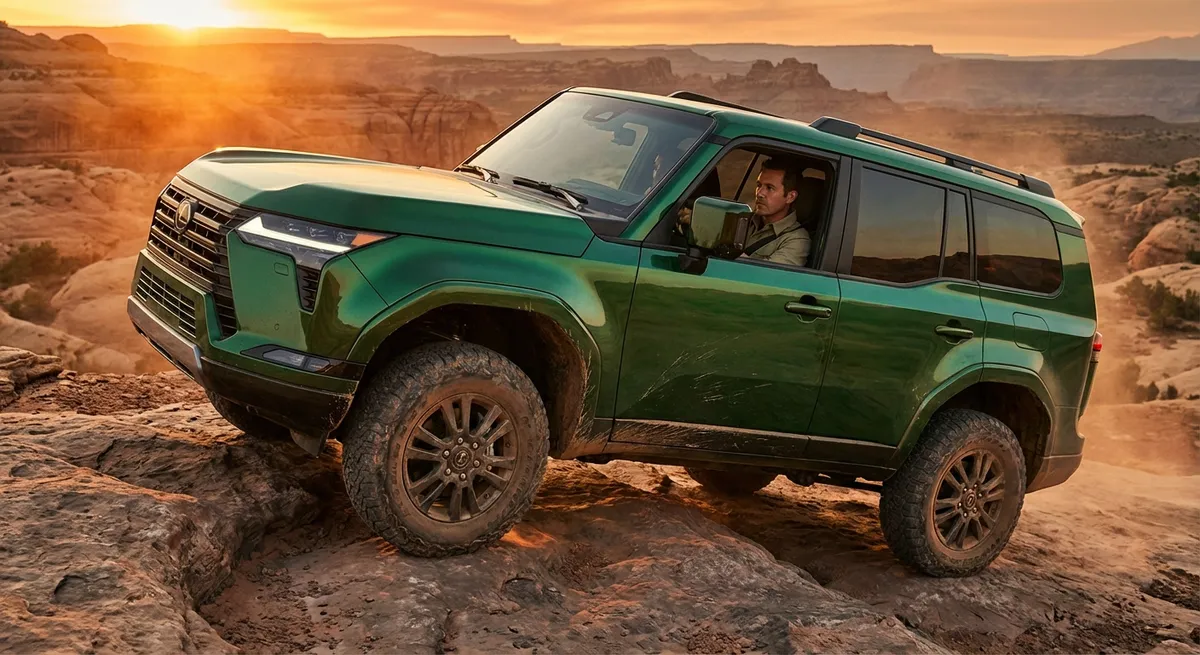
The reborn 2025 Lexus GX 550 arrives at a moment when many SUVs are drifting toward soft-road comfort and away from true capability. This model takes the opposite route: body-on-frame construction, a twin-turbo V6, full‑time 4WD, and serious off-road hardware wrapped in a premium, family-ready cabin. This review breaks down how the new GX actually feels on the road and trail, and what its specs mean in day-to-day use for buyers who want more than just rugged styling.
Design and Packaging: Boxy Form With Functional Purpose
Lexus has leaned into a squared-off, almost Land Cruiser–inspired profile, and the shape is more than styling theater. The upright windshield, tall roofline, and nearly vertical rear give the GX better headroom and improved cargo boxiness versus many coupe‑like crossovers. The squared fenders and flat hood also aid forward visibility off-road, letting drivers more easily judge wheel placement on narrow trails.
Underneath, the GX 550 rides on the TNGA-F body-on-frame platform shared with the latest Toyota Land Cruiser and Tundra. That means a separate ladder frame with a rigid, boxed structure designed to handle torsional loads from off-roading and towing. Lexus claims increased torsional rigidity over the outgoing GX, which assists both ride refinement and crash performance. Unlike soft-roader crossovers built on unibody platforms, this truck-style foundation is intentionally tuned to absorb impacts from large suspension articulation and rough surfaces without transferring harshness into the cabin.
The rear liftgate switches from the previous side-hinged door to a conventional top-hinged hatch, a key usability improvement in tight parking spaces and garages. A pop-up rear glass remains, allowing quick access to cargo without opening the full door. Roof rails and robust rear tow points underline its utility focus, while the Overtrail and Overtrail+ trims add functional skid plates, chunkier all-terrain tires, and unique bumpers with better approach angles.
For families, the packaging differentiates between five- and seven-seat layouts. The standard GX offers three rows, with either a traditional second-row bench or optional captain’s chairs, while Overtrail variants focus on five-seat practicality and expanded cargo capacity—arguably the smarter configuration for overlanding and gear-heavy use.
Powertrain and Dynamics: Turbo V6 With Real Towing Muscle
At the heart of the GX 550 is a 3.4-liter twin-turbocharged V6 (marketed as a 3.5-liter in some materials), paired with a 10‑speed automatic transmission and full-time four-wheel drive. Output sits at around 349 hp and 479 lb‑ft of torque, a substantial bump in torque versus the outgoing naturally aspirated V8. That torque arrives low in the rev range, which matters more for real-world driving than peak horsepower numbers—especially when pulling trailers or climbing grades off-road.
The 10‑speed automatic offers closely spaced ratios, helping keep the engine in its optimal torque band while also allowing tall gearing for highway fuel economy. In regular driving, the gearbox shifts unobtrusively, with smart programming that downshifts early when descending hills to add engine braking. A dedicated tow/haul mode recalibrates shift points to reduce hunting between gears when loaded, improving control and protecting the transmission from unnecessary heat.
Full-time 4WD with a Torsen center differential is standard, providing continuous torque delivery to both axles. For low-traction conditions, a locking center differential can be engaged, and a 2‑speed transfer case adds a low-range ratio—crucial for steep, slow-speed technical terrain. Depending on trim, a rear locking differential is also available, ensuring both rear wheels turn at the same speed when traction is uneven, dramatically enhancing off-road capability.
Towing capacity is rated up to approximately 8,000 pounds when properly equipped, putting the GX in serious contention for boat, camper, or utility-trailer duty. Enthusiasts should pay attention not only to that max number but also to payload ratings; overlanding builds with rooftop tents, gear, and passengers can approach payload limits long before they hit the towing ceiling. The new platform’s stiffer frame and retuned suspension help the GX resist squat and sway under load, giving it an edge over softer crossovers that may reach their practical limits well before their spec-sheet figures.
On the road, the body-on-frame architecture still can’t fully emulate the car-like composure of unibody luxury crossovers, but Lexus has dialed in significant refinement. Optional adaptive suspension and an electronically controlled stabilizer bar system (depending on market and trim) allow the GX to better balance roll control in corners with compliance on rough surfaces. Enthusiasts will notice the upright seating position, long-travel suspension feel, and a sense of mass, but there’s an underlying solidity that communicates durability rather than sloppiness.
Off-Road Hardware: Real Capability Behind the Styling
For buyers who plan to actually use the rugged look, the GX’s off-road toolkit is one of its strongest arguments. Ground clearance, approach, and departure angles vary by trim and wheel/tire setup, but Overtrail and Overtrail+ models maximize capability with all-terrain tires, unique front and rear fascias, and additional underbody protection.
Key hardware includes:
- 2‑speed transfer case with low range for controlled crawling
- Available rear locking differential on Overtrail trims
- Crawl Control (an off-road cruise control) that automatically modulates throttle and braking over rough surfaces
- Multi-Terrain Select drive modes that tailor traction control and throttle response to surfaces such as mud, sand, and rock
- Multi-Terrain Monitor camera system, which projects underbody and front-side views to help avoid obstacles
The combination of torque-rich turbo V6, low-range gearing, and locking diffs gives the GX legitimate rock-crawling competence, not just loose-surface confidence. On steep descents, Downhill Assist Control supplements engine braking to maintain a steady pace without constant pedal work.
Wheel and tire choices matter. While larger wheels with lower-profile tires improve on-road steering response and aesthetics, Overtrail’s more conservative wheel sizes and higher sidewalls better absorb impacts and conform to obstacles off-road. The tires’ construction and tread pattern also influence puncture resistance and grip on loose surfaces. For enthusiasts, the Overtrail spec is clearly the one to shortlist if trail performance is a priority.
Articulation—how far the suspension can move to keep all four wheels in contact with uneven ground—remains a strength of this platform. Combined with electronic aids, the GX can traverse terrain that would immobilize many crossovers with independent front and rear suspensions optimized for pavement. Still, serious off-roaders should consider aftermarket skid plates, rock sliders, and recovery points if they plan extended backcountry use, even though Lexus provides a solid starting package.
Interior, Tech, and Daily Usability: Where Luxury Meets Utility
Inside, the 2025 GX embraces a more modern, horizontal dashboard design anchored by a large central touchscreen (around 14 inches in most trims) running the latest Lexus interface. Physical knobs and buttons remain for key climate and audio functions—an important usability win that many touch-only competitors have abandoned. The layout is logical: drive mode selectors and off-road controls are clustered around the shifter, while towing and terrain settings are easy to reach from the driver’s seat.
Materials and build quality align with Lexus expectations. Soft-touch surfaces, real metal accents, and available semi-aniline leather create an upscale environment, while robust switchgear and chunky door pulls reflect the SUV’s utilitarian brief. Overtrail models add unique trims and durable seating surfaces aimed at owners who anticipate mud, sand, and gear-heavy use rather than pure city commuting.
Seating comfort is strong in the first two rows, with good thigh support and multiple power adjustments, including available seat ventilation and heating. The third row is usable for children or shorter trips but remains best reserved for occasional occupancy, particularly when adults are in the second row and slide the seats back. When the third row is folded flat (or in the five-seat Overtrail), the cargo area is wide and tall, benefitting from the squared-off tail design.
Tech-wise, wireless Apple CarPlay and Android Auto, multiple USB-C ports, and a premium audio system are available, along with a full suite of driver-assistance features. Lexus Safety System+ includes adaptive cruise control, lane-keeping assistance, automatic emergency braking with pedestrian detection, and blind-spot monitoring. Importantly, the tuning of these systems leans toward subtle intervention, avoiding the overbearing corrections some rivals deliver.
Noise insulation is robust, with laminated glass and extensive sound deadening mitigating wind and road noise even on all-terrain tires. Body-on-frame vehicles can transmit more vibration, but Lexus has minimized this with intelligently tuned engine mounts and isolation points between frame and body. For day-to-day commuting, school runs, and highway trips, the GX feels composed, and its boxy footprint is easier to judge than some swoopier SUVs, though its height and weight remain noticeable in tight urban environments.
Ownership Considerations: Who the GX 550 Really Suits
From an enthusiast and buyer’s perspective, the 2025 GX 550 isn’t a one-size-fits-all answer—and that’s precisely its appeal. It targets a narrower audience than car-like luxury crossovers, focusing on those who value durability, off-road capability, and towing strength alongside premium comfort.
Key considerations:
- Fuel Economy vs. Capability: The twin-turbo V6 is more efficient than the outgoing V8, but this remains a relatively heavy, brick-shaped SUV with full-time 4WD. Buyers prioritizing fuel savings above all else may be better served by a hybrid crossover, but those who tow or go off-pavement regularly will appreciate the torque and robustness.
- Long-Term Durability: Lexus has a strong reliability reputation, especially in body-on-frame SUVs. The TNGA-F platform underpins multiple global models, which often leads to wider parts availability and better long-term serviceability. For buyers planning to keep their SUV well past the warranty period—or to modify it for overlanding—this lineage is a major plus.
- Resale Value: Historically, GX models have held residual value well, thanks to their niche following and reputation for durability. The new generation’s shared DNA with the latest Land Cruiser is likely to reinforce that.
- Use Case Alignment: If most driving is urban commuting with only occasional light gravel-road adventures, many crossovers will ride softer and cost less. But if trail access, ski trips, towing, or long-distance road trips on questionable surfaces are part of your lifestyle, the GX’s capabilities justify the trade-offs.
- Upfit Potential: Enthusiasts will find a likely rich aftermarket ecosystem, thanks to the shared platform with Toyota’s truck and SUV lineup. Suspension upgrades, armor, roof racks, and drawer systems should be increasingly available, turning the GX into a premium overlanding platform without reinventing the wheel.
For families that want a vehicle as comfortable pulling into a valet line as it is picking its way up a remote forest road, the 2025 Lexus GX 550 presents a compelling, if specialized, proposition. It doesn’t chase the softest ride or the flashiest in-cabin theatrics; instead, it doubles down on honest capability, layered with Lexus refinement.
Conclusion
The 2025 Lexus GX 550 stands out in a market crowded with crossovers that talk tough but shy away from real work. Its body-on-frame construction, genuine four-wheel-drive hardware, and robust towing figures position it closer to an upscale expedition vehicle than a typical suburban runabout, while its polished interior and comprehensive tech keep it competitive as a premium family SUV.
For buyers and enthusiasts who value authentic capability, long-term robustness, and a confident, torque-rich powertrain—without sacrificing comfort and modern safety tech—the new GX 550 is one of the most compelling luxury off-roaders currently on sale. Its strengths are not universal, but for the right driver, its balance of grit and refinement will feel precisely on target.
Sources
- Lexus USA – 2025 GX Overview and Specifications - Official model information, specifications, and feature details from Lexus
- Toyota Motor Corporation – TNGA-F Platform Technical Overview - Background on the body-on-frame platform underpinning the GX and its engineering goals
- IIHS – Vehicle Safety Ratings - Independent crash-test and safety evaluation data for SUVs and other passenger vehicles
- U.S. Department of Energy – Fuel Economy Guide - Official fuel economy data and technical explanations of powertrain efficiency for comparison across SUVs
- J.D. Power – Vehicle Dependability Study - Industry data on long-term reliability and brand dependability, relevant for ownership and resale considerations
Key Takeaway
The most important thing to remember from this article is that this information can change how you think about Reviews.