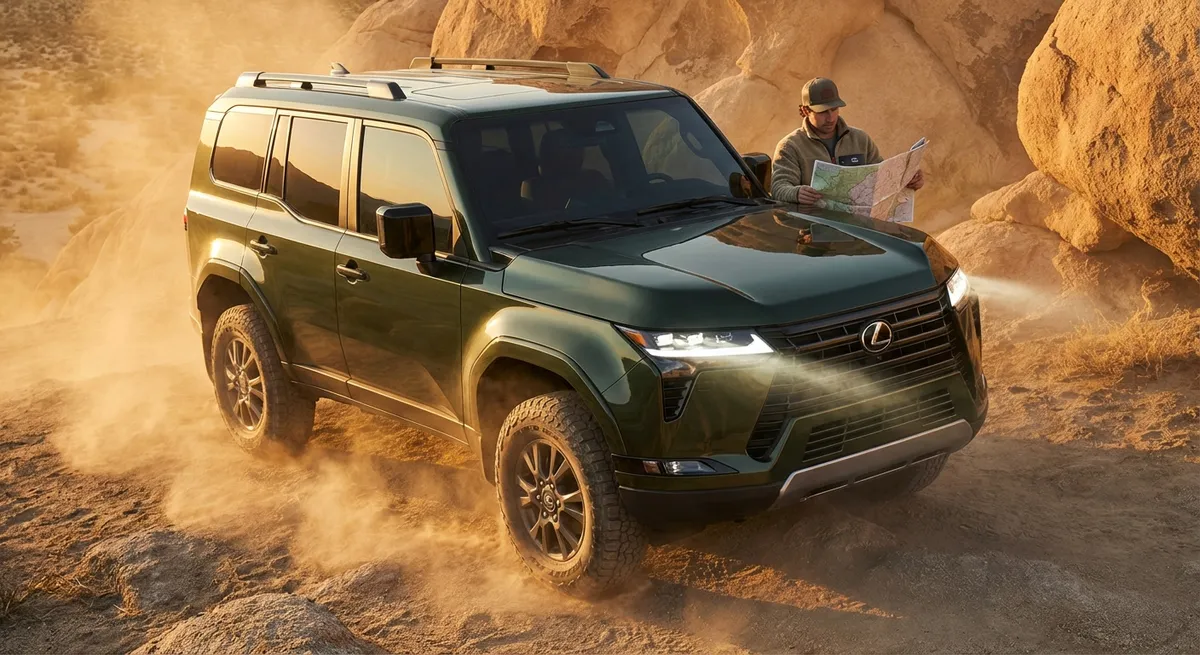
The all‑new 2025 Lexus GX 550 is one of the most anticipated body‑on‑frame SUVs of the decade—and for good reason. It promises real trail capability, three-row practicality, and a luxury badge in a market crowded with softened crossovers. This review goes deep on how the GX actually drives, tows, and lives with in the real world, and what its rebooted engineering means for enthusiasts and families shopping a serious SUV.
Chassis & Off‑Road Hardware: Real Truck Bones, Smart Tech Assist
Underneath the reshaped, squared‑off body, the 2025 GX rides on Toyota’s latest GA‑F body‑on‑frame platform, shared with the Lexus LX and global Land Cruiser 300. That means a boxed steel frame, longitudinal engine layout, and a true truck-style architecture—very different from monocoque crossovers like the Lexus RX or BMW X5.
The GX abandons its old naturally aspirated V8 in favor of a 3.4‑liter twin‑turbo V6 (T24A‑FTS) paired with a 10‑speed automatic. Output in U.S. specification is 349 hp and 479 lb‑ft of torque, delivered much lower in the rev range than the previous 4.6‑liter V8. For buyers, this translates to noticeably stronger mid‑range passing power and better performance at altitude, where turbocharging compensates for thinner air.
Off‑road purists will note that every GX 550 gets a full‑time 4WD system with a Torsen center differential and a 2‑speed transfer case—low range is standard, not an option. Select trims add an electronic locking rear differential, and the Overtrail models go further with off‑road‑specific hardware: 33‑inch all‑terrain tires on 18‑inch wheels, increased underbody protection, and Lexus’ E-KDSS (Electronic Kinetic Dynamic Suspension System) that can decouple sway bars for improved articulation over uneven terrain.
Clearance numbers are competitive for the class. With the Overtrail trim, approach, breakover, and departure angles are significantly enhanced versus the previous GX, aided by reshaped bumpers and that larger tire package. Crawl Control, Downhill Assist Control, and the Multi‑Terrain Select system (with settings for mud, sand, and rock) use both powertrain and brake modulation to manage wheel spin and maintain traction. For enthusiasts, the key takeaway is that unlike some luxury SUVs that rely mostly on software to mimic traction, the GX backs up its electronic aids with genuine mechanical capability.
On‑Road Performance & Ride Quality: Balancing Truck Roots and Luxury
On pavement, the GX 550’s character clearly reflects its truck platform—but with far more polish than its predecessor. The twin‑turbo V6 and 10‑speed automatic are smooth and quiet in normal driving. The transmission generally keeps the engine in the meat of its torque curve, which is especially noticeable during highway mergers or quick two‑lane passes. There is an occasional hunt for gears on mild grades if you leave the drive mode in its most economical setting, but the Sport and Sport S modes tighten shift logic and response.
Steering is light at low speeds and weights up naturally as speed increases. It remains a touch slower and more insulated than sportier European competitors, but that’s in line with the GX’s positioning as a comfortable long‑distance tourer. The high‑profile all‑terrain tires on Overtrail models add some low‑speed squirm and a hint of tread hum on certain surfaces, but most trims riding on 20‑inch or 22‑inch wheels with highway‑biased tires feel calm and refined.
Ride quality is where the new GX makes the biggest leap. The body‑on‑frame layout can never entirely match the isolating smoothness of a well‑tuned unibody, yet Lexus’ adaptive variable suspension (available on higher trims) and carefully tuned bushings dramatically reduce the body jiggle and ladder‑frame shimmy that defined older generations. It still communicates its mass over sharp expansion joints, but recovery is quick, and secondary motions are well suppressed.
Noise, vibration, and harshness (NVH) are impressively contained. Engine noise is a subdued growl under heavy throttle and nearly inaudible at a cruise, and Lexus’ focus on acoustic glass and extensive sound insulation, particularly around the firewall and wheel wells, pays off. For daily commuting and highway trips, the 2025 GX finally feels like a true competitor to premium luxury SUVs while preserving rugged capability.
Interior Design, Ergonomics & Tech: Function‑First Luxury
Inside, the new GX pivots away from the prior generation’s aging cockpit layout and small infotainment screen. A central 14‑inch touchscreen now dominates the dash and runs Lexus’ latest interface, with wireless Apple CarPlay and Android Auto as standard. Physical knobs for volume and climate temperature remain—an important win for usability, especially when wearing gloves on the trail.
Materials quality is strong, with soft‑touch surfaces in high‑contact areas, available semi‑aniline leather, and open‑pore wood or aluminum trim depending on the package. The design is more upright and horizontal, echoing the exterior’s squared‑off aesthetic. Visibility is excellent thanks to a tall seating position, relatively slim pillars for the segment, and a low cowl line.
Front seats are generously cushioned, with multi‑way power adjustment and available ventilation and massage features on upper trims. The second row can be optioned as either a bench or captain’s chairs. Legroom and headroom are adequate for adults, though not as expansive as some full‑size three‑row rivals. The third row, while improved, remains best suited for kids or short hops for adults; if you intend to carry six or seven grown passengers regularly, a larger platform like the Lexus LX or a full‑size American SUV may serve you better.
From a tech perspective, Lexus finally moves the GX into the modern age with over‑the‑air software update capability, cloud‑based navigation (when subscribed), and a robust suite of driver‑assist features (Lexus Safety System+ 3.0). That includes adaptive cruise control, lane‑keeping assist, lane‑tracing assist, road‑sign recognition, and pre‑collision braking with pedestrian and cyclist detection. Importantly, the calibration of lane‑centering is conservative rather than hyper‑interventionist, which many drivers will appreciate on longer journeys.
Cargo space improves due to more efficient packaging and the switch from a side‑hinged rear door to a conventional top‑hinged tailgate with a separately opening glass window in some markets. For buyers transitioning from crossovers, this change alone significantly improves day‑to‑day livability in tight parking spaces and garages.
Towing & Utility: Real-World Capability Beyond the Spec Sheet
The 2025 GX 550 is rated to tow up to 8,000 pounds in certain configurations—putting it in line with or ahead of many midsize luxury SUVs. That capacity is not theoretical: the GA‑F platform and twin‑turbo V6 were engineered with heavy‑duty duty cycles in mind, drawing strength from the same architecture used under Toyota’s global Land Cruiser and Tundra.
The broad torque curve of the turbo V6 makes towing more relaxed compared with the older V8, which often needed higher revs to maintain speed on long grades. The 10‑speed transmission provides closely spaced ratios that help keep engine speeds in an efficient band, and the presence of a 2‑speed transfer case allows for controlled low‑speed maneuvers with heavy trailers—particularly useful when backing boats up ramps or positioning camping trailers on uneven surfaces.
Payload capacity varies by trim, equipment, and wheel/tire selection, so enthusiasts planning serious overlanding builds or regular towing plus passengers should consult specific door‑jamb ratings and factor in aftermarket gear weight carefully. The Overtrail trims, while off‑road focused, still maintain competitive payload, but roof‑rack and rooftop‑tent users must remain mindful of static versus dynamic load limits.
Trailer sway control, integrated into the vehicle’s stability system, helps manage crosswinds and emergency maneuvers, while the standard full‑time 4WD with a locking center differential gives the GX strong traction on wet boat ramps or dirt access roads even without engaging low range. For buyers who want a single SUV that can credibly do weekday school duty, weekend towing, and annual long‑range overland trips, the GX’s utility envelope is a key selling point.
Efficiency, Ownership Costs & Market Position: Where the GX 550 Fits
Fuel economy remains the main compromise of the GX formula compared with lighter, unibody crossovers. Official EPA figures are pending for some trims at the time of writing, but early numbers and Lexus’ own projections suggest modest improvements over the outgoing V8, thanks to the more efficient twin‑turbo V6, 10‑speed gearbox, and better aerodynamics. Expect mid‑teens around town and low‑20s on the highway in mixed real‑world driving, with Overtrail models sitting at the lower end due to their off‑road tire package.
Long‑term ownership costs are influenced by Lexus’ reputation for reliability and robust resale values, especially on SUVs with genuine off‑road credentials. Historically, GX models have held their value exceptionally well in the used market, buoyed by global demand for durable, frame‑based vehicles and a reputation for longevity. While turbocharged engines add complexity compared with naturally aspirated V8s, Toyota’s experience with turbocharged truck powertrains (as seen in the latest Tundra and Sequoia) suggests the GX’s drivetrain has been engineered for extended durability under load.
Pricing places the GX 550 above mainstream SUVs but below some German luxury competitors, particularly when you factor in the standard 4WD system and strong base equipment. The Overtrail and Overtrail+ variants target the enthusiast and overlanding crowd more directly, offering much of the armor and capability that buyers used to add via aftermarket parts, now backed by a factory warranty and integrated engineering.
In market context, the 2025 GX is aimed squarely at shoppers who want more real capability than a soft-road crossover, but who don’t need—or don’t want to pay for—the sheer size and price of a full-size luxury SUV. Compared with rivals, it leans more toward durability and off‑road authenticity than pure on‑road dynamics, which is exactly what many enthusiasts and adventure‑oriented families have been seeking.
Conclusion
The 2025 Lexus GX 550 represents a comprehensive reinvention of a long‑standing nameplate, transforming it from a somewhat dated, V8‑powered niche player into a modern, highly capable, and well‑rounded luxury SUV. Its body‑on‑frame platform, standard low‑range 4WD, and available off‑road hardware deliver genuine trail performance, while its refined ride, updated tech, and carefully executed interior make it much easier to live with as a daily driver.
For car enthusiasts and serious shoppers, the GX 550’s appeal lies in its balance: enough truck‑grade engineering to satisfy adventure needs, wrapped in a cabin and feature set that feel competitive in today’s luxury arena. If your priorities include real off‑road ability, confident towing, and long‑term durability—but you still want a polished, tech‑forward ownership experience—the new GX deserves a close, hands‑on test drive.
Sources
- Lexus USA – 2025 GX Overview – Official specifications, features, trims, and technical overview from the manufacturer
- Toyota Global Newsroom – GA‑F Platform Details – Technical background on the GA‑F body‑on‑frame architecture used by Lexus and Toyota SUVs
- U.S. Department of Energy – Fuel Economy Guide – Class fuel‑economy benchmarks and comparison data for large 4WD SUVs
- IIHS – Crashworthiness and SUV Safety Insights – Methodology and ratings context relevant to evaluating SUV safety performance
- J.D. Power – Vehicle Dependability Study – Industry data on long‑term reliability and ownership experience for major brands, including Lexus
Key Takeaway
The most important thing to remember from this article is that this information can change how you think about Reviews.