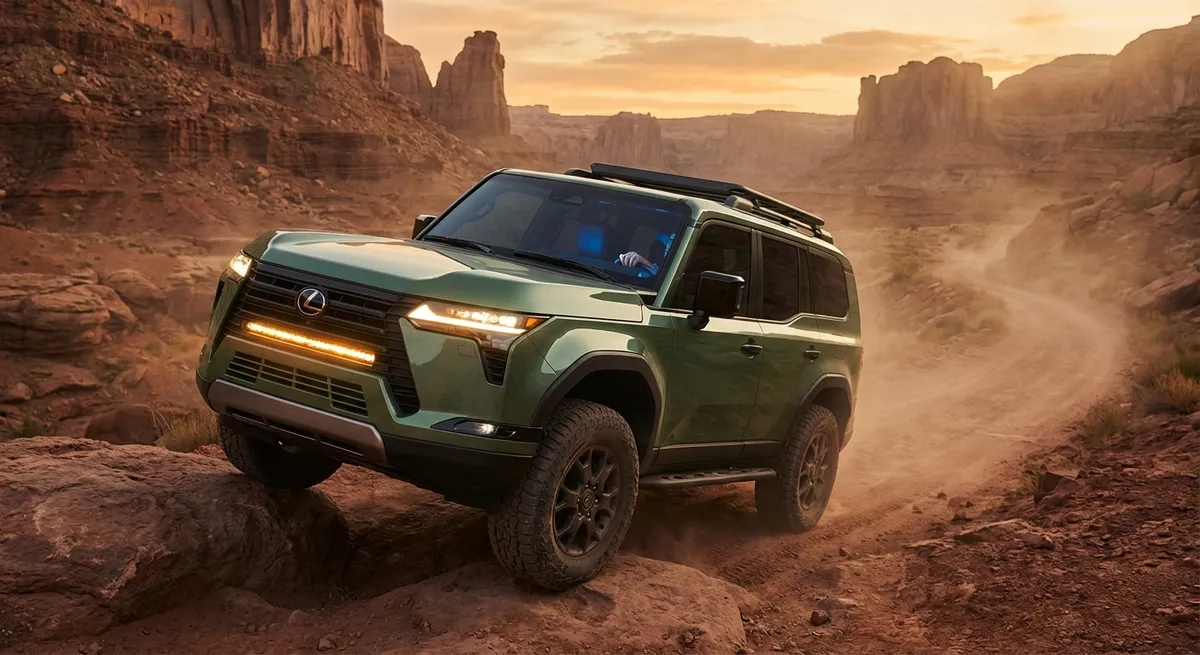
The 2025 Lexus GX Overtrail arrives at a time when most luxury SUVs are drifting closer to soft-road crossovers, and that’s precisely why it matters. Built on a ladder frame with standard full-time 4WD, locking differentials, and serious suspension hardware, the new GX is one of the few premium SUVs that still treats off-road capability as a core mission rather than a marketing slogan. This review focuses on the Overtrail and Overtrail+ trims—the most adventure-oriented versions in the lineup—and breaks down the engineering, real-world drivability, and ownership considerations that enthusiasts and serious shoppers should know before signing on the dotted line.
Platform and Powertrain: Body-on-Frame Done the Modern Way
Underneath the boxy, upright bodywork, the 2025 Lexus GX uses Toyota’s TNGA-F body-on-frame architecture, shared with the latest Land Cruiser and Tundra. This isn’t a lightly tweaked carryover—it’s a modernized ladder frame with significantly increased torsional rigidity compared with the previous GX, which pays dividends in ride quality, refinement, and durability.
Power comes from a 3.4-liter twin-turbo V6 (often labeled 3.5L for marketing) paired with a 10‑speed automatic transmission. Output in North America is approximately 349 hp and 479 lb‑ft of torque, a meaningful jump over the old naturally aspirated 4.6‑liter V8. Peak torque arrives low in the rev range, which is crucial when you’re climbing loose surfaces or towing. Unlike high-revving engines that need to be spun up, the GX’s turbos build boost quickly, giving a strong push from just above idle.
The 10‑speed automatic is geared to keep the engine in its torque band while also allowing relaxed highway cruising. Shorter lower gears help with initial acceleration and low-speed control off-road, while taller top gears keep revs low for fuel economy and cabin quietness. Lexus pairs this with a full-time 4WD system, a 2‑speed transfer case (with low range), and a Torsen center differential. Many luxury SUVs have switched to on-demand AWD without low range; the GX retains hardware that matters when you’re crawling over rocks or descending steep grades under load.
Enthusiasts should note that while the V6 doesn’t deliver the V8’s traditional soundtrack, it compensates with stronger torque, better efficiency, and a higher tow rating. The trade-off is greater mechanical complexity—more turbo plumbing and higher thermal loads—which makes proper maintenance and cooling management (especially when towing) even more important over the long term.
Off-Road Capability: Where the Overtrail Earns Its Name
The Overtrail trims are the most mechanically serious off-road variants in the GX range. Beyond aesthetics, they add functional hardware that separates them from standard luxury SUVs that only look rugged.
Key off-road specs and features include:
- Approach/Departure Angles and Clearance: The GX Overtrail has increased ground clearance (around 9 inches, depending on wheel/tire spec) and improved approach and departure angles compared with typical luxury crossovers. The chunky front fascia is shaped to clear obstacles at the corners, and the shorter rear overhang helps prevent dragging the bumper on steep departures.
- Locking Rear Differential: In addition to the Torsen center differential, the Overtrail adds an electronic locking rear diff. This is a major advantage when one rear wheel loses traction; lock the diff, and power flows equally to both sides, helping the vehicle claw forward where open diffs would simply spin a single wheel. It’s a feature still absent on many premium competitors.
- Multi‑Terrain Select and Crawl Control: The GX’s off-road electronics suite allows the driver to select terrain modes (Mud, Sand, Rock, etc.) that adjust throttle mapping, traction control thresholds, and transmission behavior. Crawl Control functions like an off‑road cruise control, modulating throttle and brakes at low speed, so the driver can focus on steering. While some purists prefer full manual control, these systems significantly reduce driver fatigue on extended rough trails.
- Adaptive Suspension and E‑KDSS (on select trims/markets): Depending on specification, the GX can be equipped with active stabilizer systems that can “decouple” sway bars off‑road for increased wheel articulation, then tighten them for flat on-road handling. This duality is critical; articulation helps keep tires planted on uneven surfaces, while stiff anti-roll bars keep body motion under control in everyday driving.
- All‑Terrain Tires and Wheel Package: Overtrail models use 18‑inch wheels wrapped in taller sidewall all‑terrain tires. That sidewall flex is not just a visual cue; it allows deflation for better traction on sand and rocks, provides more impact absorption, and reduces the risk of wheel damage. By contrast, low-profile 20‑ or 22‑inch setups on some luxury SUVs may ride harshly and be more vulnerable off-road.
The result is a vehicle that can function as a genuine backcountry tool straight off the showroom floor. For buyers comparing a GX Overtrail to a typical three‑row premium crossover, this difference in underlying hardware will be obvious the moment the pavement ends.
On‑Road Dynamics and Towing: How It Drives in the Real World
Although the Overtrail is tuned for off-road durability, Lexus knows most owners will spend the majority of their time on asphalt. Here, the TNGA‑F platform and modern suspension tuning pull the GX closer to car-like manners than its truck bones might suggest.
Steering feel is light but precise, with an electric power steering system tuned more for stability than aggressive feedback. The higher curb weight and tall profile are always present, yet body roll is effectively managed, especially in models equipped with adaptive dampers and active stabilizer control. Expansion joints and broken pavement are absorbed with a controlled, slightly firm motion—a trade-off for off-road robustness. Wind and road noise are impressively subdued for a boxy SUV; triple-sealed doors and acoustic glass contribute to a cabin that remains quiet even at highway speeds.
The twin‑turbo V6’s torque transforms the driving experience compared with the older V8 GX. Passing maneuvers require less planning, and merging onto fast interstates is more effortless. The 10‑speed gearbox can occasionally feel busy if the driver is aggressive with throttle inputs, but in everyday driving it blends shifts smoothly and keeps engine speeds low. Normal and Eco modes prioritize smoothness; Sport mode sharpens shifts and throttle response for more responsive on-road behavior.
Towing is a core use case for many GX buyers. With a properly equipped model, the GX’s tow rating can reach around 8,000 pounds in the U.S., putting it in line with or above many competitors in the mid-size luxury segment. Key towing-related components and considerations:
- Integrated Trailer Wiring and Brake Controller Compatibility: The GX is prepped for trailer wiring; enthusiasts should still verify details on integrated brake controller options or aftermarket solutions, especially for heavier trailers above 5,000 pounds.
- Cooling and Thermal Management: The twin‑turbo V6 relies on robust cooling for engine oil, transmission fluid, and charge air. When towing near maximum capacity in hot climates or on steep grades, monitoring gauges and adhering to service intervals (fluids, filters, cooling system checks) will significantly impact long-term durability.
- Suspension Tuning Under Load: The Overtrail’s suspension is designed to handle gear and accessories, but hitch weight distribution still matters. An appropriately adjusted weight-distributing hitch, proper trailer loading, and correct tire pressures will maintain stability and ride quality.
For buyers who want a dual-role SUV—daily driver during the week, tow vehicle and trail rig on the weekend—the GX Overtrail’s drivetrain and chassis layout are well-matched to that mission, provided you accept the fuel economy and size penalties inherent in a body-on-frame rig.
Interior, Technology, and Practicality: Luxury Meets Overlanding
Inside, the 2025 GX feels significantly more modern than its predecessor, replacing the old dashboard layout with a wide, horizontal design anchored by a large central touchscreen. Lexus has opted for a blend of physical controls and digital interfaces—a welcome choice for drivers who actually venture off the grid and may be wearing gloves or dealing with vibration on rough trails.
Core interior and tech highlights:
- Infotainment and Connectivity: A large touchscreen (size varies by trim, typically around 14 inches) runs the latest Lexus interface with wireless Apple CarPlay and Android Auto, over-the-air update capability, and a clean tile-based layout. Voice recognition has improved substantially versus older Lexus systems. For trail navigation, pairing the native system with offline-capable apps on a smartphone remains the most flexible solution.
- Instrumentation and Driver Displays: A digital instrument cluster presents configurable layouts for road and off-road data—pitch and roll, 4WD system status, and power distribution can be displayed. This is crucial when line selection matters, or when you want to monitor whether the center or rear diffs are locked at a glance.
- Seating and Layout: Overtrail models typically emphasize two-row configurations with more cargo flexibility, although other GX trims offer three rows. Front seats are supportive and designed for long-distance comfort; available seat ventilation helps during hot-weather wheeling. Materials skew toward durable premium—soft-touch surfaces combined with trim finishes that won’t feel out of place covered in trail dust.
- Cargo and Storage: The boxy roofline and upright tailgate enable a more practical cargo area than many coupe-styled SUVs. Tie-down points, underfloor storage, and a wide, almost square load opening are well-suited to overlanding gear, recovery equipment, and camping setups. For enthusiasts, this geometry simplifies fitting drawer systems, fridge slides, or a sleeping platform.
- Driver Assistance and Safety Tech: The latest Lexus Safety System includes adaptive cruise control, lane-centering assistance, blind-spot monitoring, and automatic emergency braking. Importantly, the calibration is more refined than previous generations; intrusive lane-keeping behavior has been scaled back, and many features can be customized or disabled. Off-road‑specific camera views (front, side, and underbody camera perspectives) are particularly useful in tight or technical terrain, reducing the risk of unseen obstacles damaging suspension or rocker panels.
This blend of luxury and practicality positions the GX Overtrail as a viable long-distance travel vehicle. For buyers comparing it to more road-biased luxury SUVs, the cockpit may feel slightly more “tool-like” than lounge-like, but that is part of its appeal to enthusiasts who actually use their vehicles as equipment, not just transport.
Ownership, Modification Potential, and Who the GX Overtrail Is For
Beyond the spec sheet, a key question for enthusiasts is: how does the 2025 GX Overtrail stack up as a long-term platform for modification and ownership?
From an engineering standpoint, the shared TNGA-F architecture with high-volume Toyota trucks and SUVs suggests strong aftermarket and parts availability over time. Expect increasing support for:
- Suspension Systems: Upgraded coilovers, remote-reservoir shocks, and longer-travel setups that retain (or improve) on-road manners while adding articulation and durability. Many components from related platforms may be adaptable with minimal modification.
- Armor and Recovery Gear: Bolt-on skid plates, rock sliders, steel bumpers with integrated winch mounts, and recovery points typically become available quickly for popular platforms. The GX’s frame construction and front-end design lend themselves to serious protection upgrades.
- Wheel and Tire Packages: The Overtrail’s 18‑inch wheels are already off-road friendly, but many owners will shift to aftermarket wheelsoptimized for offset and strength, combined with slightly larger all-terrain or mud-terrain tires. Understanding how changes in diameter affect gearing, speedometer accuracy, and braking performance will be critical—for most buyers, a moderate size increase (e.g., +1–2 inches in overall diameter) is a practical ceiling without gearing or brake upgrades.
- Roof Systems and Overlanding Accessories: The squared-off roof and strong roof rails make the GX a good candidate for full-length roof racks, rooftop tents, and awnings. Payload capacity should always be checked carefully; a fully loaded rack, passengers, and gear can push a vehicle well past its intended GVWR if you’re not methodical about weight management.
From an ownership perspective, Lexus’s reputation for reliability and dealer support is a strong draw. But with modern turbocharged engines and dense electronics, enthusiasts should plan for:
- Adhering strictly to oil change intervals with the correct spec oil
- Periodic inspection of intercooler and turbo plumbing for leaks
- Careful cleaning of sensors (MAP, MAF, etc.) if operating often in dusty environments
- Occasional software updates, especially if you rely on advanced driver aids or connected services
The ideal GX Overtrail buyer is someone who values true off-road capability and towing strength, wants a refined and comfortable daily driver, and plans to keep the vehicle for the long haul. If your reality is paved commuting with occasional gravel road trips, a lighter crossover may be more economical. If, however, your weekends involve remote trailheads, towing a boat, or overland travel with significant gear, the 2025 GX Overtrail stands out as one of the most authentically capable luxury SUVs currently on sale.
Conclusion
The 2025 Lexus GX Overtrail is a rare combination in today’s SUV market: a genuinely capable body-on-frame off-roader wrapped in a polished, tech-rich luxury package. Its twin‑turbo V6 and 10‑speed automatic provide stronger performance and towing ability than the outgoing V8, while the TNGA‑F platform underpins meaningful improvements in ride quality and refinement. Hardware like a locking rear differential, real low range, and all-terrain tires place it in a different league than most premium crossovers that only mimic rugged styling.
For enthusiasts and serious buyers, the GX Overtrail offers a robust foundation for both factory-stock adventures and thoughtful modification. It’s not the most efficient, nor the most overtly plush SUV in its class—but for drivers who actually intend to use their vehicles beyond the pavement, its balance of capability, comfort, and long-term platform potential makes it one of the most compelling new luxury SUVs to watch, test, and, for the right owner, buy.
Sources
- Lexus USA – 2024/2025 GX Overview – Official model information, features, and specifications from Lexus
- Toyota Global Newsroom – TNGA-F Platform Details – Technical background on the body-on-frame architecture underpinning the GX and related models
- U.S. Department of Energy – Fuel Economy Data – Comparative fuel economy figures for large 4WD SUVs, useful for cross-shopping
- IIHS – SUV Safety and Crashworthiness Research – Safety ratings and technical notes on SUV crash performance and active safety systems
- SAE International – Turbocharged Gasoline Engine Fundamentals – Technical reference on turbocharged engine design and durability considerations
Key Takeaway
The most important thing to remember from this article is that this information can change how you think about Reviews.