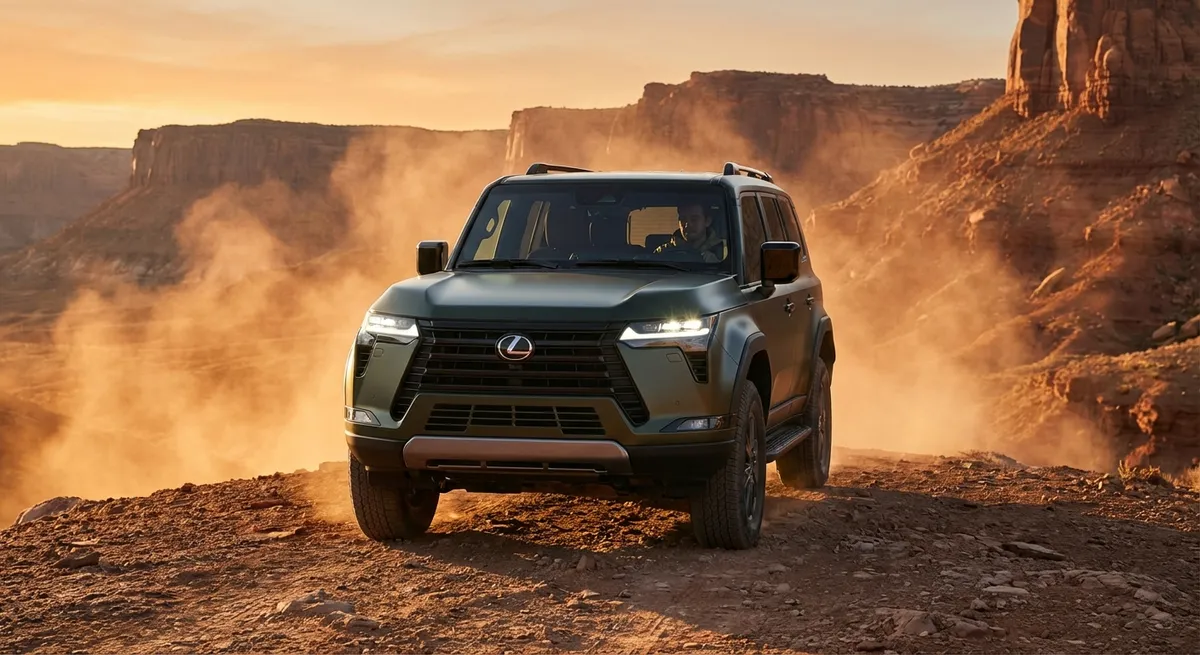
The 2025 Lexus GX has quietly shifted from an old-school, body‑on‑frame relic into one of the most technically intriguing off-road‑capable luxury SUVs on sale. Built on Toyota’s TNGA‑F platform (shared with the Land Cruiser and Sequoia), it blends genuine trail hardware with the kind of comfort and tech that suburban families expect. This review focuses on what informed SUV buyers and enthusiasts want to know: how it’s built, how it drives, how the tech really works, and what it’s like to live with day to day.
Powertrain and Platform: Body-on-Frame Done the Modern Way
Underneath the squared-off bodywork, the 2025 GX is all new. It rides on the TNGA‑F ladder frame, a modular body‑on‑frame architecture that’s engineered for stiffness and durability while integrating modern safety and NVH (noise, vibration, harshness) refinements.
The powertrain is centered around a 3.4‑liter twin‑turbocharged V6 (shared in concept with several Toyota/Lexus trucks but tuned specifically for the GX), paired with a 10‑speed automatic transmission. Output is approximately 349 hp and 479 lb‑ft of torque, a substantial improvement over the outgoing naturally aspirated V8 both in torque curve and efficiency. Peak torque arrives much lower in the rev range, making the GX feel more responsive when pulling away from a stop or climbing grades with passengers and cargo.
Full‑time 4WD is standard, with a Torsen‑type center differential and a 2‑speed transfer case. On‑road, the Torsen diff continuously biases torque front‑to‑rear for stability and traction, and it locks for serious off‑road work. The frame’s cross‑members and suspension mounting points have been optimized for rigidity; this allows the engineers to run softer bushing and suspension tuning for comfort without sacrificing steering precision. The result is a traditional truck‑style SUV that doesn’t feel as loose or “floaty” as its predecessors.
The platform also supports advanced driver assistance systems (ADAS) thanks to integrated crash structures and sensor mounting provisions. That’s why the 2025 GX can include the latest Lexus Safety System+ suite without the compromises older truck‑based SUVs used to suffer, such as limited automatic emergency braking or reduced functionality when towing.
Off-Road Hardware and Geometry: More Than Just a Boxy Look
Unlike many luxury SUVs that only look rugged, the GX’s off-road hardware is baked in rather than added on. Ground clearance varies slightly by trim and wheel/tire choice, but the GX is designed with serious approach, departure, and breakover angles. The Overtrail trims, in particular, benefit from unique bumpers, underbody protection, and all‑terrain tires that improve capability without lowering the refinement threshold too far.
The 2‑speed transfer case (with true low range) is critical. Low range multiplies torque at the wheels and slows vehicle speed for precise control on steep climbs and descents. Enthusiasts will appreciate that this isn’t just marketing—crawl ratio, the product of first gear and low‑range reduction, is tailored for real rock‑crawling scenarios. Paired with the available locking rear differential, it allows the GX to maintain forward motion where open differentials would simply spin a wheel in the air.
Lexus also integrates electronic traction aids such as Crawl Control and Multi‑Terrain Select. Crawl Control functions as an off‑road cruise‑control system, modulating throttle and braking across preset low speeds so the driver can focus on steering. Multi‑Terrain Select fine‑tunes throttle mapping, transmission behavior, and traction control parameters for surfaces like mud, sand, rock, and loose gravel.
Approach and departure angles are improved over the prior generation by pulling the bumpers higher and closer to the body, while strategic placement of skid plates protects vulnerable components such as the transfer case and fuel tank. The frame’s increased torsional rigidity helps keep all four wheels in better contact with uneven surfaces, which complements the traction control system and mechanical locking functions.
On-Road Comfort, Noise, and Handling: Where the GX Surprises
The 2025 GX is still a body‑on‑frame SUV, but its on‑road behavior has moved closer to unibody crossovers than older truck‑based luxury models. The TNGA‑F platform’s stiffness means suspension tuning can focus more on compliance than on masking flex, which pays dividends in ride control. Impacts from potholes and expansion joints are rounded off rather than crashing through the cabin.
Adaptive suspension (available or standard depending on trim) continuously adjusts damping based on wheel movement, steering input, and body motion. This not only improves comfort but also reins in body roll during lane changes and off‑ramps, making the GX feel more secure at highway speeds. Steering is electrically assisted, with carefully tuned weighting that doesn’t try to mimic a sports car, but offers more precision and feedback than many large luxury SUVs.
Noise isolation is another strong suit. Laminated glass, strategic sound deadening, and refined engine calibration work together so that the twin‑turbo V6 is audible but never harsh. Under heavy throttle, you hear a subdued growl rather than a strained roar. At 70 mph, wind noise is well controlled despite the boxy exterior. Particular attention has been paid to sealing around the A‑pillars, mirrors, and roof racks—all common wind‑noise generators in taller SUVs.
Braking hardware is sized appropriately for the GX’s mass and towing expectations, with large ventilated discs and multi‑piston calipers on higher trims. Pedal feel has been tuned to avoid the “grabby” sensation some heavy SUVs exhibit at low speeds, yet maintains confidence during repeated, high‑load stops, such as coming down a long grade with a full load of passengers and gear.
For buyers used to crossovers, the GX will still feel more “truck‑like” in its motions—especially under abrupt inputs—but compared with older body‑on‑frame models, it strikes a far more civilized balance between isolation and control.
Technology, Infotainment, and Driver Assistance: Modern Lexus, Finally
Previous GX generations were often criticized for lagging infotainment and dated interfaces. The 2025 model corrects this with the latest Lexus multimedia system, anchored by a large central touchscreen (commonly 14 inches in many Lexus applications) with high‑resolution graphics and fast response. The UI supports wireless Apple CarPlay and Android Auto, with natural‑language voice recognition that handles navigation, climate, and media commands.
Important off‑road functions—like camera views and Multi‑Terrain Select settings—are integrated into the central screen in a way that minimizes buried menus. Surround‑view and under‑body camera feeds are particularly valuable in tight trails or urban parking structures. Physical knobs and buttons remain for frequently used controls (volume, temperature, drive modes), acknowledging that haptic muscle memory is essential when driving on loose surfaces.
The driver assistance suite, Lexus Safety System+ 3.x, combines adaptive cruise control with lane tracing assist, automatic emergency braking (with pedestrian and cyclist detection), road sign assist, and proactive driving assist. Crucially, these systems have been tuned for a heavier, higher‑center‑of‑gravity SUV; lane‑keeping interventions are smoother and less abrupt than in many mainstream crossovers, and radar‑based adaptive cruise is calibrated to account for typical towing loads.
Over‑the‑air (OTA) update capability means Lexus can refine system behavior and add features post‑purchase. For a vehicle with a long service life expectation—common among Toyota/Lexus BOF platforms—this future‑proofing matters. Audio options include premium Mark Levinson systems with multiple amplifier channels and carefully positioned speakers to counteract the acoustic challenges of a tall, boxy cabin.
Tech extends beyond the dashboard. Keyless entry with digital key support, available head‑up display (HUD), multi‑zone climate with automatic humidity control, and configurable ambient lighting all contribute to a premium daily‑use experience. Importantly for buyers who plan to actually adventure, the electronics are engineered to coexist with significant electrical loads from accessories such as winches, auxiliary lighting, and refrigerators, provided they’re installed within specification.
Towing, Payload, and Real-World Utility: Luxury That Can Still Work
The GX’s traditional truck‑style underpinnings are an advantage when it comes to actual work. Towing capacity is competitive in its class (typically around 8,000 pounds depending on specific configuration), thanks to the stout frame, twin‑turbo torque output, and transmission gearing optimized for load. An integrated trailer brake controller and trailer sway control are available or standard in higher trims, using both yaw sensors and braking inputs to keep trailers stable.
Payload capacity—often overlooked in luxury SUVs—is sufficient for a family plus luggage and accessories without exceeding the gross vehicle weight rating (GVWR). That matters if you plan to add roof racks, off‑road gear, or tow with a full complement of passengers. The boxy profile contributes to a usable cargo area with a relatively tall roofline, allowing bulkier items to fit more easily than in many coupe‑inspired SUVs.
Lexus has revised the rear door and cargo access from previous generations to be more practical in tight parking situations, with attention paid to load floor height relative to the bumper. Tie‑down points, power outlets (including available 120‑volt AC outlets), and configurable seating (split‑fold second and available third row) make the GX genuinely versatile rather than just spacious on paper.
Cooling systems for engine, transmission, and differential have been engineered with high ambient temperatures and heavy loads in mind, reflecting Toyota/Lexus’s global markets and reputation for durability. This is especially important for buyers in hot climates or those who will tow frequently; thermal stability is often the limiting factor in real‑world towing, not just raw power.
For enthusiasts who see the GX as a platform for overlanding, the combination of body‑on‑frame architecture, robust towing, and relatively simple roof rack mounting options makes it a strong candidate. The aftermarket is already gearing up with suspension, armor, and storage solutions, and the vehicle’s electrical and structural robustness means it can support such modifications when done properly.
Conclusion
The 2025 Lexus GX is no longer just the conservative, V8‑powered outlier in Lexus showrooms. It’s a sophisticated, turbocharged, body‑on‑frame SUV that deliberately bridges two worlds: genuine off‑road capability and everyday luxury. Enthusiasts will appreciate the locking differentials, low‑range gearing, and thoughtful off‑road tech, while families will benefit from the refined ride, advanced safety systems, and modern infotainment.
For buyers cross‑shopping unibody luxury crossovers, the GX offers something they can’t: the structural resilience and work capability of a truck with relatively few compromises in comfort. And for those who remember the old GX fondly but wished for more power, efficiency, and technology, this new generation finally brings the hardware and software up to the level of Lexus’s reputation.
Sources
- Lexus USA – 2025 GX Overview – Official specifications, features, and trim details for the 2025 Lexus GX
- Toyota Global – TNGA-F Platform Technical Overview – Background on the body-on-frame TNGA‑F architecture shared among Toyota/Lexus SUVs and trucks
- Car and Driver – 2024–2025 Lexus GX First Drive Review – Independent testing impressions, performance data, and early review analysis
- IIHS – Vehicle Safety Ratings – Crash test data and safety evaluations for SUVs in the GX’s class (updated as new tests are completed)
- U.S. Department of Energy – Fuel Economy Guide – Official fuel economy information and class comparisons for 2025 model‑year standard SUVs
Key Takeaway
The most important thing to remember from this article is that this information can change how you think about Reviews.