The three-row SUV market has never been more crowded, but genuinely refined plug-in hybrids are still rare. The 2025 Lexus TX 550h+ steps directly into that gap, promising full-size space, luxury-brand polish, and meaningful electric-only capability. For buyers who want to lower fuel bills without jumping fully into EV ownership, it’s an especially interesting proposition. This review digs into the TX 550h+ from a serious shopper’s perspective, with a focus on the details that matter to enthusiasts and informed buyers—powertrain behavior, chassis tuning, packaging, tech execution, and long-term ownership prospects.
Powertrain and Performance: Plug-In Hybrid Done the Lexus Way
The TX 550h+ combines a 3.5-liter V6 engine with a plug-in hybrid system and a lithium-ion battery pack, delivering a total system output of about 406 hp (Lexus’ preliminary figure). Unlike many two-row PHEV crossovers that pair a small turbo-four with a single electric motor, this setup is aimed at moving a full-size, three-row SUV with confidence rather than merely improving city MPG numbers.
Electric-only driving is the headline: Lexus targets an EV range in the 30–40 mile band under typical conditions, enough for many owners’ daily commuting and errands without using a drop of gasoline. The system favors electric propulsion at low speeds and under gentle acceleration; the V6 smoothly engages as speeds climb or when you request more power via the throttle. Because the engine is naturally aspirated, throttle response is linear and the transition from electric to hybrid mode is more seamless than many turbo-based competitors.
An electronically controlled continuously variable transmission (eCVT) manages the torque blend between engine and motor. Lexus tunes this setup to simulate stepped shifts under heavier acceleration, reducing the “rubber band” feel that irritates some drivers. All-wheel drive is standard, using an electric rear motor to add traction and allow torque vectoring across the rear axle when needed. The result is a powertrain that feels relaxed rather than aggressive, but it has enough reserve thrust for confident highway merging and passing even with a full load.
Regenerative braking is a key technical point for enthusiasts. The TX 550h+ uses strong, smoothly integrated regen that recovers substantial energy without making the brake pedal feel wooden or grabby. In stop-and-go driving, you’ll notice the system capturing kinetic energy effectively, which contributes to both efficiency and brake pad longevity. For drivers coming from non-hybrid SUVs, the refinement of this blended braking system will be a pleasant surprise.
Ride, Handling, and NVH: Calm, Insulated, and Predictable
The TX 550h+ is built on Toyota’s GA-K platform (shared with models like the Toyota Highlander and Lexus RX), but it’s been stretched and reinforced to handle three real rows and a heavy plug-in battery. Lexus has focused on chassis stiffness and additional sound insulation to ensure that the plug-in’s quiet EV character is matched by equally quiet road manners.
Suspension is by MacPherson struts up front and a multi-link setup at the rear, tuned for comfort first. Damping is supple and controlled; the TX does an excellent job of smoothing out broken pavement and expansion joints while avoiding excessive body float. Because the battery is mounted low in the chassis, the center of gravity is reduced compared to a conventional gas-only SUV of similar size. That translates into less body roll in corners and a more planted feel in sweeping highway curves.
Steering is electrically assisted and clearly biased toward ease of use, with light effort at low speeds for parking and tighter maneuvers. Enthusiasts won’t mistake it for a performance SUV’s quick rack or detailed feedback, but the ratio is consistent and the on-center feel is stable at highway speeds. What it lacks in outright engagement, it makes up for with a relaxed, confidence-inspiring character that matches the rest of the vehicle.
Noise, vibration, and harshness (NVH) are where the TX 550h+ clearly separates itself from mainstream competitors. In EV mode, the cabin is exceptionally quiet, with wind and road noise well suppressed by laminated glass, extra floor insulation, and carefully tuned door seals. Even when the V6 comes online, it’s subdued and distant, never sounding strained. For buyers stepping up from mid-priced three-row crossovers, this level of acoustic refinement is a major part of the Lexus value proposition—and a daily quality-of-life upgrade.
Interior Packaging and Utility: Three Rows With Real-World Usability
One of the key differentiators for the TX versus smaller Lexus utilities is that it’s a genuine three-row SUV designed to comfortably carry six or seven adults, not just kids in the third row. The TX 550h+ offers a standard three-row configuration with either a 7-passenger setup (bench in the second row) or a 6-passenger layout with captain’s chairs, depending on trim and options.
Front seats are wide, supportive, and heavily adjustable, with available multi-way power functions, heating, ventilation, and memory. Most drivers will find an ideal position quickly thanks to a broad range of steering wheel and seat travel. The second row provides generous legroom and headroom; in the captain’s chair configuration, it feels properly upscale, with available heating, armrests, and dedicated climate controls.
The third row is where many three-row SUVs fall apart. In the TX, adults of around 5'10" can ride in the way-back for medium-length trips without feeling punished, and the low, flat floor helps with foot placement. Access is eased by tilt-and-slide second-row seats and wide rear door openings. It’s still best suited to kids or shorter adults for long road trips, but it’s far more usable than the compact “token third rows” you find in smaller crossovers.
Luggage space is a major consideration for family buyers. With all three rows up, cargo room is adequate for grocery runs or a few carry-on suitcases; fold the third row flat, and the TX turns into a substantial two-row hauler capable of swallowing strollers, sports gear, and luggage for a week-long vacation. Fold both rear rows, and the load floor is impressively long and flat, making hardware store runs or bike transport straightforward.
Importantly for plug-in hybrid shoppers, the TX 550h+’s battery placement doesn’t meaningfully compromise interior packaging or cargo capacity. Lexus has integrated the pack below the floor to preserve space, an advantage over some earlier PHEV designs that sacrificed trunk or underfloor storage for electrification hardware.
Technology, Infotainment, and Safety: High Integration, Mixed Learning Curve
The tech story in the TX 550h+ centers on Lexus’ latest infotainment platform and a full suite of advanced driver-assistance systems (ADAS). A large central touchscreen (around 14 inches, depending on market spec) dominates the dash, running the Lexus Interface software. Graphics are crisp, responses are quick, and the system supports both wireless Apple CarPlay and Android Auto, along with over-the-air (OTA) update capability for incremental improvements.
Menus are logically structured, but there is a learning curve due to the breadth of features—especially hybrid- and charging-specific settings. You can schedule charging windows to take advantage of off-peak electricity rates, precondition the cabin while plugged in, and monitor energy flow between battery, engine, and wheels in real-time. Enthusiasts who enjoy data will appreciate the energy and efficiency displays, while casual users can mostly “set and forget” the charging behavior.
Physical controls haven’t disappeared entirely. Lexus retains real knobs for volume and temperature, plus a small cluster of hard buttons for frequently used climate and defrost functions. This hybrid physical-digital approach reduces distraction compared with systems that bury every function in submenus. Still, the heavy reliance on touchscreen controls for secondary functions may frustrate some drivers who prefer dedicated switches.
On the safety front, the TX 550h+ comes standard with the latest Lexus Safety System+ suite. This typically includes adaptive cruise control with stop-and-go capability, lane departure warning with lane-centering assist, automatic emergency braking with pedestrian and cyclist detection, road sign assist, and automatic high beams. Optional extras—depending on package—can include a 360-degree camera system, blind-spot monitoring with rear cross-traffic alert, and a head-up display.
For long highway trips, the combination of adaptive cruise and lane-centering creates a semi-automated driving experience. The system is designed as a driver assistance, not a self-driving feature; hands-on-wheel attention is still required. In practice, it significantly reduces fatigue in heavy traffic and long commutes, but you’ll want to spend some time adjusting distance settings and lane-centering behavior to your preferences.
Ownership, Efficiency, and Charging: Where the TX 550h+ Makes Its Case
The primary rational argument for a plug-in hybrid like the TX 550h+ lies in its blended efficiency profile. Around town and on short commutes—especially if you can charge at home—you can operate the TX mostly as an EV, with electricity covering the bulk of daily miles. On longer trips, the V6 and hybrid system deliver the range and refueling speed of a traditional gas SUV, eliminating the route-planning anxiety associated with some all-electric rivals.
Official EPA numbers for the TX 550h+ were still being finalized at the time of writing, but based on Toyota’s and Lexus’ similar plug-in drivetrains, you can expect competitive MPGe in EV mode and fuel economy that’s in line with, or better than, comparable three-row gas SUVs when operating as a hybrid. The system also intelligently manages battery usage: for example, you can hold battery charge for later use, or let the car decide when to use electric power for maximum efficiency.
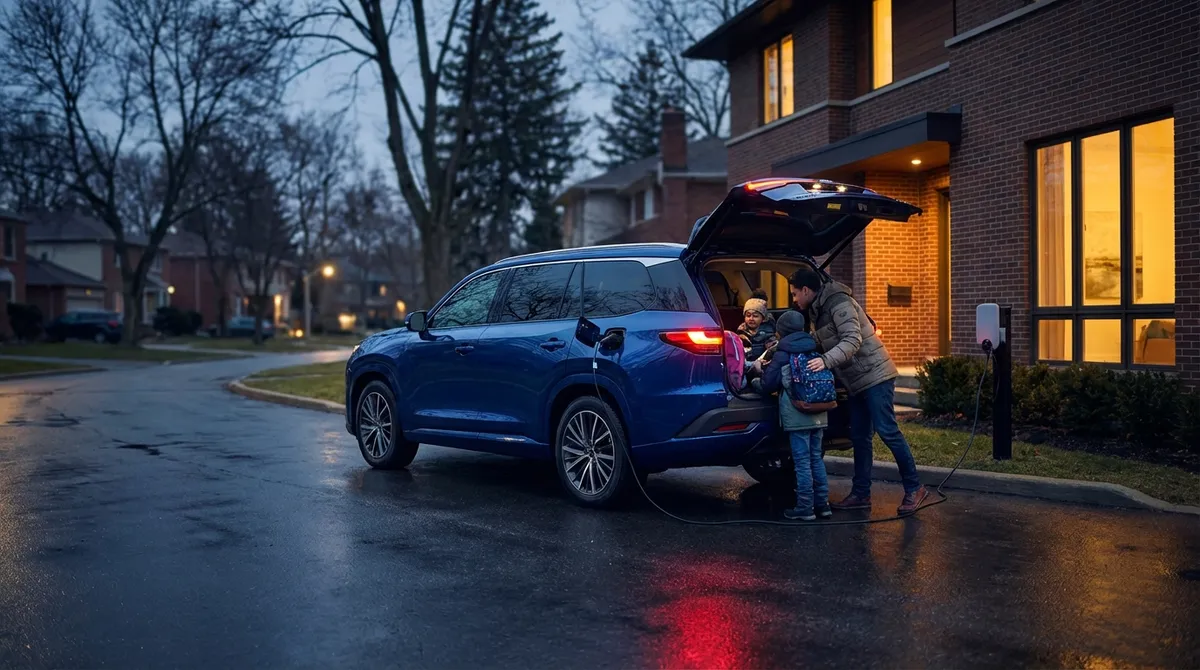
Charging hardware is straightforward. The on-board charger supports Level 2 AC charging (typically up to 6.6 kW), allowing a full recharge of the battery in roughly 3–4 hours from a 240V home or workplace charger. Standard Level 1 (120V) charging is possible from a regular household outlet but is significantly slower, best used if you can leave the vehicle plugged in overnight or longer. There is no DC fast charging; as a PHEV, the battery is sized for daily-driving EV duty rather than long-haul DC road-trip use.
From a cost-of-ownership standpoint, Lexus’ strong reliability reputation and dealer network are major pluses. The hybrid components—battery, power electronics, and electric motors—are typically covered by extended warranties compared to conventional powertrain parts, often 8–10 years depending on region. Maintenance intervals for combustion-related components can be more relaxed due to the frequent use of electric drive, and regenerative braking can extend brake pad life significantly.
Resale value is another consideration. While three-row luxury SUVs often hold value well, plug-in hybrids are in a transitional space as the market rapidly embraces full EVs. That said, buyers who want electrified driving without full EV dependency are a sizable and growing audience, which supports demand in the used market. Federal or regional incentives (where available) for plug-in hybrids can further improve the total cost equation; shoppers should check current tax credit eligibility and local rebates, which can change year to year.
Conclusion
The 2025 Lexus TX 550h+ is not a performance SUV, nor is it a bleeding-edge EV science project. Instead, it’s a carefully considered, thoroughly refined three-row plug-in hybrid that targets real-world use cases: families who want space, comfort, and quiet, paired with the ability to run most daily miles on electricity without giving up long-range flexibility. Its powertrain refinement, NVH control, and thoughtful interior packaging make it a compelling option for buyers who find full-size EVs impractical but are ready to move beyond traditional gasoline-only SUVs.
For enthusiasts, the TX 550h+’s appeal lies in the way it integrates complex hybrid hardware into a cohesive, predictable driving experience—no drama, no tech-for-tech’s-sake gimmicks, just quietly effective engineering. For serious shoppers, the calculus comes down to your charging access, driving patterns, and appetite for upfront cost versus long-term fuel savings and refinement. If those factors line up, the TX 550h+ deserves a prominent place on your three-row luxury SUV shortlist.
Sources
- Lexus USA – Lexus TX Overview - Official specifications, features, and packaging details for the TX lineup
- Toyota Global – TNGA (Toyota New Global Architecture) - Technical background on the GA-K platform underlying the TX and related models
- U.S. Department of Energy – FuelEconomy.gov: Plug-in Hybrid Electric Vehicles - Explains how PHEVs work, including efficiency, charging, and real-world use patterns
- U.S. Department of Energy – Alternative Fuels Data Center: Developing Infrastructure to Charge Plug-In Electric Vehicles - Context on Level 1 and Level 2 charging, home charging considerations, and public infrastructure
- Consumer Reports – Guide to Advanced Driver Assistance Systems - Independent overview of ADAS features similar to those offered in the Lexus Safety System+ suite
Key Takeaway
The most important thing to remember from this article is that this information can change how you think about Reviews.