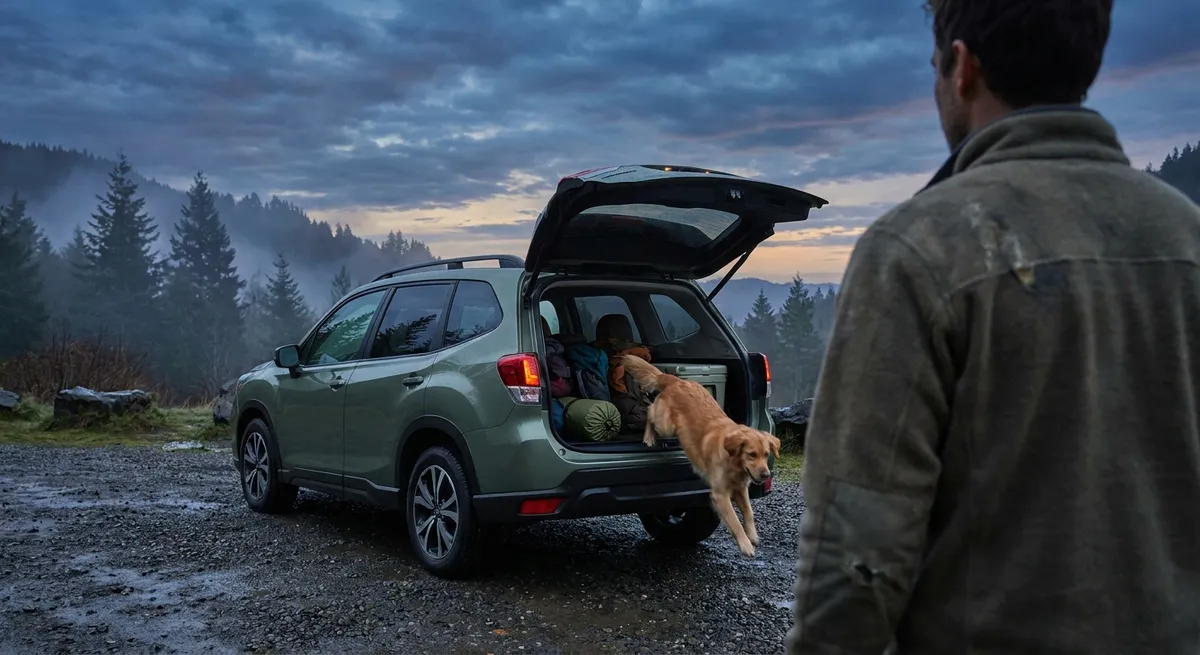
The 2025 Subaru Forester arrives in a fiercely competitive compact SUV segment with a quiet confidence rather than headline-grabbing theatrics. It doesn’t try to be the quickest, flashiest, or most luxurious. Instead, it doubles down on the formula that built its reputation: real-world usability, all-weather capability, and a pragmatic balance of efficiency and durability. For buyers who prioritize predictable handling in bad weather, usable cargo space, and straightforward technology over fashion-driven design, the latest Forester is a compelling case study in incremental, thoughtful evolution.
Powertrain and Driving Dynamics: Predictable, Not Pretentious
Under the hood, the 2025 Forester continues with Subaru’s 2.5-liter naturally aspirated flat-four (boxer) engine, delivering around 180–185 horsepower and 175–184 lb-ft of torque (final figures vary slightly by market and tune). On paper, those numbers don’t impress in a field populated by turbocharged rivals. On the road, however, the powertrain’s character plays to the Forester’s strengths.
The horizontally opposed layout keeps the engine’s mass lower in the chassis, contributing to a reduced center of gravity relative to many competitors. This yields more stable cornering and less body roll in quick transitions, particularly noticeable in emergency maneuvers or on winding secondary roads. Power is routed through Subaru’s Lineartronic CVT (continuously variable transmission), which has matured significantly from its early, droning iterations. Simulated stepped “shifts” under moderate to heavy throttle help mitigate the rubber-band sensation, while a broader ratio spread supports both brisk initial acceleration and relaxed highway cruising.
The standard symmetrical all-wheel drive system remains the Forester’s defining dynamic asset. Unlike part-time or front-biased systems that primarily engage rear wheels after slip is detected, Subaru’s setup maintains a more consistent torque distribution, contributing to predictable traction on wet, snowy, or unpaved surfaces. X-Mode, available on most trims, optimizes throttle response, AWD behavior, and stability control calibration for low-grip situations, with specific modes for snow/dirt and deep snow/mud in higher trims.
Ride quality targets daily drivability over sportiness. The suspension tuning absorbs broken pavement and expansion joints without excessive float, and suspension travel is generous enough to handle mild off-road trails without harsh impacts. Steering feedback is moderate but precise, making the Forester easy to place on the road. Enthusiasts might wish for a more powerful turbocharged option, but for most buyers, the 2.5-liter’s linear delivery and the AWD system’s surefootedness will feel well-matched to the vehicle’s mission.
Interior Packaging and Comfort: Space Efficiency Done Right
The Forester’s cabin doesn’t chase the “coupe-SUV” aesthetic that sacrifices practicality for a sloping roofline. Instead, it maintains an upright greenhouse with expansive glass and thin pillars, providing excellent outward visibility—a safety and fatigue-reduction benefit that spec sheets rarely capture.
Front seats are supportive with long-distance comfort in mind, offering a wide range of manual or power adjustments depending on trim. Cushion density leans slightly firm, which tends to age better over years of use, especially for drivers who log a lot of highway miles. In the rear, adult passengers benefit from generous headroom and legroom, with a nearly flat floor that makes the middle seat more usable than in many compact rivals. Door openings are wide, facilitating easy entry and child-seat installation.
Cargo volume remains one of the Forester’s strongest attributes in its class. The nearly box-like rear opening and low liftover height translate into real utility: large strollers, camping gear, bicycles with front wheels removed, or bulky home improvement items fit more easily than the raw cubic-foot figure suggests. Tie-down points and available cargo-area hooks help secure items, while 60/40-split rear seats fold nearly flat to create an extended load floor.
Material quality is functionally chosen rather than ostentatious. Soft-touch surfaces are placed where occupants are most likely to rest elbows and hands, while more durable plastics appear in high-contact, scuff-prone areas. Higher trims introduce contrast stitching, textured trim, and upgraded upholstery options (including leather), but even lower trims have a cohesive, utilitarian design that feels built to withstand the kind of use an SUV inevitably endures.
Acoustic insulation has been improved, with thicker glass and more sound-deadening material around the firewall and floorpan. Combined with the refined CVT tuning, cabin noise at highway speeds is well-controlled, which is important on longer trips and for drivers considering the Forester as a primary family vehicle.
Technology and Infotainment: Practical Integration Over Gadget Overload
The 2025 Forester adopts Subaru’s latest infotainment architecture, with a vertically oriented central touchscreen (up to 11.6 inches on higher trims) serving as the primary hub for media, navigation, and vehicle settings. The interface runs on updated hardware for snappier response, reducing lag when switching between menus or zooming maps. Logical menu structure and large on-screen icons make it approachable for less tech-savvy drivers, and frequently used functions are typically limited to one or two taps.
Wireless Apple CarPlay and Android Auto are widely available across the lineup, minimizing cable clutter and making smartphone integration more seamless. For buyers who prefer onboard navigation, higher trims offer native maps that integrate with the vehicle’s driver-assist systems, such as adaptive cruise control, to anticipate curves and adjust speed more smoothly on certain road types.
Crucially, Subaru retains physical controls for high-priority functions. Knobs or hard buttons for volume, temperature, and defrost ensure that essential adjustments can be made without diving through touchscreen layers or taking eyes off the road for too long. This is especially valuable in bumpy conditions where touch targets are harder to hit accurately.
The instrument cluster balances digital and analog elements, with a configurable display between traditional gauges in lower trims or a more fully digital layout in top-spec models. Vehicle status, driver-assist information, and trip data are clearly presented. Optional features such as a surround-view camera system and a front-view camera enhance low-speed maneuvering and trail driving, giving drivers a better sense of obstacles that might be hidden from direct line of sight.
Audio systems scale with trim, from an adequate base setup to an upgraded premium system tuned by a recognized audio partner (varies by market). The difference is particularly noticeable in sound clarity and bass control at higher volumes, something audiophile-oriented buyers will appreciate.
Safety and Driver Assistance: A Conservative, Comprehensive Approach
Subaru has long prioritized safety, and the 2025 Forester continues this pattern with an extensive suite of active and passive systems. Structural engineering emphasizes a rigid safety cell with carefully designed crumple zones, channeling crash energy away from the cabin. This forms the foundation for strong performance in crash evaluations from independent bodies such as the Insurance Institute for Highway Safety (IIHS) and the National Highway Traffic Safety Administration (NHTSA), where past Foresters have consistently scored well.
The latest generation of Subaru’s EyeSight driver-assist technology comes standard on most trims, using a pair of stereo cameras mounted near the rearview mirror to monitor the road ahead. This binocular vision setup allows for more nuanced object recognition and distance estimation than some single-camera systems. Core features include adaptive cruise control with lane centering, pre-collision braking, pre-collision throttle management, and lane departure warning with lane-keep assist.
For 2025, Subaru has worked on broadening EyeSight’s operational envelope. Improved cameras and processing hardware enable better performance in low-contrast conditions (such as fog or heavy rain) and more accurate recognition of pedestrians and cyclists at a wider range of speeds. Additional features such as traffic sign recognition and driver monitoring (to detect signs of drowsiness or distraction) are available, particularly in better-equipped trims.
Blind-spot detection, rear cross-traffic alert, and reverse automatic braking further enhance safety in daily use, particularly in crowded urban environments and parking lots. A rear seat reminder system can alert drivers to check the back seat when exiting, an increasingly common feature aimed at reducing hot-car incidents involving children and pets.
From a passive safety perspective, multiple airbags—including front, side, curtain, and in some markets a front-center airbag—work in conjunction with carefully tuned seatbelt pre-tensioners and load limiters to manage occupant forces during a collision. For buyers who prioritize safety ratings and real-world protection over performance benchmarks, the Forester’s holistic safety package is a major selling point.
Ownership Experience, Efficiency, and Use-Case Fit: Where the Forester Shines
The Forester’s value proposition emerges most clearly when evaluating long-term ownership rather than showroom glamour. Fuel economy is competitive for a non-hybrid, AWD compact SUV, with EPA estimates typically in the mid to high 20s mpg combined, depending on trim, wheel size, and options. The naturally aspirated engine’s simplicity relative to small-displacement turbocharged units may appeal to buyers concerned about long-term reliability and maintenance complexity.
Subaru’s reputation for longevity and owner loyalty is well-documented, driven by vehicles that often remain in service for well over a decade with proper care. Common wear items and maintenance intervals are straightforward, and the wide availability of independent shops familiar with Subaru mechanicals can help keep running costs reasonable after the warranty period.
The Forester’s use-case sweet spot is broad but particular. It’s especially well-suited to:
- Drivers in regions with frequent snow, rain, or unpaved roads who need a predictable AWD system.
- Families or individuals needing real cargo capability in a relatively compact footprint for urban or suburban environments.
- Outdoor enthusiasts who regularly transport gear for camping, biking, skiing, or kayaking, and occasionally explore light trails.
- Buyers who prioritize safety, visibility, and comfort over turbocharged acceleration and aggressively styled interiors.
Potential drawbacks should be weighed honestly. Enthusiasts looking for brisk acceleration, a sporty exhaust note, or dynamic driving modes calibrated for performance will likely find the Forester too conservative. Those who value luxurious materials, high-end audio as standard, or cutting-edge semi-autonomous driving features rivaling premium brands may also lean toward more upscale competitors or hybrid alternatives.
However, for many buyers, the Forester’s understated engineering strengths—balanced chassis, consistent AWD, thoughtfully packaged interior, and robust safety suite—translate into exactly what they need: an SUV that quietly excels at the unglamorous tasks of daily life, year after year.
Conclusion
The 2025 Subaru Forester is not the kind of SUV that dominates social media feeds with bold styling or headline-grabbing performance claims. Instead, it offers a carefully engineered blend of utility, safety, and all-weather competence that appeals to buyers who measure value in years of reliable service, not just in showroom impressions. Its boxer engine and symmetrical AWD system deliver confidence rather than drama, its cabin emphasizes space and visibility over fashion, and its technology suite focuses on clarity and usability.
In a segment where many models chase trends, the Forester stands out by refining a proven formula. For car enthusiasts who appreciate thoughtful engineering choices and potential buyers who prioritize real-world practicality, the 2025 Forester deserves a close look—especially if your driving reality includes bad weather, active weekends, and the need for an SUV that simply gets the job done, quietly and consistently.
Sources
- [Subaru Official 2025 Forester Overview](https://www.subaru.com/vehicles/forester/index.html) - Manufacturer specifications, trim details, and feature breakdown for the Forester lineup
- [U.S. EPA Fuel Economy – Subaru Forester](https://www.fueleconomy.gov/feg/bymodel/Forester_Subaru.shtml) - Official fuel economy ratings and powertrain data from the U.S. Department of Energy and EPA
- [IIHS – Subaru Forester Crash Test Ratings](https://www.iihs.org/ratings/make/subaru/forester) - Independent crashworthiness evaluations and safety feature assessments
- [NHTSA – Subaru Forester Safety Ratings](https://www.nhtsa.gov/vehicle/2024/SUBARU/FORESTER/SUV/AWD) - Federal safety ratings and recall information from the National Highway Traffic Safety Administration
- [Consumer Reports – Subaru Forester Road Test & Reliability](https://www.consumerreports.org/cars/subaru/forester/) - Long-term reliability data, owner satisfaction scores, and road test impressions
Key Takeaway
The most important thing to remember from this article is that this information can change how you think about Reviews.