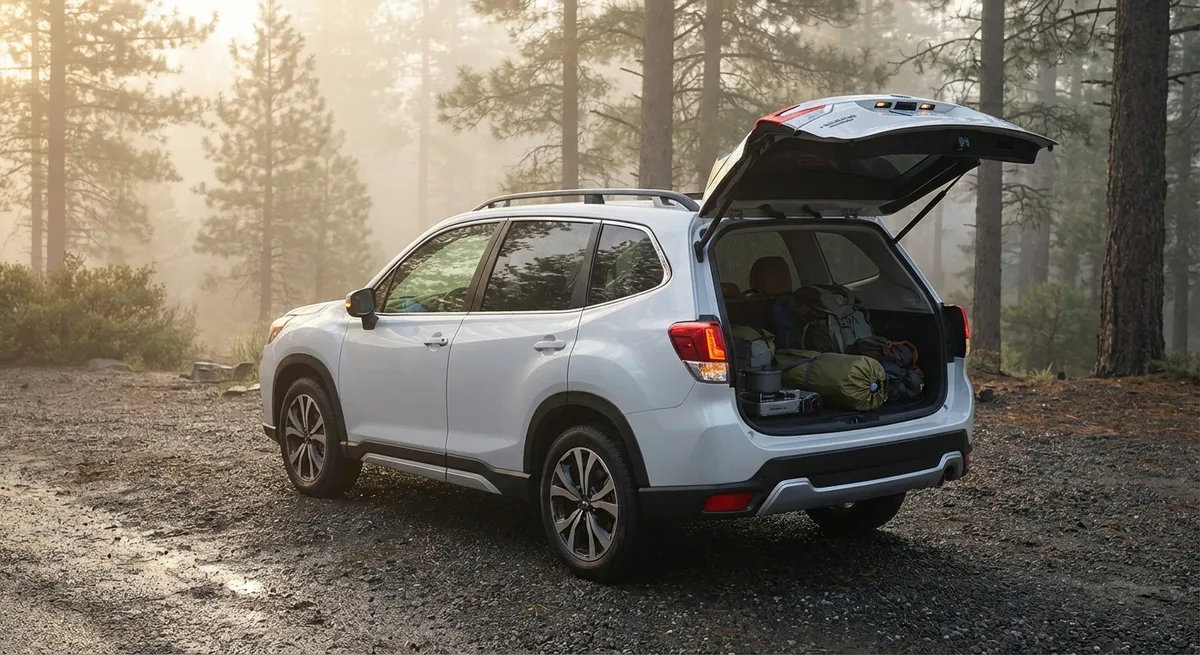
The compact SUV segment is one of the most brutally competitive corners of the market, and Subaru’s Forester has long leaned on practicality and safety rather than flash. For 2025, the Forester Touring doesn’t tear up the playbook—but it sharpens key details that matter to real-world drivers: chassis refinement, driver assistance consistency, cabin quality, and long-term usability. This review focuses on how the 2025 Forester Touring behaves in daily use and on a spirited back road, and why its understated engineering decisions still resonate with buyers who value function over spec-sheet theatrics.
Powertrain and Driving Dynamics: Adequate Power, Excellent Stability
Under the hood, the 2025 Forester Touring continues with Subaru’s familiar 2.5‑liter naturally aspirated flat‑four (Boxer) engine, rated at around 180–185 hp and 176 lb‑ft of torque (final figures vary slightly by market and calibration). On paper, that output looks modest next to turbocharged rivals. In practice, the pairing with Subaru’s Lineartronic CVT and standard symmetrical all‑wheel drive creates a drivetrain that feels predictably responsive at urban and suburban speeds but runs out of breath under heavy load or high‑speed passing.
The flat‑four layout keeps the center of gravity lower than in many upright crossovers using inline‑four engines. That pays off in body control: turn‑in is cleaner than the segment average, and the chassis resists the tall, top‑heavy feeling that plagues some competitors when you string together a series of bends or make an abrupt evasive maneuver. Subaru’s front strut and double‑wishbone rear suspension tuning skews toward comfort, but there’s enough damping discipline that secondary motions—like float and bobbing on freeway expansion joints—are nicely contained.
Steering is electrically assisted and light at parking speeds, with linear weighting as you accelerate. Enthusiasts might wish for more road feel, but the rack is accurate and predictable, which is ultimately what matters in wet, snowy, or gravel conditions. Brake pedal feel is another strong point; the system is easy to modulate in stop‑and‑go traffic and doesn’t suffer from the grabby initial bite some competitors exhibit. Where the Forester Touring falls behind is pure acceleration: merging onto a short freeway ramp with a full load demands planning, and sustained climbs can expose the limits of the naturally aspirated engine as the CVT holds higher revs to maintain pace.
Symmetrical AWD and X‑Mode: Real-World Traction, Not Just Marketing
Subaru’s symmetrical all‑wheel drive is standard across the Forester range and remains a core differentiator. Unlike part‑time or on‑demand systems that primarily drive the front wheels and only send torque rearward once slip is detected, Subaru’s layout maintains a more balanced torque split by default, then rapidly adjusts via the electronically controlled center coupling. This architecture, combined with the Boxer engine’s longitudinal placement and a more linear driveline, contributes to consistent traction when surfaces change abruptly—like transitioning from dry pavement to a patch of wet leaves or packed snow.
The Touring trim includes dual‑mode X‑Mode, providing specific calibrations for snow/dirt and deep snow/mud. These modes alter throttle mapping, transmission behavior, traction control thresholds, and AWD torque distribution to prioritize steady forward progress and wheel control on low‑mu surfaces. On a rough gravel road, X‑Mode helps the CVT avoid the “slipping clutch” feel some drivers dislike by holding more appropriate ratios and preventing over‑eager wheelspin that could dig into soft surfaces.
Ground clearance remains a Forester calling card, typically around 8.7 inches, which is meaningfully higher than many compact SUV rivals. Approach and departure angles won’t turn it into a rock‑crawler, but they do allow you to tackle unpaved fire roads, rutted camp access tracks, and snow‑choked driveways with more confidence. Hill Descent Control, integrated with X‑Mode, automatically manages speed on steep downhills, modulating braking at each wheel to maintain stability even when grip is inconsistent side‑to‑side. For buyers living in four‑season climates or who regularly visit trailheads, the Forester’s traction‑first engineering is more substantial than the light‑duty “AWD” badges on some competitors.
Interior Execution and Space: Function-First With Incremental Refinement
The 2025 Forester Touring doesn’t attempt to dazzle with a radical interior redesign, but it quietly improves materials alignment and perceived quality where previous models felt utilitarian. Soft‑touch surfaces now extend across key touchpoints—upper dash, armrests, and frequently gripped trim pieces—while gloss‑black plastics are kept relatively controlled to minimize fingerprints and reflections. The Touring’s leather upholstery, contrast stitching, and metallic accents elevate the cabin above lower trims, but the overall design language remains clean and practical rather than avant‑garde.
Where the Forester clearly outperforms many compact rivals is packaging. Subaru’s tall greenhouse and thin roof pillars contribute to excellent outward visibility—a major advantage for urban commuting and tight parking maneuvers. Large windows, a low beltline, and upright seating mean the cabin feels airier than the raw dimensions suggest. Front seats offer a wide range of adjustment, with sufficient thigh support and cushioning for long‑distance comfort, though exceptionally tall drivers may wish for a bit more telescoping steering reach.
Rear-seat space is a highlight: adults over six feet can sit behind similarly tall front occupants without knee or head compromise, and the nearly flat rear floor makes the center position more usable. Cargo volume, often near the top of the class, is aided by a square opening, low liftover height, and folding rear seats that create a largely flat load floor. Practical touches—wide‑opening rear doors, available power tailgate with adjustable height, and thoughtful storage bins—reinforce the Forester’s family‑friendly focus. Noise insulation is adequate, with wind noise kept in check and the engine mostly unobtrusive at cruising speeds, though the flat‑four can sound coarse under full throttle as the CVT holds higher revs.
Technology, Infotainment, and Safety: EyeSight as a Daily Companion
Subaru’s latest infotainment suite, depending on market and spec, leverages an 11.6‑inch vertically oriented touchscreen on upper trims like the Touring. The interface organizes climate, audio, and vehicle settings into logically grouped tiles, though there is still a learning curve as frequently used physical buttons have migrated into the screen in some configurations. Responsiveness is generally good, and both Apple CarPlay and Android Auto are supported—often with wireless capability on higher trims—allowing most drivers to bypass Subaru’s native navigation if they prefer Google Maps, Waze, or Apple Maps. Audio quality from the optional premium sound system (often a Harman Kardon setup) is respectable, with clear midrange and acceptable low‑end presence, though not a standout for audiophiles.
Where Subaru continues to invest heavily is in advanced driver assistance. The Forester Touring comes equipped with the latest generation of EyeSight Driver Assist Technology, relying on a stereo camera setup mounted near the rearview mirror to monitor lane markings, traffic, and obstacles. Core functions include adaptive cruise control with lane centering, pre‑collision braking, lane departure warning, and lead vehicle start alert. In daily use, adaptive cruise is smooth and predictable, managing cut‑ins and speed transitions with minimal abruptness once you fine‑tune following distance settings.
The camera‑based system has advantages in object recognition and pedestrian detection, especially at intersections, though it can be more affected by glare, heavy rain, or snowfall than radar‑dominant systems. Subaru has increasingly complemented EyeSight with additional sensors (including optional rear cross‑traffic alert, blind‑spot detection, and reverse automatic braking), yielding a comprehensive safety net in low‑speed maneuvers and congested urban environments. The 2025 Forester is expected to maintain top-tier scores from the IIHS and NHTSA, consistent with Subaru’s safety-focused track record, making it a strong candidate for safety‑conscious families and commuters.
Ownership Value, Efficiency, and Long-Term Appeal
For many buyers, the Forester Touring’s appeal is not about headline performance metrics but about consistent, low‑drama ownership. Fuel economy figures for the naturally aspirated 2.5‑liter with AWD typically land in the high‑20s mpg combined (EPA estimates vary slightly by wheel size and equipment), placing the Forester among the more efficient non‑hybrid AWD crossovers in its class. Real‑world results often match or come close to the official ratings, especially if you avoid prolonged high‑speed driving where the modest powertrain must work harder.
Subaru’s reputation for longevity—particularly of its AWD systems and core drivetrains when properly maintained—remains a selling point. Routine service intervals are straightforward, and parts availability is strong in most regions where Subaru has an established dealer network. Resale values have historically been robust, supported by high demand in used markets that prize winter capability and practicality. The Touring trim’s higher initial price is partially offset by stronger residuals, especially when compared with fully loaded models from brands with steeper depreciation curves.
For enthusiasts, the Forester Touring is not an overtly exciting vehicle in terms of acceleration or handling theatrics. However, there is a different kind of appeal in a machine engineered to quietly excel in the conditions most drivers actually face: rain‑slick commutes, weekend dirt roads, ski trips, and long highway runs with passengers and cargo. The combination of real AWD hardware, generous visibility, generous interior space, and a mature safety suite gives the Forester a clear, rational identity in a field increasingly filled with fashion‑forward crossovers.
Conclusion
The 2025 Subaru Forester Touring represents a careful refinement of a proven formula rather than a radical reinvention. It delivers stable, confidence‑inspiring road manners; genuinely capable all‑wheel drive backed by thoughtful traction modes; a spacious, visibility‑rich cabin; and a comprehensive safety and driver‑assistance suite. Its weaknesses—primarily modest acceleration and a powertrain that can sound strained under heavy load—are unlikely to deter buyers who prioritize capability, comfort, and long‑term usability over outright speed.
For shoppers comparing compact SUVs, the Forester Touring stands out as a rational, engineering‑driven choice. It’s the SUV you buy when you care less about making a statement and more about how a vehicle behaves in bad weather, on rough roads, and over a decade of daily use. If that aligns with your priorities, the 2025 Forester Touring deserves a prominent spot on your short list.
Sources
- Subaru USA – Forester Model Lineup and Specifications - Official specifications, trim details, and feature lists for the current Forester lineup
- IIHS – Subaru Forester Safety Ratings - Comprehensive crash-test results and safety evaluations from the Insurance Institute for Highway Safety
- NHTSA – Subaru Forester Safety Overview - Federal safety ratings and recall information for recent Forester model years (architecture-carryover reference)
- U.S. Department of Energy – Fuel Economy: Subaru Forester AWD - Official fuel economy estimates for the Forester with AWD and 2.5L engine
- Consumer Reports – Subaru Forester Road Test and Reliability - Independent testing data on performance, reliability trends, and owner satisfaction
Key Takeaway
The most important thing to remember from this article is that this information can change how you think about Reviews.