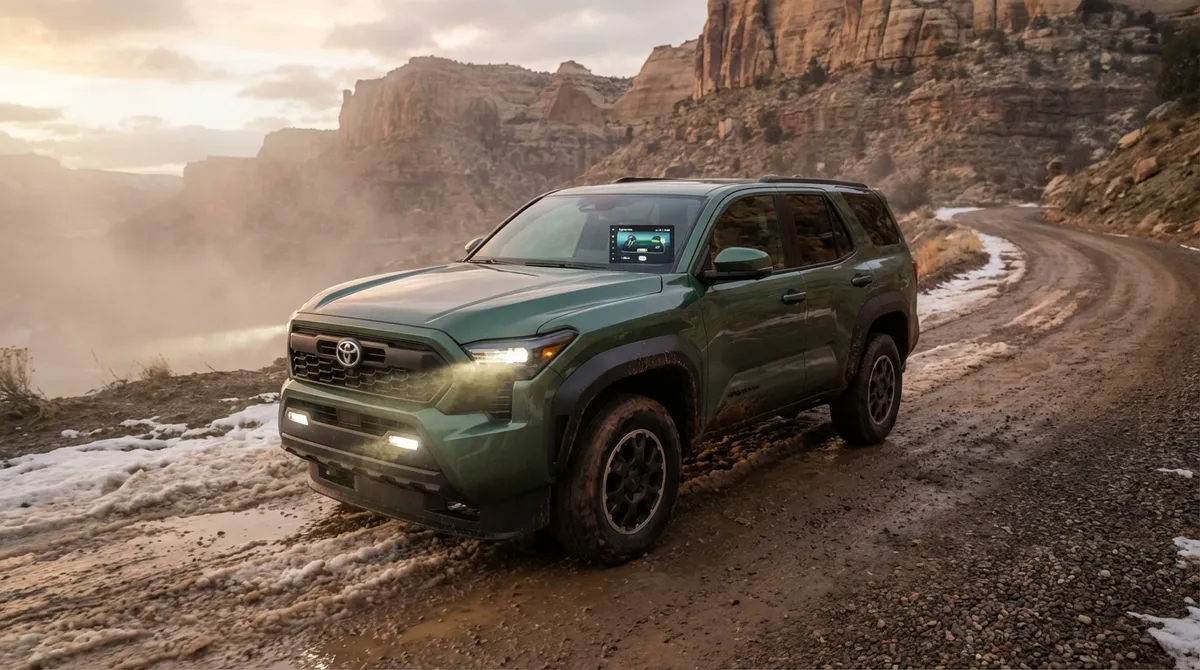
The Toyota 4Runner has long been a holdout for SUV traditionalists—body-on-frame construction, a real transfer case, and an unapologetically rugged character. For 2025, Toyota finally modernizes its off-road icon with a hybrid powertrain, upgraded technology, and a more refined on-road demeanor, all while trying to preserve the trail credibility that built its reputation. This review takes a deep dive into how the 2025 4Runner Hybrid balances efficiency, capability, and everyday usability for buyers who want a genuine SUV in an increasingly crossover-heavy world.
Powertrain and Performance: Turbo-Hybrid Muscle With a Utility Focus
Under the hood, the 2025 4Runner Hybrid swaps the outgoing naturally aspirated V6 for Toyota’s i‑FORCE MAX hybrid system, centered around a turbocharged 2.4‑liter four‑cylinder engine paired with an electric motor and a battery pack integrated under the floor.
The system produces a combined output in the neighborhood of 320–340 horsepower and roughly 450 lb‑ft of torque (figures in line with Toyota’s current hybrid truck/SUV range), channeled through an 8‑speed automatic transmission. Unlike many mild-hybrid setups, the electric motor in the i‑FORCE MAX system provides meaningful low‑speed torque, which is particularly valuable when rock-crawling or pulling away with a loaded trailer.
Response at low RPM is significantly stronger than the previous generation V6, with less need to downshift aggressively for passing or merging. Turbo lag is largely masked by the immediate torque from the electric motor, enabling smoother acceleration from a stop and more confident highway on-ramps. That said, enthusiasts should expect a different character: the linear, naturally aspirated feel is gone, replaced by a more torque-rich but slightly more complex power delivery.
Off-road, the hybrid system is tuned to maintain consistent torque at very low speeds. Paired with a low-range transfer case, crawl control, and multi-terrain select modes, the 4Runner Hybrid remains a serious trail machine rather than just a marketing exercise. The hybrid battery is packaged to preserve ground clearance and approach/departure angles; breather components and key electronics are sealed or elevated to reduce vulnerability in deep water crossings.
Chassis, Suspension, and Off-Road Capability: Traditional Bones, Modern Control
The 2025 4Runner Hybrid continues to ride on a body-on-frame architecture, closely related to the latest Tacoma and Lexus GX platforms. This traditional layout is still favored for serious off-roading and towing due to its durability and resistance to twisting forces. A double-wishbone front suspension and solid rear axle with coil springs remain, but geometry, tuning, and bushing design have been refined to reduce head toss and harshness over broken pavement.
Multiple suspension setups are available depending on trim. Off-road-oriented variants offer features such as:
- Adaptive dampers with multiple drive modes
- Optional front and rear locking differentials
- Skid plates and rock rails
- All-terrain tires with more aggressive sidewalls
- Increased suspension travel and revised bump stops
Toyota’s crawl control and downhill assist systems have been recalibrated to work smoothly with the hybrid powertrain, allowing precise modulation of torque in slow technical sections. On the road, the 4Runner still feels like a truck-based SUV—there is more body motion and steering weight than a unibody crossover—but roll and pitch are better managed than in the outgoing model.
Towing capacity remains competitive, expected in the 5,000–6,000 lb range depending on configuration. The hybrid’s torque advantage makes pulling mid-size trailers and boats more relaxed, but payload and tongue-weight ratings should be checked carefully by buyers planning frequent towing. Importantly, the added mass of the hybrid battery is compensated with reinforced suspension components to keep payload within practical limits.
Efficiency, Range, and Real-World Use: Hybrid Advantages Without Losing Utility
One of the most significant changes for long-time 4Runner fans is fuel economy. The previous V6 model habitually delivered mid-to-high teens mpg in mixed driving. With the hybrid, EPA estimates are expected to land in the low-to-mid 20s mpg combined, with highway numbers potentially touching the high 20s depending on final gearing, tire selection, and aerodynamic tweaks.
In urban environments and stop‑and‑go traffic, the hybrid system shines. Regenerative braking recaptures energy during deceleration, easing wear on physical brake components while boosting efficiency. The ability to glide at low speeds on electric assistance alone—particularly in parking lots or slow-moving traffic—adds a smoothness that traditional 4Runner owners won’t be used to.
For long-distance adventurers, total range on a full tank improves noticeably, reducing fuel stops on highway road trips or remote overlanding routes. Buyers should note that off‑road consumption can still be high, especially in low range or on steep grades where hybrid assist is limited by traction, but the baseline efficiency advantage over a non-hybrid V6 remains.
Cold-weather performance and battery management are handled by a dedicated thermal control system. In extreme climates, the hybrid may rely more on the gasoline engine to maintain performance and cabin heat, slightly reducing efficiency gains. However, Toyota’s extensive hybrid experience (Camry, Prius, RAV4, Highlander) suggests robust reliability for the 4Runner system based on proven architecture, albeit adapted for higher torque and heavier loads.
Interior, Technology, and Practicality: Modern Cabin Meets Old-School Layout
Inside, the 2025 4Runner Hybrid finally feels like it belongs in the current decade. The dashboard design is more horizontal and cleanly integrated, with higher-quality materials, better switchgear, and noticeably improved sound insulation. Yet Toyota has deliberately preserved physical controls for critical functions—large knobs for climate, tactile buttons for four‑wheel-drive modes, and hard keys for off‑road features—making operation easier with gloves or in rough terrain.
Key interior highlights include:
- A large central touchscreen (typically 12+ inches on higher trims) with Toyota’s latest infotainment system, supporting wireless Apple CarPlay and Android Auto
- A fully digital or hybrid analog/digital instrument cluster, configurable to show off‑road data such as pitch/roll, differential lock status, and power flow for the hybrid system
- Multiple USB‑C ports and 12V outlets in both rows, plus an available 110V household-style outlet in the cargo area
- Improved seat ergonomics with longer cushions and better lateral support, especially in off‑road and sportier trims
Cargo space remains a strength. The squared-off rear design and relatively tall roofline provide generous volume for gear, pets, or overlanding setups. Split-folding rear seats enable flexible load configurations, and some trims offer an available power tailgate or sliding cargo floor. The hybrid battery is located to minimize intrusion into cargo capacity, though under-floor storage may be reduced in some layouts.
Practical buyers will appreciate numerous small details: rubberized storage shelves, large door pockets sized for water bottles, and available washable floor mats and cargo liners. Noise levels at highway speed are improved, thanks to additional insulation and better door seals, but the upright body and off-road-ready tires still create more wind and road noise than car-based crossovers.
Safety, Driver Assistance, and Ownership Outlook: Tech-Forward but Still Driver-Focused
The 2025 4Runner Hybrid comes standard with a full suite of Toyota Safety Sense driver-assistance technologies. While exact feature lists vary by trim, core systems include:
- Forward collision warning with pedestrian and cyclist detection
- Automatic emergency braking
- Lane departure alert with steering assist
- Adaptive cruise control with stop-and-go capability
- Road sign recognition in some trim levels
Higher trims may add blind-spot monitoring, rear cross-traffic alert, a 360‑degree camera system with off-road underbody views, and enhanced parking assist features. Crucially for enthusiasts, Toyota has so far favored tuning these systems to be assistive rather than intrusive—lane keeping is generally gentle, and adaptive cruise can be easily tailored or deactivated.
From an ownership perspective, warranty coverage and expected reliability are strong selling points. Toyota typically backs its hybrids with separate coverage on hybrid components (such as battery and electric motor) beyond the standard powertrain warranty. Scheduled maintenance intervals remain straightforward, with oil changes, fluid checks, and standard inspections comparable to non-hybrid models.
Resale value is another key concern for buyers. The previous 4Runner was famous for holding its value exceptionally well, driven by demand from off-road and overlanding communities. The introduction of hybrid technology presents a new variable, but Toyota’s track record in hybrid reliability and broad market acceptance of hybrid SUVs like the RAV4 and Highlander suggests that long-term residual values should remain strong, particularly for well-equipped off-road trims.
For shoppers, the 4Runner Hybrid fills an increasingly rare niche: a genuine, ladder-frame SUV with serious trail hardware, now made more liveable and efficient with hybrid power. Enthusiasts focused purely on analog driving feel may miss the simplicity of the old V6, but for most real-world buyers who split their time between city commutes, weekend trails, and family road trips, the 2025 4Runner Hybrid represents a thoughtful evolution rather than a departure from its roots.
Conclusion
The 2025 Toyota 4Runner Hybrid marks a pivotal moment for one of the last traditional SUVs standing. By combining a robust body-on-frame platform, true off-road hardware, and a torque-rich hybrid powertrain, Toyota has crafted a package that speaks to both long-time 4Runner loyalists and a new generation of buyers who expect efficiency and advanced tech as standard. It’s not a soft crossover and doesn’t try to be—ride quality, steering, and cabin character still clearly reflect its truck-based DNA.
For car enthusiasts and serious shoppers, the real story lies in how well the hybrid system integrates with the 4Runner’s mission. In daily driving, it delivers better fuel economy and stronger low-end torque; on the trail, it retains the mechanical tools and durability that enthusiasts demand. If you’ve been waiting for a 4Runner that can tackle both the weekday grind and remote backcountry routes with fewer fuel stops and more refinement, the 2025 Hybrid is the most compelling version yet—and a sign that rugged SUVs can adapt to a more efficient future without abandoning what made them icons in the first place.
Sources
- Toyota USA – Hybrid Vehicles Overview - Official information on Toyota’s hybrid systems, warranty coverage, and technology philosophy
- Toyota Global Newsroom – i-FORCE MAX Powertrain Details - Technical releases and engineering insights on Toyota’s turbo-hybrid truck/SUV powertrains
- U.S. Department of Energy – Fuel Economy and Hybrids - Explains how hybrid systems improve efficiency, regenerative braking, and real-world fuel economy factors
- IIHS – Vehicle Safety Ratings and Crash Test Information - Provides safety ratings and crash-test data for body-on-frame SUVs and comparable models
- Consumer Reports – Hybrid SUVs Reliability and Ownership Trends - Independent analysis of hybrid SUV reliability, ownership costs, and long-term durability
Key Takeaway
The most important thing to remember from this article is that this information can change how you think about Reviews.