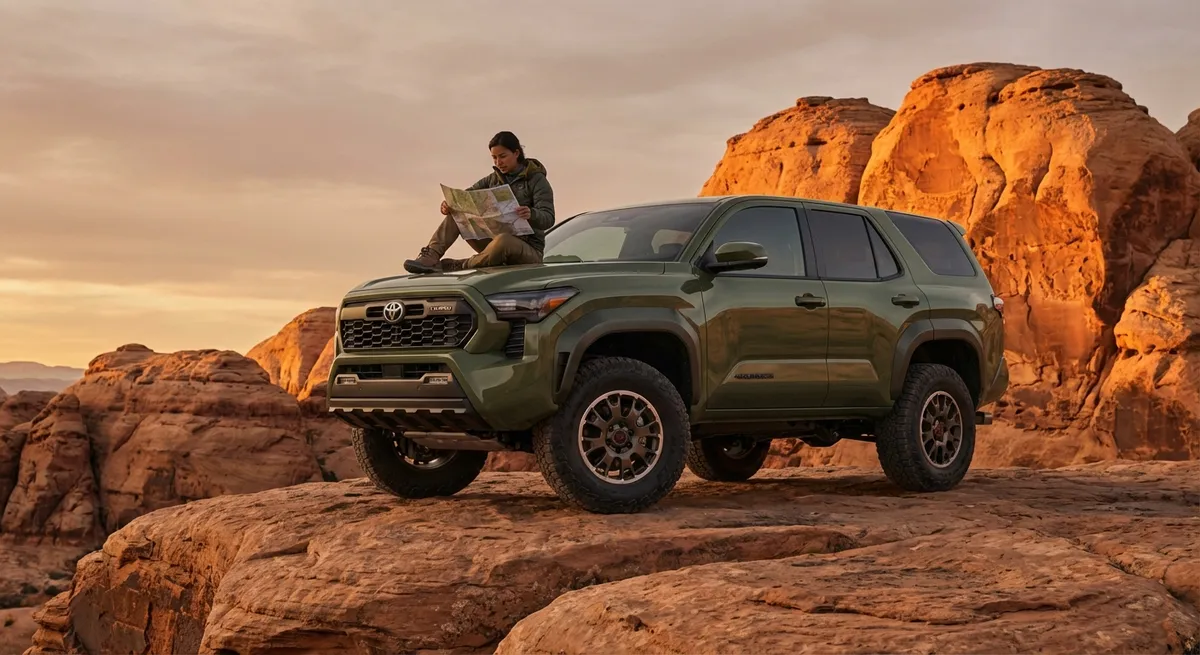
The Toyota 4Runner has been the default answer for buyers wanting a body-on-frame SUV that can take real abuse, carry a family, and outlast multiple owners. For 2025, Toyota finally moves this icon onto the modern TNGA-F platform, adds a turbocharged four-cylinder, and layers in technology it has historically lagged on. This review walks through how the new 4Runner actually drives, what’s changed structurally, and where it still stands out—or falls behind—versus modern SUVs. If you’re cross-shopping everything from crossovers to Bronco and Wrangler, the details below are where the 4Runner makes its case.
Platform & Chassis: Old-School Bones, New-Generation Refinement
The 2025 4Runner now rides on Toyota’s TNGA-F body-on-frame architecture, shared with the latest Tacoma, Tundra, Sequoia, Land Cruiser, and Lexus GX. This is not a cosmetic update—it fundamentally changes how the SUV rides, handles, and manages loads.
The boxed steel frame is significantly stiffer than the outgoing truck-based chassis, improving torsional rigidity and giving the suspension a more stable foundation. That stiffness lets Toyota soften spring and damper rates without losing control, so you’ll notice reduced body shudder over potholes and washboard dirt roads compared to the previous generation. At the same time, the ladder-frame layout preserves the 4Runner’s key advantages for hardcore use: body-on-frame isolation from impacts, robust tow and recovery points, and compatibility with traditional off-road hardware like skid plates, rock sliders, and long-travel suspension kits.
Wheelbase and track are modestly revised to improve stability but not so stretched that breakover angle is compromised. The rear retains a solid axle with coil springs, chosen for durability, articulation, and predictable behavior under load. Higher trims introduce advanced hardware—like available adaptive dampers and Toyota’s KDSS-style sway-bar tech on certain off-road variants—to balance on-road cornering control with loosened articulation off-pavement.
From a practical standpoint, this platform is built to carry weight. Whether that’s a full camping setup, rooftop tent, steel bumpers, or a small trailer, the 4Runner’s frame and rear axle are engineered around sustained load, not just peak numbers on a spec sheet. Enthusiasts who plan to keep the SUV past 150,000 miles will appreciate that Toyota continues to prioritize overbuilding core structural components.
Powertrain & Drivability: Turbo Torque Replaces V6 Tradition
Under the hood, the 4Runner leaves behind its naturally aspirated 4.0L V6 and adopts a 2.4L turbocharged four-cylinder, similar to what Toyota runs in the Tacoma and other TNGA-F vehicles. In standard form (exact output can vary slightly by market and trim), the engine delivers power and especially torque that rival or exceed the outgoing V6, but at lower rpm. That matters when merging, towing, or crawling off-road, where accessible torque is more important than peak horsepower.
The turbo engine is paired with an eight-speed automatic transmission, a major step up from the old five-speed. The wider ratio spread allows shorter lower gears for better off-the-line response and climbing, with taller top gears to keep revs low on the highway. Gear spacing is closer and smarter, which reduces hunting on grades and makes the truck feel less strained under moderate throttle. Toyota tends to prioritize durability over lightning-fast shifts, but the calibration is noticeably more modern and less “slushy” than before.
From behind the wheel, the turbo’s character is defined by midrange grunt. A light prod of the throttle delivers meaningful acceleration, thanks to boost coming on early, but you do feel a different character than the linear, always-on V6. Enthusiasts will want to pay attention to how Toyota tunes throttle mapping in different drive modes—Off-Road, Sport, Normal, and Eco—because turbo engines can feel touchy or laggy if calibration isn’t careful. In low-range four-wheel drive, the combination of low gearing and turbo torque yields confident rock crawling, with the transmission keeping revs in the sweet spot.
Fuel economy is improved relative to the older V6, especially on highway cruises, but buyers should remember that heavy loads, aggressive tires, and roof racks will still hurt real-world numbers. Turbocharged engines can be efficient when driven gently, but they’ll consume fuel quickly under sustained boost. For most buyers, the trade-off—stronger midrange torque, better towing performance, and quieter cruising—is worth the shift away from a big naturally aspirated six.
Off-Road Hardware & Capability: More Than an Appearance Package
The 4Runner’s calling card has always been genuine off-road competence, and the 2025 model doubles down with both mechanical hardware and electronic aids that go beyond simple “rugged” styling cues.
Mechanically, you still get a traditional two-speed transfer case on 4WD models, with low range for serious off-road work. Selected trims add a locking rear differential, critical for maintaining traction when a wheel is in the air or on loose rock. Suspension travel is generous for a factory SUV, with approach and departure angles tuned to clear rocks, ruts, and steep trail transitions. Ground clearance remains competitive, and key underbody components are routed and protected to avoid snagging.
On specialized off-road trims (often labeled TRD or equivalent), you get additional hardware like off-road-tuned shocks, optional remote-reservoir dampers, more aggressive all-terrain tires, and skid plates protecting the front, transfer case, and sometimes fuel tank. These trims also typically widen the track slightly, aiding stability on side slopes and at higher desert-running speeds. The suspension is tuned to control body motions on washboard and high-frequency impacts but still allow enough compliance for slow-speed articulation.
Electronics now play a big role. Toyota’s Multi-Terrain Select adapts traction control, throttle, and wheel-slip behavior to specific surfaces like mud, sand, or rock. Crawl Control acts like a low-speed cruise control for technical terrain, modulating throttle and brakes to maintain a set speed so the driver can focus on steering. Hill descent assist further helps maintain composure on steep declines. While some purists prefer a fully analog driving experience, these systems are especially useful for newer off-roaders or when fatigue sets in after hours on the trail.
Critically, none of this feels tacked on. The 4Runner remains a body-on-frame SUV with a mechanical 4WD system at its core; the electronics are layered over a fundamentally capable package. That sets it apart from crossovers that rely almost entirely on software to mask the limitations of front-biased, slip-and-grip all-wheel-drive systems with limited ground clearance.
Interior, Tech & Everyday Usability: Rough-Road DNA Meets Modern Cabin
Step inside the 2025 4Runner and you’ll notice a substantial leap in cabin design and technology over the outgoing model, which was showing its age. The dashboard architecture follows Toyota’s newer truck style, with a horizontal layout, large physical controls, and a focus on function first—but now accompanied by materials and screens that feel current rather than utilitarian.
Central to the experience is Toyota’s latest touchscreen infotainment system, available in large formats (exact size depends on trim). It supports wireless Apple CarPlay and Android Auto, over-the-air updates, and improved voice recognition. The interface is quicker and sharper than the old Entune-based systems, with menus designed to be readable at a glance. Importantly for SUV buyers, there are still hard buttons and knobs for critical functions like climate and volume, so dusty fingers or gloves remain workable.
Seating ergonomics are improved with better adjustability, more lateral support, and more thoughtful cushioning for long drives. Higher trims offer heated and ventilated front seats, leather or SofTex upholstery, and memory settings. Rear-seat space is competitive, with enough knee and headroom for adults, and the squared-off roofline preserves usable space for child seats and tall passengers. Depending on configuration, some markets may retain an optional third row, but even in two-row versions, the emphasis is on a cargo area that is wide, flat, and accessible.
Road noise and vibration are noticeably reduced thanks to improved body sealing, more sound-deadening, and the stiffer TNGA-F platform. While it still feels like a truck-based SUV—especially over sharp impacts—the 4Runner is now much more relaxed at 70+ mph cruising. Wind and tire noise levels are closer to what mid-size crossover buyers would accept, making daily commuting and long road trips more pleasant.
Safety tech is also brought up to current standards. Toyota Safety Sense (TSS) equips the 4Runner with forward collision warning, automatic emergency braking, lane departure alert, adaptive cruise control, and various driver-assist aids. Off-roaders may worry about false interventions, but Toyota generally allows configurable sensitivity or partial shutdown of some systems when trails demand full driver control. Overall, the cabin now matches the 4Runner’s price point and positioning far better than before, without abandoning the durability and straightforward layout that long-time owners appreciate.
Towing, Payload & Real-World Ownership: Built for Work and Weekends
Beyond spec-sheet glamour, SUV buyers care about what their vehicle can actually do day-to-day—tow a boat, haul camping gear, manage winter conditions, and survive years of hard use. This is where the 4Runner’s truck-derived engineering continues to pay dividends.
Towing capacity is set to remain competitive within the mid-size body-on-frame segment. The turbocharged engine’s torque curve, combined with the new eight-speed transmission, lends confidence when pulling a trailer near the rated limit. The stiffer platform and robust rear axle design also contribute to better stability under load. Factory towing packages typically include an integrated receiver hitch, wiring harnesses, and often upgraded cooling, giving buyers a turnkey solution for recreational towing.
Payload—how much weight the vehicle can safely carry in passengers and cargo—is another strength. The 4Runner is engineered to comfortably manage the mass of full occupants, luggage, and accessories like bike racks, roof boxes, or recovery gear. Important for enthusiasts is how the SUV handles when loaded: the suspension tuning and frame rigidity mean the 4Runner remains composed and doesn’t feel overwhelmed when packed for a long overlanding trip. That’s an area where many crossovers, despite attractive tow ratings, begin to feel unsettled.
Long-term ownership is where Toyota traditionally excels. The brand’s body-on-frame trucks and SUVs have a reputation for crossing 200,000+ miles with consistent maintenance, and the 4Runner’s components draw from that parts bin. The move to a turbo engine will shift how some owners think about longevity—turbochargers, direct injection systems, and emissions components add complexity—but Toyota’s track record with similar powertrains in other models is encouraging. Regular oil changes with the proper grade, fuel from reputable stations, and adherence to maintenance schedules become more critical.
Finally, modification potential remains high. The ladder frame, solid rear axle, and traditional 4WD layout make the 4Runner a favorite for aftermarket suspension kits, armor, bumpers, winches, and overlanding builds. The new platform shares much with other TNGA-F trucks, which should accelerate the availability of lift kits, skid plates, and performance parts. For buyers who see their SUV as a long-term platform to build on, the 2025 4Runner is engineered with that ecosystem in mind.
Conclusion
The 2025 Toyota 4Runner doesn’t abandon its core identity. It is still a body-on-frame SUV designed to handle serious off-road work, regular towing, and years of hard use. What has changed is the refinement layer: a modern turbocharged powertrain, a significantly more sophisticated chassis, a quieter and more comfortable interior, and up-to-date safety and infotainment technology.
For shoppers who have been debating whether to jump to a crossover for comfort or stay with a traditional SUV for capability, the new 4Runner narrows that gap more than any previous generation. It won’t be the right answer for everyone—its truck-like nature and likely fuel economy will still deter some buyers—but for enthusiasts and practical owners who value durability, off-road composure, and a strong aftermarket community, this new iteration keeps the 4Runner firmly in the conversation as one of the most compelling adventure-ready SUVs on sale.
Sources
- [Toyota Global Newsroom – TNGA-F Platform Overview](https://global.toyota/en/newsroom/toyota/36428992.html) – Technical background on Toyota’s body-on-frame architecture used by the 4Runner and related models
- [Toyota USA – 4Runner Official Site](https://www.toyota.com/4runner/) – Manufacturer specifications, trims, and feature summaries for the current 4Runner
- [IIHS – Vehicle Safety Ratings](https://www.iihs.org/ratings) – Crash-test data and safety technology evaluations for mid-size SUVs, including truck-based models
- [U.S. Department of Energy – Fuel Economy](https://www.fueleconomy.gov/) – Official fuel economy ratings and comparisons for SUVs and light trucks
- [Consumer Reports – Car Reliability & Owner Satisfaction](https://www.consumerreports.org/cars/) – Long-term reliability trends and owner feedback for Toyota SUVs and competing models
Key Takeaway
The most important thing to remember from this article is that this information can change how you think about Reviews.