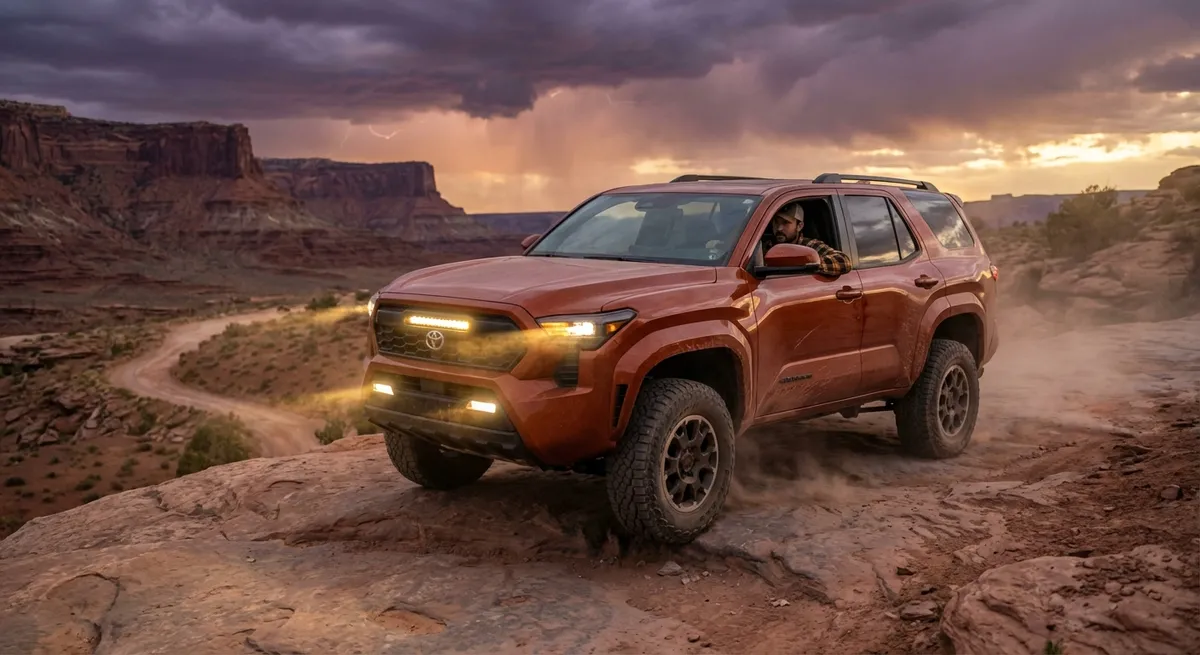
Toyota’s 4Runner returns for 2025 as one of the last body-on-frame SUVs that still unapologetically prioritizes durability and off‑road capability. In a market crowded with car‑based crossovers, the 4Runner stands out as a truck‑derived SUV that appeals to enthusiasts, overlanders, and buyers who want a machine built to take abuse far beyond paved roads. This review walks through the details that matter to serious shoppers: platform, powertrain, real off‑road hardware, on‑road behavior, and ownership realities.
Platform, Chassis, and What “Body-on-Frame” Really Buys You
The 2025 4Runner rides on Toyota’s TNGA‑F body‑on‑frame architecture, the same global truck platform underpinning the latest Tacoma, Tundra, Land Cruiser, and Lexus GX. That alone tells you a lot about how this SUV is engineered and where it’s meant to be used.
Unlike a unibody crossover (where the body and frame are one structure), the 4Runner uses a separate fully boxed steel ladder frame with the body mounted on top. This brings several real‑world advantages for enthusiasts and adventurers:
- Torsional durability under load: A separate frame is better suited to handle point loads from tow hitches, winch bumpers, recovery points, and roof racks with rooftop tents. The TNGA‑F frame uses high‑strength steel and multiple crossmembers to resist twist when one wheel is compressed and another is drooping off‑road.
- Damage tolerance and repairability: If you bend a crossmember on a trail or crunch a rocker panel, a body‑on‑frame layout is generally easier (and more economical) to repair or replace structural elements versus a unibody shell.
- Real payload with accessories: With many buyers adding steel skid plates, rock sliders, full‑length roof racks, and drawer systems in the cargo area, the 4Runner’s truck‑like structure is engineered to take that extra static and dynamic weight with less compromise.
- Traditional rear‑drive proportions: The long hood, generous front overhang, and robust rear axle packaging are a direct result of the longitudinal engine and frame‑mounted drivetrain layout. This supports proper low‑range gearing and differential options that many crossovers simply can’t offer.
Suspension remains traditional for the segment: independent double‑wishbone front and a solid rear axle with coil springs. Enthusiasts will care that the rear axle uses a multi‑link locating setup, which improves ride and articulation relative to older leaf‑spring designs while still preserving simplicity and strength.
Powertrain and Drivetrain: Turbocharged Muscle with Real 4x4 Hardware
For 2025, the naturally aspirated V6 is gone, replaced by a 2.4‑liter turbocharged four‑cylinder shared with the latest Tacoma. In most trims, this “i‑FORCE” engine produces around 278 hp and 317 lb‑ft of torque, routed through an 8‑speed automatic transmission. While some purists will miss the V6’s character, the new powertrain offers several clear advantages:
- Torque curve: Peak torque arrives lower in the rev range compared with the old V6, which pays dividends when climbing, towing, or crawling at low speed. Real‑world drivability—especially with a loaded vehicle—is significantly improved.
- Gear spread and control: The 8‑speed auto provides shorter first and second gears for better launch and off‑road crawl, while taller top gears reduce engine speed at highway cruise. For long highway drives to trailheads, this improves refinement and fuel economy.
- Available hybrid boost (i‑FORCE MAX): On higher trims, an optional hybridized version pairs the turbo four with an electric motor and battery pack, pushing system output into the 320+ hp and 450+ lb‑ft range (figures vary slightly by market and final calibration). This setup can deliver diesel‑like low‑rpm shove, which is ideal for steep grades, sand, or deep mud.
Drivetrain is where the 4Runner separates itself from soft‑roaders:
- Part‑time 4WD: Most trims offer a traditional 2H/4H/4L system with a two‑speed transfer case. This is the configuration enthusiasts tend to prefer for its mechanical simplicity and ability to run rear‑wheel drive on dry pavement.
- Full‑time 4WD (select trims): Certain premium trims add a Torsen limited‑slip center differential, allowing full‑time all‑wheel drive on‑road while retaining low‑range capability off‑road. This is optimal for buyers in snowy climates who drive in mixed traction conditions for months at a time.
- Locking rear differential: TRD Off‑Road and TRD Pro models include a driver‑selectable rear locker. When engaged, it forces both rear wheels to rotate at the same speed, dramatically enhancing traction in rock, mud, or off‑camber situations where one wheel might hang in the air.
- Crawl Control and multi‑terrain modes: Electronically managed driving aids automatically modulate throttle and brakes in low‑range situations, letting the driver focus on line choice without worrying about stalling or wheelspin. Enthusiasts still have full manual control, but these systems lower the skill barrier for newer off‑roaders.
From a buyer’s perspective, the key is matching driveline to use case. If you rarely leave the pavement, the base powertrain and part‑time system will suffice. If you plan serious off‑road trips, the presence of a real low range, locker, and robust gear ratios becomes non‑negotiable.
Real Off-Road Capability: Angles, Hardware, and Heat Management
On paper, the 4Runner is engineered as a legitimate off‑roader; in practice, the details are what matter. Toyota backs up the marketing with specific design decisions targeted at trail use.
- Approach, departure, and breakover angles: Depending on trim and tire size, approach angles sit in the mid‑30‑degree range, with departure and breakover slightly lower but still competitive. TRD Pro and off‑road‑focused trims gain more favorable numbers thanks to unique bumpers and slightly increased ride height. These angles dictate how steep an obstacle you can approach or leave without scraping the bumpers or getting high‑centered.
- Ground clearance and underbody protection: Ground clearance is typically in the 9–10‑inch range, but more important is how Toyota protects vulnerable components. Off‑road trims include skid plates over the engine, front differential, and transfer case. Enthusiasts should note the routing of fuel and brake lines and the placement of the exhaust—Toyota consciously tucks critical hardware above the lowest frame members to minimize snag potential.
- Cooling and heat management: Sustained low‑speed climbs, sand driving, and high‑altitude towing generate considerable thermal load. Toyota leverages the TNGA‑F platform’s airflow management, improved radiator capacity, and separate transmission coolers on select trims to keep temperatures in check. This matters if you plan long overland trips at GVWR in hot environments.
- Tires and wheel specs: Factory fitment on volume trims is still conservative—typically all‑season or mild all‑terrain tires in the 17–20 inch wheel range. TRD trims move to more aggressive all‑terrain rubber with stronger sidewalls. Enthusiasts will appreciate that wheel offsets and fender clearances are conducive to upsizing to 32–33 inch tires with minimal modification, although pushing beyond that often requires trimming or aftermarket suspension.
- Articulation and traction management: The solid rear axle and multi‑link rear suspension allow good articulation relative to independent rear setups. Paired with modern traction control algorithms, the 4Runner can keep momentum in low‑traction scenarios even before engaging the rear locker. For rock‑heavy terrain, the combination of a low crawl ratio, locker, and suspension travel gives the 4Runner a substantial edge over most crossovers.
If your priorities are overlanding, remote camping, or serious trail exploration, these hardware choices translate into less drama, fewer recovery situations, and more confidence when venturing far from services.
On-Road Behavior, Cabin Experience, and Everyday Usability
While the 4Runner’s off‑road chops are undeniable, most owners still spend the majority of their time on pavement. Here the 2025 model makes notable strides without pretending to be something it’s not.
Ride and handling:
- The TNGA‑F chassis is appreciably stiffer than the outgoing frame, which helps reduce flex‑induced squeaks and rattles over time and provides a more refined baseline ride.
- Coil‑spring solid rear axles can’t fully match the composure of independent rear suspensions, but tuning and longer control arms help mitigate head toss and hobby‑horse motions. TRD models with off‑road‑oriented shocks (such as Fox or Bilstein) strike a balance between impact absorption on rough surfaces and body control at speed.
- Steering feel remains on the heavier, slower side compared with crossovers, which actually suits the 4Runner’s personality and gives a sense of stability at highway speeds and on gravel.
Noise, vibration, and harshness (NVH):
- Additional sound deadening, better door seals, and more refined powertrain mounts make the 2025 4Runner quieter than its predecessor.
- The turbo four is more audible when worked hard compared with the old naturally aspirated V6; buyers prioritizing refinement over character will prefer the hybrid’s smoother torque delivery and lower engine speeds under load.
Interior and tech:
- The cabin layout favors large, glove‑friendly physical controls for drive modes, climate, and off‑road systems—an advantage when bouncing down a washboard trail.
- Higher trims benefit from a large central touchscreen with Toyota’s latest infotainment software, wireless Apple CarPlay/Android Auto, and over‑the‑air update capability.
- Seating comfort is improved with better bolstering and a more supportive second row. A third row is available on select trims but is best viewed as emergency or child seating rather than adult‑friendly long‑distance accommodation.
- Cargo area packaging remains a strong point. The near‑vertical tailgate and boxy roofline maximize usable volume; with the third row folded (or absent), the load floor accommodates bulky camping gear, recovery tools, and fridge slides without awkward tapering.
For a daily driver, the main trade‑offs are fuel consumption and maneuverability compared with smaller crossovers. In return, you get a driving position and sense of solidity that many buyers still find reassuring and enjoyable.
Ownership, Reliability Expectations, and Who the 4Runner Really Suits
Toyota’s reputation for truck‑based durability is a major part of the 4Runner’s appeal, and the 2025 model is designed to continue that legacy while integrating more complex technology.
Reliability and maintenance:
- The turbocharged 2.4‑liter engine and hybrid system are newer in the 4Runner but already fielded across multiple Toyota trucks, which accelerates real‑world testing and issue resolution.
- Turbo and hybrid components add complexity—high‑pressure fuel systems, intercoolers, power electronics, and battery packs—but Toyota generally engineers these with conservative outputs and extensive validation.
- Routine maintenance remains straightforward: conventional oil change intervals, easily accessible filters, and durable driveline components built to support off‑road use. Proper service on differentials, transfer case, and transmission is critical for long‑term reliability, especially for heavy off‑road or towing use.
Fuel economy and range:
- The turbo four’s efficiency is better than the old V6, but this is still a tall, heavy, truck‑framed SUV with off‑road‑capable tires; don’t expect crossover‑like consumption.
- The hybrid variant offers tangible gains, especially in mixed city driving and low‑speed use, where electric assist reduces fuel burn. For overlanders, that translates to extended range from the same tank size—an important factor when traveling in remote areas with limited fuel availability.
Resale and aftermarket ecosystem:
- Historically, the 4Runner has enjoyed exceptionally strong resale values, often outpacing the segment average. Enthusiasts appreciate the platform’s longevity, and demand for used examples has stayed high.
- The aftermarket support ecosystem—lifts, armor, bumpers, roof systems, drawers, lighting—is among the deepest of any SUV. Buyers looking to build a personalized overland or rock‑focused rig will find nearly every component available off the shelf.
Who it suits best:
- Buyers who prioritize long‑term durability, off‑road credibility, and modification potential over maximum on‑road comfort and fuel savings.
- Enthusiasts planning multi‑day trail trips, dispersed camping, and backcountry travel where recovery services are scarce.
- Families who want a rugged, “forever truck” SUV and are comfortable with the compromises that come with that mission.
If you spend 95% of your time in the city and want something that drives like a car, a unibody crossover is likely a better fit. If your weekends involve topo maps, recovery gear, and remote destinations, the 2025 4Runner is exactly the sort of tool you want in your driveway.
Conclusion
The 2025 Toyota 4Runner is not trying to be all things to all people—and that’s precisely its strength. Built on a shared truck platform, equipped with modern turbo and hybrid powertrains, and backed by serious four‑wheel‑drive hardware, it delivers genuine off‑road capability and long‑term ruggedness in a market increasingly tilted toward comfort‑first crossovers. For buyers who see their SUV as both daily transport and a long‑range adventure partner, the latest 4Runner offers a compelling blend of tradition and modernity, with a depth of engineering that still resonates strongly with enthusiasts.
Sources
- [Toyota USA – 2025 4Runner Overview](https://www.toyota.com/upcoming-vehicles/4runner/) – Official product information, engine options, trim details, and feature highlights
- [Toyota Global – TNGA‑F Platform Technical Overview](https://global.toyota/en/newsroom/toyota/35309539.html) – Background on the shared truck architecture underpinning 4Runner, Tacoma, Tundra, and Land Cruiser
- [IIHS – SUV and Pickup Truck Crashworthiness Research](https://www.iihs.org/iihs/topics/t/suvs) – Independent safety and structural context for SUVs and truck‑based platforms
- [U.S. Department of Energy – Fuel Economy of Light‑Duty Trucks](https://www.fueleconomy.gov/feg/findacar.shtml) – Official EPA fuel‑economy data and comparison tool for SUVs and trucks
- [Consumer Reports – Vehicle Reliability and Owner Satisfaction](https://www.consumerreports.org/cars/) – Long‑term reliability trends and survey data for Toyota body‑on‑frame SUVs and trucks
Key Takeaway
The most important thing to remember from this article is that this information can change how you think about Reviews.