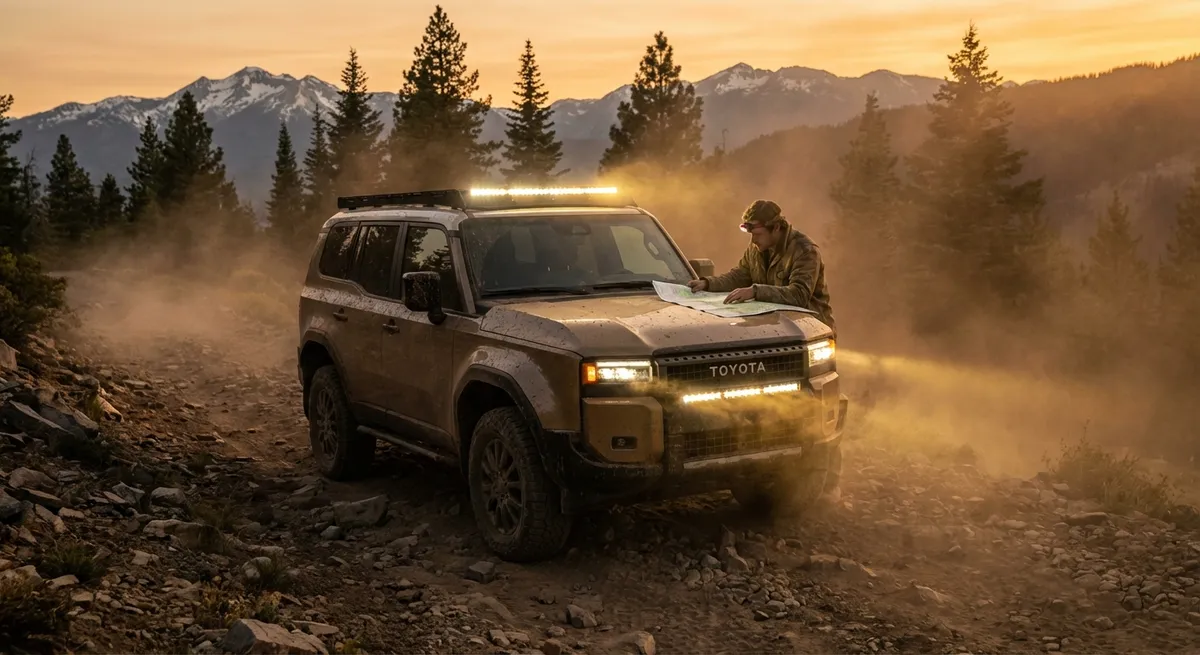
The Land Cruiser nameplate returns to North America for 2025 with a very different mission. Once a V8-powered luxury flagship, it’s now a mid-size, turbo-hybrid 4x4 positioned closer to the off-road mainstream—but still trading heavily on Toyota’s reputation for durability. For SUV shoppers cross-shopping everything from the Ford Bronco to the Jeep Wrangler to three-row crossovers, the 2025 Land Cruiser is a pivotal model: it blends classic body-on-frame toughness with modern electrified power and safety tech. This review focuses on what matters most to enthusiasts and buyers: real-world usability, off-road capability, efficiency, tech, and long-term value.
Chassis & Off-Road Hardware: Old-School Bones, New-School Control
The 2025 Land Cruiser rides on Toyota’s TNGA-F body-on-frame architecture, the same basic platform underpinning the new Tacoma and Tundra. This matters because body-on-frame construction typically offers superior durability and better isolation from bumps compared with unibody crossovers, especially under towing and off-road stress. The ladder frame is boxed and heavily reinforced at key points, which increases torsional rigidity and improves steering precision over the outgoing 200 Series while helping reduce NVH (noise, vibration, harshness).
A full-time 4WD system with a center locking differential is standard across the range, a key differentiator from many midsize SUVs that either use part-time 4WD or front-biased AWD systems designed primarily for on-road use. The Land Cruiser also features a low-range transfer case (2-speed), with a crawl ratio suitable for technical off-roading, particularly when combined with first gear in the 8-speed automatic. Select trims add a rear locking differential, which dramatically improves traction when diagonal wheels lift or lose grip on rocks, deep ruts, or loose surfaces.
Suspension is a double-wishbone setup in front and a multi-link solid rear axle in back. While some competitors move to independent rear suspensions for ride comfort, Toyota’s choice of a live axle in the rear prioritizes articulation, load-carrying capacity, and durability. Approach, breakover, and departure angles are competitive in the class, and underbody skid plates protect critical components such as the engine oil pan and transfer case. For enthusiasts, the key takeaway is that this Land Cruiser retains “real 4x4” fundamentals despite being downsized and electrified.
Powertrain & Performance: Turbo-Hybrid Torque with Real-World Benefits
All 2025 Land Cruiser models sold in North America are powered by Toyota’s i-Force Max 2.4-liter turbocharged four-cylinder hybrid system. On paper, output of roughly 326 hp and 465 lb-ft of torque might not sound radical next to V6 and V8 rivals, but the character of this setup is different—and in many situations, more useful. The electric motor is integrated into the 8-speed automatic transmission, providing immediate torque fill at low rpm and smoothing out turbo lag.
From a technical perspective, the hybrid system uses a relatively small battery pack (similar in concept to Toyota’s other non-plug-in hybrids) designed for frequent charge/discharge cycles rather than long EV-only range. This allows the powertrain to harvest energy under braking and redeploy it under acceleration and low-speed off-road maneuvers. The result is robust low-end torque delivery, which is particularly beneficial for towing, crawling over obstacles, and highway passing.
On-road, the i-Force Max delivers a linear and relaxed driving experience. The turbo-four doesn’t have the aural character of an old V8 Land Cruiser, but it is noticeably more efficient. Expected fuel economy is in the high teens to low 20s mpg combined, depending on wheel/tire setup and driving conditions, which is a substantial improvement over the previous generation’s real-world consumption. Enthusiasts should note that while outright 0–60 mph times may be similar to the old V8, the in-gear response feels stronger thanks to electric torque and a modern 8-speed with tighter ratios.
Interior & Packaging: Functional Retro, but Thoughtfully Modernized
Inside, the 2025 Land Cruiser takes a pragmatic approach: it’s more utilitarian than a Lexus GX, but far from spartan. The dashboard design is boxy and upright, with strong horizontal lines and large, easy-to-grab physical controls—important when you’re wearing gloves on the trail. Materials are a mix of soft-touch plastics, durable fabrics or synthetic leathers (depending on trim), and rubberized surfaces in high-contact areas. It’s clearly designed to withstand real use rather than just to impress in a showroom.
The seating configuration is strictly two-row: five seats only. This is a strategic choice, positioning the Land Cruiser as a more adventure-focused SUV with generous cargo volume behind the second row instead of cramped optional third-row seats. For families that genuinely need seven or eight seats, Toyota will steer them toward the Highlander or Sequoia; for those who prioritize gear-hauling, overlanding setups, or pet space, the Land Cruiser’s layout makes more sense.
Ergonomically, the driving position is upright with good outward visibility and a squared-off hood that makes it easier to place the vehicle on narrow trails. Large side mirrors, an available 360-degree camera system, and dedicated off-road camera views (including underbody perspectives on some trims) greatly reduce blind spots. Rear-seat legroom is adequate but not class-leading; adults can ride comfortably, but this isn’t a three-row family bus. Cargo capacity and load-floor height benefit from the body-on-frame design, and the tailgate area is designed to be flat and easily accessible for loading heavy gear, coolers, or camping equipment.
Technology & Safety: Trail-Focused Tools Meet Daily-Commuter Tech
Toyota has equipped the 2025 Land Cruiser with a comprehensive suite of modern technology geared toward both safety and off-road usability. The infotainment system centers around a touchscreen (size varies by trim) running Toyota’s latest software interface, with standard Apple CarPlay and Android Auto integration. Graphics are cleaner and response times faster than previous generations, and physical controls remain for critical climate and audio functions—an important usability detail many enthusiasts appreciate.
For off-roading, selectable drive modes alter throttle response, traction control thresholds, and transmission behavior for different terrains such as mud, sand, or rocks. Available Crawl Control functions like a low-speed off-road cruise control, automatically modulating throttle and brakes to help maintain a steady pace over difficult surfaces. A Multi-Terrain Monitor uses external cameras to show a virtual view around and under the vehicle, which is particularly useful for avoiding rocks, stumps, or ledges that would otherwise be hidden from the driver’s seat.
Safety is a priority, and Toyota Safety Sense (TSS) is standard. This typically includes features such as pre-collision warning with pedestrian detection, lane departure alert with steering assist, adaptive cruise control, and lane-tracing assistance. Unlike some older driver-assist systems that can feel intrusive, Toyota’s latest calibrations are more refined, though some drivers will still prefer to disable lane-keeping aids during spirited or off-road driving. The Land Cruiser’s high seating position and robust structure are inherently reassuring, and, once crash-test results are published by NHTSA and IIHS, they will likely serve as key reference points for buyers comparing SUVs in this segment.
Ownership Experience & Long-Term Value: Durability Still the Core Promise
The Land Cruiser badge has long been synonymous with longevity, particularly in global markets where older models are still running with high mileage and minimal issues. While the 2025 model is more complex—especially with its turbocharged engine and hybrid system—Toyota’s track record with hybrid reliability is one of the strongest in the industry. Many Prius and other Toyota hybrids have logged hundreds of thousands of miles, and the company typically backs hybrid components with extended warranties in many markets.
For potential buyers, cost of ownership encompasses more than just reliability. The turbo-hybrid’s improved fuel economy reduces operating costs compared with older V8 Land Cruisers and some body-on-frame rivals. Scheduled maintenance intervals are aligned with other modern Toyota trucks, and many dealers offer complimentary maintenance for the first few years. Hybrid systems can slightly increase complexity and future repair costs outside warranty, but Toyota’s extensive global service network and parts availability help mitigate owner anxiety.
Resale value is another critical element. Historically, Land Cruisers have held their value exceptionally well, often commanding premiums even at high mileage because of their reputation in harsh environments. The 2025 model, with its more accessible price point compared with the old 200 Series, is likely to remain desirable in the used market, especially among overlanding and off-road enthusiasts who appreciate its combination of heritage, capability, and modern efficiency. For buyers weighing the up-front price against long-term cost, this expected residual strength is a major advantage.
Conclusion
The 2025 Toyota Land Cruiser represents a strategic rethinking of a storied nameplate. It’s no longer a heavy, V8-powered luxury truck; instead, it’s a mid-size, turbo-hybrid 4x4 built to bridge daily commuting and serious off-road use. Body-on-frame construction, full-time 4WD with low range, and available locking differentials confirm that Toyota hasn’t abandoned the Land Cruiser’s core identity, while improved fuel efficiency, modern driver-assist tech, and a more approachable price broaden its appeal.
For enthusiasts, the key questions are whether the new powertrain feels authentic and whether the slightly smaller, more efficient package still delivers the ruggedness expected of a Land Cruiser. Based on its architecture, hardware, and Toyota’s engineering priorities, the 2025 model remains one of the few SUVs in its price band that can credibly serve as both a reliable family vehicle and a long-distance overland platform. For buyers who value real 4x4 credentials, long-term durability, and balanced day-to-day usability, the reimagined Land Cruiser is one of the most compelling new SUV entries of 2025.
Sources
- [Toyota USA – 2025 Land Cruiser Overview](https://www.toyota.com/upcoming-vehicles/landcruiser/) - Official specifications, features, and trim information direct from Toyota
- [Toyota Global Newsroom – TNGA-F Platform Details](https://global.toyota/en/newsroom/toyota/38874707.html) - Technical background on the body-on-frame architecture underpinning the Land Cruiser, Tacoma, and Tundra
- [U.S. Department of Energy – Fuel Economy Guide](https://www.fueleconomy.gov/feg/hybrid.jsp) - Context on hybrid powertrain efficiency and how systems like Toyota’s i-Force Max improve real-world consumption
- [IIHS – Vehicle Safety Ratings](https://www.iihs.org/ratings) - Reference for crash-test methodologies and how body-on-frame SUVs are evaluated for safety
- [Consumer Reports – Car Reliability and Ownership Costs](https://www.consumerreports.org/cars/car-reliability-owner-satisfaction-car-buying-guide/) - Independent data and analysis on long-term reliability and cost of ownership across brands, including Toyota
Key Takeaway
The most important thing to remember from this article is that this information can change how you think about Reviews.