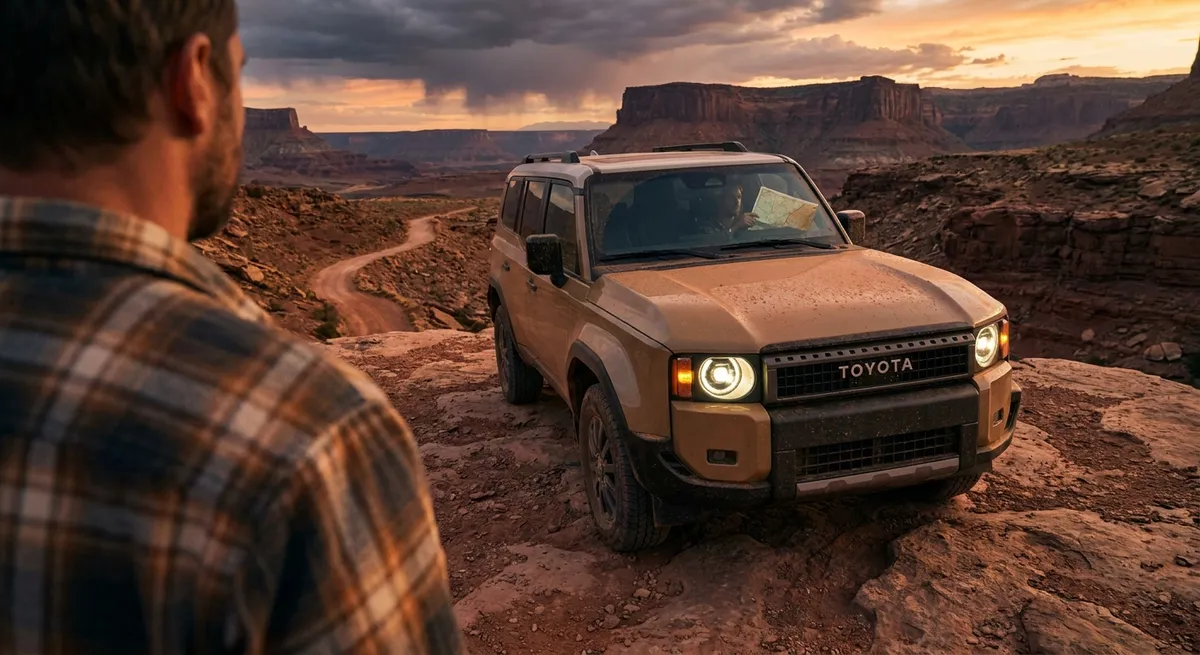
The Land Cruiser nameplate carries serious weight among SUV enthusiasts, and its reintroduction to the U.S. for 2025 arrives with a very different mission. Gone is the V8-powered, six-figure luxury rig; in its place is a downsized, turbo-hybrid, mid-size off-roader with a much more approachable price point. This review examines how the 2025 Toyota Land Cruiser blends its legacy of durability with modern efficiency and electronics, and whether the new formula still delivers the authentic Land Cruiser experience enthusiasts expect.
Powertrain and Performance: From V8 Brute to Turbo-Hybrid Torque
The most dramatic shift is under the hood. Every 2025 Land Cruiser is powered by Toyota’s i-Force Max hybrid system: a 2.4-liter turbocharged inline-4 (T24A-FTS) paired with an electric motor integrated into an 8‑speed automatic transmission and a 1.87 kWh nickel-metal hydride battery.
Toyota rates the system at:
- 326 hp (243 kW) combined output
- 465 lb-ft (630 Nm) of torque, available low in the rev range
Compared with the outgoing 5.7-liter V8 (381 hp / 401 lb-ft), peak horsepower is down on paper, but usable torque is significantly higher and arrives earlier. In real-world driving, that means:
- Strong, immediate response off the line and out of tight corners
- Confident two-lane passing, especially when lightly loaded
- Far better drivability at altitude, where turbocharging mitigates power loss
The 8-speed automatic is tuned conservatively, prioritizing smoothness over aggressive shift logic. In Normal and Eco modes, it upshifts early to exploit the hybrid assist and keep revs low; Sport mode holds gears longer but does not transform the Land Cruiser into a performance SUV. This is still a body-on-frame off-roader, not a German autobahn bruiser.
From an enthusiast perspective, the trade-off is clear:
- You lose the acoustic character and linearity of the old naturally aspirated V8
- You gain substantially more torque and materially better fuel efficiency
Preliminary EPA estimates place the hybrid Land Cruiser in the mid‑20 mpg combined range—roughly a 30–40% improvement over the prior generation’s mid‑teens. That shift alone changes the ownership calculus for buyers who intend to daily-drive their rigs.
Chassis, Suspension, and Off-Road Hardware: Built on the TNGA-F Backbone
Underneath, the 2025 Land Cruiser rides on Toyota’s TNGA‑F body-on-frame platform, shared with the latest Tundra, Sequoia, and Lexus GX. This architecture brings several technical advantages over the previous 200‑series:
- Increased use of high-strength steel for a stiffer frame
- Revised mounting points for improved ride quality and NVH
- Better integration of modern safety and stability systems
Suspension layout remains traditional for an off-road SUV:
- Front: Independent double-wishbone with coil springs
- Rear: Solid axle with multi-link coil-spring setup
Unlike some prior international Land Cruiser variants, there’s no KDSS (Kinetic Dynamic Suspension System) here; instead, Toyota relies on careful tuning, tall-sidewall tires, and electronic aids. Key off-road hardware includes:
- Full-time 4WD with a center locking differential
- Two-speed transfer case with low range
- Available rear locking differential
- Electronic Multi-Terrain Select drive modes (off-road calibrated)
- Crawl Control (low-speed off-road cruise control)
Ground clearance is competitive in the mid-size off-road SUV segment, and approach/departure angles are designed to be functional rather than flashy, aided by relatively short overhangs. Enthusiasts will note that Toyota has prioritized:
- A square, practical wheel/tire package that can accept real all-terrain rubber
- Underbody protection on key components
- Conservatively tuned traction control to avoid excessive wheelspin in loose terrain
On-road behavior is where the TNGA-F platform’s stiffness pays dividends. The Land Cruiser still feels like a body-on-frame SUV—there is some head toss over broken pavement and occasional secondary motions—but steering response, lane discipline, and ride composure are notably improved over the 200‑series. For long highway drives, it now feels closer to a refined truck-based Lexus than an old-school workhorse.
Interior, Ergonomics, and Technology: Utilitarian Premium, Not Full Luxury
The new Land Cruiser’s cabin intentionally steps away from the ultra-luxury positioning of its predecessor and leans into a “utility-first premium” philosophy. The layout is upright, visibility is excellent, and the control surfaces are oriented around quick, gloved-hand operation.
Materials and design highlights:
- Soft-touch dash top and door uppers, with durable plastics in high-contact lower areas
- Traditional hard buttons and knobs for HVAC, drive modes, and core audio functions
- Large, horizontal grab handles integrated into the dash—useful off-road and a nod to heritage
Depending on trim, you’ll find a mix of fabric and synthetic leather, with higher-spec models offering more refined upholstery and contrasting stitching. Unlike the outgoing U.S. Land Cruiser, the 2025 model is strictly a two-row, five-seat configuration. This aligns it more directly with serious off-road competitors and acknowledges that buyers needing a three-row Toyota SUV can move to the Sequoia or Grand Highlander.
Technology is thoroughly modern:
- A tablet-style central touchscreen (size varies by trim, up to ~12–14 inches depending on final spec) running Toyota’s latest multimedia system
- Wireless Apple CarPlay and Android Auto
- Multiple USB-C ports and available wireless charging pad
- Fully digital or hybrid digital-analog instrument cluster depending on trim
Toyota’s Safety Sense suite is standard, typically including:
- Pre-collision system with pedestrian detection
- Adaptive cruise control with full-speed capability
- Lane departure alert and lane tracing assist
- Road sign assist and automatic high beams
Ergonomically, the Land Cruiser strikes a useful balance:
- Seating position is high and commanding without feeling bus-like
- Large physical controls for 4WD, diff locks, and drive modes reduce menu-diving off-road
- Visibility is aided by thin-ish A-pillars and square glasshouse design
The cabin doesn’t reach the opulence of German or British luxury SUVs, and that’s by design. Toyota’s target is durability, easy cleaning, and long-term robustness over a decade-plus of use, not a short lifecycle of trendy materials.
Practicality, Towing, and Everyday Liveability
For many potential buyers, the new Land Cruiser will be a primary family vehicle rather than a dedicated trail toy. In that context, its real-world usability matters as much as its spec sheet.
Key functional aspects:
- Seating: Comfortable, supportive front seats with enough bolstering to hold occupants in place on rough trails without being confining on long drives
- Second row: Adequate knee and foot room for adults, with a bench contour that properly supports longer thighs; rear seatbacks typically recline and split-fold
- Cargo: With no third row, the cargo floor is long and flat, making the Land Cruiser more practical for gear-intensive trips (camping, biking, overlanding)
The hybrid system doesn’t significantly compromise interior packaging. The relatively small traction battery is packaged without creating noticeable load floor intrusions, unlike some early hybrid SUVs.
Towing capacity is expected to be in the 5,000–6,000 lb range (final market-specific figures should be verified), which is sufficient for:
- Small to mid-size travel trailers
- Dual-axle utility trailers
- Boats and enclosed bike/ATV trailers
The hybrid torque delivery helps with initial launch and hill climbs when towing, though the 2.4‑liter engine will work harder than the old V8 under sustained heavy loads. Cooling systems, transmission mapping, and integrated trailer stability assist are designed to support typical recreational towing rather than commercial-level duty cycles.
Around town, the Land Cruiser’s footprint is more manageable than full-size truck-based SUVs. The turning radius is reasonable for parking garages, and cameras plus parking sensors aid in tight maneuvering. However, its boxy profile and upright stature mean it will always feel more like a truck than a unibody crossover on narrow urban streets.
Value Proposition and Target Buyer: A Different Kind of Land Cruiser
The biggest philosophical shift with the 2025 Land Cruiser is its repositioning on the market ladder. Instead of competing directly with luxury-brand, full-size SUVs, it now sits in a more accessible price band, closer to vehicles like the Ford Bronco, Jeep Wrangler Unlimited, and mid- to high-spec versions of Toyota’s own 4Runner and Tacoma.
From a value perspective, consider these elements:
- Standard 4WD and off-road hardware mean you are not paying for a poseur package; core capability is baked in
- Hybrid powertrain is standard, so you don’t face an upcharge to get the best efficiency and torque
- Interior spec is intentionally “premium-rugged” instead of opulent; fewer fragile or trendy materials that date quickly
This repositioning also changes the ideal buyer profile. The new Land Cruiser is best suited for:
- Enthusiasts who prioritize long-term durability, frame-based robustness, and mechanical simplicity in off-road systems
- Buyers who actually use low range and locking differentials several times a year, not merely as talking points
- Families who want a highly capable, two-row SUV that can serve as a daily driver without the fuel-cost penalty of a big-displacement engine
It may not satisfy traditionalists who associate the Land Cruiser badge with V8 smoothness and flagship-luxury trimmings. However, for a new generation of buyers focused on mixed-use capability, hybrid efficiency, and real off-road competence, the 2025 Land Cruiser presents a coherent, technically sound package.
Conclusion
The 2025 Toyota Land Cruiser is not a nostalgic recreation of its predecessor; it’s a strategic reinvention built on a modern ladder frame, powered by a downsized turbo-hybrid, and dressed in a cabin that leans more toward field gear than executive lounge. Its 326 hp hybrid system delivers abundant torque and real-world efficiency gains. The TNGA‑F chassis and robust 4WD hardware preserve the model’s core strengths in durability and off-road performance, while updated safety and infotainment tech make it perfectly viable as a primary family SUV.
For enthusiasts and serious buyers, the key question is whether this new formula remains faithful to the Land Cruiser ethos of reliability, go-anywhere capability, and long-term durability. On paper—and in early drives—it does, albeit with a different character. If you value torque, efficiency, and practical capability over V8 nostalgia and ultra-luxury trim, the 2025 Land Cruiser is one of the most technically compelling off-road SUVs entering the market.
Sources
- [Toyota USA – 2024–2025 Land Cruiser Overview](https://www.toyota.com/upcoming-vehicles/landcruiser/) – Official product page with specs, platform details, and feature highlights
- [Toyota Global – TNGA-F Platform Technical Information](https://global.toyota/en/mobility/tnga/platform/) – Background on the body-on-frame architecture underpinning the new Land Cruiser
- [U.S. Department of Energy – Fuel Economy Guide](https://www.fueleconomy.gov/feg/hybrid_sbs.shtml) – Technical explanation of hybrid system benefits and efficiency characteristics
- [IIHS – Vehicle Safety Ratings Explained](https://www.iihs.org/ratings/about-our-tests) – Methodology behind crash-test and safety evaluations for SUVs like the Land Cruiser
- [Consumer Reports – Body-on-Frame vs. Unibody SUVs](https://www.consumerreports.org/cars/suvs/what-to-know-about-suvs-a7909540270/) – Discussion of platform differences and their impact on ride, handling, and durability
Key Takeaway
The most important thing to remember from this article is that this information can change how you think about Reviews.