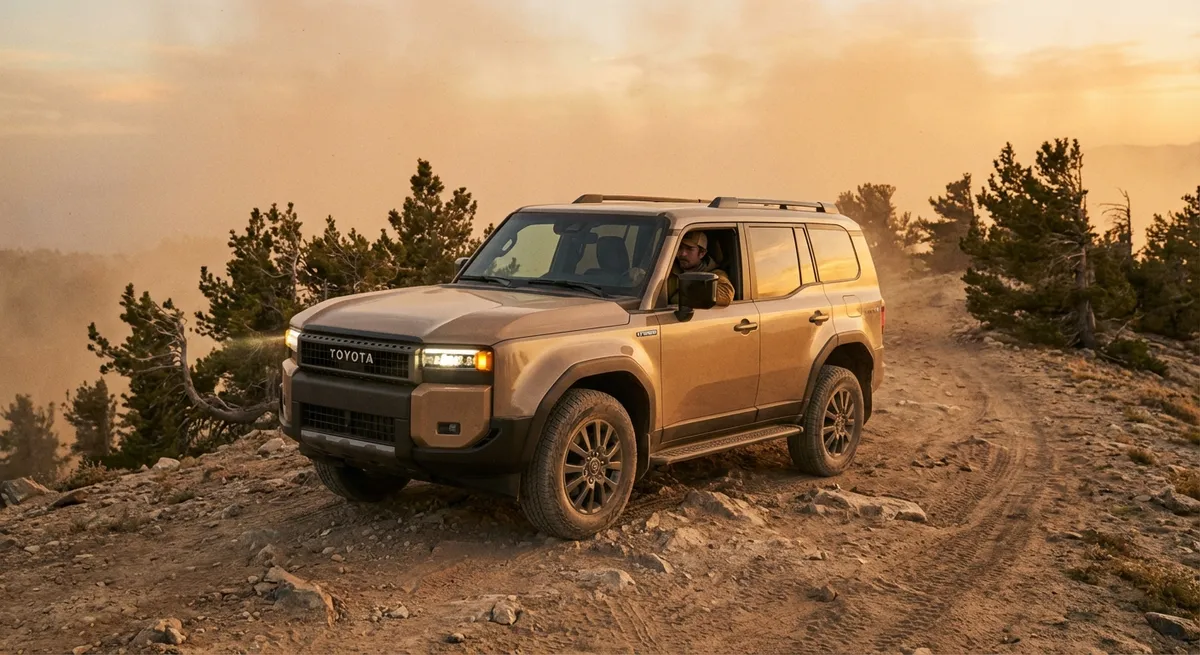
The Land Cruiser nameplate has long carried serious off-road credibility, but the 2025 Toyota Land Cruiser marks a sharp pivot: it’s smaller, hybrid-only in the U.S., and positioned closer to the heart of the SUV market than the ultra‑luxury niche it used to occupy. For shoppers tracking the shift from traditional V8 bruisers to tech‑heavy, efficiency‑minded SUVs, this model is a bellwether. This review breaks down what the new Land Cruiser actually delivers on the road, on the trail, and at the pump—well beyond the nostalgia and marketing.
Powertrain and Performance: Turbo Hybrid with a Truck Soul
The 2025 Land Cruiser abandons its old-school V8 for Toyota’s i‑FORCE MAX hybrid system, pairing a 2.4‑liter turbocharged inline‑four with an electric motor integrated into an 8‑speed automatic transmission. Total system output stands at about 326 horsepower and 465 lb‑ft of torque—numbers that matter more than the cylinder count for everyday driving and towing.
Torque delivery is the headline here. Peak torque arrives low in the rev range, thanks to the turbo and electric assist, which makes the Land Cruiser feel more forceful off the line than its horsepower figure suggests. Around town, the hybrid system masks the turbo lag you might expect from a small displacement engine in a heavy SUV. Merging and passing on the highway feel confident, with the 8‑speed tuned to hold gears under load rather than constantly hunting.
The full‑time 4WD system uses a center locking differential and a 2‑speed transfer case, giving the Land Cruiser a mechanically robust backbone. A Torsen center differential manages torque split between front and rear axles under normal driving, improving stability on wet or mixed surfaces. When you lock the center diff, you get a rigid 50:50 torque split—critical for serious off‑road traction.
For towing, the Land Cruiser is rated around 6,000 pounds—less than some full‑size, body‑on‑frame rivals but competitive within the midsize 4x4 space. The hybrid’s broad torque band works well with moderate trailers, but buyers planning to haul at the upper limit regularly should consider the impact on fuel economy and acceleration, particularly on steep grades.
Chassis, Off-Road Hardware, and Real-World Capability
Underneath, this Land Cruiser rides on Toyota’s TNGA‑F body‑on‑frame platform, shared with the Lexus GX, Sequoia, and Tundra. That means a boxed steel frame designed for torsional rigidity and long‑term durability. In practice, it feels more composed over broken pavement than the previous generation, with less body shudder and tighter control over vertical motions.
Off-road, Toyota backs the Land Cruiser badge with real hardware, not just badging. A selectable 2‑speed transfer case with low range, a locking center differential, and, on certain trims, an electronically controlled rear locking differential, give it mechanical traction tools many crossovers simply don’t have. Crawl Control works like a low‑speed off‑road cruise control, modulating throttle and brakes over rocks or loose surfaces, while Downhill Assist Control helps maintain speed on steep descents.
Ground clearance is competitive, typically around 8.5–9 inches depending on wheel and tire setup. Approach and departure angles are tailored for trail work, with shorter overhangs than the outgoing luxo‑Cruiser. While it doesn’t offer the trick hydraulic KDSS (Kinetic Dynamic Suspension System) of some prior models, the new suspension tuning balances articulation and body control effectively for most buyers.
On technical trails, the Land Cruiser’s narrower body compared to many full‑size SUVs makes it easier to place between obstacles and in tree‑lined sections. Multi‑Terrain Select allows drivers to tailor traction control mapping for mud, sand, rock, or automatic mode, optimizing wheelspin and brake intervention. The Multi‑Terrain Monitor, with underbody and forward‑facing camera views, is more than a gimmick—being able to “see” where the front tires and differential are going reduces the risk of expensive impacts.
Interior Execution, Packaging, and Daily Usability
Toyota intentionally moved the 2025 Land Cruiser downmarket relative to the previous ultra‑premium generation, and the cabin reflects that repositioning. Instead of full‑luxury leather and wood everywhere, you get a more utilitarian, adventure‑ready feel with ruggedized surfaces, durable seat materials, and a dashboard design that emphasizes function over pure opulence.
Seat comfort in the first row is strong, with supportive cushions and ample adjustability, although some shoppers may miss the plushness of the old model. The Land Cruiser is now strictly a two‑row SUV in the U.S. market, which will simplify the decision for buyers who don’t need a third row and prioritize cargo space. Rear legroom is adequate for adults, and headroom is generous thanks to the boxy roofline, but this is not a cavernous family bus in the way a Sequoia or Tahoe can be.
Cargo capacity behind the second row is practical, with a relatively low load floor aided by the hybrid battery packaging under the body rather than intruding into the cargo area. The split tailgate of older models is gone, replaced by a conventional liftgate that simplifies loading but may disappoint traditionalists. Multiple tie‑down points, a wide opening, and square corners make the space genuinely useful for gear, strollers, or camping equipment.
Material quality is mixed by design: soft‑touch surfaces appear in the right contact points (armrests, key dash zones), while harder plastics are used in areas likely to encounter boots, pets, and equipment. This is an SUV meant to be used, not just admired from a valet stand. Noise isolation is improved over older off‑road‑focused Toyotas, but wind and tire noise are more noticeable than in full luxury competitors—an intentional trade‑off for all‑terrain tire options and a boxier, functional shape.
Technology, Safety Systems, and Infotainment Experience
The 2025 Land Cruiser brings Toyota’s latest technology suite, but with a slightly more rugged presentation. A central touchscreen (commonly around 12.3 inches on higher trims) runs Toyota’s latest multimedia system, supporting wireless Apple CarPlay and Android Auto. Responsiveness is solid, with quick menu transitions and minimal lag, though the interface still leans on nested menus for some settings.
Importantly for buyers who actually venture off‑pavement, Toyota retains real physical controls for key functions: large climate dials, dedicated buttons for drive modes, differential locks, and off‑road assistance systems. This makes the Land Cruiser easier to operate while wearing gloves or while bouncing on uneven terrain, avoiding the “everything in a touchscreen” trap.
Toyota Safety Sense 3.0 (or the latest available at launch) is standard, bringing adaptive cruise control, lane departure warning with steering assist, automatic emergency braking with pedestrian detection, and road‑sign recognition. On the road, lane‑keeping assist is acceptable but not segment‑leading; it can feel a bit assertive on curvy highways, and some drivers may choose to dial back the steering assist. Adaptive cruise is smooth in stop‑and‑go traffic, an important consideration for those using the Land Cruiser as a daily commuter.
Off‑road‑specific tech, including the Multi‑Terrain Monitor, Crawl Control, and Multi‑Terrain Select, operates through the central interface and dedicated physical switches. The camera system is especially valuable, offering a pseudo “transparent hood” view that digitally stitches feeds together to reveal what’s directly in front of the vehicle. For newer off‑road drivers, this shortens the learning curve significantly.
Audio options typically include a base system that’s adequate for podcasts and daily radio, and an available premium sound system that improves clarity and low‑end response. Given the Land Cruiser’s cabin acoustics and intended use, audiophiles may still prefer aftermarket tuning, but most buyers will find the upgraded system more than sufficient for road trips.
Efficiency, Ownership Costs, and Who This SUV Really Suits
Perhaps the most consequential change for 2025 is the move to a hybrid‑only powertrain in the U.S., which dramatically changes the Land Cruiser’s cost‑of‑ownership profile. Where older V8 models were notorious for double‑digit fuel economy, the hybrid is projected to deliver roughly mid‑20s mpg combined—numbers that will vary with tire choice, load, and driving style but still represent a major improvement in real‑world running costs.
For owners who rack up highway miles, this efficiency gain is significant over a 5–10 year ownership horizon, especially given current and projected fuel prices. Hybrid systems do add complexity, but Toyota’s track record with hybrid durability in vehicles like the Prius, RAV4 Hybrid, and Highlander Hybrid provides some peace of mind. Routine maintenance remains relatively straightforward compared to European luxury SUVs, aided by Toyota’s broad dealer network and common parts across the TNGA‑F family.
Pricing positions the new Land Cruiser in a space that overlaps well‑equipped midsize crossovers, premium off‑roaders like the Jeep Wrangler and Ford Bronco in higher trims, and more affordable versions of luxury SUVs like the Land Rover Defender. Unlike the outgoing model, which sat in near‑niche territory on price alone, this Land Cruiser is a serious contender for buyers who previously assumed a “real” off‑road SUV was out of reach.
Who is it actually for? The 2025 Land Cruiser is best suited to buyers who:
- Want authentic off‑road capability and body‑on‑frame robustness, but don’t need extreme rock‑crawler modifications from the factory.
- Value Toyota’s reliability reputation and dealer footprint more than ultra‑luxury interior finishes.
- Plan to keep the vehicle long term and appreciate improved fuel economy versus V8 predecessors.
- Prioritize two‑row practicality, cargo versatility, and towing in the 5,000–6,000 lb range.
Buyers who want maximum third‑row space, plush luxury appointments, or the strongest towing numbers may be better served by a Sequoia, large American full‑size SUV, or a luxury three‑row. Enthusiasts lamenting the loss of the V8 will need to weigh that emotional response against the hybrid’s real‑world advantages in torque delivery and efficiency.
Conclusion
The 2025 Toyota Land Cruiser is not just a rebadged nostalgia play—it’s a deliberate repositioning of a storied off‑road name into a more practical, accessible, and efficiency‑minded package. By combining a torque‑rich hybrid drivetrain with a true body‑on‑frame chassis, locking differentials, and a full‑time 4WD system, Toyota has created an SUV that can commute comfortably all week and tackle demanding trails on the weekend without requiring a second vehicle.
It won’t please every purist, and it no longer chases the ultra‑luxury segment. But for buyers who’ve been waiting for a genuinely capable, modern, and somewhat sensible Land Cruiser, this generation finally aligns heritage with real‑world needs. In a market crowded with crossovers wearing off‑road styling cues, the 2025 Land Cruiser remains the real thing—just updated for an era where efficiency and technology matter as much as badge and brawn.
Sources
- Toyota USA – 2024/2025 Land Cruiser Overview - Official manufacturer information on powertrain, features, and off‑road systems
- EPA – Fuel Economy Data - Comparative fuel economy metrics for SUVs and crossovers in the U.S. market
- IIHS – Vehicle Ratings - Safety ratings and crash test results for SUVs, including body‑on‑frame models
- NHTSA – Vehicle Safety Information - Regulatory safety data and recalls for Toyota vehicles
- US Department of Energy – Alternative Fuels Data Center - Technical background and ownership considerations for hybrid vehicle technology
Key Takeaway
The most important thing to remember from this article is that this information can change how you think about Reviews.