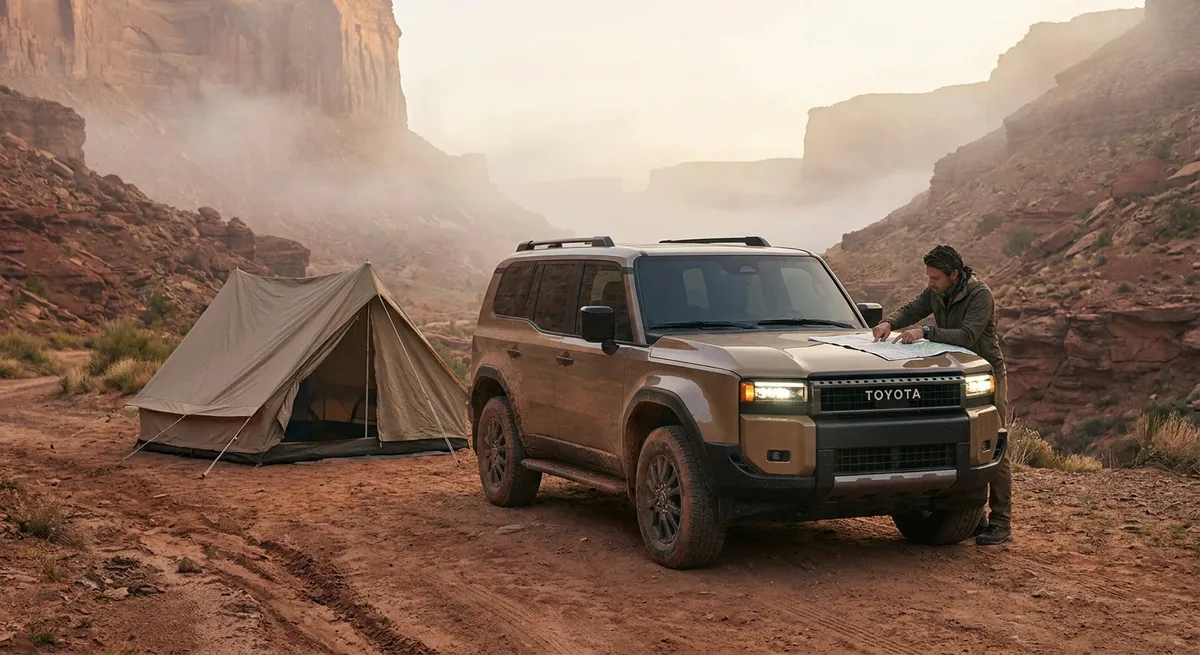
The Land Cruiser name returns to the U.S. marketplace with a very different mission than the V8 flagship that left in 2021. The 2025 Toyota Land Cruiser is now a mid-size, turbo-hybrid SUV built on the same TNGA-F body-on-frame platform as the current Tundra, Sequoia, and Lexus GX—but sized, priced, and powered to target modern overlanding and family-duty buyers instead of old-school luxury-truck traditionalists. This review focuses on what matters to technical enthusiasts and serious shoppers: platform fundamentals, powertrain behavior, off-road hardware, real-world efficiency, and how the new Land Cruiser stacks up against its own legend.
Platform & Chassis: TNGA-F Downsized, Not Diluted
Toyota’s TNGA-F architecture is the backbone of nearly all its body-on-frame trucks globally, and in the 2025 Land Cruiser it adopts a shorter wheelbase and narrower track than the global 300-Series Land Cruiser, aligning instead with the Lexus GX and new 4Runner.
The frame is a fully boxed, high-tensile-steel ladder structure designed to increase torsional rigidity versus the previous 200-Series while allowing weight reductions through more optimized crossmembers and strategic use of high-strength materials. This more rigid base improves steering precision and reduces secondary vibrations, particularly noticeable on broken pavement and washboard trails.
Suspension is conventional but well-executed: double wishbones up front with coil springs and a multi-link solid rear axle with coil springs out back. Toyota avoids air suspension and four-corner adaptivity here; the choice is deliberate, prioritizing durability and consistency over adjustable ride height. Enthusiasts will appreciate the predictable, linear damper tuning and the way the solid axle maintains articulation off-road.
Approach, departure, and breakover angles vary slightly by trim and tire choice, but Toyota quotes competitive geometry for its class. The Land Cruiser also features underbody protection plates and available rock rails, with key driveline components packaged high relative to the frame rails to protect against ground contact.
Steering is electric power-assisted, which enables integration of driver-assistance features but is tuned to retain some weight and self-centering feel on the highway. Chassis engineers also shortened and stiffened the steering column to improve on-center stability compared with older Toyota trucks.
Powertrain & Drivability: Turbo-Hybrid Torque in the Real World
Every 2025 Land Cruiser in the U.S. uses Toyota’s i-FORCE MAX 2.4-liter turbocharged inline-4 hybrid system. It pairs a 2,393 cc direct-injection gasoline engine with a single electric motor integrated into an 8‑speed automatic transmission, fed by a 1.87 kWh nickel-metal hydride (NiMH) battery pack. System output is rated at 326 hp and 465 lb-ft of torque.
What matters to buyers is how that torque arrives. Peak torque comes in low, thanks to the electric motor’s instant response and the turbo’s relatively small, quick-spooling design. In practice, the Land Cruiser feels significantly stronger off the line than the outgoing V8 200-Series, particularly when merging or climbing grades with passengers and gear. The 8‑speed gearbox uses shorter lower ratios than Toyota’s naturally aspirated trucks, making first and second gears punchy for trail crawling and low-speed maneuvering.
Because the electric motor is integrated in the transmission rather than mounted at the axle, transitions between electric assist and engine power are smoother than older Toyota hybrids that combined CVTs with planetary gearsets. Under moderate load, the engine settles into a low, quiet rpm band while the motor fills torque gaps between shifts. Enthusiasts will notice slight turbo lag if they floor it from a roll in higher gears, but the calibration masks much of that with aggressive downshifts and electric boost.
Towing capacity is rated at up to 6,000 pounds when properly equipped, a reduction compared with big V8 body-on-frame rivals but appropriate for its size and target use. For most owners—camping trailers, small boats, and overland setups—this capacity is more than sufficient, and the hybrid system’s torque curve can make it feel more confident than the raw numbers suggest at real-world speeds between 30–70 mph.
Off-Road Systems: Full-Time 4WD, Lockers, and Trail Tech
The Land Cruiser continues to use full-time four-wheel drive with a Torsen center differential, a 2-speed transfer case, and selectable low range. Unlike part-time 4WD systems, the full-time setup allows you to leave the truck in 4WD on any surface without binding, constantly distributing torque between front and rear axles for better traction in varying conditions.
Key off-road hardware includes:
- Locking center differential: Can be locked to split torque 50:50 front to rear for predictable traction on deep sand, snow, or loose rock.
- Available rear locking differential: Helps maintain forward progress when one rear wheel is unloaded or airborne; a major advantage on technical trails and off-camber rock sections.
- Crawl Control: A low-speed off-road cruise control that modulates throttle and brakes independently at each wheel, letting the driver concentrate on steering through obstacles.
- Multi-Terrain Select: Allows the driver to choose surface-specific traction control strategies (e.g., mud, dirt, sand, rock), altering throttle mapping, ABS behavior, and wheel slip thresholds.
- Multi-Terrain Monitor: Uses multiple exterior cameras to create a near-360° view around the vehicle, including a virtual “underbody” view that’s highly useful when cresting blind ledges or threading through narrow rock gates.
Wheel and tire packages are intentionally modest in diameter to preserve sidewall for off-road compliance. Many trims ride on 18‑inch wheels, which strikes a balance between brake packaging and tire flexibility. Enthusiast up-fits to 33‑inch all-terrains are feasible with minimal impact on gearing and driveline stress; larger sizes will begin to affect crawl performance and hybrid cooling.
The notable absence is Toyota’s KDSS or e‑KDSS (hydraulically or electronically disconnecting sway bars) found on some Land Cruiser and Lexus GX variants globally. Instead, the new Land Cruiser relies on careful anti-roll bar sizing and geometry to keep road manners in check without overly limiting wheel articulation. In stock form, the vehicle offers enough flex for moderate rock crawling, but heavy-duty off-roaders may look to aftermarket long-travel kits or disconnectable sway bars.
Interior, Packaging & Tech: Functional Utility Over Flash
The cabin of the 2025 Land Cruiser positions itself closer to an upscale tool than a luxury lounge. The design is upright with a low, squared-off dash, excellent outward visibility, and minimal glossy trim. Enthusiasts will appreciate hard-switch controls for climate, drive modes, and key off-road functions, rather than burying them in touchscreen menus.
Seating is strictly two-row in the U.S. specification, with a roomy second row and no third row option. This is a deliberate break from the three-row 200-Series and many modern mid-size SUVs. It yields more cargo volume and simplifies rear suspension load tuning. For buyers who regularly carry more than five passengers, this will be a deal-breaker; for overlanders and families who pack bulky gear, the flat, well-shaped cargo area is a benefit.
Infotainment uses Toyota’s latest touchscreen interface, available in sizes up to 12.3 inches, with wireless Apple CarPlay and Android Auto, integrated navigation, and over-the-air update capability. The system supports cloud-based voice commands and can tap into online data for routing and POIs, though serious off-roaders may still favor standalone mapping apps or dedicated trail navigation hardware.
Toyota Safety Sense 3.0 is standard, bundling adaptive cruise control, lane-keeping assistance, pre-collision braking with pedestrian detection, road sign assist, and automatic high beams. The calibration is generally conservative; lane-centering is effective on clear highways but can be disabled quickly via steering wheel controls for drivers who prefer a more analog experience.
Material quality is robust rather than opulent. Higher trims add SofTex or leather, contrast stitching, and more soft-touch surfaces, but the overarching feel remains “purpose-built.” Touch points like door handles and steering wheel are substantial, and the floor and cargo surfaces are designed to be easily cleaned—critical for buyers actually using the truck off pavement.
Efficiency, Ownership Costs & Market Position
Perhaps the most dramatic change from the prior Land Cruiser is fuel economy. While official EPA figures vary slightly by configuration, Toyota targets mid‑20s mpg combined for the hybrid Land Cruiser—a significant gain over the outgoing V8’s real-world mid-teens. In mixed use, owners can expect a meaningful range increase on a single tank, which has real implications for backcountry travel and daily commuting.
The NiMH battery chemistry, while less energy dense than lithium-ion, is chosen for durability and tolerance of frequent charge/discharge cycles at high temperatures—exactly the sort of abuse that off-road and towing scenarios create. Toyota has decades of field experience with NiMH packs in hybrids, which should reassure long-term owners concerned about battery longevity. Hybrid component warranties in the U.S. typically extend to at least 8 years or 100,000 miles (and longer in some states), reducing the financial risk of early component failure.
Maintenance intervals are broadly in line with other Toyota trucks: oil changes, differential and transfer case fluids, brake inspections, and cooling system checks. The hybrid system is largely maintenance-free aside from periodic coolant service for the inverter and associated electronics. Because the Land Cruiser uses a conventional stepped automatic rather than a specialized hybrid transaxle, transmission service procedures are familiar to most technicians.
Pricing positions the 2025 Land Cruiser below the prior model’s luxury bracket and roughly in line with up-trim 4Runners and entry-level Lexus GX variants. This shifts the Land Cruiser from niche flagship to a more accessible, high-content off-road SUV that cross-shops with models like the Ford Bronco, Jeep Wrangler Unlimited, Land Rover Defender 110, and higher trims of the Bronco Sport/4Runner segment. For shoppers who value Toyota’s reliability reputation, dealer network, and conservative engineering philosophy, this new market placement is a strategic advantage.
From an enthusiast standpoint, the 2025 Land Cruiser is not a direct spiritual successor to the 200-Series; it’s more of a bridge between that world and modern hybridized, midsize off-roaders. Some will miss the V8, mass, and understated opulence. Others will see the lighter footprint, improved efficiency, and still-serious hardware as exactly what the Land Cruiser needed to remain relevant.
Conclusion
The 2025 Toyota Land Cruiser redefines what its iconic badge means in the U.S., trading V8 excess and three-row luxury for a tightly packaged, turbo-hybrid, two-row SUV with real off-road hardware and everyday usability. Its TNGA-F chassis is rigid and well-tuned, the i‑FORCE MAX hybrid delivers meaningful low-end torque and fuel savings, and the full-time 4WD system with center and available rear locker retains the core Land Cruiser identity where it counts—on challenging terrain, far from pavement.
Potential buyers should think of this Land Cruiser less as a rolling status symbol and more as a highly capable, technically advanced tool that happens to be comfortable and refined enough for family duty. For enthusiasts planning serious trail work, overland builds, or long-distance adventure travel, the combination of hybrid range, robust mechanicals, and Toyota’s conservative engineering may outweigh nostalgia for the old V8 era. In a market increasingly filled with lifestyle-flavored crossovers, the 2025 Land Cruiser still feels purpose-built—and that is exactly its appeal.
Sources
- [Toyota USA – 2024–2025 Land Cruiser Product Information](https://www.toyota.com/landcruiser) - Official specifications, features, and technical overview from Toyota
- [Toyota Global – TNGA-F Platform Technical Brief](https://global.toyota/en/mobility/tnga/platform/) - Background on the TNGA-F body-on-frame architecture and its engineering goals
- [U.S. Department of Energy – Hybrid Electric Vehicle Basics](https://afdc.energy.gov/vehicles/hybrids) - Explanation of hybrid systems, efficiency benefits, and typical component layouts
- [EPA – Fuel Economy Data and Trends](https://www.fueleconomy.gov/feg/byclass/Large_SUV_4wd2024.shtml) - Comparative fuel economy information for large and midsize 4WD SUVs
- [IIHS – Crashworthiness and Safety Technology Overview](https://www.iihs.org/ratings/about-our-tests) - Methodology behind safety ratings relevant to modern SUV design and evaluation
Key Takeaway
The most important thing to remember from this article is that this information can change how you think about Reviews.